How to Cut the Cost of Precast Accessories Without Buying the Wrong Product

A buyer once sends the same lifting anchor drawing to three factories.
Three quotations come back.
The first supplier is the cheapest. The second is somewhere in the middle. The third is almost 15% higher.
At first glance, this looks like an easy purchasing decision. Why pay more for what appears to be the same piece of steel?
Then the questions start.
Supplier A quoted its nearest standard size rather than the exact drawing. Supplier B included the specified finish but had not included the requested inspection documents. Supplier C quoted exactly to the drawing and included the additional requirements in the RFQ.
Now the three prices don't look quite so comparable.
This happens more often than people think.
When purchasing precast accessories, reducing cost is important. But the useful question isn't simply:
“Who has the lowest price?”
It is:
“Where can we remove unnecessary cost without changing what the project actually requires?”
Those are two very different conversations.
Start With the Drawing
For a custom part, we would rather receive a drawing than a long email.
It tells us much more.
The problem is that a drawing doesn't always tell us everything.
A buyer might send a PDF showing all the dimensions but say nothing about expected order quantity. Or the finish is mentioned in the email but not on the drawing. Sometimes there are two drawing revisions circulating between purchasing and engineering.
This is where quotation mistakes begin.
For most drawing-based inquiries, a few pieces of information make the discussion much easier:
drawing and revision, material, finish, quantity, critical tolerances, inspection requirements and packaging.
Annual demand is useful too.
Not because the factory wants to push the buyer into a bigger order. It simply gives production a better idea of whether this is a one-time job or something that may run several times a year.
There is a big difference between:
Please quote 2,000 pcs.
and:
First order 2,000 pcs. Expected annual demand approximately 40,000 pcs, ordered in several batches.
The second inquiry gives the manufacturer something to plan around.
And planning can affect cost.
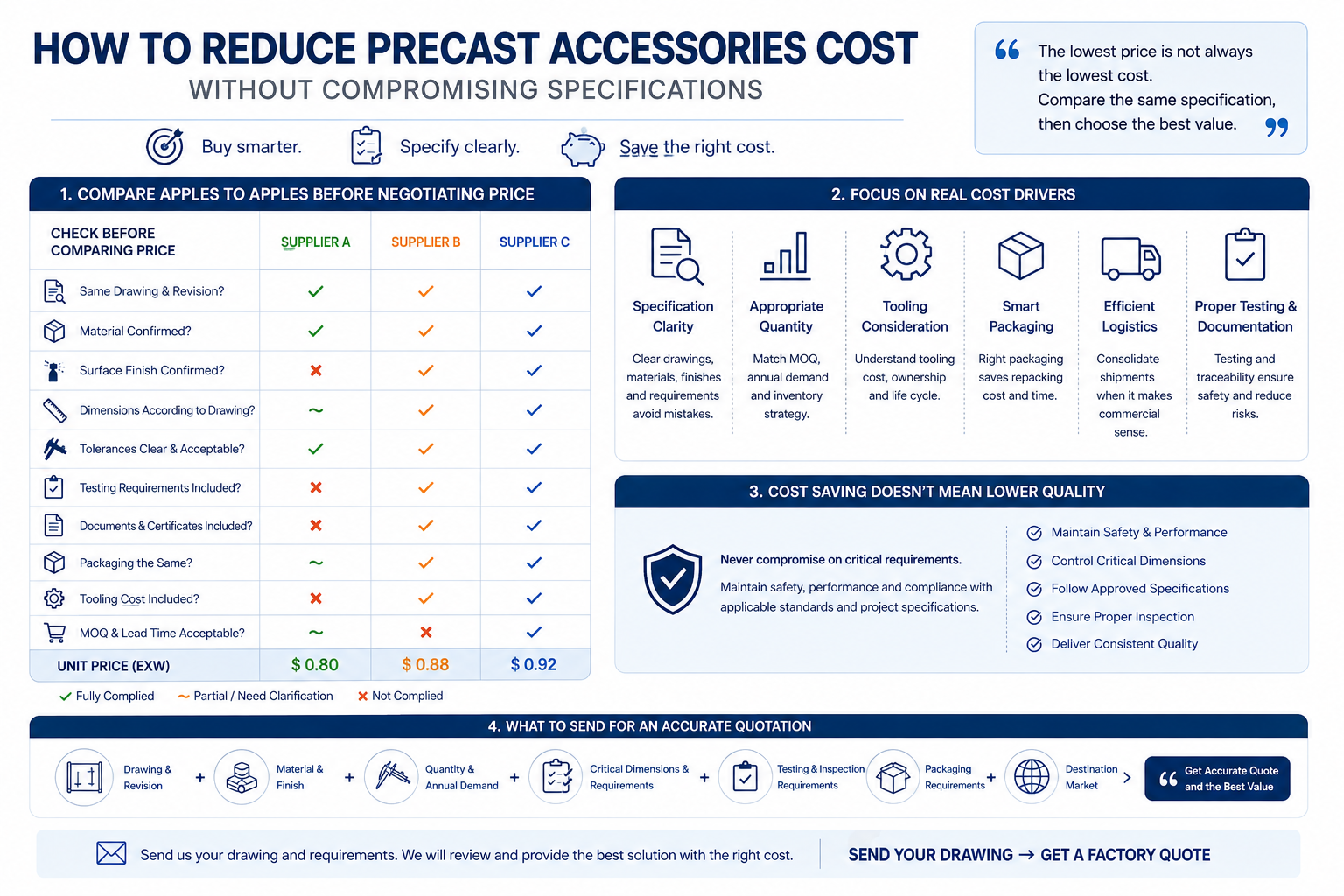
Before Negotiating Price, Make Sure the Quotes Are Actually the Same
This sounds basic, but it is worth doing.
Put the quotations next to each other and ignore the prices for five minutes.
Check the product first.
| Check | Supplier A | Supplier B | Supplier C |
|---|---|---|---|
| Same drawing revision? | |||
| Material confirmed? | |||
| Finish confirmed? | |||
| Dimensions fully according to drawing? | |||
| Any deviations declared? | |||
| Testing included where required? | |||
| Required documents included? | |||
| Packaging the same? | |||
| Tooling included or separate? | |||
| MOQ acceptable? |
Only then go back to the unit price.
We've seen inquiries where a buyer asks us to match another supplier's price, but after checking the details, the competing quotation isn't based on exactly the same specification.
That doesn't automatically mean the other quotation is wrong.
It means there is something to clarify.
Sometimes the cheaper specification is perfectly acceptable.
Sometimes it isn't.
The buyer needs to know which one it is.
One Question Can Be More Useful Than “Can You Give Me 5%?”
Try asking your supplier this instead:
Which part of this specification is making the product expensive?
That can start a much more useful conversation.
Maybe it is a tight tolerance.
Maybe it is the finish.
Maybe the order quantity doesn't suit the production process.
Maybe a special package is adding handling work.
Maybe the part requires dedicated tooling.
None of these things should be changed by the supplier without approval. But once the cost driver is visible, purchasing and engineering can decide whether there is another way to achieve the same requirement.
That's genuine cost reduction.
Repeatedly asking for another 2% or 3% discount eventually reaches a wall. Asking why the part costs what it costs can uncover something neither side noticed at the beginning.
Tight Tolerances Have a Price
A dimension on a drawing might say ±0.05 mm.
Does the application really require ±0.05 mm?
Maybe it does.
If it does, leave it alone.
But if that tolerance was copied from an old drawing and the functional requirement would allow something wider, it is worth discussing with engineering.
The same applies to dimensions that are not functionally critical.
A factory should never quietly relax a customer's tolerances to make production cheaper. The correct approach is to identify the issue, explain the manufacturing impact and let the customer's technical team make the decision.
That little distinction is important.
The supplier can suggest. The customer approves.
MOQ Is Not Just a Supplier Problem
MOQ conversations often go like this:
Buyer: Can you make 500 pcs?
Supplier: MOQ is 2,000 pcs.
Buyer: We only need 500.
Supplier: Sorry.
That conversation doesn't tell either side very much.
Ask why.
If the MOQ comes from raw material purchasing, that's one situation.
If it comes from tooling and machine setup, that's another.
If the supplier simply uses 2,000 pcs as its normal commercial minimum, perhaps there is room to talk.
And if your annual demand is 20,000 pcs but you only want 2,000 pieces in the first shipment, tell the factory that.
The production quantity and shipment quantity do not always have to be thought about in exactly the same way.
Whether a different arrangement is practical depends on the product, storage, cash flow and commercial terms. But it is worth discussing before either side walks away from the inquiry.
Don't Chase a Low Piece Price Into a Warehouse Full of Stock
There is a familiar temptation in purchasing.
10,000 pcs costs $X.
50,000 pcs is cheaper.
100,000 pcs is cheaper again.
So 100,000 must be the best deal.
Not necessarily.
If those 100,000 pieces sit in your warehouse for eighteen months, the saving on the unit price may not look so attractive anymore.
There is cash tied up in the inventory. There is storage. There may also be a drawing revision before the stock is consumed.
For repeat products, ask for several realistic price breaks.
If your normal purchase is somewhere between 5,000 and 20,000 pieces, those are the quantities you need to understand.
A 500,000-piece price makes a quotation look impressive.
It doesn't help much if you will never buy 500,000.
Packaging Is an Easy Place to Waste Money
Packaging rarely gets much attention during the first RFQ.
Then production finishes.
Someone asks:
“Where is our barcode?”
Or:
“We need 50 pcs per carton, not 100.”
Now finished goods have to be reopened and repacked.
It is avoidable.
If you are a distributor, tell the supplier about customer labels, barcodes, carton quantities or neutral packaging at the beginning.
If none of that matters, factory-standard export packaging may be perfectly adequate.
This is one of those small decisions that doesn't look like a cost-saving project.
It is.
Samples Cost Money. Mistakes Cost More.
When tooling is involved, buyers sometimes hesitate over sample costs.
That's understandable. Nobody wants to spend money before the production order.
But consider the alternative.
A dimension is misunderstood.
The finish is slightly different from what purchasing expected.
A mating part doesn't fit the way everyone assumed it would.
Finding this on five samples is annoying.
Finding it on 20,000 finished pieces is something else entirely.
For a new custom item, decide what the sample is supposed to confirm before you order it.
Maybe you need to check dimensions.
Maybe fit.
Maybe finish or marking.
Maybe your engineering team needs additional validation.
Don't turn sample approval into a vague “looks OK” exercise.
And for lifting products, appearance alone is obviously not enough.
Selection and validation need to account for the complete lifting application. VDI/BV-BS 6205, for example, specifically addresses the development, manufacture, testing, monitoring and application of lifting anchor systems for precast concrete elements.
For U.S. applications, OSHA 29 CFR 1926.704 states that lifting inserts attached to precast concrete members other than tilt-up members must support at least four times the maximum intended load, while lifting hardware must support at least five times the maximum intended load. Those are safety requirements—not areas where procurement should look for savings by quietly changing specifications.
Know Where Not to Cut Cost
This is probably the most important part of the article.
There are costs you can discuss.
Packaging? Certainly.
Order quantity? Of course.
Production scheduling? Often.
A tolerance that engineering confirms is unnecessarily tight? Worth reviewing.
Then there are things that should not be treated as purchasing shortcuts.
If the approved specification calls for a particular material, don't silently substitute another one because it is cheaper.
If a lifting system requires compatible components, don't mix parts because two catalog pictures look similar.
If testing is required, don't delete it simply to win a price negotiation.
If a critical dimension matters to the function of the product, don't widen the tolerance without engineering approval.
Precast lifting components aren't decorative hardware.
Their selection belongs to a lifting system and application, and recognized industry guidance treats them accordingly. The NPCA quality-control manual, for example, discusses verification of lifting-insert capacity while accounting for forces such as form-release suction, impact and different handling positions.
There is plenty of room to negotiate purchasing cost without negotiating away the specification.
Tooling Deserves Its Own Conversation
Custom parts can require tooling.
When they do, don't bury the tooling charge inside the piece-price discussion.
Ask:
How much is the tooling?
Who owns it?
Is it a one-time charge?
What happens on repeat orders?
Is there a tooling-life or replacement condition we should know about?
A quotation of $0.48 per piece plus tooling cannot be fairly compared with $0.52 per piece until you understand the expected volume and tooling arrangement.
At 2,000 pieces, the answer may go one way.
At 200,000 pieces over several years, it may go another.
This is why we prefer to know expected annual demand when discussing custom projects.
Freight Can Undo a Good Negotiation
You negotiate five cents out of the product.
Good.
Then ship a small quantity inefficiently and give all five cents back to the freight company.
For buyers importing several related products, shipment consolidation is worth checking.
Not blindly—there is no point delaying an urgent order for six weeks just to fill more container space.
But if several products will finish around the same time, compare the numbers.
Product cost and logistics cost belong on the same spreadsheet.
What We Would Rather Receive From a Buyer
If you want us to look at a custom precast accessory, don't spend half an hour writing the perfect introduction email.
Send the drawing.
Then tell us:
How many do you need now?
How many might you use in a year?
What material and finish are required?
Are there critical dimensions or inspection requirements we need to pay particular attention to?
Do you have special packaging requirements?
That is enough to start a useful conversation.
If something on the drawing has a noticeable manufacturing-cost impact, the next question can be whether an alternative is worth discussing.
But we would quote the requested specification first.
That's important.
A cheaper alternative isn't really cheaper if nobody told the buyer that something had changed.
Before You Ask for the Final Discount
Try this checklist first.
Same drawing?
Same revision?
Same material?
Same finish?
Same critical dimensions?
Same inspection requirement?
Same testing scope?
Same packaging?
Same Incoterm?
Same tooling assumptions?
If the answer is yes across the board, now you have a proper price negotiation.
If not, fix the comparison first.
You may discover that the lowest quotation is still the best one.
Or you may discover why it was the lowest.
Either result is useful.
Have a Precast Accessory You Want Us to Review?
Send us the drawing and quantity.
If it is an existing product, photographs or a current sample reference can also help. For a custom item, include the material, finish and any important inspection or testing requirements you already know.
We can review the manufacturing requirements first.
Then we can talk about price.
Send Your Drawing → [INTERNAL LINK REQUIRED: Contact/RFQ page]
A Few Questions Buyers Usually Ask
“Can you make it cheaper if we increase the quantity?”
Possibly. Quantity can affect manufacturing cost, but the result depends on the product and production route. Send both the immediate order quantity and expected annual demand rather than an artificially large quantity used only to obtain a low quotation.
“Another supplier is cheaper. Can you match the price?”
Send us the comparable specification and commercial scope. Before discussing whether a price can be matched, it is useful to confirm that both offers cover the same drawing, material, finish, testing, packaging and quantity.
“Can we change the material to save money?”
An alternative material can be proposed for technical review, but a specified material should not be changed without approval.
“Should we order samples first?”
For a new custom product, samples can be useful for checking agreed characteristics before volume production. The appropriate validation requirements depend on the product and application.
“What is your MOQ?”
It depends on the item and manufacturing route. [NEEDS JINGLE CONFIRMATION]
“How long is production?”
Lead time depends on specification, tooling requirements, quantity and current production arrangements. [NEEDS JINGLE CONFIRMATION]