Hydrogen Embrittlement in Bolts: Why 10.9 Parts Crack Days After Plating
The bolts passed. Dimensionally. Visually. They were gauged, plated, baked, boxed and shipped with a certificate in the carton.
Then a fitter tightened one onto a machine frame at 340 N·m. That was below the figure on the drawing. The head came off in his hand. No stretch. No warning. No noise until the bang.
The part was fine when it left the plating line. It was fine at the receiving dock. It was fine at eight in the morning and it was scrap by lunch.
That delay is the whole problem with hydrogen embrittlement in bolts. The damage happens in a tank of acid, not at the wrench. The wrench only collects the debt.
This article stays on class 10.9 and 12.9, because that is where the risk concentrates. It covers where the hydrogen enters, why lower classes escape, what a bake oven can and cannot undo, how coating choice changes exposure, and the exact lines to put on a purchase order so the risk lands on the party able to control it.
The crack arrives after the paperwork is signed
Embrittlement failures follow a script. The sequence repeats with dull regularity.
Steel is pickled. Steel is electroplated. The parts look right. Coating thickness reads inside tolerance. Hardness passes. Threads gauge. A sample goes on a tensile machine and holds. The lot ships.
Days later a bolt fractures under a load it should carry without complaint. Sometimes below proof load. Often during the first tightening, or in the hours just after it.
The fracture carries a signature. Little or no necking. A flat, bright zone near the origin. A crack that began under the head fillet or at the root of the first engaged thread, where stress already concentrates.
Receiving inspection cannot catch this. A dimensional report cannot detect a part that will crack tomorrow. A hardness reading cannot either. The part is compliant on the day it is measured, and the mechanism that will break it is invisible at that scale.
Where the hydrogen actually gets in
Hydrogen does not arrive with the steel. It arrives with the process.
Two steps matter most. Acid cleaning, and electroplating. Everything else is a variation on those two.
Acid cleaning. Before a coating can bond, the surface has to be clean. That usually means pickling or an acid dip to strip scale, rust and oxide. In acid, steel can absorb hydrogen. The pickling line is the first place a high-strength part takes on risk, and it happens before any zinc is deposited.
Electroplating. In a zinc bath the part is the cathode. Metal deposits onto it. Hydrogen evolves at the same surface at the same time, as a by-product of the reaction. Some of that hydrogen adsorbs onto the steel, splits into atoms, and diffuses inward.
Once inside, hydrogen does not sit still. It migrates toward disorder: grain boundaries, inclusions, the tips of small defects. There it recombines into molecular gas. The molecule is too large to move. It accumulates, and local pressure climbs.
Nothing visible happens. The part still measures correctly. It still survives a short tensile pull. But the steel has lost its ability to deform before it breaks, and that loss is what converts a ductile part into a brittle one.
Phosphating, acid activation before zinc flake, and some passivation steps add exposure too. The common factor is an acidic, hydrogen-generating step applied to steel that is already heat treated to high strength.
Sequence matters. A part plated and then machined has a fresh surface. A part machined and then plated carries the risk at every thread root, in the notch that geometry already created. The order of operations belongs in the specification, whether or not anyone writes it down.
One more source gets ignored. A repaired coating. When a plater strips and re-plates a rejected lot, the part passes through acid and through the bath twice. A reworked lot is not the same product as a first-pass lot.
Which classes are at risk, and why the lower ones are not
The mechanism needs hard steel. Hardness is the useful proxy, because hardness is what the heat treater controls and what a plater can check. The standards that address baking key their requirements off hardness, not off the property class printed on the head.
That distinction matters commercially. Class is what the buyer orders. Hardness is what the process reacts to. A part can carry a 10.9 mark and sit in a hardness band where the risk is severe, or sit near the bottom of the band where it is smaller. The mark alone does not tell you which.
Class 4.8 and 5.8 are low-carbon steels, often not quenched and tempered at all. They are not immune to hydrogen. They are simply much harder to break with it. Lower strength leaves more plastic reserve, so a small crack blunts instead of running.
Class 8.8 is quenched and tempered, and it can be embrittled under severe conditions. The field record is dominated by 10.9 and 12.9 all the same. Those classes sit high enough on the strength curve that very little ductility remains to absorb a crack tip.
Class 12.9 is the worst case in common use. It carries the highest strength, and it is frequently specified in exactly the applications that also want a thin, cosmetic, electroplated finish. Compact joints, machine tools, automotive brackets, die-cast housings.
| Property class (ISO 898-1) | Condition and strength level | Embrittlement exposure | What changes in the purchase |
|---|---|---|---|
| 4.8 / 5.8 | Low carbon, generally not quenched and tempered | Low. Ductility absorbs a crack tip rather than letting it run | Standard electroplate is normally acceptable; baking clauses rarely needed |
| 8.8 | Quenched and tempered, moderate strength | Moderate. Real cases exist, usually on larger sections or heavy coating build | Baking and process control stated where the part is large or safety-related |
| 10.9 | Quenched and tempered, high strength | High. The most common class in documented plating failures | Baking to ISO 4042 is mandatory in practice; zinc flake or mechanical coating preferred |
| 12.9 | Quenched and tempered, very high strength | Severe. Small process errors are enough | Avoid electrolytic plating where possible; require process verification and lot testing if not |
| 12.9, small diameter and long thread | High strength plus a deep notch at the thread root | Severe, with less inspection surface to find the crack | Treat as a safety part; agree sampling and acceptance before the order is placed |
| Any class, reworked or re-plated lot | Second pass through acid and bath | Higher than the class suggests, because exposure doubled | Require disclosure of rework; re-test after any re-plating |
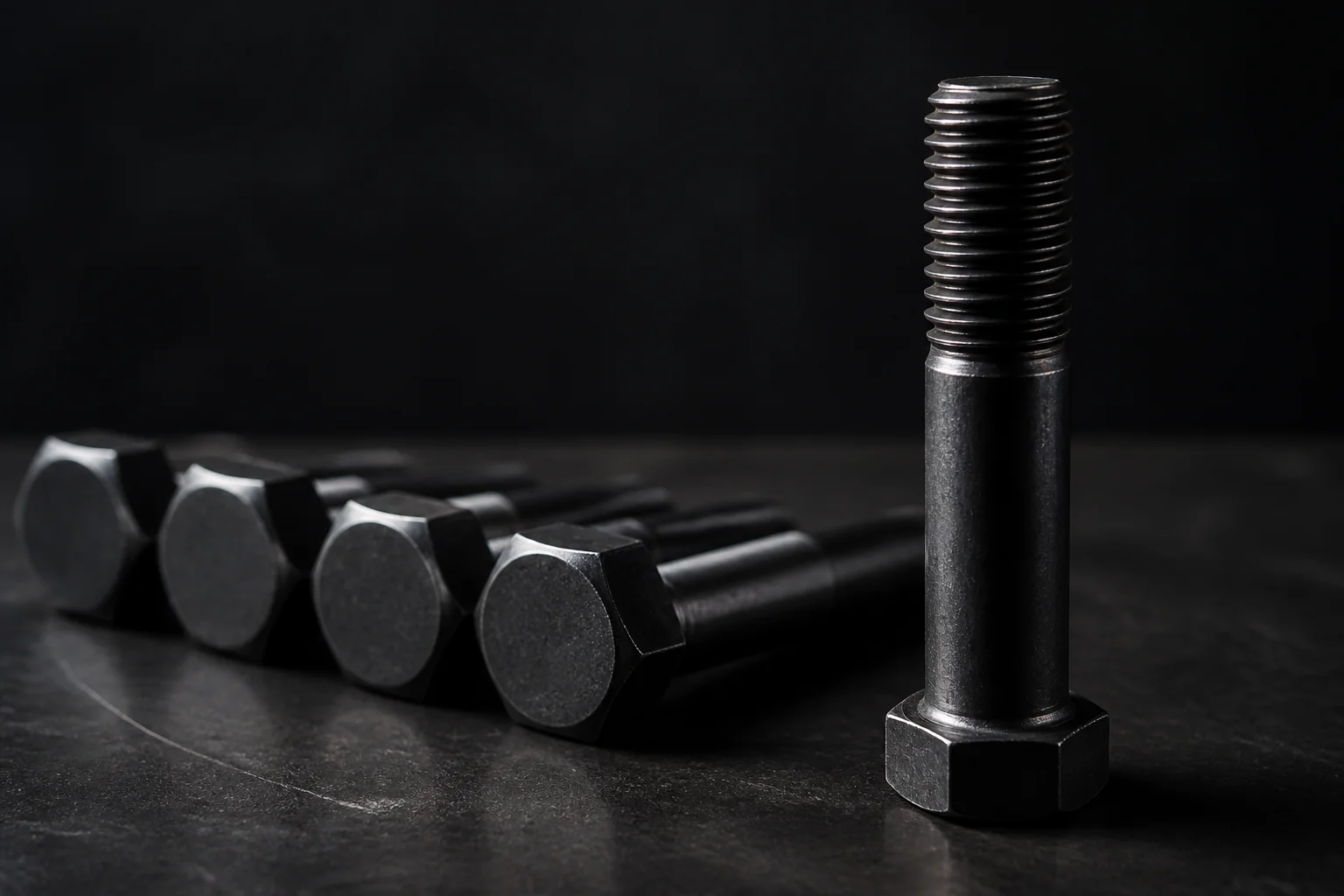
Black oxide or phosphate-and-oil class 10.9 hex bolts. The marking on the head tells you the strength. It says nothing about how many times the part passed through an acid tank.
If the application genuinely needs 12.9, buy it and control the process. If it needs 10.9, do not accept 12.9 as an upgrade. Higher strength buys clamp load and costs ductility. Our hex bolt range is quoted by class and by coating route for that reason.
What baking does, and what it does not
Baking is the industry's answer, and it is a real one. It is also the most over-claimed step in the whole process.
The principle is simple. Hydrogen that is still mobile can be driven out by heat. Raise the part to a controlled temperature for a defined period, and the dissolved atoms diffuse back toward the surface and leave. ISO 4042 sets out baking requirements for electroplated fasteners, including the temperature range, the duration and the maximum delay between plating and baking. ASTM B850 covers post-coating treatments for reducing embrittlement risk in the same territory.
Three conditions decide whether baking does anything at all.
The delay. Baking has to start within the window the standard allows. A part left in a basket overnight, or over a weekend, has had hours for hydrogen to migrate to the places it cannot leave from. Late baking moves gas that is already trapped. Early baking moves hydrogen that is still mobile. Those are different jobs.
The temperature. Too low and diffusion is too slow to matter inside a production shift. Too high and you start to touch the tempering condition of the part, which is a different way to lose strength. Baking is a heat treatment, not a warm-up, and the range is specified for a reason.
The duration. Time at temperature, not time in the oven door. A batch that is loaded cold and counted from the moment the switch is flipped has not been baked for the stated period.
Now the limits.
Baking does not repair a part that has already cracked. Cracks do not close. A lot that cracked in the basket will still crack on the line, just later and in a different place.
Baking does not remove hydrogen that has already recombined into gas at an inclusion or a grain boundary. Diffusion works on dissolved atoms. A molecule sitting in a void is not going anywhere at baking temperature.
Baking does nothing for hydrogen picked up later. Acid cleaning on a service site, a descaling step during maintenance, corrosion in a wet environment, or cathodic protection can all feed hydrogen into a high-strength bolt long after it was installed. This is why hydrogen embrittlement in bolts is not only a factory topic. It is a life-cycle topic for anything buried, submerged or chemically exposed.
And baking cannot be applied backwards. A purchase order that says "bake if required" transfers the decision to whoever is running the oven that day. Bake parameters belong on the drawing, with the standard named.
On records: a bake chart proves the oven was hot. It does not prove these bolts were in it, unless the chart carries the lot number. Platers who understand the risk keep load sheets. Buyers who understand the risk ask for them.
The coating route sets the exposure
Coating selection is where most of this risk is decided. Usually by someone thinking only about corrosion. The coating fixes the process route. The route fixes the hydrogen exposure.
Electroplated zinc to ISO 4042 is the cheap, familiar, dimensionally tidy answer. Thin coating. Controlled thickness. Bright finish. It is also the route that puts a high-strength part in a hydrogen-generating bath, and it is where the baking requirement comes from in the first place.
Zinc flake to ISO 10683 is applied by dip-spin or spray, not by electrolysis. There is no cathodic hydrogen generation at the part surface during coating. The acidic pretreatment still needs watching, and the standard addresses it, but the dominant mechanism is removed from the route. That is why zinc flake is the default recommendation for class 10.9 and 12.9 parts that need corrosion resistance.
Hot-dip galvanizing to ISO 10684 or ASTM F2329 is molten zinc at high temperature, not electrolysis. The exposure is different in kind. Hot-dip brings its own problems: thread clearance, overtapped nuts, and a heat cycle a very high strength part may not enjoy. Those are covered in our note on hot-dip galvanized fasteners. The point here is contrast. Hot-dip changes the failure mode, not just the finish.
Phosphate and oil, or black oxide adds almost no corrosion protection outdoors, and can involve acid steps. Indoors, in a dry plant, it is often the lowest-risk finish available for a high-strength part. For a machine frame that never sees rain, it is frequently the right answer and almost never the one quoted first.
| Coating route | Hydrogen exposure | Suitable for 10.9 / 12.9 | What it costs you |
|---|---|---|---|
| Electroplated zinc, ISO 4042, no bake | Highest. Acid clean plus cathodic deposition, nothing removed | Not acceptable in practice | Lowest invoice, highest exposure to a field failure you will own |
| Electroplated zinc, ISO 4042, baked | High at deposition, reduced afterwards if timing and temperature hold | Acceptable with process control and evidence | Extra process step, oven capacity, lot documentation, periodic testing |
| Electroplated zinc-nickel | High. Still electrolytic | Same controls as zinc, no shortcut | Higher coating cost and the same bake and test burden |
| Zinc flake, ISO 10683 | Low. Non-electrolytic deposition, pretreatment still controlled | Preferred route for both classes | Higher coating cost, longer lead time, duller appearance, friction data needed |
| Mechanical zinc | Low. No electrolytic hydrogen at the part | Suitable, mainly for smaller sizes | Limited size range, matte finish, thicker build on threads |
| Hot-dip galvanized, ISO 10684 / ASTM F2329 | Different mechanism, molten zinc rather than electrolysis | Usually limited to class 8.8 and below | Thick coating, overtapped nuts, heat cycle, no fine thread fit |
| Phosphate and oil, or black oxide | Low to moderate, depends on the acid steps used | Suitable indoors, no corrosion credit outdoors | Cheap, fast, and it will rust. Only right for dry service |
The cheapest coating carries the most process risk. The most expensive carries the least.
Why the crack waits 24 to 72 hours
The delay is not mysterious. It is the time the mechanism needs.
Hydrogen sitting in the lattice does not break anything by itself. It needs stress. Tightening supplies it. The bolt stretches, the thread root is loaded, and the head fillet goes into tension. Now there is a stress field and a population of hydrogen atoms in the same place.
Hydrogen migrates to the point of maximum triaxial stress, just ahead of the crack tip. There it reduces the local cohesion of the lattice. A very small crack starts. It grows slowly at first, then faster, because a longer crack concentrates more stress and pulls in more hydrogen.
That growth is time-dependent. It is not instant. A part can take a full day to reach the point where the remaining section cannot carry the load, and then it goes in one event, with no deformation, at a stress it survived easily the day before.
The practical consequence is uncomfortable. The window in which a bolt fails may open after it has been signed for, installed, torqued and inspected. Nothing in the receiving process covers that window.
It also explains a false conclusion. A proof load test at the plant is short. The part passes because the mechanism has not had time to complete. ISO 15330 exists for that gap.
The preload side of this is covered in our guide to bolt torque and clamp load. Embrittlement needs a tensile stress. A preloaded joint supplies one permanently.
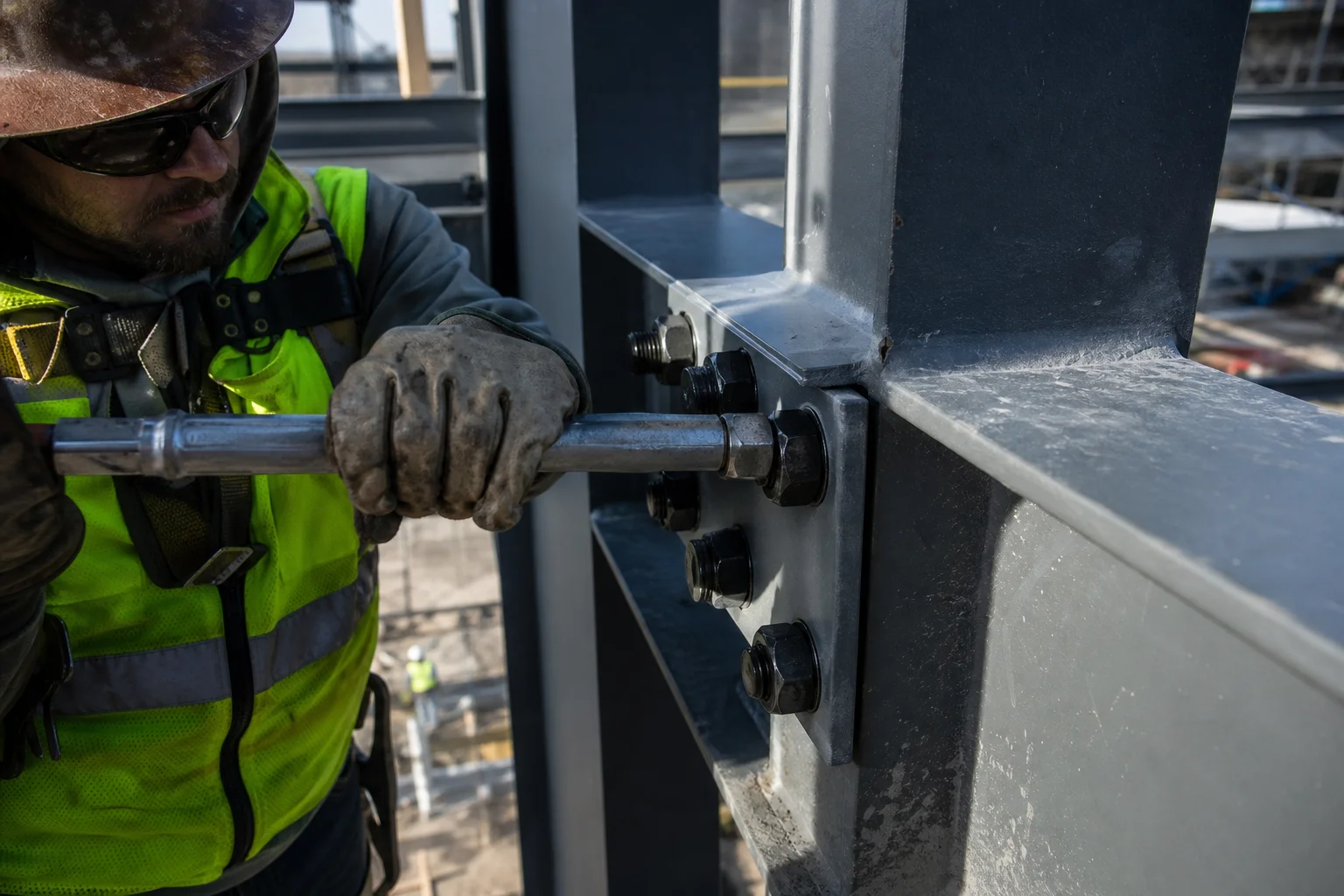
A steel frame full of high-strength bolts. Every one of them is under sustained tensile load from the day it is tightened. That is the stress the mechanism was waiting for.
Tests that can see it, and tests that cannot
Process control is the cheap one. ASTM F1940 describes a method for verifying that a plating process is controlled well enough to keep hydrogen embrittlement risk low. It is run on a test piece, not on your parts, and it tells you whether the line is behaving. Run it on a schedule and you have a trend. Skip it and you have an opinion.
Lot acceptance is the one that costs money. ISO 15330 sets out a preloading test for detecting hydrogen embrittlement in fasteners, using a parallel bearing surface and a sustained load. Parts are loaded and held, and the ones that fail do so within the test. It is destructive. It is also sampled, which means it reports on a lot, not on every bolt in the box.
Failure analysis is the slow one. A fracture surface under magnification shows whether the mechanism was brittle. Intergranular cracking near the origin, no dimples, no shear lips. That answers the "why" after the fact. It does not help you ship the next lot.
What cannot see it: dimensional inspection, visual inspection, coating thickness, thread gauging, a standard tensile pull, and a hardness check. Every one of those is worth doing. None of them detects a part that will crack on Thursday.
This is the honest limit of incoming inspection. The only reliable control sits upstream, in the process route and in the evidence that the route was followed.
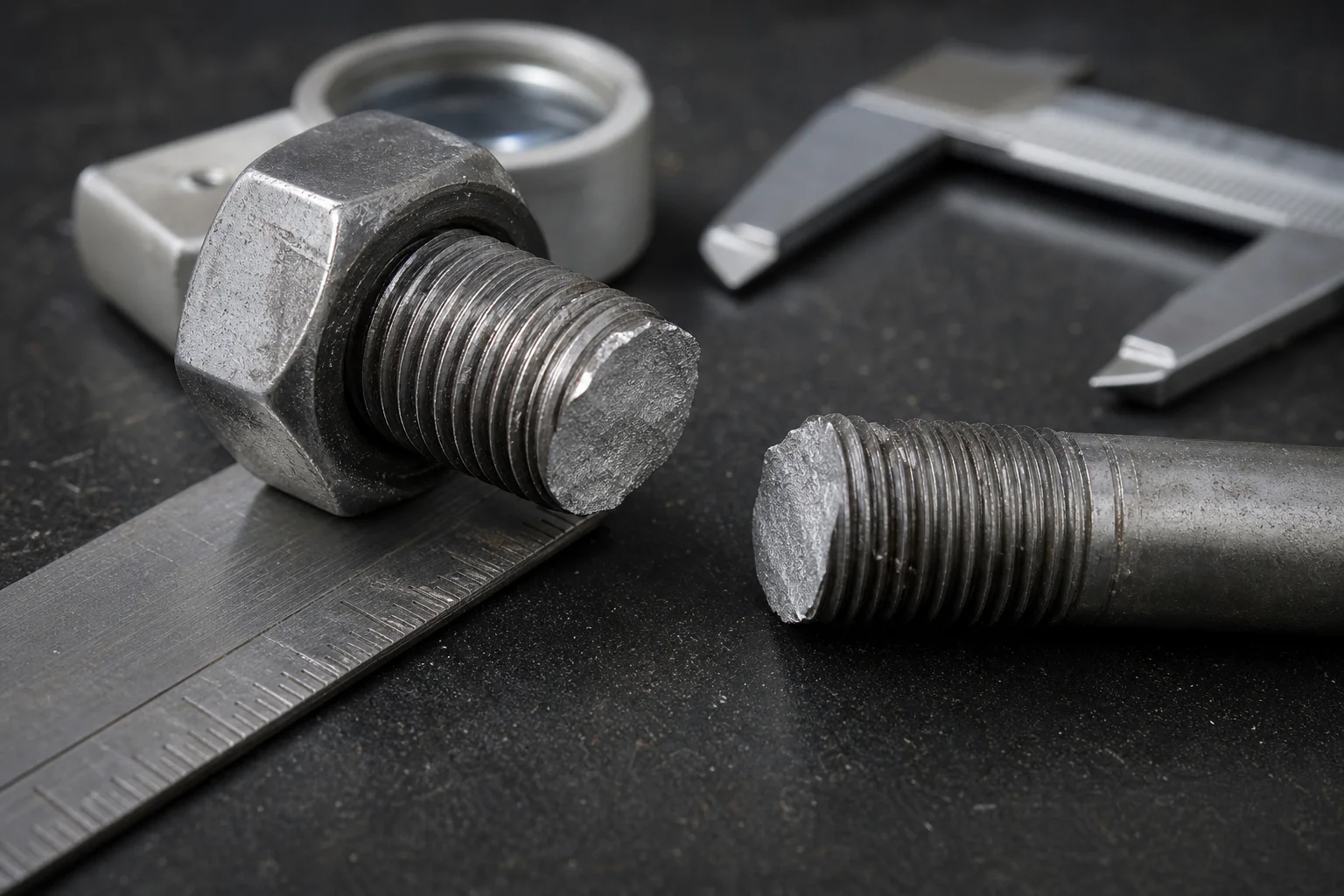
A bend or sustained-load test breaks the parts you can spare, so the parts you ship do not break in service. The failure surface is flat and bright, with no necking.
The lines that move the risk onto the supplier
Here is the commercial core of the argument. Embrittlement is a process risk. Process risk belongs to the party that owns the process. If your purchase order is silent, that party is you, because you accepted an unspecified route and paid for it.
A purchase order does not need to be long. It needs to be specific in the places where silence is expensive. Six clauses cover most of it.
Name the class and the standard. "Class 10.9 to ISO 898-1" is a start. Add the size range and the thread tolerance, because the notch geometry at the thread root is part of the stress state.
Name the coating and its standard. "Zinc flake to ISO 10683" and "electroplated zinc to ISO 4042" are two different products with two different risk profiles. A generic word like "zinc plated" is not a specification.
Name the baking requirement, including the clock. If the route is electrolytic, reference ISO 4042 and state that baking is required within the interval the standard allows, at the temperature and duration it specifies. Require the oven record per lot.
Name the acceptance test and the sampling. ISO 15330 for lot verification. ASTM F1940 for process control. Say who samples, how often, and what happens to a failed lot. Silence here means the supplier chooses, and the supplier chooses the cheapest reading of the requirement.
Name the rework rule. Any re-plating after a rejection requires re-baking and re-testing, and the lot must be identified as reworked. This single line closes the most common gap in the whole chain.
Name the evidence package. Coating certificate, bake record, test report, and material certificate tied to the lot number on the carton. Not to a product family. To the lot.
| PO line | Weak wording to avoid | Wording that transfers the risk |
|---|---|---|
| Property class | "High strength bolts" | Class 10.9 to ISO 898-1, thread 6g, marking as specified |
| Coating route | "Zinc plated, clear" | Zinc flake to ISO 10683, or electroplated zinc to ISO 4042 with baking |
| Baking | "Bake if required" | Bake per ISO 4042 within the specified interval after plating; oven record per lot |
| Lot verification | "Supplier to ensure no embrittlement" | ISO 15330 test per lot, stated sample size, failure rejects the lot |
| Process control | Nothing at all | ASTM F1940 verification on the plating line, frequency stated, report on request |
| Rework | "Rejects may be corrected" | Re-plated parts to be re-baked, re-tested and identified as reworked |
| Records | "Certificate of compliance" | Bake record, test report and material certificate tied to the lot number on the carton |
| Change control | "Equivalent finish acceptable" | No change of coating route, plater or heat treater without written approval |
The last line is the one that gets skipped. Suppliers switch plating subcontractors for capacity, for price, or because a line is down. A different plater means a different acid bath and a different oven. The bolt is unchanged. The risk is not.
None of this is exotic. A capable fastener supplier already runs these controls for automotive and machinery customers. The clauses simply make those controls visible and contractual instead of assumed.
For structural work, the same principle applies with a different standard stack. A structural bolt manufacturer working to ASTM F3125 or EN 14399 assemblies has its own coating and testing rules, and those rules already treat galvanizing and electroplating differently. Do not carry a machinery PO template onto a structural order without checking it.
Questions buyers actually ask
How can I tell if my bolts are at risk before they fail?
You cannot inspect the risk into a part. You can only inspect the process that made it. Ask which coating route was used, whether it was electrolytic, when baking started relative to plating, and what lot test was run. If those answers are vague, the risk is unquantified.
Does baking make an electroplated class 10.9 bolt safe?
It reduces the risk when it is done to ISO 4042 within the allowed interval, at the specified temperature and duration. It does not eliminate it, and it does nothing for a part that has already cracked. Baking is a control, not a cure.
Why do class 8.8 bolts rarely have this problem?
Lower strength means more ductility. A small crack tip blunts instead of propagating, so the same hydrogen dose does much less damage. Class 8.8 is not immune, and severe cases exist, but the margin is larger.
Is zinc flake genuinely safer than electroplated zinc?
For hydrogen embrittlement in bolts, yes, because there is no electrolytic deposition at the part surface. ISO 10683 still requires the pretreatment to be controlled, since acid steps can introduce hydrogen. The advantage is that the main mechanism is removed from the route.
Can I just specify 12.9 and reduce the number of bolts?
You can, and it will make the joint smaller. It also raises the process sensitivity. Fewer, harder bolts carry more load each and tolerate less error, so tighten the process requirements rather than relaxing them.
What does a hydrogen embrittlement failure look like?
No necking at the fracture. A flat, bright origin near the head fillet or first engaged thread, and no deformation of the shank. It looks like the bolt was cut, not pulled, and it happens well below the rated strength.
Should I test every lot, or just the first one?
Every lot where the coating route is electrolytic and the class is 10.9 or 12.9. The process varies, not the drawing. A plater change, an oven fault or a delayed batch all happen between lots.
A bolt that fails on Thursday was decided three weeks earlier
Hydrogen embrittlement in bolts is a process defect with a delay fuse. It is decided at the acid tank and the plating bath. It is collected at the torque wrench. It is discovered at the worst possible moment, by someone who has no way to have prevented it.
That is why the receiving dock cannot solve this. Gauges, certificates and visual checks all describe a part that is compliant today. None of them describe what the part will do after a day under load.
The control points are few, and all are upstream. Choose a coating route that does not generate hydrogen, or accept the electrolytic route with baking to ISO 4042 and evidence that the timing held. Keep the class honest. Test the lot to ISO 15330, verify the line to ASTM F1940, and put all of it on the order.
Twelve years of export experience says the same thing every time. The buyers who never see this failure are not the ones with the longest inspection reports. They are the ones whose purchase orders name the process.
JingleFix supplies hex bolts, structural fasteners and custom parts from Ningbo, quoted by property class, coating route and test requirement, with documentation agreed per order. If you have a class 10.9 or 12.9 part going through an electrolytic line, send the drawing and the service environment. We will tell you which route we would quote, and what evidence comes with it.
Get a process route you can defend
Send your drawing, property class and service environment. We reply with the coating route we recommend, the baking and test requirements, and the records we can provide for that specific lot.
Send Your Inquiry Now →Or email sales@jinglefix.com · WhatsApp +86 13958236696