Automotive Fastening Systems: Lightweight Design Meets Safety Requirements
Engineering at the Crossroads of Efficiency and Safety
Every kilogram saved in a vehicle can translate into measurable gains—better fuel efficiency, extended EV range, and reduced emissions. Yet every bolt, rivet, and screw also holds responsibility for occupant safety.
The modern automotive industry operates on a fine balance: make components lighter, but not weaker. That paradox drives innovation in fastening systems, from new alloy compositions to hybrid joining techniques that secure structural strength without excess weight.
At Jingle, we see fastening not as a simple mechanical task but as an engineering ecosystem—where materials, geometry, and assembly precision converge to protect lives at highway speeds.
How Fastening Demands Have Evolved in Modern Vehicles
In the internal combustion era, steel dominated chassis and engine mounts. Now, electric vehicles (EVs) and composite-based designs are redefining mechanical joining challenges.
Key evolution trends include:
-
Mixed-material assemblies: Combining aluminum, magnesium, and carbon fiber demands adaptable fastener geometries.
-
Thermal management needs: EV battery enclosures require fasteners that endure high temperature variations.
-
NVH optimization: Bolts now double as vibration dampers, enhancing cabin comfort and structural sound quality.
-
Automated installation: Precision torque control is vital for robotic assembly lines.
This evolution turns the fastener from a passive connector into an active design variable influencing crash energy absorption, load distribution, and modular vehicle architecture.
Material Innovation: Strength in Every Gram
The lightest fastener is the one that maintains structural integrity while minimizing mass. Advances in metallurgy and coatings are key enablers.
| Material Type | Density | Typical Use | Advantages |
|---|---|---|---|
| High-Strength Steel (HSS) | ~7.8 g/cm³ | Chassis & suspension | Proven fatigue strength |
| Aluminum Alloy | ~2.7 g/cm³ | Body panels & trims | Lightweight, corrosion-resistant |
| Titanium Alloy | ~4.5 g/cm³ | Aerospace-grade EV joints | Exceptional strength-to-weight ratio |
| Composite Fasteners | ~1.8–2.0 g/cm³ | Non-critical interior parts | Ultra-light, non-conductive |
Coating enhancements, such as zinc-nickel or ceramic layers, extend fatigue life while maintaining a sleek surface finish—critical for components under cyclic stress.
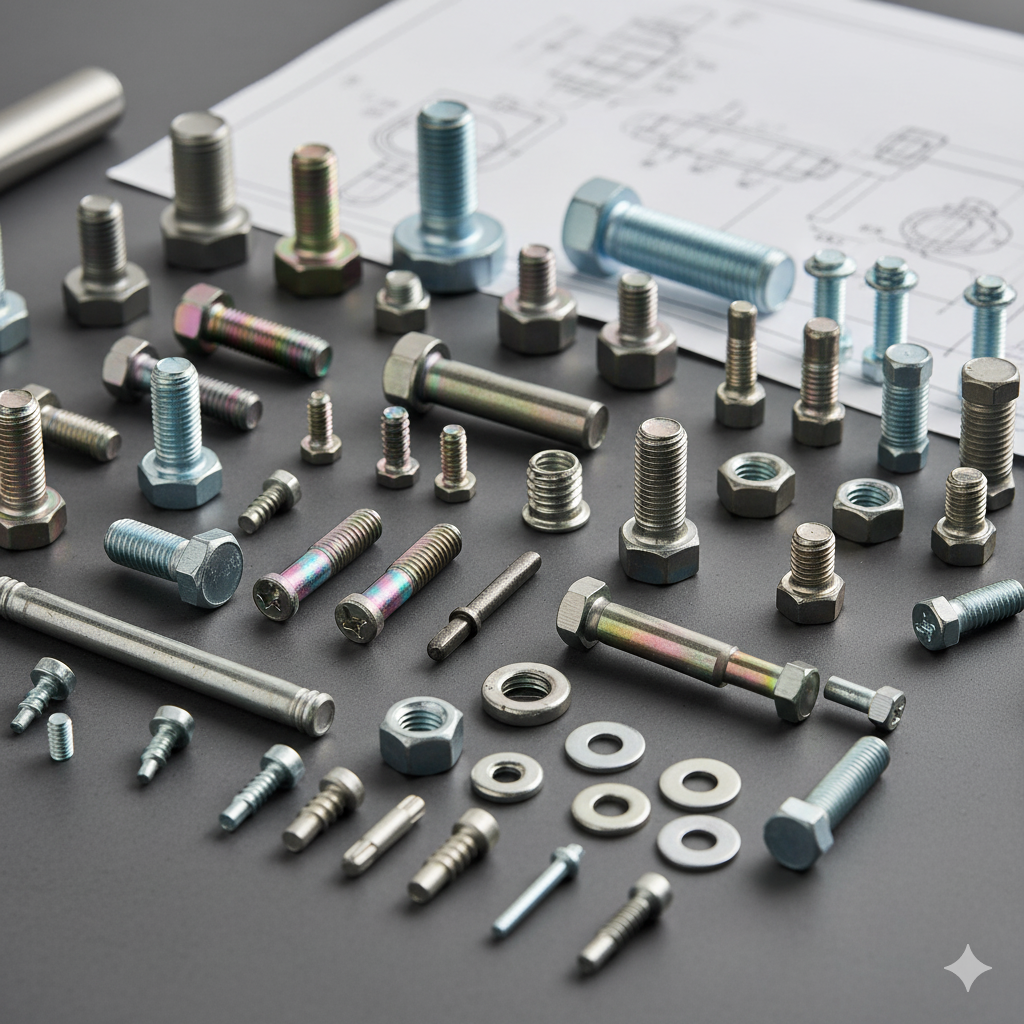
At Jingle, our CNC-machined titanium and treated steel bolts undergo thermal fatigue simulations and salt spray testing to ensure long-term performance under automotive-grade vibration and load.
The Mechanics of Lightweight Fastening
Weight reduction cannot come at the cost of safety. The challenge lies in optimizing fastener geometry, thread design, and installation torque.
1. Optimized Thread Profiles
Fine-pitch threads distribute loads more uniformly, especially in thin-walled aluminum housings.
2. Integrated Washers & Flanges
Reduce the need for separate components and improve clamping stability.
3. Controlled Preload Systems
Sensors or torque-control mechanisms ensure bolts maintain optimal tension, even after thermal expansion.
4. Structural Adhesive Hybridization
Fasteners combined with adhesives create stronger bonds, reducing vibration and preventing galvanic corrosion.
These improvements collectively cut hardware weight by up to 20% in some assemblies while maintaining equivalent tensile strength.
Real-world Validation: When Design Meets Road Impact
A fastening system’s success is proven in testing, not theory.
Automotive validation includes:
-
Crash load simulations (CAE): Measuring load transfer during impact events.
-
Cyclic fatigue testing: 1 million+ stress cycles under variable torque.
-
Thermal shock assessments: Between -40°C and 120°C to mimic battery pack environments.
-
Salt fog exposure: Evaluating corrosion protection in coastal climates.
For instance, in a Jingle project for an EV battery frame, replacing stainless steel bolts with zinc-nickel coated aluminum fasteners reduced assembly mass by 18%—while meeting ISO 898-1 tensile standards and maintaining crash energy integrity.
Integrating Fasteners into Vehicle Architecture
Modern vehicles rely on modularity. Fasteners play a structural role in:
-
Battery housing and underbody protection
-
Seat frames and restraint systems
-
Suspension subframes and control arms
-
EV motor mounts and inverter housings
In each, precision torque and uniform tension ensure stability and performance. Even minor deviations—like over-tightening or uneven torque—can trigger microcracks that evolve into fatigue failures.
Jingle’s production integrates digital torque monitoring and statistical process control (SPC) to ensure every fastener performs as designed.
Choosing the Right Fastening Approach for Modern Automotive Projects
Not all fastening challenges are the same. The selection process should consider mechanical, thermal, and lifecycle factors.
| Scenario | Recommended Fastener Type | Reason |
|---|---|---|
| EV Battery Modules | Aluminum or titanium fasteners | Lightweight, heat-tolerant |
| Structural Frames | High-strength steel | Maximum fatigue resistance |
| Interior & Trim Components | Polymer/composite | Lightweight, non-conductive |
| Chassis-to-Body Joints | Hybrid metal-bonding fasteners | Reduces vibration and weight |
Pro tip: consider the assembly environment (robotic vs. manual) and serviceability—as over-torqued bolts can undermine both safety and warranty performance.
Frequently Asked Questions
Q1: Can lightweight fasteners replace traditional steel bolts in all vehicle areas?
No. They’re best suited for non-critical or medium-load zones. High-stress joints still require high-strength alloys.
Q2: What testing standards apply to automotive fasteners?
Common ones include ISO 898, SAE J429, and DIN 267, depending on application load and environment.
Q3: Do lighter materials affect corrosion performance?
They can, but modern coatings like zinc-nickel and ceramic micro-layers compensate for this with enhanced surface protection.
Q4: How do Jingle’s fasteners differ in manufacturing?
Each batch undergoes automated torque verification, fatigue simulation, and coating uniformity inspection to meet both OEM and Tier-1 supplier standards.
Engineering the Balance Between Strength and Efficiency
Lightweight engineering is not just about removing mass—it’s about redistributing strength intelligently.
Every fastener represents a decision: between safety and efficiency, cost and performance, innovation and reliability.
At Jingle, we build fastening systems that embody this balance.
Through precision machining, advanced coatings, and fatigue-tested alloys, we help automotive engineers achieve safer, lighter, and more efficient vehicles.
To learn more about our automotive fastening capabilities, visit our homepage or contact us directly via the contact page.