CNC milling parts often look correct on drawings and pass initial inspection, yet problems appear once assemblies begin: hole misalignment, flatness issues on mounting surfaces, or inconsistent fit between mating components. These issues are rarely caused by machine accuracy alone. They originate from how complex geometry is machined, how material is removed, and how tolerances are distributed across the part.
A reliable CNC milling parts supplier does not simply “machine to drawing,” but builds process control around how the part will actually function.
Material and Geometry Strategy: Preventing Deformation Before It Starts
Milled parts are often larger, more complex, and less symmetric than turned parts. This makes them more sensitive to internal stress release and uneven material removal.
In real production, a CNC milling parts supplier evaluates:
-
geometry symmetry and material removal balance
-
wall thickness variation across the part
-
flatness-critical vs non-critical surfaces
-
clamping position relative to functional features
Instead of treating all surfaces equally, machining strategy is aligned with structural behavior. This reduces deformation before it becomes a tolerance issue.
Milling Process Design: Toolpath and Sequencing Control
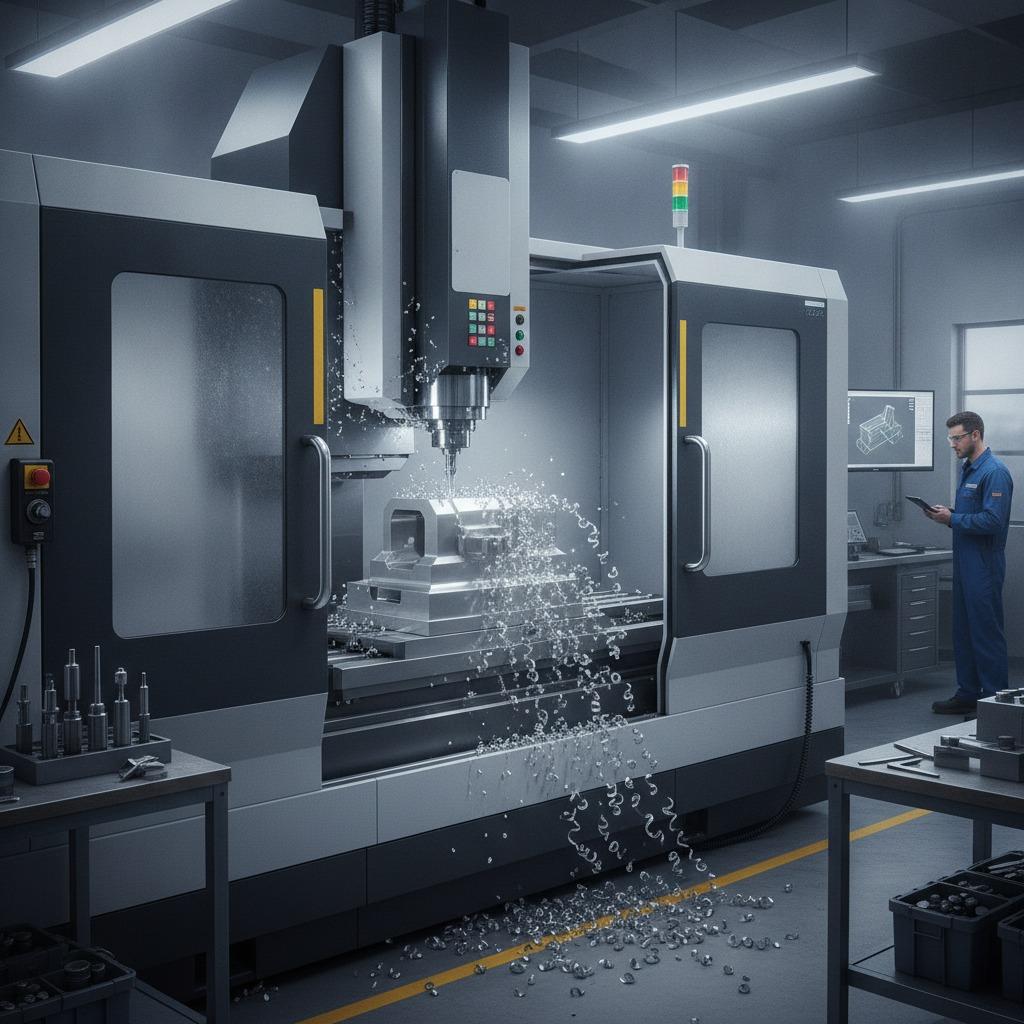
Unlike simple machining, milling involves multi-axis movement, layered cutting, and varying tool engagement. Poor toolpath strategy leads directly to vibration marks, dimensional drift, and inconsistent surface quality.
To stabilize CNC milling parts, process design includes:
-
roughing strategies that distribute cutting forces evenly
-
semi-finishing passes to release internal stress
-
final finishing aligned with functional datums
-
controlled tool engagement to reduce vibration
This ensures that geometry remains stable not only during machining, but also after unclamping and during assembly.
Application Scenario 1: Equipment Frames and Structural Plates
CNC milling parts are widely used in equipment bases, mounting plates, and machine frames where flatness and hole positioning are critical.
Challenges in this environment
-
uneven flatness causing assembly misalignment
-
bolt hole deviation affecting installation accuracy
-
distortion after machining large surfaces
Our approach
-
large surfaces are machined with balanced toolpaths to control heat distribution
-
hole positioning is referenced from functional datums, not edge geometry
-
finishing passes are applied after structural stabilization
This allows CNC milling parts to maintain alignment across full assemblies, not just as individual components.
Application Scenario 2: Complex Housings and Enclosures
Many CNC milling parts serve as housings for mechanical or electronic systems, requiring both dimensional accuracy and surface integrity.
Challenges in this environment
-
cavity deformation during deep pocket milling
-
inconsistent wall thickness affecting strength
-
surface defects affecting sealing or fitting
Our approach
-
pocket milling is sequenced to avoid localized stress concentration
-
wall thickness transitions are evaluated for machining feasibility
-
critical sealing surfaces are isolated and finished last
This ensures CNC milling parts perform reliably in both structural and protective roles.
Application Scenario 3: Multi-Surface Precision Components
Parts with multiple machined faces—such as brackets, connectors, and mounting interfaces—require consistent relationships between surfaces.
Challenges in this environment
-
loss of perpendicularity between faces
-
tolerance stack-up across multiple setups
-
repositioning errors during machining
Our approach
-
multi-face machining is planned with controlled datum transfer
-
setups are minimized to reduce repositioning deviation
-
inspection tracks relationships between features, not just individual dimensions
This allows CNC milling parts to maintain geometric integrity across all surfaces.
Measurable Production Impact From Controlled Milling Processes
The table below shows typical industry performance improvements when CNC milling parts are produced with controlled material strategy, toolpath planning, and tolerance zoning.
| Control method applied | Production outcome | Typical improvement |
|---|---|---|
| Balanced material removal strategy | Reduced deformation | 20–35% reduction |
| Optimized toolpath & cutting load | Improved surface consistency | 15–30% increase |
| Functional tolerance zoning | Higher assembly pass rate | 15–25% increase |
| Controlled multi-face setup | Reduced positional error | ~30% reduction |
| Process-locked repeat production | Batch consistency | >95% |
These improvements directly reduce rework, assembly issues, and delivery delays.
How This Supports Scalable CNC Milling Supply
When machining strategy is aligned with geometry and application, CNC milling parts become predictable across repeat production. This eliminates the need for repeated adjustments, reduces inspection burden, and stabilizes delivery timelines.
For procurement and engineering teams, this means:
-
fewer assembly corrections
-
consistent dimensional performance
-
reliable scaling from prototype to production
Common Buyer Questions
Q: Why do CNC milled parts misalign during assembly?
A: Because machining does not control datum relationships and deformation during processing.
Q: Can tighter tolerance solve flatness issues?
A: No, flatness depends on material removal strategy and stress control, not tolerance alone.
Q: How can CNC milling parts remain consistent across batches?
A: By locking machining sequence, toolpath strategy, and datum control throughout production.
Conclusion and Next Steps
Reliable CNC milling parts are produced by aligning material behavior, machining strategy, and tolerance control with real application requirements. When these elements are built into the process, a CNC milling parts supplier can deliver consistent geometry, stable performance, and predictable production outcomes.
To review milling capabilities and precision component supply scope, visit:
👉 https://jinglefix.com/
If you are working on complex milled components, multi-surface parts, or structural assemblies and want to reduce deformation, misalignment, and rework before production, early technical coordination can significantly improve project stability:
👉 https://jinglefix.com/en/contact-us