Why dacromet coating gets so much attention in fastener and component sourcing
When engineers compare corrosion-protection options for bolts, brackets, clips, and other metal parts, dacromet coating often comes up as a practical middle ground between traditional zinc systems and heavier-duty finishes. The reason is simple: many buyers want consistent corrosion resistance without adding a thick metal layer, changing dimensions too much, or creating hydrogen embrittlement concerns for high-strength parts. That makes the topic important not just to design teams, but to sourcing managers who need a finish that behaves predictably on the line and in the field.
This is not a one-size-fits-all answer. The right coating depends on the service environment, part geometry, assembly method, and what the customer expects in appearance and performance. Still, if you are deciding whether a dacromet-style finish belongs in your specification, it helps to understand where it sits relative to other common options such as geomet coating, zinc plated fasteners, and hot dip galvanized parts.
What dacromet coating is designed to do
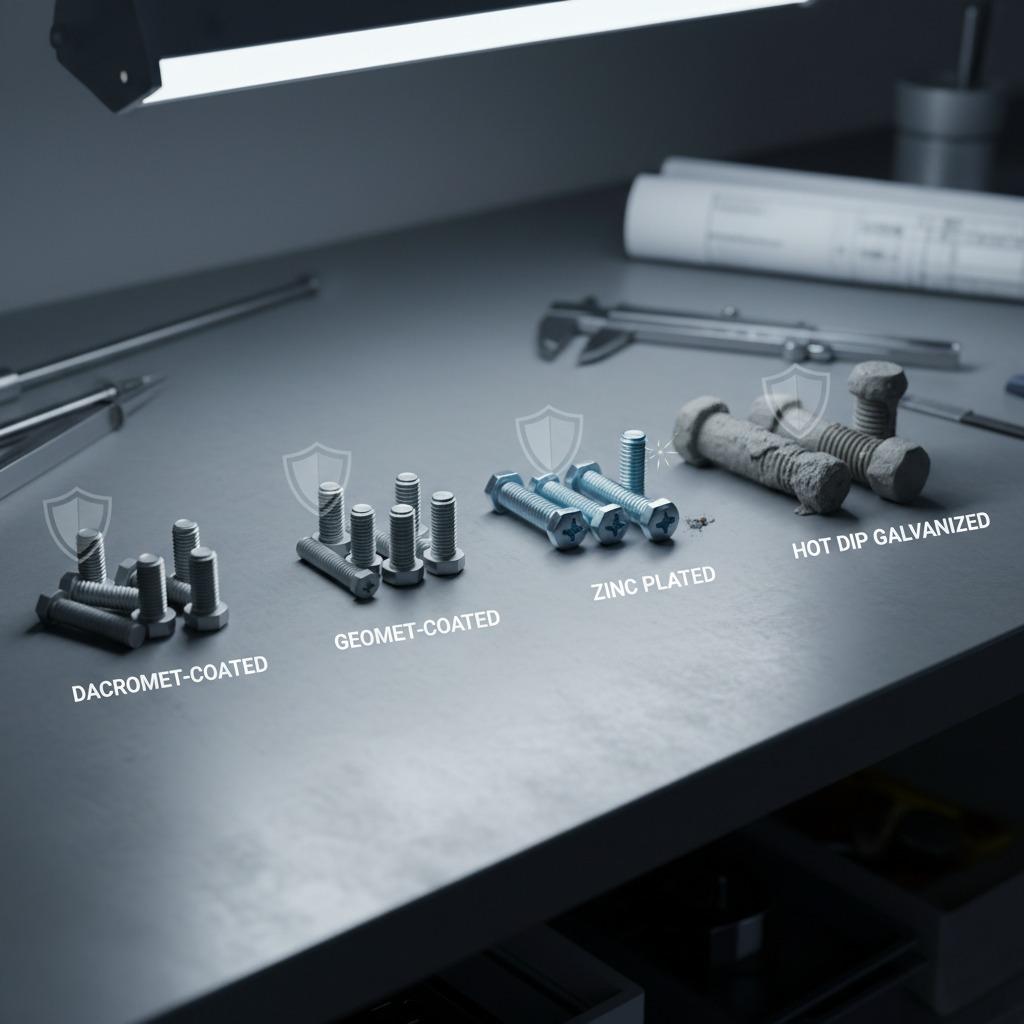
Dacromet is generally understood as a zinc-aluminum flake coating system applied as a protective layer on metal components, especially fasteners. Instead of building a thick electroplated shell, it relies on thin flake layers that help slow corrosion and improve durability. That thin-film character matters. On threaded parts, especially, excess build-up can interfere with fit, while a more controlled coating helps preserve assembly consistency.
In practical terms, buyers often look at dacromet coating when they need a finish that can handle outdoor exposure, road spray, or humid storage conditions better than standard plating. It is often discussed in the same conversation as other flake coatings because the selection decision is rarely about chemistry alone; it is about how the part will behave after coating, during tightening, and over its service life.
Quick comparison: where it tends to fit
Zinc plated fasteners
Zinc plated fasteners are widely used because they are familiar, economical, and easy to source. For many indoor or mildly corrosive applications, zinc plating is enough. The trade-off is that conventional plating may not offer the same level of corrosion resistance as a flake-based system in harsher conditions.
Geomet coating
Geomet coating is frequently mentioned alongside dacromet because both are used for corrosion protection on fasteners and formed metal parts. In buyer discussions, geomet is often treated as a similar alternative, though exact formulations and performance targets can vary by supplier and specification. If you are comparing the two, focus less on brand names and more on the actual test requirements, appearance, friction behavior, and process control your application needs.
Hot dip galvanized
Hot dip galvanized parts are usually chosen when the job calls for robust, heavy-duty corrosion resistance on larger steel components. The coating is thicker and well suited to structural exposure, but that thickness can be a drawback on fine threads or precision assemblies. It also changes part dimensions more aggressively than a thin coating system. For small fasteners, that is a meaningful design constraint, not a minor detail.
Selection criteria engineers should not overlook
The first question is environment. Will the part sit indoors, face intermittent moisture, or live outdoors with regular exposure to salt, condensation, or chemicals? The second question is geometry. A coating that works well on a bracket may create headaches on a small screw or a tight-tolerance threaded insert. The third is assembly behavior. Coatings affect friction, torque-tension consistency, and sometimes the need for additional lubrication or process adjustment.
Another point that is easy to miss: appearance can matter more than some teams expect. Even when corrosion performance is the priority, customers may still care about finish color, uniformity, or whether the surface looks patchy after handling. That is especially true for visible hardware in equipment, automotive subassemblies, and consumer-facing products.
Common mistakes when specifying protective coatings
One common mistake is treating all corrosion-resistant coatings as interchangeable. They are not. A finish that performs well in a lab-style test may behave differently once it is installed on a real part with burrs, sharp edges, or mixed-metal contact. Another mistake is ignoring the manufacturing route. Parts that are stamped, machined, or cold-formed may respond differently to coating processes, especially if surface cleanliness is inconsistent.
A practical caution: if your drawing only says “corrosion-resistant coating,” the purchasing process becomes slower and more ambiguous. Clearer specifications usually save time. State the part function, exposure level, and any critical assembly concerns, then let the supplier recommend the most suitable finish.
Buyer advice: how to choose the right finish
If you are sourcing fasteners or custom metal parts, start with the failure mode you want to avoid. Is the main risk red rust, thread seizure, cosmetic degradation, or premature wear in service? Once that is clear, the finish choice becomes more rational. Dacromet coating is often a sensible option when you need thin, uniform coverage and stronger corrosion protection than basic zinc plating, but do not assume it is automatically the best answer for every part.
Ask suppliers how the coating affects dimensions, assembly torque, and long-term storage. If your team already uses zinc plated fasteners or is considering a move from hot dip galvanized components, compare not only corrosion resistance but also cost, part size, and downstream process impact. That broader view usually leads to a better decision than focusing on coating type alone.
What to ask before you release a drawing or RFQ
Ask whether the coating is suitable for the substrate and part geometry. Ask how it performs on threads and whether any post-treatment is recommended. Ask what the visual finish will look like, because coatings that perform similarly can still differ noticeably in appearance. And if you are substituting one coating family for another, request a side-by-side review rather than assuming a drop-in replacement.
That is often where projects either stay on schedule or drift. A coating decision made early, with a realistic view of manufacturing and use conditions, prevents a lot of expensive correction later.
FAQ: short answers buyers usually want
Is dacromet coating only for fasteners?
No. It is commonly used on fasteners, but it can also be applied to other metal components where a thin corrosion-protective finish is useful.
Is it the same as geomet coating?
They are often discussed as similar flake-coating options, but buyers should verify the actual process, performance targets, and supplier specification rather than relying on the name alone.
Should I replace zinc plated fasteners with dacromet?
Only if your application needs better corrosion protection, different friction behavior, or improved performance in harsher environments. For mild service, zinc plating may still be the more economical choice.
When is hot dip galvanized still the better option?
Usually on larger steel parts or structures where thicker coating and strong outdoor durability matter more than precise thread fit or a thin finish.
The practical takeaway for sourcing and engineering teams
Dacromet coating is worth serious consideration when corrosion resistance, thin-film build, and predictable assembly behavior all matter at once. It is not a universal upgrade, and that is precisely why it deserves careful review. The best choice depends on the part, the exposure, and the manufacturing route. If you are preparing a specification or comparing finishes for a new project, start with the service environment first, then check the dimensional and assembly consequences before you lock in the coating.
If you want the finish recommendation to hold up in production, ask for supplier guidance early and make the performance requirement explicit. That small step usually saves more time than it takes.