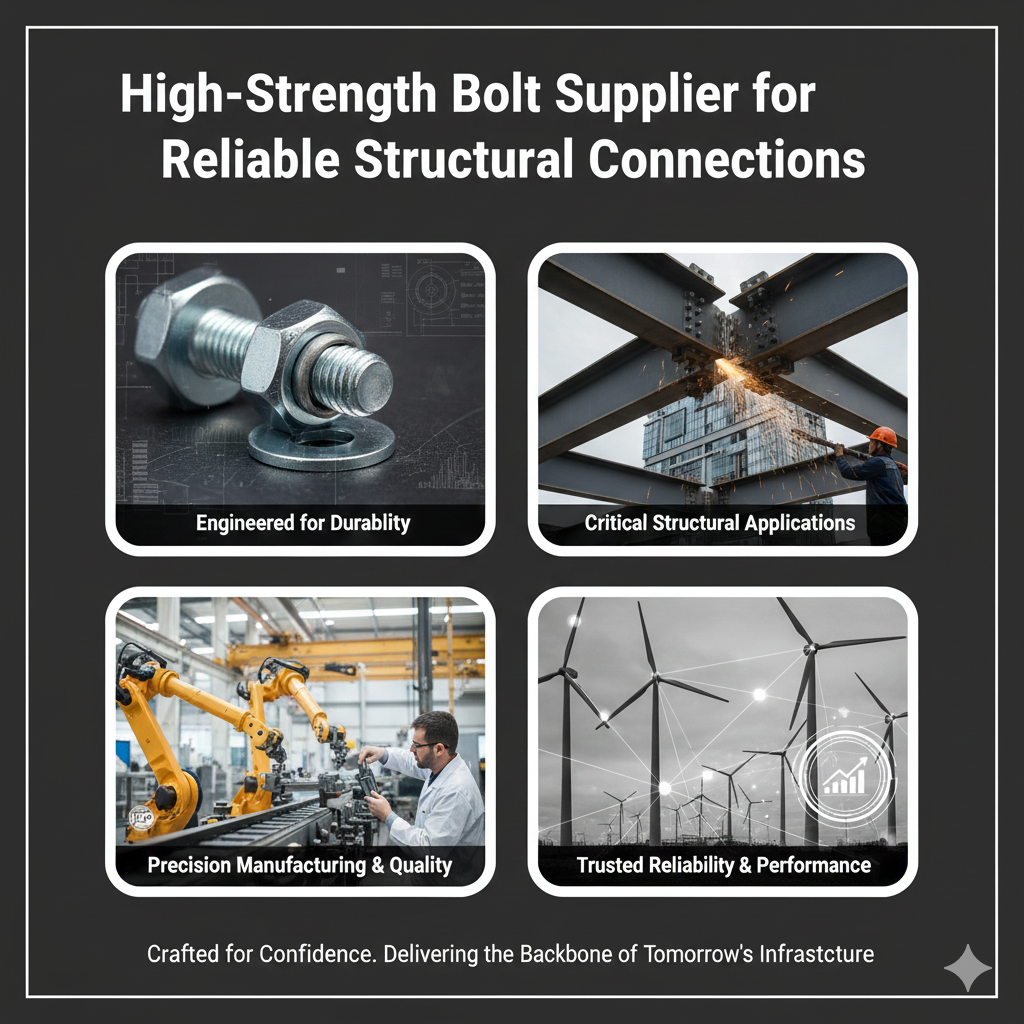
High-Strength Bolt Supplier for Reliable Structural Connections
1. Strength That Holds Every Structure Together
In large-scale construction, the difference between stability and failure often lies in the smallest part — the bolt.
Every connection between beams, plates, or columns depends on how well each bolt manages stress, vibration, and environmental impact.
That’s why high-strength bolts are not generic hardware; they’re designed to deliver consistent tensile power and load endurance across decades of use.
A dependable supplier ensures not only quality materials but also uniform strength, verified through batch testing and strict process control.
2. Material and Design Standards That Define Performance
High-strength bolts are manufactured using medium-carbon or alloy steel, processed through heat treatment for improved toughness and elasticity.
Complying with international standards like ASTM A325, A490, and ISO 898-1, they maintain performance even under long-term fatigue or temperature shifts.
Core Parameters of Reliable Bolts:
-
Tensile strength: 830–1040 MPa depending on grade
-
Yield ratio: 0.8–0.9 for balanced load absorption
-
Surface coating: hot-dip galvanizing or Dacromet to prevent corrosion
-
Thread accuracy: ISO 6g tolerance to ensure full engagement
Each specification is engineered to maintain bolt stability through heavy loads, thermal expansion, and field vibrations.
3. Common Causes of Bolt Failure and How to Prevent Them
Even with strong materials, bolts can fail when selection or installation is overlooked.
Based on testing data and site evaluations, most structural fastener issues arise from:
| Failure Type | Cause | Prevention |
|---|---|---|
| Fatigue cracking | Over-torquing or uneven preload | Use torque-calibrated tools |
| Thread stripping | Mismatch of bolt and nut grades | Pair matched-grade components |
| Corrosion fatigue | Thin coating or improper galvanization | Apply full-surface hot-dip layer |
| Joint slippage | Uneven contact or dirt on surfaces | Use hardened washers and clean contact faces |
A professional supplier eliminates these risks through dimensional consistency, torque verification, and full inspection reports before delivery.
4. Applications Where Strength Matters Most
| Industry | Typical Use | Required Grade |
|---|---|---|
| Steel construction | Column joints, roof trusses | 8.8 / 10.9 |
| Bridge building | Expansion joints, bearing plates | 10.9 / 12.9 |
| Wind power | Tower flanges, nacelle frames | 10.9 HV |
| Machinery | Equipment housings, brackets | 12.9 |
| Energy plants | Pipe and turbine supports | ASTM A490 |
These bolts are chosen not for price, but for long-term durability and safety under continuous stress cycles, especially in outdoor or dynamic environments.
5. From Raw Steel to Certified Fastener
Producing high-strength bolts involves several controlled stages that directly affect their performance:
-
Material selection — steel bars tested for chemical balance and mechanical stability.
-
Cold forging — forming bolt heads without altering the grain structure.
-
Heat treatment — quenching and tempering to achieve strength and flexibility.
-
Thread rolling — improving fatigue resistance through grain alignment.
-
Coating — galvanizing for corrosion protection.
-
Inspection — torque, tensile, and impact testing with traceable reports.
This process ensures every bolt can withstand mechanical loads while maintaining consistent tension in real-world installations.
6. The Real Cost of Using Reliable Bolts
Using certified bolts may increase initial material costs by 10–15%,
but according to multiple structural studies, total project savings over time can exceed 30% due to fewer maintenance cycles, reduced reinstallation, and improved service life.
The best suppliers provide mechanical documentation, corrosion tests, and torque calibration sheets — making quality a measurable, verifiable investment rather than an assumption.
7. What to Check Before Choosing a Bolt Supplier
Reliable sourcing is as important as material strength.
When evaluating a supplier, engineers should look for:
-
ISO 9001 and CE certification
-
Batch-level test documentation
-
Third-party inspection reports (SGS, TÜV)
-
Traceable heat-number tracking
-
Coating thickness and torque test data
Suppliers like Jingle combine manufacturing and inspection under one quality management system, ensuring that every bolt meets global construction standards.
8. Long-Term Reliability Built Into Every Shipment
In bridge construction, industrial machinery, and wind turbine assembly,
every bolt plays a role in maintaining alignment and safety across decades.
High-strength fasteners supplied by trusted manufacturers such as Jingle
undergo rigorous testing to ensure consistent performance, corrosion resistance, and mechanical reliability.
A strong project starts with dependable components — and a dependable supply chain.
9. FAQ: What Buyers Often Ask
Q1: How are high-strength bolts tested before shipment?
→ Through tensile, hardness, and salt-spray testing following ASTM and ISO procedures.
Q2: Can I customize coating thickness or bolt dimensions?
→ Yes, standard sizes range from M12–M64, with adjustable coating layers.
Q3: What documentation should accompany a certified shipment?
→ Material test certificate (MTC), torque test data, and surface coating report.
Q4: Are replacement batches consistent with earlier supplies?
→ Yes, full traceability ensures continuity of mechanical properties.
10. Build Stability That Lasts
From bridges to wind turbines, high-strength bolts form the unseen framework that keeps projects safe, aligned, and durable.
Selecting the right supplier means investing in the strength and consistency that every large-scale project relies on.
Discover more about industrial fasteners and connection systems on the Jingle Home Page
or contact the team through the Inquiry Page for detailed specifications and technical advice.