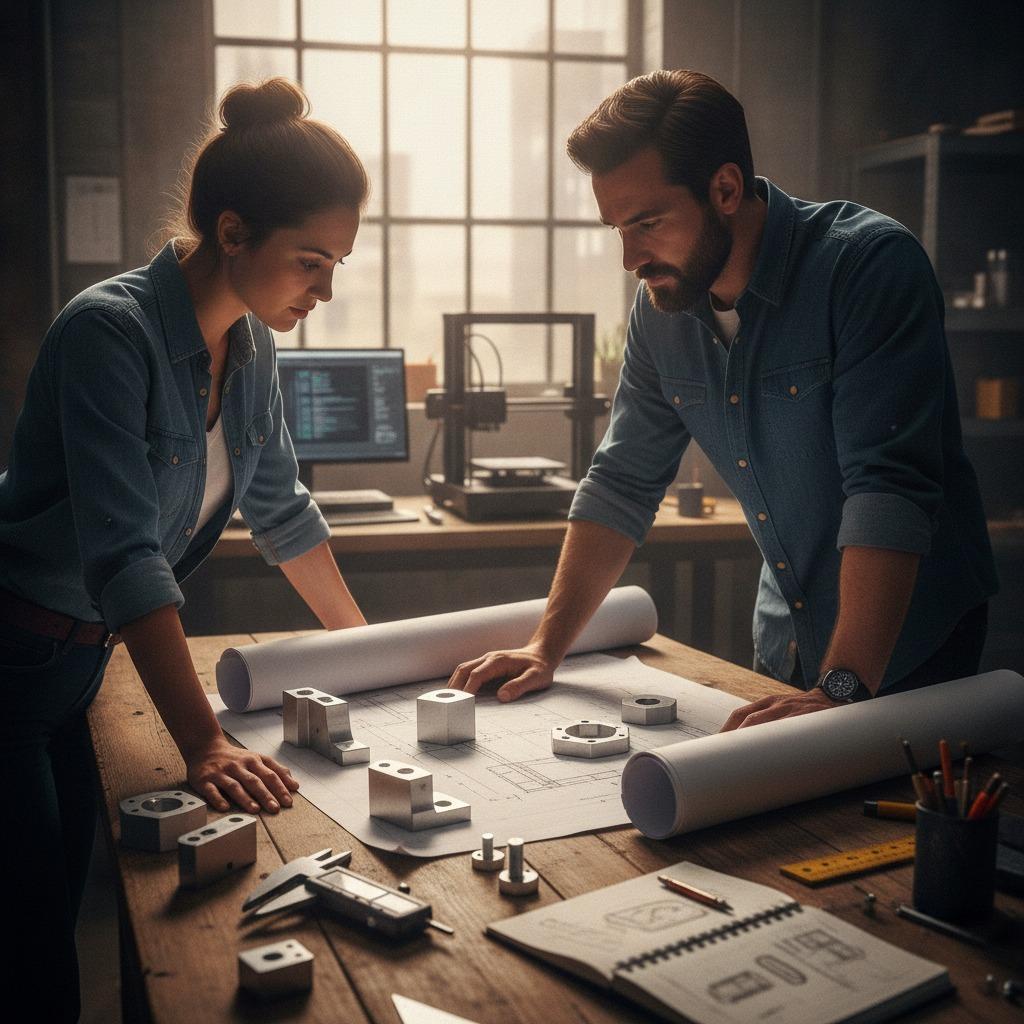
How to Choose a CNC Machining Supplier Without Buying a Future Problem
If you are figuring out how to choose CNC machining supplier partners for a new part, a program ramp, or a sourcing reset, the real issue is rarely just price. Most buyers eventually learn that a supplier decision affects fit, finish, repeatability, communication, and how much time your engineering team spends cleaning up after the order. A low quote can look smart on paper and still become expensive once drawings start moving, tolerances get questioned, or deliveries slip.
That is why the selection process should be treated as a manufacturing decision, not a purchasing checkbox. The right shop can reduce risk across prototyping, pilot runs, and production. The wrong one usually shows its weaknesses after the PO is signed, when the schedule is already tied to a launch date.
Start with the part, not the vendor
The fastest way to narrow the field is to look closely at the part itself. Is it a simple bracket, a housing with several pockets, a tight-tolerance shaft, or a cosmetic component that must look good as well as function well? Different shops are strong in different areas. A supplier that handles aluminum prototypes well may not be the best fit for stainless steel parts with demanding surface requirements. A shop that is excellent on short-run work may not be the most stable option for repeat production.
Engineers and sourcing managers should also ask a basic but useful question: what matters most for this part? Cost, speed, dimensional control, material traceability, surface quality, or consistency over multiple releases? The answer changes the supplier ranking more than many teams admit in early discussions.
Check capability, but read between the lines
Most machine shops can say they do CNC milling or CNC turning. That alone does not tell you enough. The better question is whether they routinely machine parts like yours. Look for evidence that the supplier understands your material, geometry, and volume profile. A shop with the right equipment still may not have the right process discipline for thin walls, deep pockets, interrupted cuts, or parts that require careful deburring.
Ask how they handle setup verification, in-process checks, and drawing review. Good suppliers do not treat a drawing as a simple printout. They look for ambiguous dimensions, missing datum logic, and features that can cause scrap if left unchallenged. That kind of feedback is often more valuable than a slightly lower unit price.
Quality control should be visible, not vague
One practical way to judge a CNC machining supplier is to listen for specificity. A strong shop can explain how parts are inspected, what happens when a nonconformance appears, and how revisions are controlled. If the quality answer is only “we inspect everything,” that is not much of a process statement.
You do not need a lecture, but you do need confidence that the supplier understands measurable control. For critical parts, ask what inspection records are normally shared, whether first-article review is part of their workflow, and how they communicate deviations. Even on ordinary parts, a shop with a real quality habit will save time when something changes midstream.
Communication is a manufacturing capability
Buyers often underestimate this. A technically capable supplier that answers slowly, hides bad news, or keeps changing promises can do more damage than a smaller shop with sharper communication. In CNC work, the ability to flag a material issue, a drawing ambiguity, or a schedule risk early is part of the job.
When evaluating how to choose CNC machining supplier candidates, pay attention to response quality, not just response speed. Did they ask intelligent questions about the print? Did they comment on manufacturability? Did they identify a need for clarification before quoting? Those are signs that the supplier is thinking like a process partner instead of a price taker.
Compare these practical decision points
Prototype versus production fit
Some suppliers are excellent for fast prototypes but less attractive when the volume rises. Others are set up for stable repeat runs and tooling discipline. Match the shop to the phase you are in, not the phase you hope to reach someday.
Material and finishing experience
Metal choice matters. Aluminum, stainless steel, brass, titanium, and engineered plastics each bring different machining behavior. If your part also needs anodizing, passivation, polishing, or coating, the supplier should be able to manage that workflow or coordinate it cleanly.
Process transparency
Buyers should prefer a supplier that can explain how work will be routed, inspected, and packaged. Packaging sounds minor until a finished batch arrives with cosmetic damage or mixed labels. That kind of avoidable mess consumes real time.
Common mistakes buyers make
The first mistake is selecting only on unit price. The second is assuming all CNC shops are interchangeable. They are not. Another common error is overloading the quote request with incomplete information and then blaming the supplier when the estimate is weak. If the drawing is missing revision history, surface finish notes, or inspection priorities, the quote will often reflect that uncertainty.
A more subtle mistake is failing to think past the first order. If the program might scale, ask whether the shop has room to grow with it. A capable supplier should not only win the prototype; it should remain credible when your purchasing team wants a second source, a tighter release schedule, or a more formal production plan.
What to ask before you place the order
A short supplier conversation can reveal a lot. Ask about the types of parts they handle most often, how they review drawings, what inspection methods are typical, and how they communicate changes. If the part is important to assembly or end-use performance, ask how they reduce the risk of burrs, damage, or dimensional drift. Keep the discussion practical. You are not looking for a sales pitch; you are looking for operating habits.
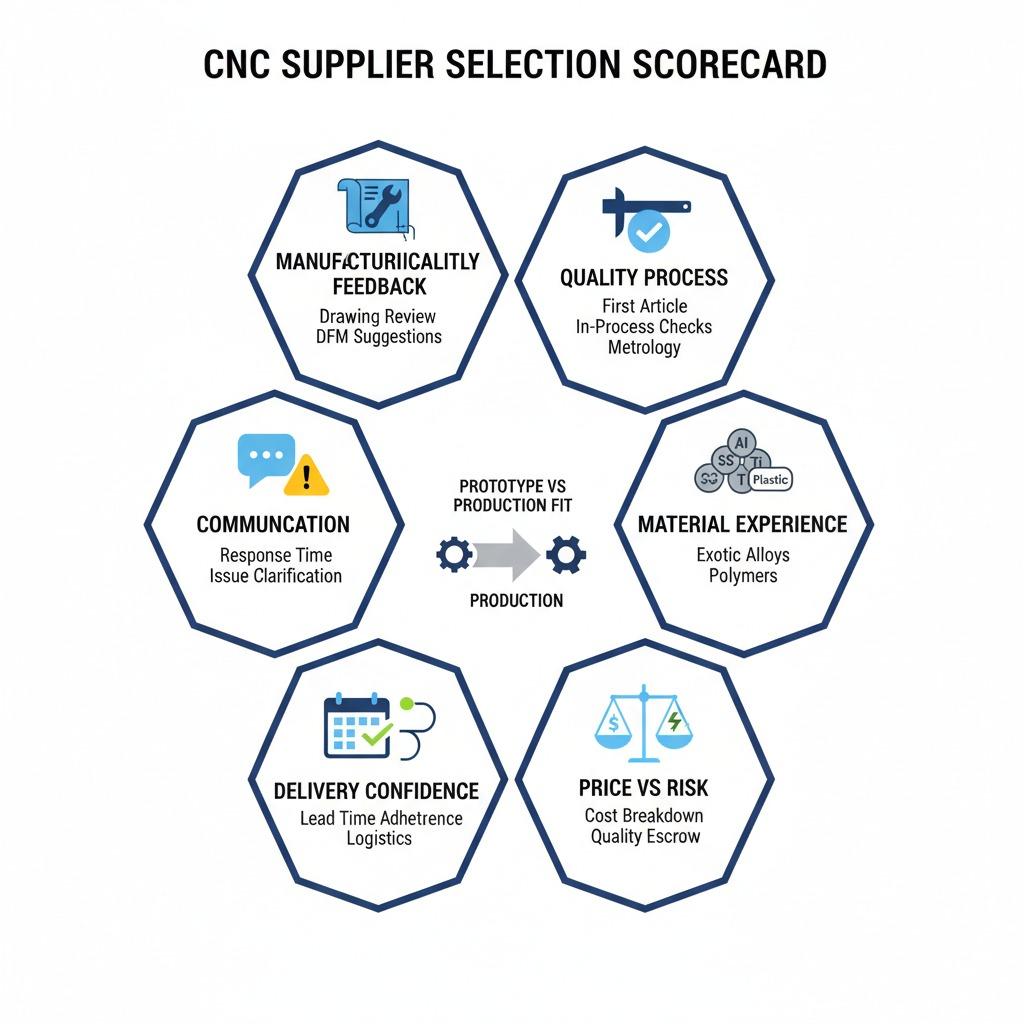
For teams comparing multiple quotes, it helps to build a simple scorecard: manufacturability feedback, quality process, communication, material experience, delivery confidence, and price. That approach is less dramatic than chasing the cheapest number, but it usually leads to better outcomes.
Final buyer advice
Choosing a CNC machining partner is ultimately about reducing uncertainty. The best supplier is not always the largest one, and not always the cheapest one. It is the shop that understands your part, asks the right questions, and can deliver repeatable results without creating noise for your team.
If you are still deciding how to choose CNC machining supplier options for a current project, start by comparing a few shops on the same drawing and look closely at how they respond. The quote itself matters, but the conversation around it often tells you more. For engineering and sourcing teams, that is usually where the real decision is made.