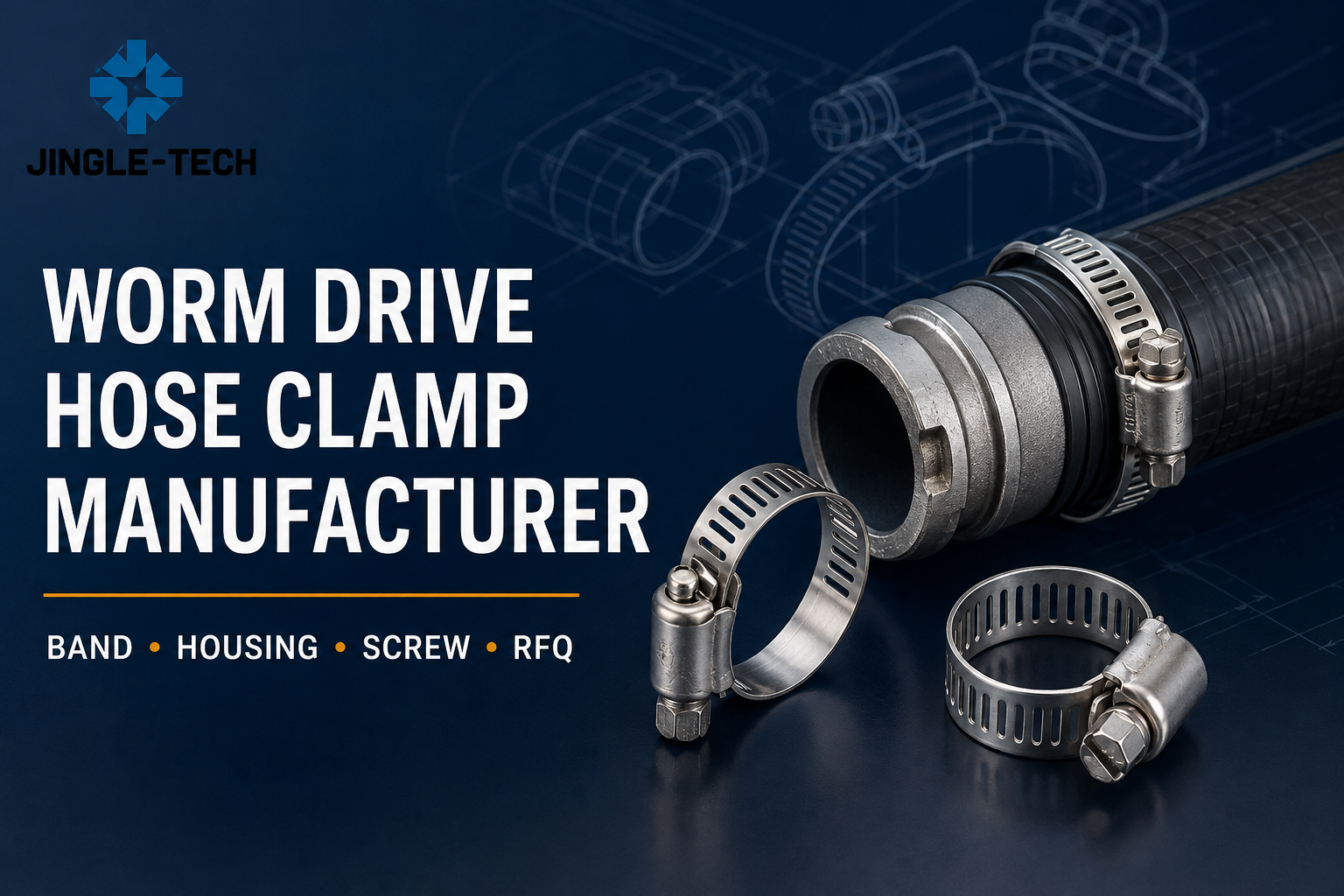
A worm-drive hose clamp looks simple enough to buy from a photograph. There is a perforated or embossed band, a housing and a screw. The clamp tightens; the price fits; the carton ships. Then a complaint reveals what the RFQ missed. Perhaps the driver slips from the screw. Perhaps the housing lifts, a sharp edge marks the hose, one component rusts, or two ranges arrive mixed in the same line-side bin.
This guide is written for the OEM buyer, distributor, private-label brand or maintenance supplier qualifying a worm drive hose clamp manufacturer. The practical work is to define the complete clamp, compare material and corrosion choices, test fit and torque, and keep size and lot identity intact through export packing.
It is a procurement and quality-planning guide, not an application approval. Hose construction, fitting geometry, pressure, temperature, vibration, fluid compatibility and installation method are system-level responsibilities.The buyer’s engineer or product owner must approve the final clamp and joint. A responsible supplier supports that decision with clear drawings, representative samples, test evidence and change control.
Request a Worm-Drive Clamp Quote →
Quick answer: what should an overseas buyer put in the RFQ?
Do not begin with diameter and stainless steel alone.Send a compact application package covering:
- installed diameter range and fitting outside diameter;
- hose material, wall behavior and service environment;
- band style, width, thickness and edge requirement;
- housing construction and screw drive;
- material for band, housing and screw separately;
- corrosion finish and test/evaluation criteria;
- tightening method, target torque or functional test;
- marking, range identification and traceability;
- sample, annual volume, MOQ and packaging;
- delivery term, destination and required documents.
Say so at the start when the joint is safety-critical, highly pressurized, very hot, regulated, or used in a high-consequence fuel, braking or medical system. A catalog clamp must not be treated as approved merely because its nominal range fits around the hose.
Why clamp range alone is not enough
Two clamps marked with the same nominal range can behave differently. Band width and thickness affect stiffness. Perforation geometry changes how the screw engages and how the band carries load. Housing design affects alignment and lift resistance. Screw diameter, pitch, point and drive affect installation.Edge shape affects the hose surface. Material combinations change corrosion behavior. Lubricant and finish alter torque.
Range notation itself needs clarification. Some catalogs show minimum and maximum inside diameter; others use a size code or nominal hose size. Buyers should request a dimensional drawing showing the free diameter, practical installation range, band length, width, thickness, housing envelope and screw projection. The joint should be checked near both ends of the proposed range, not only at the convenient middle.
A clamp near minimum diameter may have excessive tail or the housing may approach a geometric limit. Near maximum diameter, the screw may have insufficient band engagement. The correct range is the one that works on the real production tolerances of hose and fitting, with adequate engagement and installation access.
Start with the hose-and-fitting stack
The clamp does not seal by itself. It compresses a hose against a fitting. The stack includes hose material, reinforcement, wall thickness, surface hardness, fitting outside diameter, bead or barb geometry, insertion depth and clamp position. Temperature and fluid exposure can change the hose after installation. Vibration and pressure cycling can relax or move the joint.
Provide the supplier with nominal dimensions and tolerance extremes. When confidential, a controlled interface drawing may be enough.If physical samples are sent, identify whether they represent production material, aged material or prototype tooling. A sample that feels similar but has different reinforcement can produce a misleading clamp result.
The buyer should also state whether the clamp is installed before the hose is assembled, opened and wrapped around an existing joint, or fed through a restricted space. Housing orientation and screw-access angle often matter more on the line than catalog appearance.
Recognize the worm-drive family without assuming interchangeability
“Worm drive” describes the screw-driven band mechanism, but market names vary. “American type,” “German type,” “British type” and other regional labels may refer to different band perforations, embossing, housing and width conventions. Suppliers do not always use those labels consistently. A type name should therefore be followed by a drawing or a controlled sample.
SAE’s current J1508_202301 Hose Clamp Specifications covers 32 clamp types commonly used on OEM coolant, fuel, oil, vacuum and emission systems. Its scope is a useful reminder that “hose clamp” is a broad family rather than one interchangeable item.If an application calls out SAE J1508 or another standard, specify the exact type and revision required by the design.
For private-label distribution, the buyer may intentionally source several regional constructions. Keep each family under a separate part number and drawing. A shared marketing name must not allow one construction to replace another without approval.
Define every component separately
A stainless band does not mean an all-stainless clamp. The housing may use another stainless grade or coated carbon steel. The screw may be stainless, plated steel or another specified material. Mixed materials can be a deliberate cost/performance choice, but they must be visible.
| Component | Specification questions | Common buyer risk |
|---|---|---|
| Band | Material grade, width, thickness, perforated/embossed profile, edge, length | Sharp edge, weak engagement, wrong range, excessive hose marking |
| Housing | Grade, wall, joining detail and the way it holds the screw in line | Lifted housing, distorted walls or a crooked band path |
| Screw | Grade, thread profile,diameter, drive, head, surface and lubricant | Driver slip, seizure, stripped engagement or erratic tightening |
| Marking | Location, size range, material code, brand, lot | Unreadable identification or incorrect claims |
| Packaging | Count, range separation, corrosion protection, label | Mixed sizes, moisture damage, receiving errors |
Write the material for each component on the drawing or specification. If “stainless steel” is commercially acceptable without a fixed grade, require the supplier to state its proposed grades in the quote. For demanding environments, material family alone may still be insufficient; chemical compatibility and corrosion mode must be evaluated for the full joint.
Band design controls load transfer and hose contact
The band transfers screw motion around the hose.Its width, thickness, material condition and tooth geometry influence stiffness and load distribution. A wider band may distribute pressure over more area, but it can be harder to conform to tight curves or short fitting lands. A narrow band may fit a compact space but create higher local pressure. No width is automatically superior outside the application context.
Perforated bands offer positive screw engagement but the slots create local geometry that can mark a very soft hose if the design or installation is unsuitable. Embossed, non-perforated or smooth-inner-band concepts are chosen in some applications to change hose contact. Do not substitute between them based only on price.
Inspect edge condition under consistent lighting and magnification appropriate to the risk. A rolled, formed or deburred edge can reduce cutting potential, but the exact requirement needs a drawing and representative joint test. “No sharp edges” is subjective unless the buyer defines a visual standard, radius/edge condition or approved sample.
Housing construction is a hidden differentiator
The housing holds the screw in alignment with the band. Under tightening load, a weak or poorly formed housing can spread, lift or rotate. The clamp may still feel tight to an installer while losing effective load or damaging the band.
Review housing length, wall thickness, tabs, welds or mechanical interlocks, screw retention and how the band enters/exits.A smooth production sample should turn without binding through the claimed range. Watch for burrs, cracked corners, inconsistent joining and contact that scrapes protective finish.
When housing joints are welded, brazed or otherwise specially processed, the supplier should control process parameters and inspection. A photograph of the housing is not enough. Ask for the production route, in-process checks and reaction plan for lift or fracture failures.
Screw details affect installation more than buyers expect
The screw is the human or automated interface. Drive style must match the installer’s tool and access. Slot width/depth, hex size, head shape and concentricity affect engagement. Thread form and surface condition determine how smoothly torque converts into band movement.
Specify the accepted drive combinations—slotted, hex, combination or another controlled design—and any go/no-go features. If an electric or pneumatic driver is used, include tool speed, shutoff behavior and socket access in validation. A clamp that passes slow manual tightening may not behave the same at production-line speed.
Screw lubrication deserves a line in the specification. An unrecorded oil, wax or topcoat can change installation torque and corrosion behavior. The supplier should state whether lubrication is intentional, its application method and how contamination or migration is controlled.
Build a functional test around the real joint
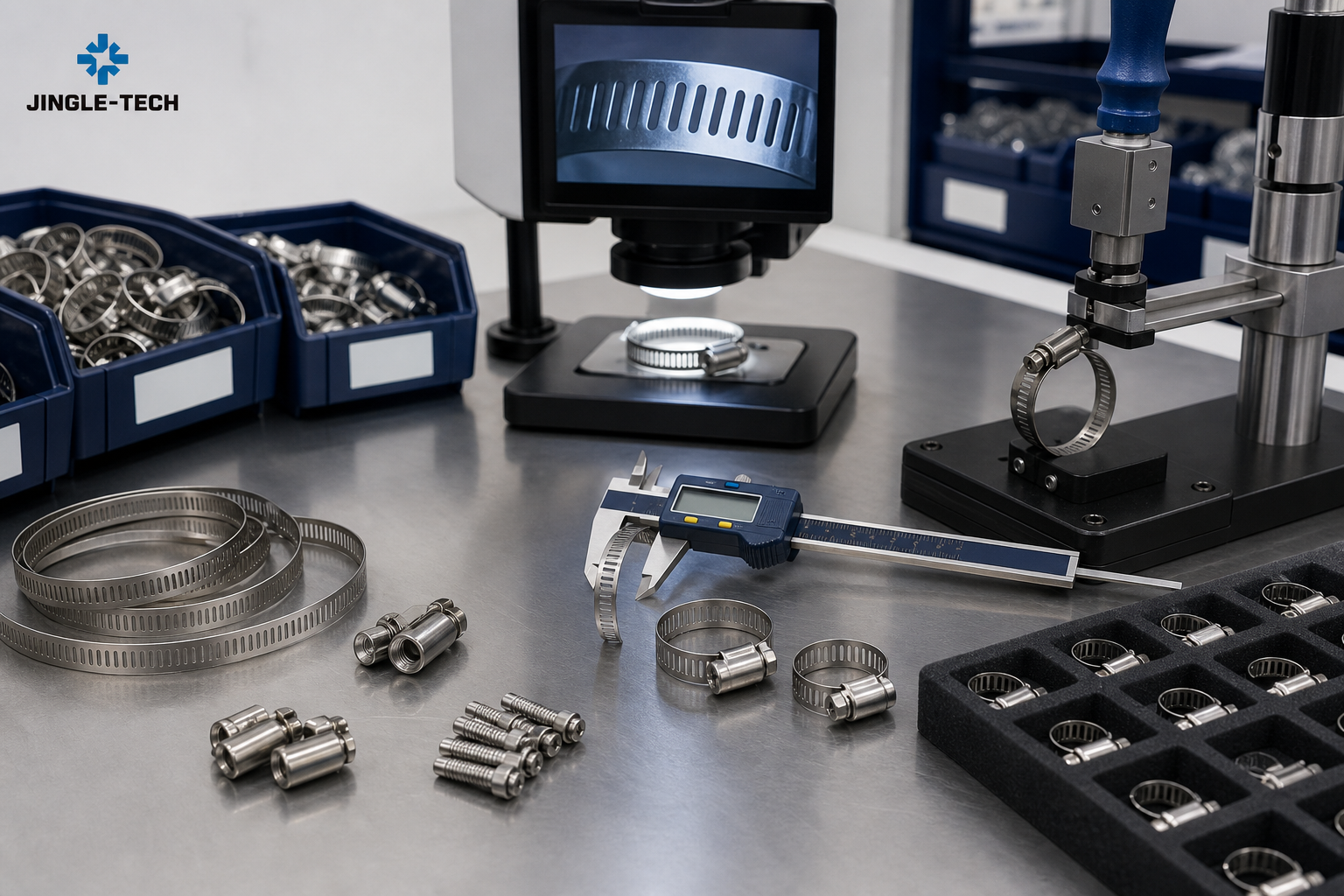
Clamp torque is easy to measure, but a single torque value does not prove sealing performance. The test program should connect component behavior to the intended joint. Depending on the application, useful evaluations may include installation feel, torque-to-failure, free-running torque, band pull, housing lift, leakage, pressure cycling, thermal cycling, vibration, hose damage and retention after conditioning.
Define the test fixture and failure criteria. A mandrel test can compare clamp production consistency, while a complete hose/fitting test evaluates the real interface. The two serve different purposes. If the buyer uses a rigid mandrel for incoming inspection, document diameter, material, surface and tightening method so supplier and buyer results can be compared.
Avoid publishing a universal recommended torque. The suitable value depends on clamp design, size, material, finish, hose, fitting and application. The buyer’s engineering approval should establish the installation specification.The supplier can support with product data and representative tests, not replace that responsibility.
Test at both ends of range
A broad range is commercially attractive because it reduces SKU count, but the mechanism sees different geometry across that range. Validate at minimum diameter, nominal working diameter and maximum intended diameter using production-tolerance hoses/fittings where possible.
At minimum, examine tail length, housing proximity, band overlap, tooth engagement and local hose compression. At maximum, examine screw engagement, housing alignment, remaining adjustment and resistance to pullout. Include installer access and surrounding parts. A clamp may be mechanically capable of reaching a diameter yet impractical to install in the assembly.
Range validation also informs packaging labels. If engineering approves a narrower working range than the supplier’s generic catalog range for a specific hose system, the buyer’s part data should reflect the approved use rather than invite overextension.
Corrosion specification: material, finish and environment
Corrosion performance cannot be reduced to “stainless” or a finish color. Tell the supplier where the joint lives and what reaches it: splash water, chlorides, chemicals, condensation, heat or washdown. Name the hose and fitting materials too.Their geometry may hold a wet pocket against the clamp long after the surrounding surface looks dry.
Mixed band, housing and screw materials may behave differently. A stainless band with a plated carbon-steel screw can show red rust at the screw even when the band remains bright. Different stainless grades can have different resistance in chloride environments. Crevices and deposits change local conditions. Ask the supplier to identify every component, not just the band.
For coated carbon-steel components, define coating system and thickness/class, conversion layer, sealer or topcoat, appearance and test. For stainless components, define grade and any passivation or surface requirement if applicable. Do not accept a generic “rust proof” statement; no exposed metal system is universally rust proof.
Use salt-spray tests for process control, not life prediction
ISO 9227:2022 specifies apparatus, reagents and procedures for neutral salt spray, acetic acid salt spray and copper-accelerated acetic acid salt spray tests. Its abstract explicitly says the methods are useful for finding coating discontinuities and maintaining quality, but are not intended to rank different materials for corrosion resistance or predict long-term corrosion resistance in service.
ASTM’s active B117-26 similarly describes a controlled salt-fog environment and cautions that standalone results seldom correlate predictably with natural-environment performance. This matters commercially. A buyer should use a test to verify a defined coating/product requirement, not market an unsupported “X hours equals Y years” promise.
State the test standard and edition, specimen condition, exposure period, position, scribe requirement if any, cleaning, allowed corrosion type/location and evaluation method. Clarify whether acceptance concerns red rust, white corrosion, base-metal corrosion or functional operation. A bare hour number cannot be compared fairly across different criteria.
Appearance standards need photographs and words
Export buyers often care about brightness, color consistency, stain, burrs, dents and oil. Appearance language such as “beautiful” or “premium” is not inspectable. Build a small visual standard using approved photos, defined lighting and clear defect categories.
Separate cosmetic conditions from functional defects. Minor shade variation may be acceptable for an industrial clamp while a burr at the hose-contact edge is not. A small housing mark may be cosmetic, while a misaligned screw is functional.This separation prevents disputes and directs inspection effort toward risk.
If clamps are sold in transparent retail packs, tighten the cosmetic and cleanliness criteria before quote. Retail presentation can require protective handling that is unnecessary for bulk OEM bins; it has a real cost.
Dimensional inspection should follow the drawing
Create a ballooned drawing and measurement plan. Typical characteristics include band width/thickness, overall band length, housing dimensions, screw dimensions, slot/hex drive, tooth/perforation pitch, minimum/maximum assembled diameter and markings. The actual list depends on construction.
Use calibrated tools suitable for thin, curved metal. Measurement pressure can distort a band. Specify where thickness and width are measured and whether coatings are included. Diameter fixtures should reproduce the defined condition rather than squeezing the clamp into a preferred shape.
For supplier qualification, request capability evidence on the characteristics most likely to drive function. For routine production, combine first-piece, in-process and final checks. A final inspector cannot efficiently sort out a drifting forming tool after thousands of pieces are mixed.
Torque and destructive tests require precise language
“Torque test” can mean several different things: installation torque on a mandrel, torque at first slip, screw or band failure torque, free-running torque, or a customer joint test. Name the method, fixture, driver speed, direction, preconditioning, sample size and failure definition.
Record both values and failure modes. Two clamps may fail at the same torque through different mechanisms. A stripped band, fractured screw and lifted housing point to different corrective actions. Photographs of representative failures help supplier and buyer communicate without ambiguity.
Destructive-test samples must be linked to production lots. Retain reference samples when appropriate. If a test fails, contain the lot and investigate; do not simply test extra pieces until enough pass. Any retest must follow the agreed rule.
Sampling and acceptance: define before production
“AQL inspection” is not complete without lot definition, inspection level, sampling plan, defect classes and acceptance numbers. Define critical, major and minor defects according to real consequence. A wrong material marking may be critical in one program; a small surface mark may be minor.
| Inspection area | Possible method | Example record |
|---|---|---|
| Material identity | Supplier certificate, grade verification as required | Component material record |
| Dimensions | Caliper, micrometer, gauges,diameter fixture | Ballooned report |
| Band/housing workmanship | Visual standard and magnification as agreed | Defect tally and photos |
| Screw operation | Full-range functional cycling | In-process check sheet |
| Torque/failure | Controlled fixture and defined method | Test report with failure mode |
| Corrosion process | Approved finish route and test as specified | Coating certificate/lab report |
| Marking/range | Visual/scan check against artwork | First-off and final record |
| Pack/quantity | Count, weight reconciliation, scan | Packing release checklist |
Supplier and buyer should agree what happens after a failure: stop, segregate, increase inspection, rework, retest under rules, or scrap. Reaction plans belong in the control plan rather than being negotiated during a shipping deadline.
Traceability without making a low-cost item unmanageable
Hose clamps are often ordered in high quantities and many nearby sizes. Traceability should be strong enough to contain risk but practical enough to maintain. Define a lot based on product, component material batches, production period, forming/tool setup, assembly and finish batches as relevant.
A supplier can assign one finished-lot number and maintain internal cross-references to band, housing and screw batches.The finished-lot identity should appear on inner labels, master cartons and packing documents. If several lots share a pallet, map them clearly.
Range and part number are especially important. Similar clamps can be impossible to distinguish visually after labels are removed. For OEM line-side bins, consider durable product marking when space and forming allow. For distributor packs, preserve the label at every salable level.
Packaging protects both finish and assortment
Clamps can nest, hook together and scratch one another. Loose bulk packs may be acceptable for some industrial programs, but they complicate counting and can damage retail appearance. The pack design should follow the sales channel and receiving method.
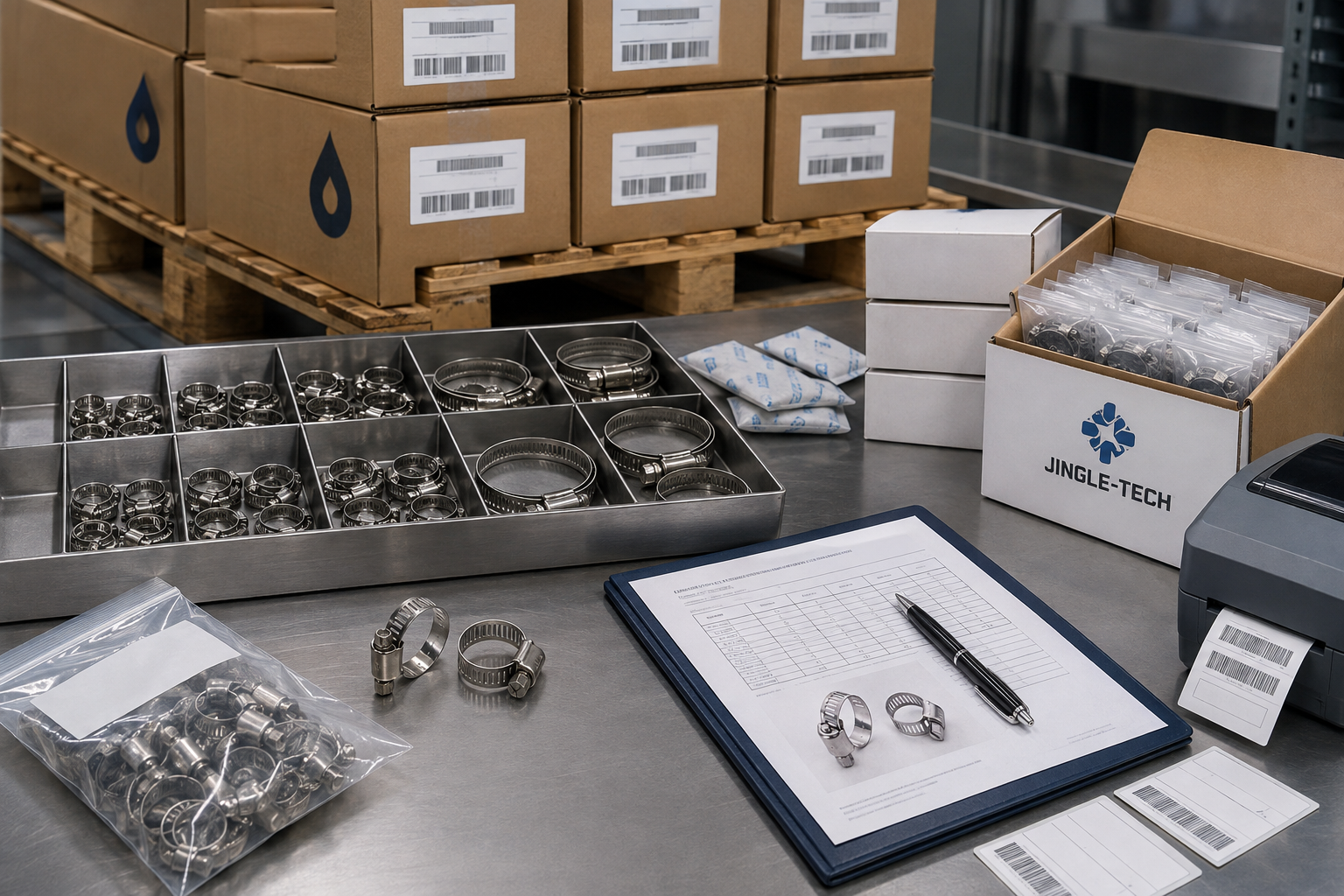
Define pieces per polybag or box, bag thickness, rust-prevention needs, carton count, maximum gross weight, labels, barcode, palletization and mixed-size separation. If desiccant is used, specify type and placement appropriate to the package. If wood pallets or cases cross borders, applicable ISPM 15 requirements must be addressed.
Private-label programs also need artwork ownership, version control, language, claims review and approval samples. A factory should not invent performance claims to fill blank packaging space. Product statements must come from the buyer’s approved data and applicable evidence.
MOQ is a result of the production and packing route
MOQ is not a moral quality of a supplier; it comes from material procurement, tooling/setup, forming efficiency, finish batch, assembly, testing, labels and packaging. Ask for the constraint instead of only pressing for a smaller number.
Useful quantity tiers include prototype/sample, pilot, first commercial order and annual forecast. A buyer may reduce total setup cost by combining sizes using the same material and finish, but component and label separation must remain controlled. Mixed-container programs can improve freight utilization, yet they should not force production lots into one anonymous bulk pack.
For branded packaging, the printed bag or box may have a higher MOQ than the clamp itself. Alternatives include generic protective packs with buyer labels for early orders, followed by fully printed packaging after demand stabilizes. Put artwork, plate/cylinder/tooling charges and remaining-pack-material ownership in writing.
A realistic schedule includes approvals
Lead time starts from a defined event: approved drawing, deposit, material release or approved packaging artwork. If the order includes new tooling, special stainless, corrosion testing or retail packaging, show those steps separately.
An illustrative schedule may include technical review, tool/sample preparation, production-representative samples, buyer approval, material release, forming/assembly, finishing, testing, packing and freight booking. Actual durations vary by product and supplier; the quotation should state its assumptions.
Buyers often save more time by answering a complete clarification list within two days than by demanding an unsupported production reduction. Supplier and buyer should share a milestone tracker for the first order and identify which approvals sit on the critical path.
Supplier audit: follow one clamp from coil to carton
The strongest audit question is simple: “Show how this packed clamp was made and released.” A capable worm drive hose clamp manufacturer should be able to answer by demonstrating the route, not by opening a generic presentation. Start at a finished carton, note its part and lot, then walk backward through final inspection, assembly, screw/housing/band components, forming records, material identity and any coating or passivation route. Then choose a record and walk forward to the affected cartons.
During a remote or on-site audit, review:
- incoming material identification and segregation;
- band forming/perforating tooling and setup approval;
- housing and screw source control;
- assembly equipment, error-proofing and in-process checks;
- dimensional gauges and calibration;
- torque/functional fixture and method;
- visual standards and lighting;
- nonconforming material containment;
- lot assignment and label reconciliation;
- approved subcontractors and change notification;
- packaging count and mixed-size prevention.
Machine ownership is less important than process ownership. If screws are outsourced, the clamp supplier still has to define, inspect and trace them.
Two sample stages reveal different risks
Begin with feasibility samples to confirm range, installation access, appearance and preliminary joint behavior. The supplier must disclose if these use hand operations, temporary tooling or substitute material.They answer “Can the concept work?”
Then require production-representative samples made with intended band stock, housing, screw, tooling, assembly settings, finish and packaging. They answer “Can the production route repeat it?” Attach the dimensional, material and functional records that will accompany mass production.
Test samples across tolerance conditions and service conditioning appropriate to the application. Record tightening tool, torque, clamp position and hose/fitting identity. An unlabeled clamp in a courier envelope is not an approvable sample.
Pilot production before a large private-label launch
A pilot lot gives the buyer a chance to test receiving, barcode scanning, packaging durability and assembly-line use as well as the clamp. Include multiple cartons and, if relevant, more than one production shift. Track installation issues by lot and size.
The pilot review should close:
- drawing and bill-of-material revisions;
- golden appearance sample;
- functional test method and limits;
- label and artwork files;
- unit count and carton-weight tolerance;
- traceability fields;
- approved deviations;
- mass-production control plan;
- change-notification triggers.
Do not use the pilot as an informal shipment with unresolved safety or compliance questions. It is a controlled release with limited scope and explicit acceptance.
Compare quotations on landed, usable value
Normalize unit price with tooling, inspection, corrosion testing, packaging, label setup, inland freight, export handling and Incoterm. Consider reject containment and replenishment flexibility. A lower unit price for mixed, scratched or poorly identified sizes is not a saving.
| Commercial field | What to compare |
|---|---|
| Product basis | Same drawing, range, component materials and finish |
| Quality basis | Same dimensions, functional tests, sampling and reports |
| Packaging | Same count, retail/bulk format, barcode and pallet standard |
| Quantity | MOQ per size,per finish and per artwork; annual breaks |
| Tooling | Ownership, life, maintenance, replacement and modification |
| Schedule | Same starting event and approval assumptions |
| Delivery | Same Incoterm and named place; same freight mode |
| Change control | Notice required for material, source, tool, finish or pack |
Ask every bidder to list deviations and exclusions. A concise, transparent quote is easier to qualify than a low price supported by optimistic email answers.
Common failure modes and what they suggest
The screw turns but the clamp stops closing
Possible causes include stripped engagement, band/housing misalignment, damaged screw threads, bottoming geometry or an incorrect range. Record the diameter and failure point, then inspect components rather than simply applying more torque.
The housing lifts or opens
Review housing material/thickness, tabs or joints, screw alignment, forming and excessive installation torque. Compare failure mode with the approved sample and production fixture.
The band cuts or marks the hose
Check band edge, perforation/embossing, clamp width, installation position and torque, along with hose material and fitting geometry. A different band design may be required, but the complete joint must be evaluated.
Red rust appears only on the screw
Verify screw material and finish separately from band/housing. Review coating thickness, process control, storage and galvanic/crevice conditions. Do not conclude that the full clamp was falsely labeled until component specifications and evidence are checked.
Installation torque varies widely
Investigate screw finish/lubrication, thread geometry, housing alignment, band profile, tool speed and contamination. Control the test fixture and conditioning before comparing lots.
Cartons contain mixed ranges
Audit bin identification, line clearance, count/weight method, label printing, scan verification and packing reconciliation. Size mixing is usually a system problem, not something final inspection can reliably sort at scale.
Red flags when qualifying a manufacturer
Investigate further if the supplier:
- quotes from a picture without asking for hose, fitting or use conditions;
- calls the entire clamp stainless but will not identify component grades;
- promises universal torque or pressure performance across all sizes;
- describes corrosion only with an hour number and no standard or criteria;
- uses regional type names without a drawing;
- cannot show how band, housing and screw batches link to finished lots;
- sends hand-selected samples but will not confirm the mass-production route;
- changes screw or finish supplier without notification;
- cannot reproduce its torque test method;
- packs nearby sizes at adjacent stations without line-clearance controls;
- offers certification or compliance claims unrelated to the specific product;
- refuses to write deviations into the quotation.
The goal is not paperwork for its own sake. Every requested record should close a real technical or commercial risk.
An RFQ template buyers can reuse
| RFQ section | Required buyer input |
|---|---|
| Application | Hose/fitting function, medium, pressure, temperature, vibration, environment |
| Geometry | Clamp range, band width/thickness, housing envelope, access, drawing/revision |
| Band | Grade, perforated/embossed/smooth style,edge and marking |
| Housing | Grade/construction and any joining controls |
| Screw | Grade/finish, drive, thread/profile, lubrication |
| Standards | Product/test standard numbers and editions; precedence rule |
| Function | Installation tool, target method, torque/retention/leak/pressure tests |
| Corrosion | Coating/passivation, test standard, duration and evaluation criteria |
| Quality | Sample plan, lot definition,inspection and required reports |
| Branding | Logo, artwork, claims approval, language and barcode |
| Quantity | Sample/pilot/first order/annual forecast; size mix |
| Packing | Pieces per pack/carton, weight, moisture protection and pallet |
| Delivery | Incoterm, named place, destination and milestone dates |
Send drawings as controlled PDF plus editable artwork files when private label is required. State which dimensions are critical and which requirements are negotiable. Ask the supplier to return a completed feasibility and deviation sheet.
Send Your Clamp Drawing and Size List →
Illustrative sourcing scenario
This example is hypothetical and is not presented as a completed JINGLE customer project.
A maintenance distributor wants a stainless-looking worm-drive range for marine-adjacent service and branded small boxes. Its first inquiry lists eight ranges, an annual quantity and “96-hour salt spray.” The supplier comes back with a short interrogation: “All three components in stainless? Is any red rust allowed? Which salt test and endpoint? Direct seawater or only coastal air? Which hose and fitting are we clamping?”
Those questions expose two different end-use environments. They also reveal that the hour value was copied years ago from a competitor’s catalog. The buyer replaces one vague product with two controlled series, each with named component materials and test criteria. Samples go onto representative joints at both diameter limits. During the pilot, two neighboring sizes still look too similar in their cartons, so the artwork receives color bars and a barcode check.
The lesson is not that every distributor needs two series. It is that clarifying service environment, component materials and evaluation criteria before artwork prevents expensive relabeling and unsupported marketing claims.
Working with JINGLE-TECH on a clamp program
JINGLE-TECH supports industrial hardware sourcing, drawing/sample customization, material and finish options, private-label packaging and export coordination from Ningbo. Product capability, manufacturing route, component source, test evidence and certification scope are confirmed against the actual inquiry. Tell the team which legal entity must appear on the quotation, invoice, certificates and origin paperwork; those names should not be assumed interchangeable.
A useful first message includes a range table, photos or drawing, hose/fitting interface, component material preference, corrosion environment, installation method, tests, annual demand, packaging and destination. JINGLE-TECH can then identify missing information, prepare a comparable quotation basis and propose a sample/evidence plan.
For related industrial sourcing programs, these resources connect to the next buyer decision:
| Requirement | JINGLE buyer resource |
|---|---|
| Drawing-controlled fasteners | custom fastener manufacturer |
| Special screws and drive interfaces | custom screw manufacturer |
| High-load structural bolting | structural bolt manufacturer |
| Mechanical and concrete anchoring | concrete anchor manufacturer |
| Nuts, washers, rods and pins | custom nut manufacturer |
| Clamp families and selection | hose clamp manufacturer |
| Precast lifting components | lifting anchor manufacturer |
| Sockets, inserts and accessories | precast concrete accessories manufacturer |
| Turned and milled interfaces | precision CNC machining parts manufacturer |
| Consolidated hardware programs | OEM fastener and machined parts supplier |
Frequently asked buyer questions
What is the difference between American, German and British type clamps?
Those market names often refer to differences in band perforation or embossing, housing, screw and width, but usage is not perfectly consistent among catalogs. Specify the construction with a drawing or controlled sample and define the component materials. Do not approve a substitute based on type name alone.
Can one clamp range cover several hose sizes?
Possibly, but validate the real hose/fitting tolerance stack at the minimum, normal and maximum intended diameters. Check engagement, tail, housing position, installation access and joint performance. A broad catalog range is not automatic application approval.
Is 304 stainless always required?
No universal grade is best. Choose band, housing and screw materials based on environment, mechanical needs, contact materials, regulatory/customer requirements and cost. State each component grade and confirm any finish or passivation. Some chloride or chemical environments will push the material review beyond the usual stainless choices.
Why do some stainless-band clamps still use a plated screw?
It can be a deliberate cost, strength, thread or installation choice for a given environment. The supplier must disclose the combination and control corrosion and compatibility. If the buyer needs all-stainless construction, write it component by component.
How should maximum tightening torque be specified?
Define the clamp size, test fixture or joint, driver and speed, conditioning, number of cycles, endpoint and failure criteria. Separate recommended installation torque from destructive torque. Final values require application validation and engineering approval.
Does a salt-spray result prove the clamp will last outdoors?
No. It verifies behavior under a defined accelerated laboratory procedure and is useful for coating/process quality checks. It should not be converted directly into service years. Evaluate the actual environment and corroborating application evidence.
Can you make a private-label carton with our logo?
Private-label options can be reviewed against order volume, artwork, pack count and market requirements. The buyer should supply approved logo files, language, barcode data and substantiated claims.Confirm printed-material MOQ and ownership of unused packaging.
What quality documents are useful for a hose clamp order?
Depending on risk, request a component material declaration/certificate, dimensional report, functional or torque report, corrosion/finish evidence, final inspection, lot traceability and packaging verification. Define the exact document package before quotation.
How can we prevent mixed clamp sizes?
Use distinct part numbers and labels, segregated bins, line-clearance checks, scan verification, count/weight reconciliation and a final carton audit. Preserve size/range identification on inner and master packs.
Can the supplier reverse-engineer an existing clamp?
A sample can establish geometry and construction, but not always exact grade, finish process, performance requirement or intellectual-property status. The buyer should confirm it has the right to reproduce the design and approve a new controlled drawing and specification.
What causes MOQ to rise?
Special material, unique width/thickness, dedicated tooling, small component purchases, finish-batch minimums, destructive tests, printed packaging and size fragmentation can all raise MOQ.Ask which constraint drives the number and consider a pilot pack strategy.
What should we send for the fastest quotation?
Send the range/size table, drawing or clear samples, component material requirements, environment, installation method, tests and acceptance criteria, branding/packing, sample and annual quantities, Incoterm, destination and target milestones. Clearly mark open questions.
Final buyer checklist
Before approving the order, verify that:
- the hose/fitting interface and service condition are understood;
- clamp family and construction are controlled by drawing/sample revision;
- range is validated at tolerance extremes;
- band, housing and screw materials are stated separately;
- band width, thickness, edge and tooth profile are defined;
- housing alignment and lift resistance are evaluated;
- screw drive, finish and lubrication match installation;
- torque and functional tests name fixture, method and endpoint;
- corrosion tests include standard, duration and evaluation criteria;
- material/finish claims match actual evidence;
- samples use the intended production route;
- lot identity links records to inner and master packs;
- packaging separates nearby sizes and protects finish;
- artwork and barcode revisions are approved;
- MOQ, tooling, testing and printed-pack charges are visible;
- lead time starts from defined approvals;
- source, material, process and finish changes require notice.
Turn the clamp inquiry into an approvable program
A good sourcing process does not make a worm-drive clamp complicated. It makes hidden assumptions visible. Put the component materials, range, hardware design, tightening method, corrosion rule, functional tests and pack format on the page. Now bidders are pricing the same item, and the buyer knows which evidence deserves approval.
For a standard or custom worm-drive inquiry, JINGLE-TECH can work through range consolidation, component choices, samples, private-label packs, inspection papers and export delivery. The answer will depend on the actual drawing, use and order. A generic claim on a website is not a substitute for that review.
Attach your drawing or size list and tell us the hose/fitting application, component materials, environment, installation tool, quality evidence, pack format, annual demand and destination. The clearer the starting information, the faster the technical team can close questions and prepare a useful quotation.
Get a Worm-Drive Hose Clamp Quotation →
Editorial note: This article provides general procurement and quality-planning information. Clamp selection, joint design, pressure/temperature rating, installation and acceptance must follow the buyer’s controlled engineering documents, applicable standards and responsible approvals.