Designing Fasteners for EV Battery Pack Safety and Integration
Battery Packs Are Structurally Critical—and Electrically Sensitive
In electric vehicles (EVs), the battery pack isn’t just the energy source—it’s part of the load-bearing chassis. Fasteners and mounts must ensuremechanical stability,electrical insulation, andresistance to fire and thermal runaway events.
According to BloombergNEF,EV battery systems now account for up to 40% of vehicle structural mass, and industry recalls due tothermal incidentsrose 27% between 2022–2024—often tied to component failure in housing or connections.
Common Design Challenges in Battery Fastening
| Challenge | Impact |
|---|---|
| Conductive contact between bolts and busbars | Risk of short-circuit, arcing |
| Flame spread via metal hardware | Increases fire propagation in thermal events |
| Poor alignment in pack housing | Causes stress on cooling plates, wire harnesses |
| Torque variation on vibration | Leads to loss of sealing or housing failure |
Use Case: Battery Tray Bolts with Electrical Isolation
A European OEM requiredhigh-strength boltsfor battery enclosures that could withstand road vibration and resist high-voltage leakage during wet conditions.
JINGLE’s Solution
-
10.9-classbattery pack boltswith nylon and ceramic washers
-
Customized zinc-nickel plating with dielectric seal
-
Delivered with torque-patch and color ID ring for easy QC
Result: Passed 1000h water + voltage leakage test; achieved >95% torque retention after 50,000 vibration cycles.
Use Case: Modular Brackets for Pack Housing & Mount Rails
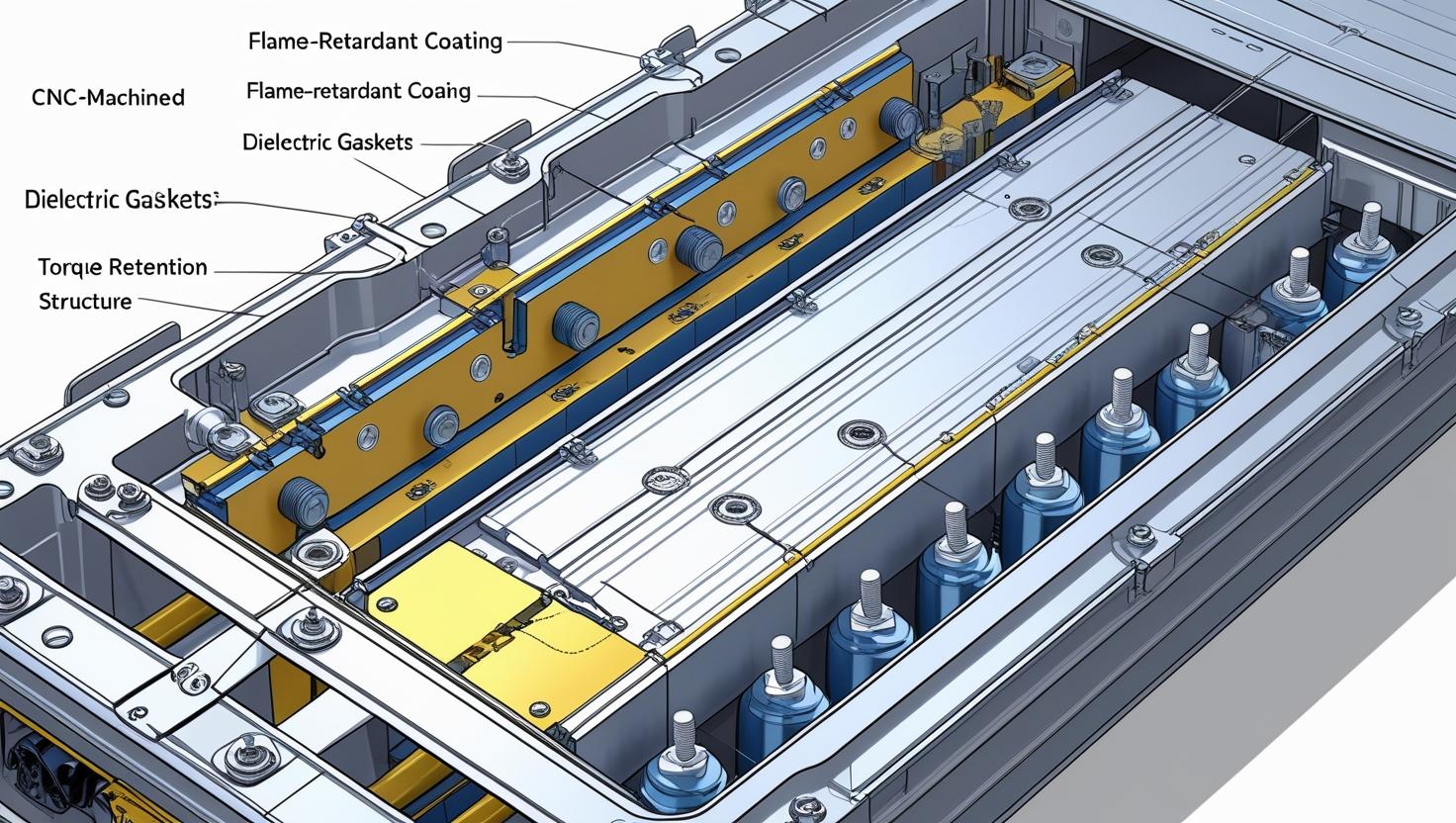
A global EV startup neededmodular CNC bracketsthat would align battery trays across multiple vehicle platforms while maintaining weight and insulation targets.
JINGLE’s Response
-
CNC-milled aluminum + fiber-reinforced hybrid mounts
-
Black anodized surface + edge chamfer to prevent harness abrasion
-
All parts traceable to batch, drawings archived with QA stamps
Result: Assembly time per pack reduced by 17%; component fit tolerance improved by 0.02 mm compared to previous supplier.
What to Specify When Designing EV Battery Fastener Systems
-
Insulating washers, sleeves, or coatingto block electrical paths
-
Material choices like stainless or coated aluminumto reduce weight
-
Preload stability with torque patch or locking undercut
-
Flame-rated finishesthat comply with UL94 and automotive fire standards
-
Multi-geometry bracket holesto match variable thermal expansion in modules
Why Battery Engineers Trust JINGLE
| Capability | EV Battery Pack Value |
|---|---|
| Dielectric performance up to 1000V | Prevents arcing near HV connectors |
| UL94-V0 compatible coating options | Helps contain thermal propagation |
| CNC ±0.01 mm fitment on mounts | Ensures sealed enclosure, wiring clearance |
| Batch stamping + QR tracking | Matches service, recall, and plant audits |
| Light + strong hybrid part support | Keeps structural integrity without weight penalty |
Power Up with Safer, Smarter Battery Fastening
Battery safety isn’t optional—it’s fundamental. From module brackets to tray bolts and enclosure locking systems,every fastener in an EV pack must protect electrical integrity, structural rigidity, and fire resistance.
With JINGLE, EV suppliers get:
-
Insulated fasteners designed for safety-critical integration
-
CNC bracket solutions optimized for weight, clearance, and fit
-
Regulatory documentation and batch traceabilitybuilt-in
When your bolts are the last thing between 400V and the chassis, make sure they’re built to do more than just hold parts together.Build battery confidence with JINGLE.