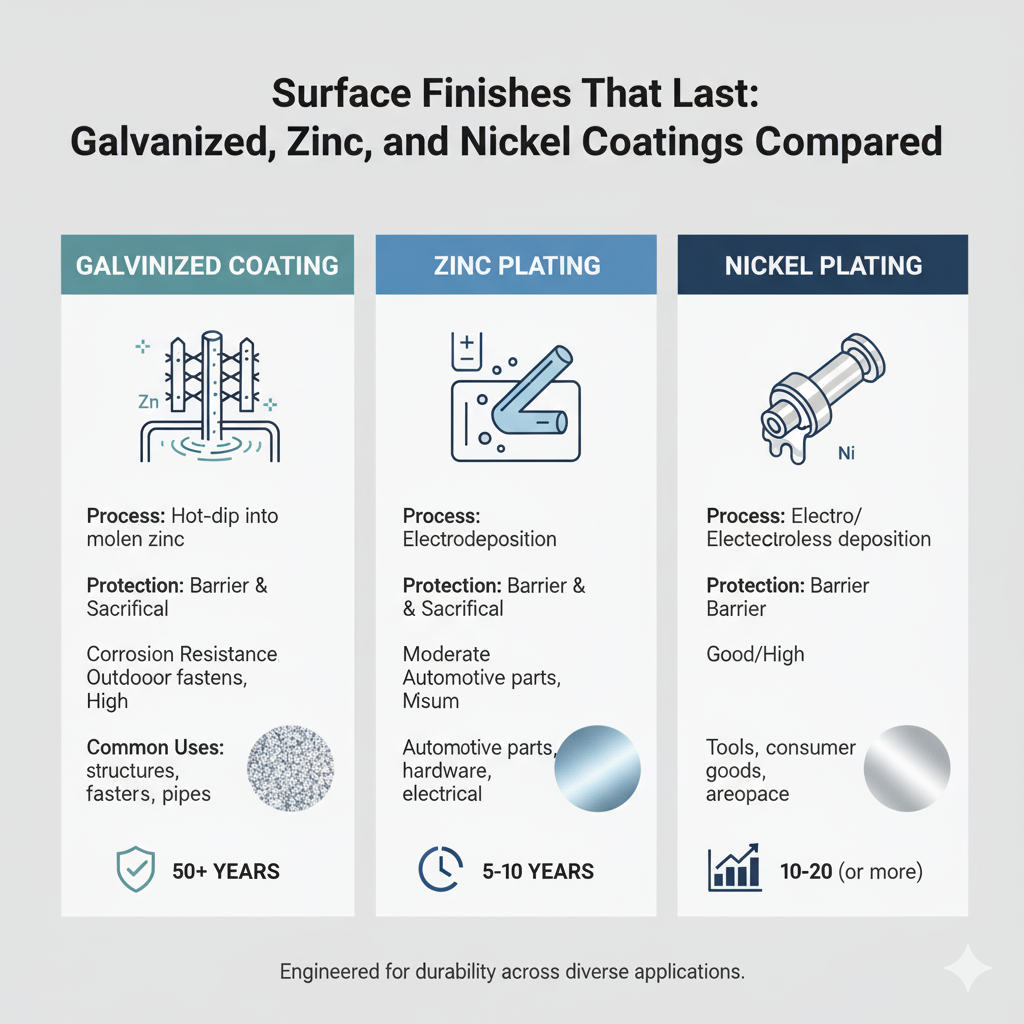
Surface Finishes That Last: Galvanized, Zinc, and Nickel Coatings Compared
Why Surface Finishes Define Component Longevity
A metal part’s performance isn’t just about its material strength—it’s about how well it resists time, moisture, and chemistry.
In fasteners, precast inserts, and CNC-machined components, surface finishing often decides whether a structure lasts decades or degrades in months.
Environmental exposure—from humidity and salt to industrial pollutants—creates a battlefield for corrosion. Coatings serve as both armor and shield, protecting the underlying metal while influencing appearance, conductivity, and maintenance cycles.
That’s why understanding the difference between galvanized, zinc, and nickel coatings isn’t cosmetic—it’s strategic engineering.
Coating Mechanisms: What Actually Happens Beneath the Surface
Though all three coatings share a protective purpose, their chemistry and bonding methods differ dramatically.
| Coating Type | Process Mechanism | Bonding Strength | Primary Function |
|---|---|---|---|
| Galvanized | Hot-dip immersion forms zinc-iron alloy layers | Metallurgical bond | Heavy-duty corrosion protection |
| Zinc Plating | Electrolytic deposition of zinc | Electrochemical adhesion | Decorative + short-term protection |
| Nickel Coating | Electroplating or electroless chemical deposition | Chemical + mechanical | Wear resistance, aesthetics, conductivity |
In principle:
-
Galvanizing acts like armor plating—it sacrifices itself through oxidation, protecting the steel beneath.
-
Zinc plating offers a thinner barrier, ideal for indoor or controlled environments.
-
Nickel coatings emphasize hardness and smoothness, often used where appearance and abrasion resistance matter.
Performance and Durability: Beyond First Impressions
In the lab, all coatings appear shiny and uniform. In the field, their differences become pronounced.
Galvanized Coating: Built for Extremes
Hot-dip galvanizing produces layers up to 80–100 μm thick, ensuring years of corrosion resistance. The zinc-iron intermetallic layer forms a barrier that actively corrodes instead of the steel, extending lifespan in outdoor and marine environments.
Ideal for:
-
Structural bolts and anchors
-
Precast accessories in humid or coastal zones
-
Long-term outdoor applications
Zinc Plating: Lightweight Protection
Zinc plating is thinner—typically 5–25 μm—and suitable for hardware not exposed to constant moisture. It’s commonly used for automotive interiors, indoor fixtures, and electronics housings, where aesthetic finish and low cost matter more than heavy-duty protection.
Ideal for:
-
Electrical housings
-
Furniture and appliance hardware
-
Standard bolts and nuts for dry environments
Nickel Coating: Precision and Presentation
Nickel coatings serve dual roles—functional and decorative. They offer moderate corrosion resistance but exceptional surface hardness, reducing wear on precision-machined parts. In CNC applications, nickel-plated fasteners maintain dimensional tolerance under friction and load.
Ideal for:
-
CNC machined precision fittings
-
Decorative metal components
-
Components requiring low-friction surfaces
Corrosion Resistance and Field Behavior
A controlled salt spray test (ASTM B117) offers quantitative comparison:
| Environment | Galvanized | Zinc-Plated | Nickel-Coated |
|---|---|---|---|
| Humid (48h) | Minor dulling | White rust visible | Stable finish |
| Marine (240h) | Minimal rust | Heavy corrosion | Moderate pitting |
| Industrial (480h+) | Excellent | Poor | Moderate |
According to the American Galvanizers Association, galvanized coatings can last over 50 years in rural conditions and 20–25 years in coastal regions before first maintenance. Zinc and nickel, while effective in specific contexts, can’t match that longevity in outdoor use.
Balancing Cost, Application, and Performance
The challenge for engineers isn’t choosing the best coating—it’s choosing the right one.
| Criteria | Galvanized | Zinc-Plated | Nickel-Coated |
|---|---|---|---|
| Cost | Moderate | Low | High |
| Aesthetic Appeal | Matte gray | Bright silver | Mirror-like |
| Durability | 20–50 years | 1–5 years | 5–10 years |
| Best Use Case | Structural hardware | Indoor fasteners | Precision components |
For large-scale construction, galvanized finishes deliver unmatched ROI.
For OEM assembly lines, zinc plating’s flexibility and low cost make it ideal.
For industrial-grade CNC components, nickel coatings combine protection with technical finesse.
Selecting the Right Finish for Industrial Projects
Choosing a coating shouldn’t rely on supplier preference—it should start with environmental mapping and performance goals.
Practical evaluation checklist for engineers:
-
Operating Environment: Humidity, salt exposure, chemical contact
-
Required Service Life: 5, 10, or 25 years
-
Mechanical Stress: Friction, vibration, or static load
-
Aesthetic Requirements: Gloss, color consistency, or reflectivity
-
Maintenance Cycles: Accessibility for re-coating or replacement
When specifications align with application, surface finish becomes a controlled variable—not a hidden risk factor.
Common Questions About Metal Coatings
Q1: Can zinc plating be used outdoors?
Only in dry, mild environments. For long-term outdoor exposure, galvanized coatings are far more reliable.
Q2: What’s the difference between electroless and electrolytic nickel plating?
Electroless plating produces uniform thickness and better corrosion resistance—ideal for complex geometries.
Q3: Are galvanized coatings environmentally safe?
Yes, modern galvanizing processes comply with RoHS and REACH standards, minimizing zinc runoff and energy waste.
Q4: Can coatings be combined?
Yes, hybrid coatings (e.g., zinc-nickel alloy) offer balance between cost, corrosion resistance, and finish quality.
Engineering Longevity Through Material Science
A finish isn’t just a final touch—it’s an engineered solution.
Whether the goal is decades of outdoor durability, aesthetic precision, or tight CNC tolerances, the right coating transforms performance from the surface inward.
At Jingle, every fastener, insert, and machined component is finished under controlled standards to ensure consistent adhesion, corrosion resistance, and lifespan.
Explore our engineered solutions at the homepage or connect with our specialists through the contact page for project-specific recommendations.