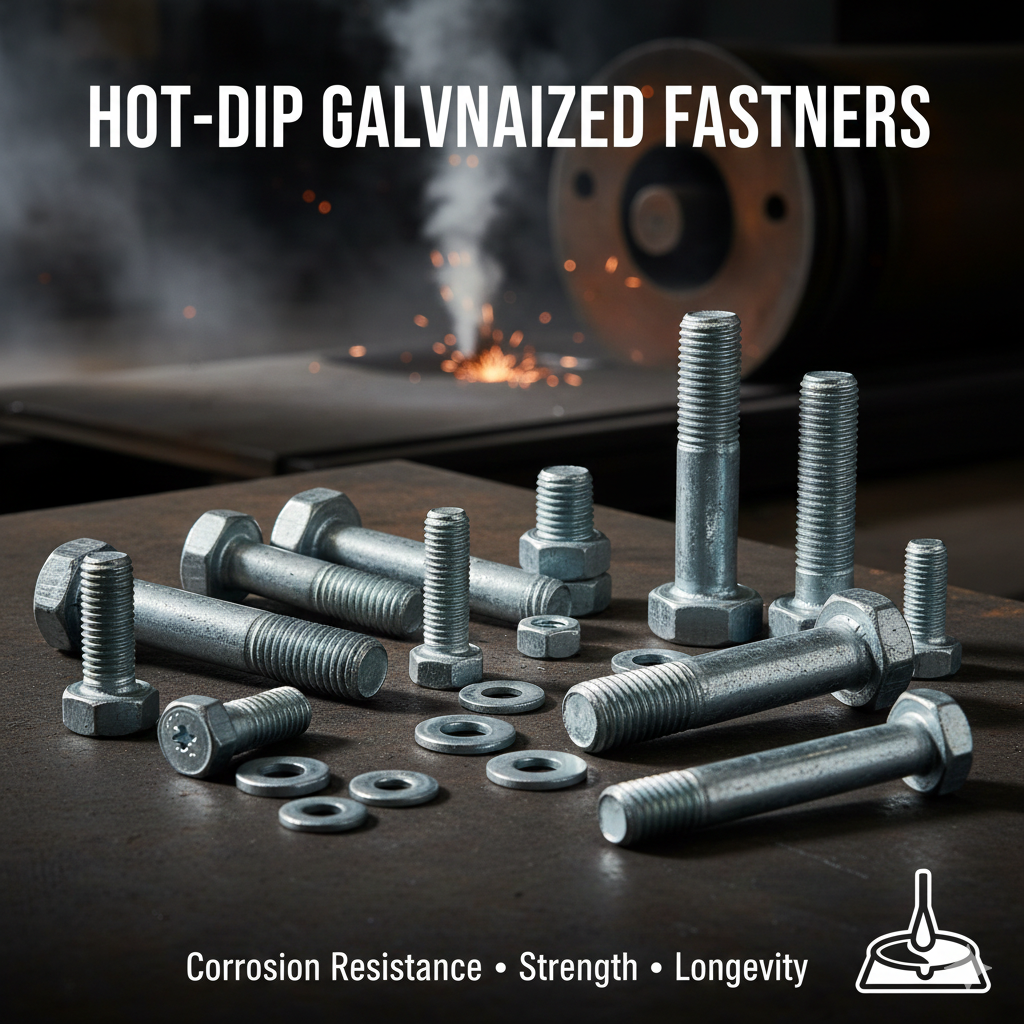
Hot Dip Galvanized Fasteners: How Coating Decisions Affect Structural Performance
In structural projects, fasteners rarely fail because corrosion appears too early.
They fail because clamp force is inconsistent, threads bind during installation, or preload relaxes after tightening. These problems often surface long before any visible rust.
Hot dip galvanized fasteners are widely specified to avoid long-term corrosion, but the galvanizing process itself changes how a fastener behaves mechanically. When coating decisions are made without considering thread geometry, torque behavior, and load transfer, corrosion resistance is gained at the expense of structural reliability.
This trade-off is rarely obvious on drawings. It becomes visible on site.
Why Galvanizing Changes Fastener Behavior More Than Expected
Hot dip galvanizing immerses steel fasteners into molten zinc, forming a metallurgically bonded coating that is significantly thicker than electroplated finishes. Typical coating thickness ranges from 50 to 100 microns, depending on steel chemistry and process control.
That thickness does not sit passively on the surface. It changes thread engagement, friction coefficients, and the relationship between applied torque and achieved preload. As a result, two fasteners that look identical on paper may behave very differently during installation.
This is the first point where many projects lose control.
Thread Allowance Is the Hidden Structural Variable
Unlike black or lightly plated fasteners, hot dip galvanized fasteners cannot rely on standard thread tolerances. Zinc buildup on thread flanks increases interference, especially on coarse threads used in structural applications.
If allowance is not designed into the system, installers encounter resistance during tightening. The common response is to apply more torque. That action increases friction, not clamp force.
| Thread configuration | Typical outcome in field installation |
|---|---|
| Standard thread, no allowance | Binding, uneven tightening |
| Oversized bolt only | Unstable preload |
| Matched oversized bolt + nut | Predictable assembly behavior |
This is why experienced suppliers treat hot dip galvanized fasteners as matched systems, not interchangeable hardware.
Torque Does Not Equal Tension in HDG Fasteners
Structural design assumes clamp force, not torque.
Hot dip galvanizing disrupts that relationship.
Zinc has a higher and more variable friction coefficient than bare steel. This widens torque scatter and reduces preload predictability.
| Fastener condition | Typical torque-to-tension variation |
|---|---|
| Black steel | ±10–15% |
| Electro-galvanized | ±15–20% |
| Hot dip galvanized | ±25–35% |
In high-load connections, this variation directly affects joint performance. Without adjusted installation procedures, designers may unknowingly accept preload ranges far outside their assumptions.
Coating Thickness Alone Does Not Guarantee Service Life
Hot dip galvanizing is highly effective in outdoor exposure, but corrosion resistance depends on environmental context, not zinc thickness alone.
| Exposure environment | Typical HDG service life |
|---|---|
| Rural atmosphere | 40–70 years |
| Urban / industrial | 20–40 years |
| Marine / coastal | 10–25 years |
Over-specifying zinc thickness without addressing drainage, crevice exposure, or dissimilar metal contact often increases cost without proportionally extending service life.
Where Cost Actually Escalates in HDG Fastener Projects
Hot dip galvanized fasteners are often chosen to reduce maintenance.
Unexpected cost usually appears elsewhere.
Common escalation points include:
-
on-site re-tapping due to thread mismatch
-
nut replacement after galling
-
inconsistent preload requiring retightening
-
installation delays caused by binding
In large structural projects, these secondary effects can increase total fastener-related cost by 15–30%, largely through labor rather than materials.
Customization Magnifies Galvanizing Risk Without Process Control
Customization is common in structural fasteners: special lengths, non-standard diameters, specific strength grades, or project-matched nut sets.
Each customization increases sensitivity to galvanizing variables. Without controlled process sequencing—thread cutting, galvanizing, inspection, and matching—risk shifts downstream to installation crews.
Manufacturers such as Jingle manage hot dip galvanized fasteners as engineered systems, aligning material selection, thread design, and coating control so corrosion protection does not undermine structural performance.
Where Hot Dip Galvanized Fasteners Make Sense
When specified and executed correctly, HDG fasteners are well suited for:
| Application | Structural requirement |
|---|---|
| Structural steel frames | Long-term outdoor exposure |
| Precast concrete connections | Embedded corrosion protection |
| Solar mounting systems | Atmospheric durability |
| Bridges and guardrails | Limited maintenance access |
| Infrastructure projects | Extended service life |
In these applications, correct system-level specification matters more than zinc thickness alone.
Common Buyer Questions
Q1: Why do HDG bolts feel tight before reaching design torque?
Because zinc coating increases thread friction. Higher torque does not translate proportionally into clamp force.
Q2: Can standard nuts be used with HDG bolts?
This often leads to binding or unstable preload. Matched bolt–nut systems are strongly recommended.
Q3: Is thicker zinc always better for corrosion resistance?
No. Beyond a certain range, thicker coating increases assembly risk and cost without proportional durability gains.
Conclusion
Hot dip galvanized fasteners deliver corrosion protection, but structural performance depends on how galvanizing interacts with threads, preload behavior, and installation practices. When coating decisions are treated as system-level engineering choices rather than surface treatments, both durability and reliability improve.
For an overview of structural fastener solutions and galvanizing-ready components, visit the
👉 Jingle Home Page
For projects involving drawings, specifications, or active construction schedules where fastener performance and installation reliability matter, early technical discussion helps prevent costly field adjustments later:
👉 Contact Jingle