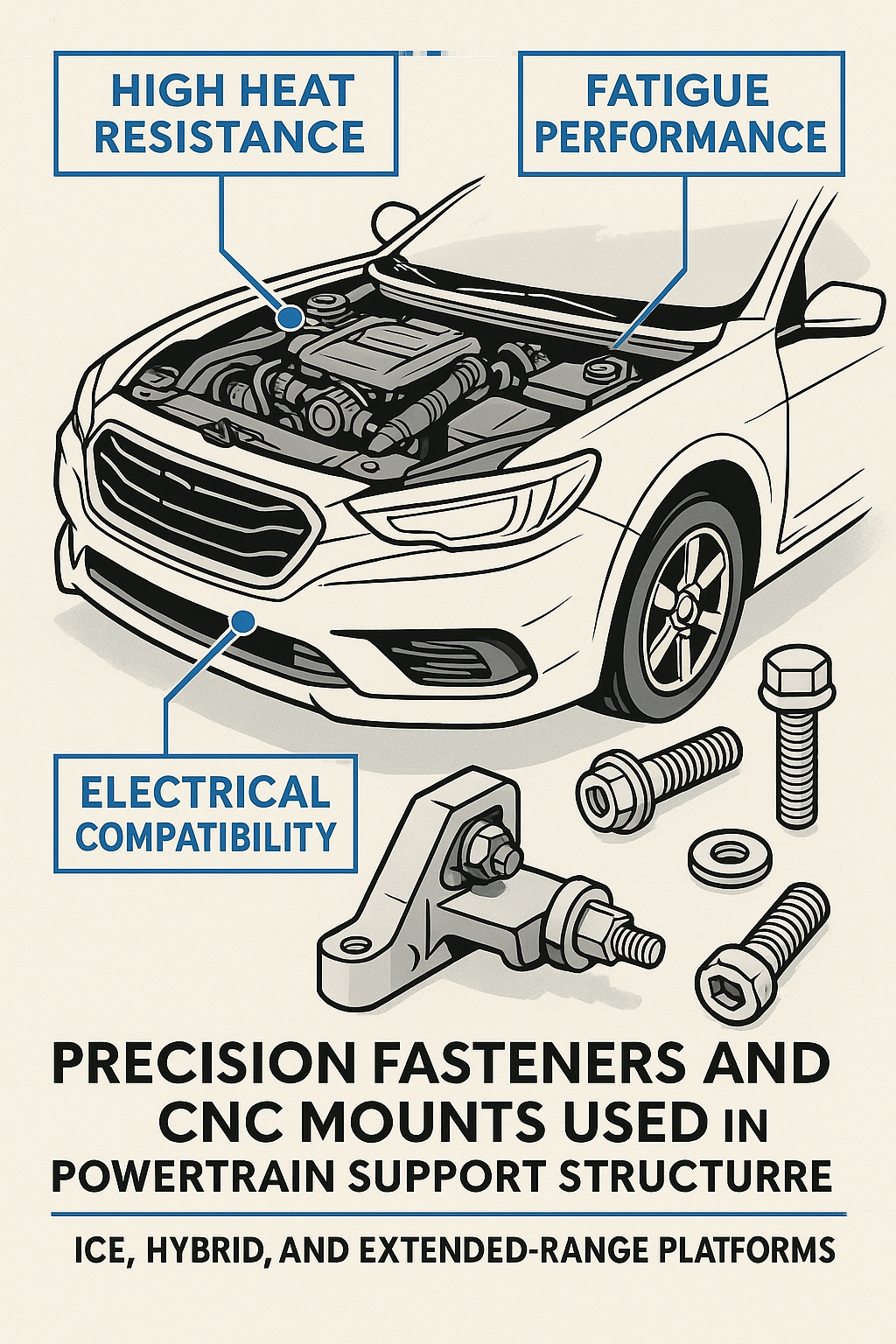
Fastener Solutions for Powertrain and Engine Bay Components
Under the Hood, the Standards Are Higher
Powertrain zones—engine mounts, transmission housings, and bracket structures—are among themost punishing environments in a vehicle. Components must handle:
-
High temperatures(up to 150–200 °C)
-
Persistent vibration and torsional stress
-
Chemical exposure from oil, coolant, salt spray
-
Long-term fatigue over tens of thousands of cycles
In a 2023 survey by SAE,48% of fastener-related recallsin ICE vehicles involved engine bay or suspension failure points—often due to torque loss, corrosion, or crack initiation.
Key Engineering Challenges in Powertrain Fastening
| Challenge | Cause | Risk |
|---|---|---|
| Thermal loosening | Bolt expansion at high heat reduces clamp load | Seal leakage, rattle, fatigue |
| Fretting corrosion | Metal contact with micro-motion | Material degradation, misalignment |
| Torque decay | Thread galling or surface instability | Inconsistent preload, NVH issues |
| Fatigue cracking | High load repetition | Sudden structural failure |
Use Case: Turbocharger Bracket & Exhaust Support
A performance SUV supplier struggled with fastener deformation and torque loss on its turbo bracket bolts. This affected heat shield positioning and NVH insulation.
JINGLE’s Solution
-
High-temp fastenersmade from 12.9-grade alloy steel with MoS2 dry-film coating
-
Lab testing at 200 °C under cyclic shear loading
-
Verified performance via torque-tension-retention simulation
Result: Torque retention >90% after 1,000-hour thermal cycling; NVH complaints dropped 73% post-upgrade.
Use Case: CNC Transmission Mounting Plates
A drivetrain assembly program in Europe requiredCNC-machined transmission bracketswith multi-hole patterns and asymmetric bosses for an eDCT hybrid setup.
JINGLE’s Response
-
CNC 5-axis milledpowertrain componentsfrom 7075-T6 aluminum
-
Custom fixturing for shape repeatability; tolerances ±0.01 mm
-
Surface: black anodized + anti-electrochemical barrier finish
Result: Zero part rejection in trial batches; passed OEM 1000h vibration/temperature bench test.
Why Powertrain Engineers Choose JINGLE
| Feature | Benefit |
|---|---|
| ISO/TS16949 certification | Meets global OEM audit protocols |
| MoS2, Zn-Ni, and PTFE coatings | Protects from heat + fluid contact |
| ±0.01 mm CNC tolerance | Prevents alignment or shift in multi-bolt assemblies |
| 10⁶-cycle fatigue testing | Validates true lifecycle integrity |
| Traceable lot stamping | Simplifies service parts or warranty recovery |
Design Tips for Engine Bay Fastener Success
-
Use fine-thread, coated boltsto mitigate thermal loss and vibration
-
Select alloy grades tested above 150 °C
-
Design mounting plates with expansion compensationfor heat fluctuation
-
Verify torque retention under thermal + mechanical load
-
Specify salt spray & chemical resistance coatingsnear fluid paths
Build Safer, Quieter, and Stronger Engine Systems
Powertrain reliability begins with the right components—especially fasteners and mounts. With JINGLE, you get:
-
Heat-validatedengine bay bolts
-
CNC bracketsthat eliminate misfit and rework
-
Corrosion and fatigue protection
-
ISO-level traceability for every part
Whether you're securing turbo brackets, mounting transmissions, or optimizing drivetrain stiffness,JINGLE fasteners hold the line—literally and structurally.