Quick answer for buyers

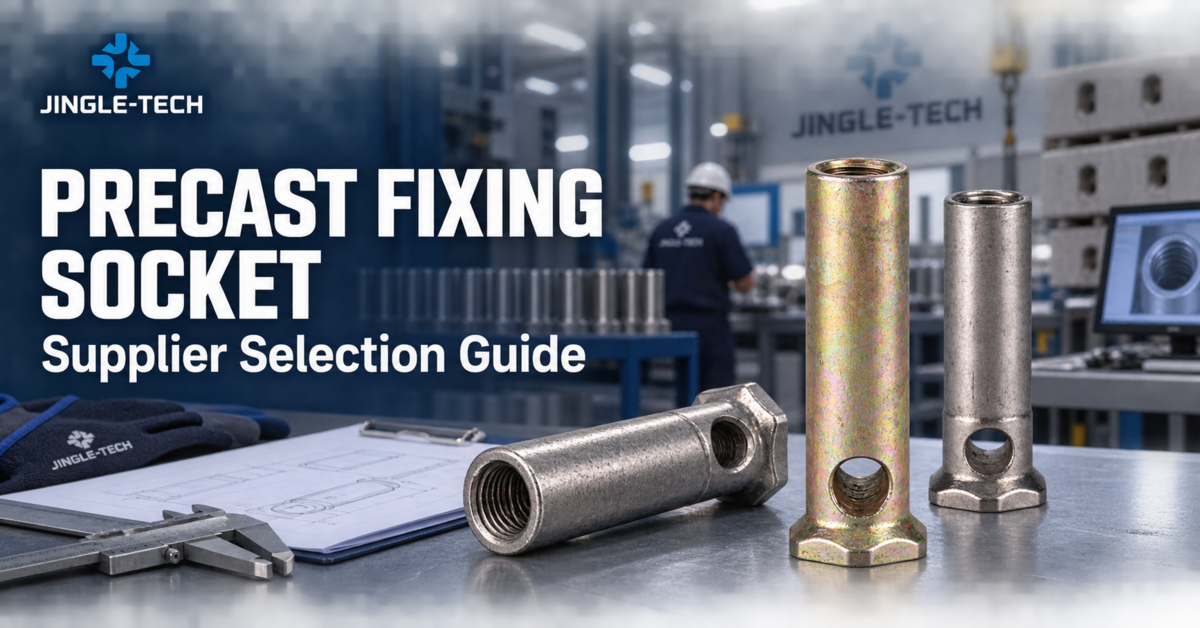
Choose a precast fixing socket supplier by checking the thread designation, socket depth, anchorage form, intended load path, concrete cover, finish, sample fit, traceability and packing method before you compare price. A fixing socket is a small part, but one wrong thread, short embedment, weak weld, blocked internal thread or mixed batch can hold up a precast project faster than many larger components.
For JINGLE Precast Accessories, a useful enquiry should include the drawing, socket thread, outside shape, anchor tail or cross bar requirement, finish, quantity, packing rule, sample request and inspection documents. If any value is still open, mark it clearly as [NEEDS JINGLE CONFIRMATION] instead of letting different suppliers guess.
Why this product needs a careful supplier check
A fixing socket normally sits inside the concrete unit and waits for the next trade: fixing brackets, façade supports, temporary attachments, service frames, handling fixtures or other project hardware. The person ordering it may not be the person installing it. That gap is where mistakes happen.
The common buyer problem is not only “bad quality.” It is unclear quality. A socket may look acceptable in a photo, but the actual job can fail at simple points:
- the bolt does not run smoothly into the internal thread;
- the socket position on the precast drawing does not match the site bracket;
- concrete paste blocks the thread because protection was weak;
- the anchorage tail is different from the approved sample;
- the finish changes from batch to batch;
- cartons arrive with mixed sizes and no clean label.
So the best supplier is not always the supplier with the most polished catalogue. The better choice is the precast fixing socket manufacturer that asks drawing questions early and keeps the approved version under control.
Confirm the exact function first
Do not start with the socket photo. Start with the function. Ask what the socket must do in the element and what will be connected to it later.
Use these questions during the first review:
- Is the socket for permanent fixing, temporary fixing, site alignment or installation support?
- Will the mating bolt be metric, Rd thread, inch thread or another project thread?
- Is the socket loaded in tension, shear, combined action or mostly used as a locating point?
- Is the socket near an edge, corner, opening or thin concrete section?
- Will the socket need a nail plate, plastic plug, magnetic former or other mould fixing aid?
- Does the project drawing show a required anchorage tail, cross bar, washer plate or deformed bar?
If the answer is not known, do not let the factory “choose a similar item.” Put the open point into the RFQ. That one habit saves arguments later.
Thread details matter more than the product name
Many products are called “fixing socket,” “threaded insert,” “fixing insert,” “concrete socket” or “precast socket.” The name is not enough for purchasing. The thread must be stated in a way the supplier, inspector and site team can all read the same way.
When the socket uses a metric thread, the drawing team may base the callout on the ISO metric thread family, including the general plan, basic dimensions and tolerance rules. For purchasing, the shop-floor lesson is plain enough: spell out the thread callout fully, and do not rely on a short nickname passed through email.
Ask your precast fixing socket supplier to confirm:
| Check item | What the buyer should ask |
|---|---|
| Thread type | Metric, Rd, inch or project-specific thread |
| Nominal size | Full designation, not a short nickname |
| Usable thread depth | Minimum usable depth after protection and finishing |
| Go/no-go method | Gauge or mating bolt method used before packing |
| Protection | Plastic plug, cap, foam, tape or another agreed method |
| After-finish fit | Thread fit after zinc plating, galvanizing or other coating |
The last point is easy to miss. A thread that feels good before finishing may feel tight after coating if the process allowance is not controlled.
Review the anchorage style, not only the socket barrel
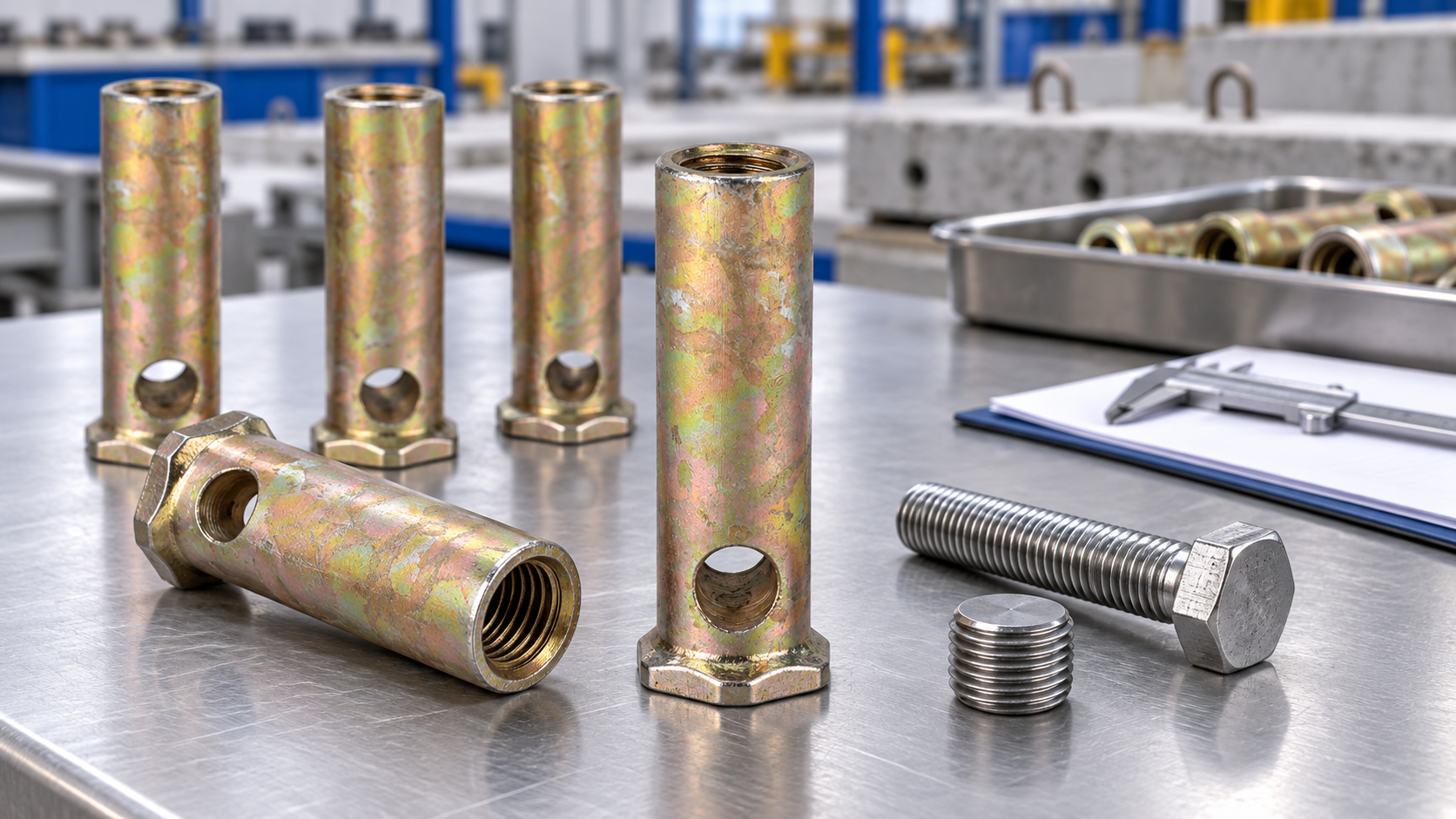
The internal thread gets most of the attention, but the anchorage is what transfers force into the concrete. Depending on the project, a fixing socket may use a deformed tail, bent bar, welded cross bar, plate, washer, hole, flange or special shape.
For buyer comparison, ask each supplier to show the same information:
- socket body length and outside geometry;
- anchorage tail length and orientation;
- cross bar or welded part size, if used;
- weld position and visual acceptance rule, if welding is used;
- bend location and bend direction, if a bar is formed;
- minimum concrete cover required by the design party;
- position tolerance needed in the mould.
Avoid approving a quote based only on “same as photo.” A photo can hide the rear anchorage, weld route and real thread depth.
Material and finish: keep the language project-specific
The right material depends on the drawing, exposure, load path and buyer specification. Do not invent a grade in the purchase order just because a supplier used it before. If the drawing already states the material, copy it exactly. If the drawing does not state it, write [NEEDS JINGLE CONFIRMATION] or ask the design team before final order.
The same rule applies to finish. A zinc plated socket, hot dip galvanized socket, black socket and stainless socket are not interchangeable just because the shape is similar. Finish can affect:
- corrosion resistance;
- thread fit;
- coating thickness around the mouth of the socket;
- appearance after storage;
- cost and lead time;
- inspection method.
For zinc or galvanized parts, ask how the supplier protects the internal thread and checks fit after finishing. That question is more useful than asking only for a beautiful surface photo.
Sample approval should copy real production conditions
A good sample is not a showroom piece. It should be made with the route planned for the order, or the supplier should explain the difference. When possible, ask for:
- one loose sample for measurement;
- one sample with thread protection installed;
- one sample packed as the bulk order will be packed;
- photos of the production route if the part includes welding, forming or assembly;
- a short inspection sheet with the critical checks.
When the sample arrives, check it like a site person would. Run the mating bolt by hand. Look for blocked thread, sharp burrs, poor mouth chamfer, damaged caps, wrong label and loose rust powder in the bag. These are ordinary checks, but they catch ordinary failures.
Factory questions that reveal control
You do not need a long audit form for every small socket order, but you do need a few focused questions. A reliable precast socket factory should answer them without turning the discussion into guesswork.
Ask:
- Which drawing revision will you quote and produce against?
- Which features are critical for your inspection?
- How do you verify internal thread fit?
- How do you prevent coating or concrete paste from blocking the socket?
- How are different sizes separated during packing?
- What photos or records can be supplied with the shipment?
- What will change if we move from sample to bulk order?
The answers show whether the supplier is thinking like a production partner or only a trader forwarding a price.
Packing is part of quality for threaded sockets
Threaded sockets are easy to damage in transport because the useful surface is inside the part. A carton may look fine from the outside while the socket mouths are dented, caps are loose or mixed sizes are rubbing together.
For export orders, define packing before price is final:
- quantity per bag, inner box and carton;
- whether sockets need caps or plugs installed;
- whether each size needs separate colour labels;
- whether cartons need product name, size, batch and gross weight;
- whether pallets need corner protection or moisture protection;
- whether the buyer needs photo confirmation before shipment.
If the project uses several socket sizes, clear labels are not a small detail. They protect the precast factory from placing the wrong insert in the wrong mould.
RFQ information for a clean supplier quotation
Send a practical RFQ instead of a short message like “quote fixing socket.” A useful RFQ lets every supplier quote the same part and keeps the later negotiation honest.
Include:
- product name: precast fixing socket / threaded socket / project name;
- drawing and revision number;
- thread designation and required usable thread depth;
- socket body length and outside form;
- anchorage tail, cross bar, plate or welded part requirement;
- material and finish, or
[NEEDS JINGLE CONFIRMATION]; - required samples and sample quantity;
- inspection items required before shipment;
- packaging method and label rule;
- order quantity and delivery destination;
- whether the socket is for lifting, fixing or another project function;
- any document requirement from the project.
If the socket is connected with lifting or erection work, the project engineer must apply the relevant project rules and safety requirements. For example, OSHA’s U.S. precast concrete construction rule includes minimum capacity factors for lifting inserts and lifting hardware used with precast members. Do not treat a catalogue socket as a lifting insert unless the complete approved system supports that use.
Comparison table for supplier selection
| Supplier check | Weak answer | Better answer |
|---|---|---|
| Drawing control | “Same as picture” | “We quote revision A2 and will mark it on the order” |
| Thread fit | “Standard thread” | “We check with the agreed gauge or mating bolt after finish” |
| Anchorage | “Normal tail” | “Tail length, bar direction and weld position follow the drawing” |
| Finish | “Zinc is fine” | “Finish and thread allowance need confirmation before bulk order” |
| Packing | “Export carton” | “Caps installed, size labels separated, carton label includes batch” |
| Documents | “Can provide” | “Inspection sheet and shipment photos are listed before order” |
The better answer is not always longer. It is more specific.
Common mistakes when sourcing fixing sockets
The most common mistakes are also the easiest to prevent:
- ordering by outside diameter while ignoring the internal thread;
- approving a sample without checking the mating bolt;
- changing the finish after sample approval without checking thread fit again;
- mixing several socket sizes in one carton without strong labels;
- accepting a substitute anchorage shape because it looks close;
- failing to tell the supplier whether the socket is for fixing, positioning or lifting-related use;
- leaving open items out of the purchase order.
Small inserts become expensive when they stop a casting bed or force workers to repair hardened concrete. A careful RFQ is cheaper than a site fix.
Where JINGLE can help
JINGLE can support buyers who need a structured discussion for precast fixing sockets, threaded sockets and related precast accessories. To keep the quotation accurate, send the drawing, thread detail, application, finish, quantity, packing expectation and any inspection or document request.
If you are not sure which detail is fixed and which detail is still open, send the available project information first. JINGLE can mark open points for confirmation instead of hiding them inside a vague quote.
FAQ
Is a fixing socket the same as a lifting socket?
Not always. A fixing socket may be used for attachments or positioning, while a lifting socket belongs to a controlled lifting system. Do not substitute one for the other unless the project design and approved system allow it.
What keyword should buyers use when searching for suppliers?
Use commercial terms such as “precast fixing socket supplier,” “precast fixing socket manufacturer,” “threaded socket supplier” or “OEM concrete fixing socket manufacturer.” Then send the drawing, because search terms alone cannot define the product.
Should I choose zinc plated or galvanized finish?
It depends on the project environment, drawing and thread-fit requirement. Confirm the finish before sample approval, and check the internal thread after finishing.
What is the easiest sample test?
Run the mating bolt into the socket by hand, check usable depth, look for burrs or blocked threads, and confirm that the anchorage shape matches the drawing.
What should be written on the carton label?
At minimum, use product name, size or thread, quantity, batch or order reference, and any project code required by the buyer. For mixed project orders, separate labels reduce mould-placement mistakes.