Quick answer for buyers

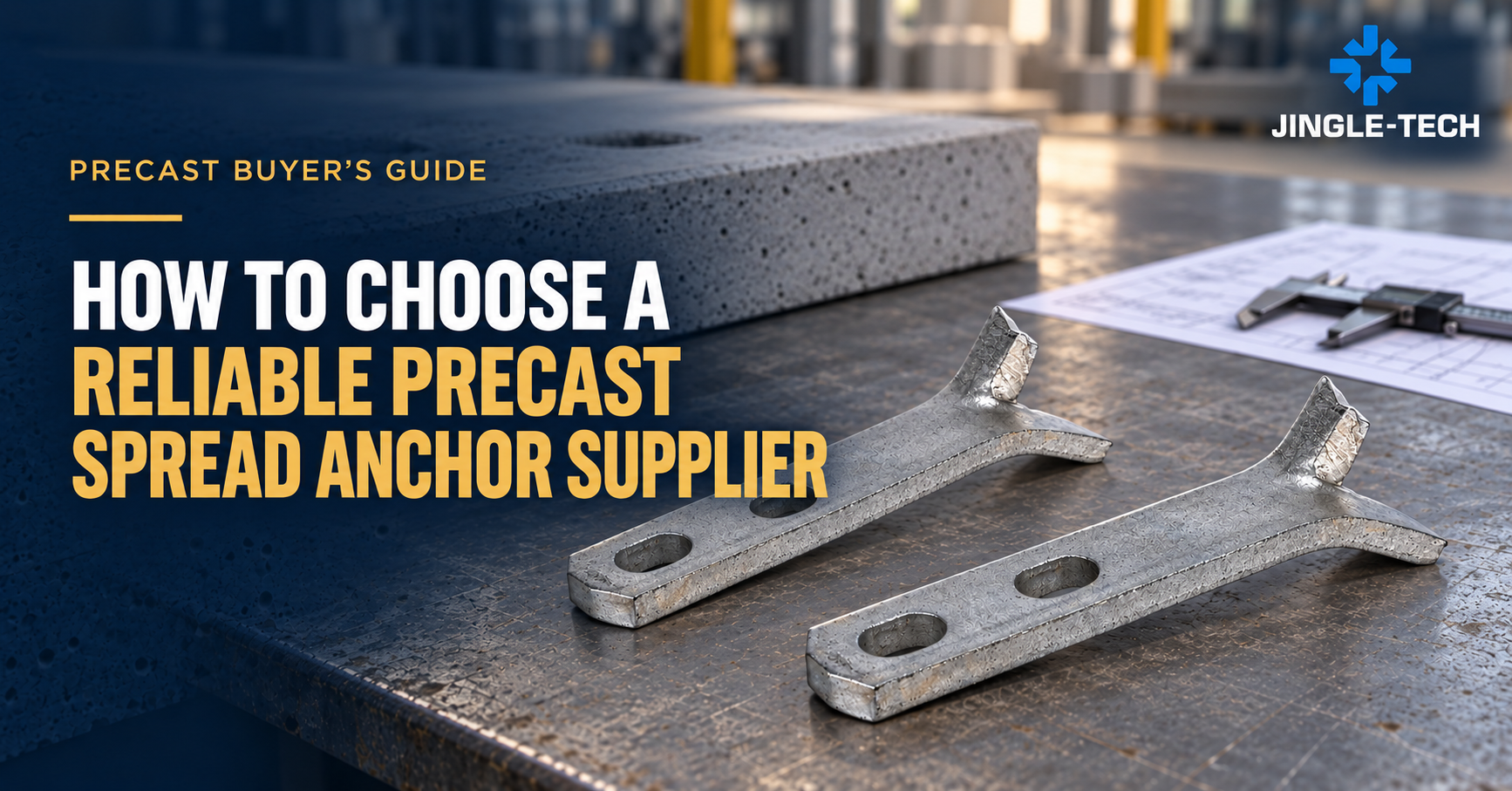
Choose a precast spread anchor supplier by checking the complete lifting system, not only the anchor shape. A spread anchor may look like a simple flat steel part, but the buying decision should include panel thickness, lifting direction, edge distance, concrete strength at lifting, reinforcement around the insert, compatible lifting device, marking, sample fit, packing and the project’s approved lifting plan.
For JINGLE Precast Accessories, a clean enquiry should include the drawing, anchor type, panel application, lifting direction, required system, surface finish, quantity, sample request, packing rule and document list. If a value is not confirmed, mark it as [NEEDS JINGLE CONFIRMATION] instead of letting the factory guess.
Why spread anchors need more detail than a photo
Spread anchors are often used where load must be spread into a relatively flat or thin precast element. That does not mean every flat anchor can be used in every panel. A small change in panel thickness, edge distance, lifting angle, concrete strength or reinforcement can change the way the anchor behaves.
The usual purchasing problem is simple. A buyer sends a photo and asks for “same anchor.” The supplier replies with a price. Nobody has confirmed the lift direction, matching clutch or socket, recess former, concrete strength at lift, additional reinforcement or edge conditions. The part may look close, but the lifting condition is still unclear.
For a safety-related anchor, unclear is not good enough.
Start with the lifting system
Before comparing prices, ask which lifting system the anchor belongs to. A spread anchor may need a certain clutch, lifting loop, recess former, socket or threaded lifting device. It may also need added reinforcement around the insert.
Ask the precast spread anchor supplier:
- Which anchor system is this product designed for?
- Which lifting device is compatible with it?
- Is the anchor for face lifting, edge lifting, turning, transport, erection or another operation?
- What lifting direction and angle range is allowed by the approved system?
- What concrete strength is required at the time of lifting?
- What minimum panel thickness, edge distance and spacing are required?
- What reinforcement is needed near the anchor?
If the supplier can only answer “standard type,” the discussion is not finished.
Confirm panel thickness and edge distance early
A spread anchor is often chosen because the precast element is flat, wide or thin. That makes panel geometry a first-order buying detail, not a later shop-floor issue.
Send the supplier:
| Drawing detail | Why it matters |
|---|---|
| Panel thickness | A thin element leaves less concrete around the anchor |
| Anchor location | Edge distance affects breakout and handling risk |
| Lift point layout | Several anchors may not share load equally |
| Recess or former detail | The lifting device must seat correctly |
| Concrete strength at lift | Early lifting strength can be lower than final strength |
| Nearby openings | Openings can weaken the local zone |
| Reinforcement layout | Bars may be needed to transfer or spread load |
Do not leave edge distance to a catalogue photo. Put the actual value on the RFQ.
Lifting direction changes the purchase discussion
A spread anchor may be used for demoulding, turning, transport or final erection. Those are different situations. The load path during stripping from the mould can be very different from a vertical site lift.
Before ordering, define:
- vertical lift or angled lift;
- face lift or edge lift;
- whether the unit will be rotated;
- whether suction, adhesion or mould friction is expected;
- whether the element will be lifted from flat storage;
- whether the same anchor will be used for more than one operation.
If the anchor is used for turning, ask for project engineering input. Do not assume that an anchor approved for one direction is automatically suitable for another.
Working load and safety evidence
A buyer should not infer capacity from anchor length, plate thickness or weight. Ask for the working load information and the conditions behind it. Those conditions may include concrete strength, embedment, edge distance, reinforcement, lifting direction and compatible hardware.
OSHA 29 CFR 1926.704 gives capacity-factor requirements for lifting inserts and lifting hardware used with precast concrete. The buyer’s practical takeaway is that lifting inserts and lifting hardware need a documented capacity basis. They should not be treated as ordinary hardware.
Ask each spread anchor manufacturer for:
- rated load or working load information;
- the system or document used for that value;
- compatible lifting device;
- concrete strength requirement at lift;
- minimum dimensions and edge distances;
- reinforcement notes;
- inspection and marking details.
If these conditions are not supplied, the quote is not ready for approval.
Compare the anchor head, body and tail
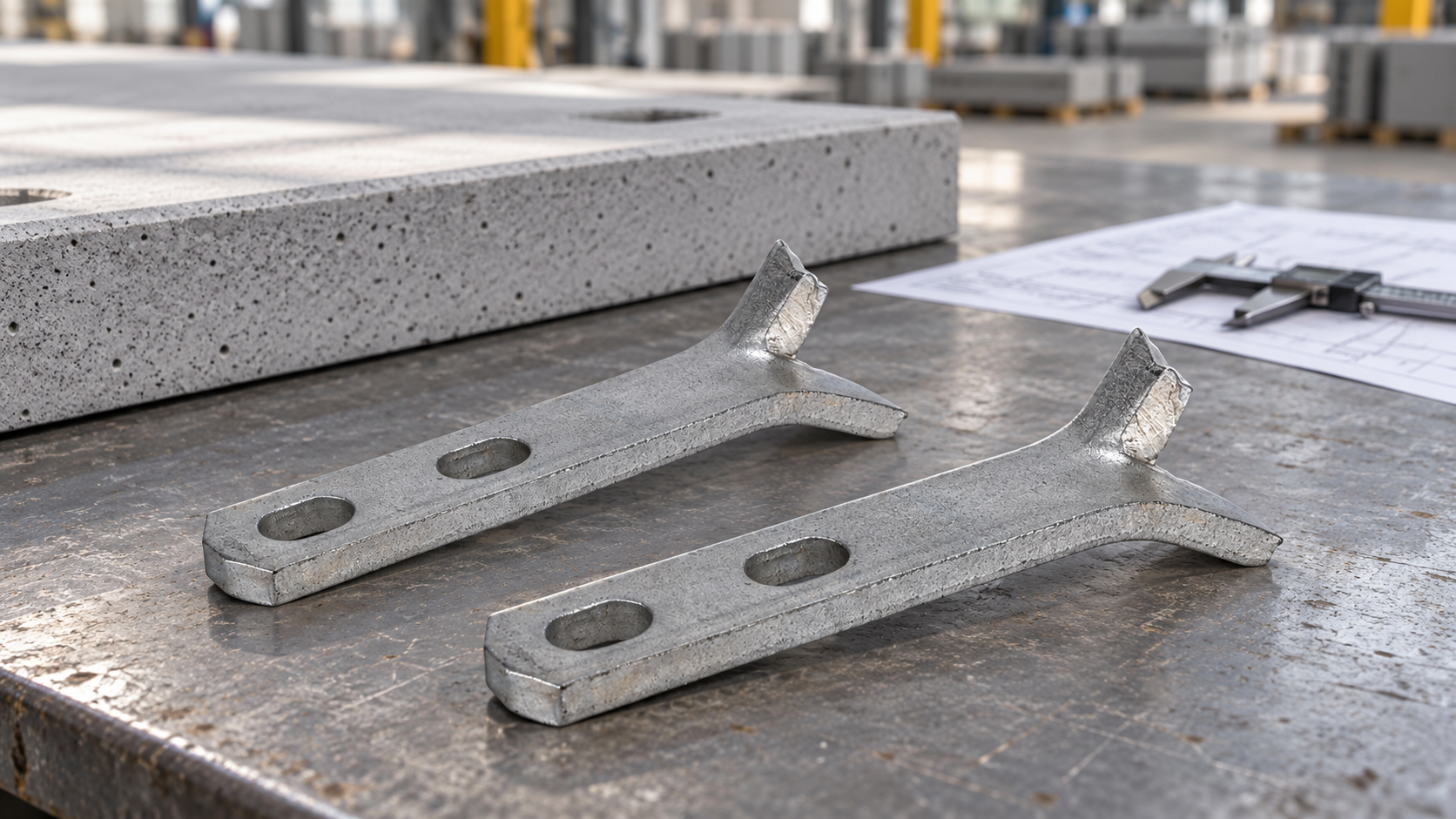
Spread anchors can differ at details that are easy to miss in photos. Compare the drawing, not only the overall length.
Check:
- head or engagement geometry;
- hole, slot or clutch contact area;
- body width and thickness;
- tail shape;
- bend radius, if formed;
- weld location, if assembled;
- surface finish and coating build-up;
- sharp edges and burrs;
- marking position.
If a supplier changes the tail shape to make production easier, the buyer should treat it as a new design. “Close enough” is not a safe purchasing rule for a lifting insert.
Sample approval should include fit and installation checks
A sample spread anchor should be checked in a way that reflects the job. Do not approve it only from a photo on a desk.
Use a sample checklist:
- Compare the sample with the approved drawing.
- Check the anchor head or engagement area.
- Test the compatible lifting device or former.
- Check marking readability.
- Inspect coating and burrs.
- Confirm packing protection.
- Take photos from the front, side, top and engaged position.
If a recess former or lifting clutch is part of the system, ask for the sample set, not just the anchor alone.
Marking and traceability
Marking helps the precast plant and site team avoid mix-ups. For spread anchors, the mark may be on the anchor body, tag, bag or carton. A physical mark on the anchor is often more useful than a loose paper label, but the exact method depends on the product and drawing.
Ask for:
- supplier or factory identification;
- size or load class where applicable;
- batch or lot reference;
- finish or material reference if needed;
- carton label with product name and quantity;
- separate packing for different sizes.
If several anchor types arrive together, poor labelling can create a mould-placement error before anyone notices.
Packing for export and precast plant use
Spread anchors may be flat, but they can still bend, scratch, rust or damage labels if packed loosely. Define packing before the order is placed.
Useful packing points:
- quantity per bundle, bag, carton or pallet;
- separation by size and type;
- rust prevention if the route or storage time requires it;
- edge protection for formed or coated parts;
- carton label format;
- batch list or packing list;
- photos before shipment.
For a precast plant, clear packing saves time at the casting bed. Workers should not need to open every carton to find the correct anchor.
RFQ checklist for a reliable quotation
Send a structured RFQ to the precast spread anchor supplier:
- product name: spread anchor / flat steel anchor / lifting anchor;
- anchor drawing and revision;
- panel type and thickness;
- anchor location, edge distance and spacing;
- concrete strength at lifting;
- lifting direction and use stage;
- compatible lifting clutch, loop or device;
- finish and material requirement, or
[NEEDS JINGLE CONFIRMATION]; - reinforcement notes from the project;
- sample request and sample-fit requirement;
- marking and traceability requirement;
- packing and label rule;
- order quantity and delivery destination;
- documents required before shipment.
This makes the quotation more useful than a short “send price” message.
Supplier comparison table
| Supplier answer | Buyer risk | Better response |
|---|---|---|
| “Same as picture” | No system confirmation | Ask for drawing, system and compatible lifting device |
| “Any panel is OK” | Geometry ignored | Ask for panel thickness and edge distance |
| “Capacity is enough” | No basis | Ask for WLL conditions and document basis |
| “No sample needed” | Fit not checked | Request sample with mating device or former |
| “Mixed packing is fine” | Site mix-up | Require size separation and carton labels |
| “Standard finish” | Thread or coating issue may be hidden | State finish and inspection method |
The better supplier gives conditions, not only a unit price.
When to stop and ask for engineering confirmation
Stop the purchase discussion and ask for clarification if:
- the anchor system is not identified;
- the lifting direction is unknown;
- edge distance is missing;
- concrete strength at lifting is not known;
- the supplier wants to substitute the shape;
- the compatible lifting device is unclear;
- the project requires additional reinforcement but the detail is missing;
- the anchor will be used for turning or special handling.
Those pauses feel slow during purchasing, but they are faster than fixing a casting or erection problem later.
Where JINGLE can help
JINGLE can help buyers prepare a clear enquiry for spread anchors, flat steel anchors and related precast lifting accessories. Send the drawing, panel details, lifting condition, compatible device, finish, quantity, sample needs, packing rule and document request.
If the project information is incomplete, JINGLE can keep the quotation open around [NEEDS JINGLE CONFIRMATION] items instead of hiding unknown values inside a price.
FAQ
Is a spread anchor the same as a flat steel anchor?
The terms can overlap in buyer language, but they should not replace the drawing. Use the project name, anchor drawing and compatible lifting device to define the product.
Can I choose a spread anchor by panel weight only?
No. Panel weight is only one part of the check. Panel thickness, edge distance, lifting direction, concrete strength and reinforcement also matter.
What should I ask a spread anchor manufacturer first?
Ask which lifting system the anchor belongs to, which lifting device is compatible, and what conditions apply to the stated working load.
Do I need a sample?
For a new supplier, new drawing or changed finish, a sample is strongly recommended. Check fit, marking, coating, burrs and packing before bulk order.
Why should packing be specified?
Different anchor sizes can look similar in a busy precast plant. Clear packing and labels reduce the chance of placing the wrong anchor in a mould.