A request for “stainless steel bolts and nuts” looks complete until quotations arrive. One supplier offers 304, another writes A2-70, a third proposes 316 without a property class, and a fourth simply promises “marine grade.” The prices cannot be compared because the technical baselines are different. More importantly, none of those short descriptions tells a buyer how the fastener will behave in a chloride deposit, a wet crevice, a hot assembly, or a joint tightened repeatedly during maintenance.
This guide is written for importers, OEM engineers, distributors, project buyers and quality teams evaluating a stainless steel fasteners supplier. It turns an imprecise material request into a quote-ready package covering the applicable fastener standard, stainless grade, property class, thread, passivation, surface condition, mating materials, installation method, inspection evidence and export packing.The aim is not to choose one alloy for every project. The aim is to ask enough good questions that the selected material and supply route can be defended.
The buyer still owns the application decision. Product selection must follow the controlled drawing, governing specification, service environment and approval of the responsible engineer. A supplier can explain options and manufacture to an agreed requirement, but a catalog photograph cannot establish corrosion life, joint capacity or regulatory suitability.
Send Your Stainless Fastener RFQ →
The short answer: what should a buyer verify first?
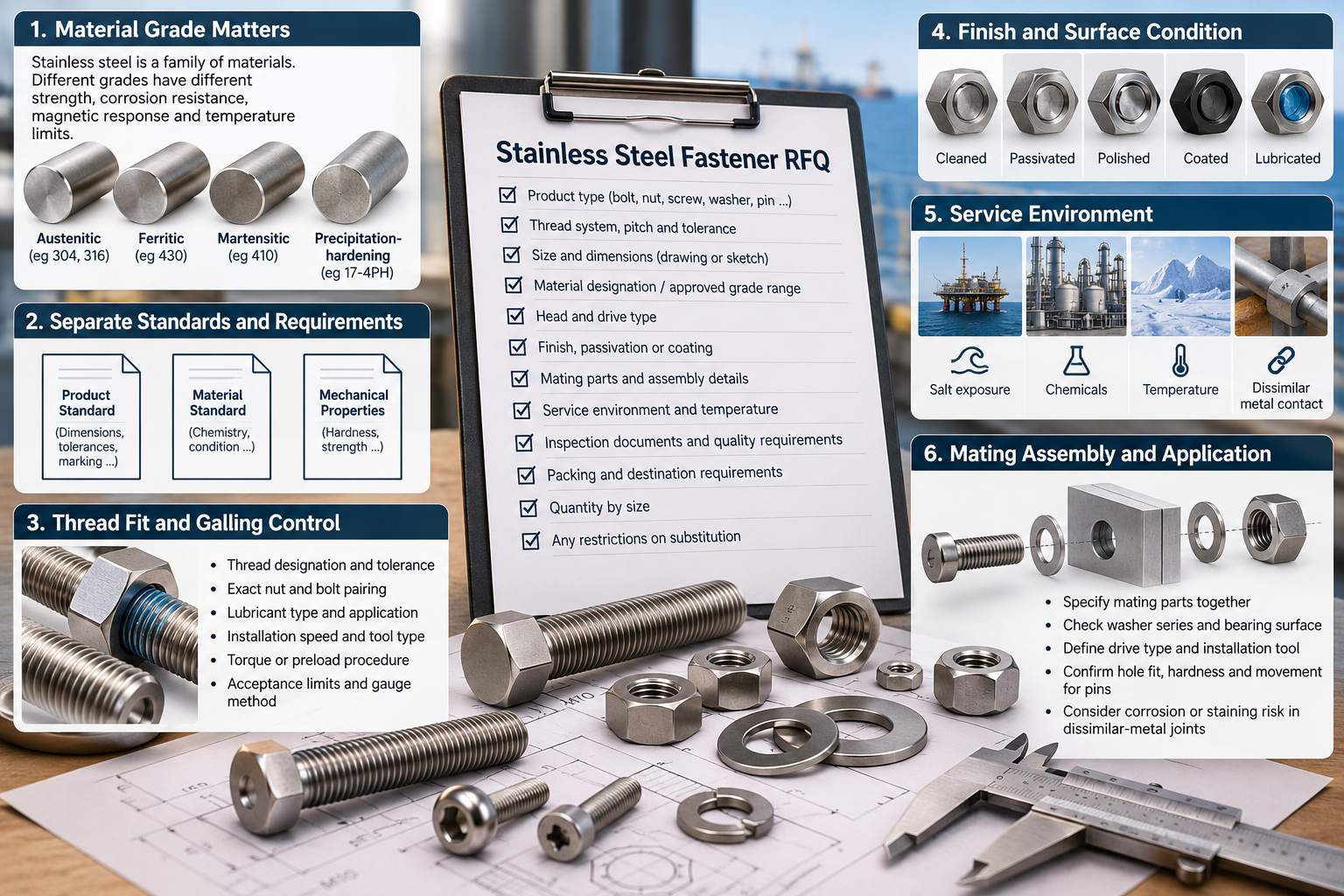
Begin with the joint and its exposure. Then define the product.A useful first inquiry answers the following questions before price is treated as firm:
- What does the fastener hold, and what failure would stop the customer’s operation?
- Which dimensional and mechanical standard, edition, drawing and revision govern?
- What stainless fastener grade and property class are required?
- What fluids, salts, cleaning agents, temperatures and wet/dry cycles reach the joint?
- Which metals, sealants, washers and coatings touch the stainless part?
- Is passivation, cleaning, electropolishing, lubrication or another finish specified?
- How will threads be gauged and the joint tightened without galling?
- Which material, mechanical, dimensional and surface records must follow the lot?
- How will pieces, cartons and pallets preserve identity through sea shipment?
- What are the sample quantity, production quantity, annual demand and required date?
If the inquiry leaves these points open, a responsible stainless steel fasteners supplier should return a clarification list. Silence is not agreement. A quote can win the price column because nobody priced the unanswered work. The missing cost then returns as rework, a delayed inspection, seized threads, a document dispute or a material change discovered after sample approval.
Keep 304/316 and A2/A4 on separate RFQ lines
In everyday emails, buyers often write 304 when they mean A2, or 316 when they mean A4. That gets the first call moving. It should not survive unchanged into the purchase order. “304” and “316” are familiar alloy-family descriptions used under particular material systems. A2 and A4 are stainless fastener grade groups used within the ISO 3506 series. The fastener designation also includes a property class or hardness class, depending on the product.
When the ordered item is a bolt, screw or stud, review the scope of ISO 3506-1:2020. Nuts are handled separately in ISO 3506-2:2020, which includes their grade and property-class framework. Read together, the two documents make the distinction procurement needs: material group is one requirement and finished-fastener mechanical classification is another. An order that says only “stainless steel 304” can leave the second line blank.
The reverse mistake also occurs. An order may state A4-80 but omit the product standard, size limits, service temperature, surface treatment or chemistry restrictions required by the project. A designation can be correct inside its standard and still be incomplete for an actual assembly.Stainless fastener selection must connect the material, manufacturing route, mechanical properties, geometry, exposure and installation conditions.
| RFQ field | What it controls | Common incomplete entry |
|---|---|---|
| Fastener standard | Dimensions,product form and referenced requirements | “DIN bolt” |
| Stainless grade | Fastener material group and permitted composition route | “stainless” |
| Property class | Specified mechanical performance of the finished fastener | “304 strength” |
| Chemistry requirement | Any project-specific alloy or elemental restriction | Assumed from appearance |
| Surface condition | Cleaning, passivation, polish, lubricant and contamination control | “plain” |
| Acceptance evidence | How the stated material and performance will be verified | “certificate available” |
For a new source,ask the quotation to repeat every one of these fields. The response becomes much easier to compare. It also exposes where the supplier is proposing an alternative instead of quietly substituting a familiar stock grade.
Select stainless steel from the real exposure
“Outdoor” and “marine” are not test conditions. A fastener on a covered inland enclosure sees a different environment from a bolt in a tidal splash zone. A food-processing line washed daily with chloride-containing chemicals is different again. The specification should describe what contacts the joint, how long it stays wet, whether deposits are cleaned away, and whether a crevice traps solution around the washer or under the head.
Useful exposure inputs include chloride concentration, humidity, temperature, immersion or splash frequency, cleaning chemistry, pH, expected deposits, maintenance interval, contact metals and desired service life. If those values are unknown, describe the location and operating cycle honestly. A vague but truthful description is better than a confident alloy label copied from another project.
For the material-selection side of the file, consult ISO 3506-6:2020. It is the general-rules companion for stainless steels and nickel alloys used in fasteners, and it sits beside the product-specific ISO 3506 parts rather than replacing them.The layout is useful for buyers: corrosion-related grade selection and the finished part’s mechanical requirements must meet in the same approval record.
| Service question | Why procurement needs the answer | Evidence or decision |
|---|---|---|
| Is chloride present? | Chloride can drive localized attack, especially in deposits and crevices. | Record source, concentration range and wetting cycle. |
| Can water drain and surfaces dry? | Joint geometry may be more severe than open-panel exposure. | Review washer, gasket, recess and thread geometry. |
| What metal touches the fastener? | A conductive wet interface can create galvanic concerns. | Define isolation, coating and drainage details. |
| Will the joint run hot, cold or through repeated cycles? | Temperature can alter the fastener, lubricant, seal and corrosion response. | State minimum, maximum and duration, not one nominal value. |
| How is the joint cleaned? | Cleaning agents and trapped residues may govern alloy choice. | List chemicals, concentration, temperature and rinse practice. |
| Will the joint be reopened? | Repeated assembly increases thread damage and galling risk. | Approve lubricant, replacement rule and installation method. |
Avoid turning this table into a false alloy selector. It is a discovery tool. The final grade belongs on an approved drawing or purchase specification after the responsible technical team reviews the complete environment and joint.
Pitting, crevice and galvanic risks deserve separate questions
A stainless fastener can look clean on the exposed head while a hidden interface deteriorates. Pitting is localized attack.Crevice corrosion develops in shielded areas where the local chemistry differs from the freely exposed surface. A washer edge, gasket, deposit, blind hole or thread root can create the geometry. Galvanic effects may matter when dissimilar metals remain electrically connected in an electrolyte. Calling all three problems “rust” hides the mechanism that should drive the design review.
The supplier needs enough assembly context to flag obvious conflicts. Name the receiving material: carbon steel, a galvanized member, aluminum or another stainless grade. Then show what sits under the head and washer. Paint damaged during tightening, water held beneath a flange and conductive sealant between unlike metals all change the discussion. A part number alone reveals none of this.
Laboratory work is useful when its result answers a defined purchasing question. Start with the decision, then choose the test. The current ASTM B117 page describes a controlled salt-fog environment for relative corrosion-resistance information; it also notes the weak stand-alone correlation with natural exposure. Treat chamber hours as test evidence under stated conditions, not as a calculator that prints years of outdoor life.
Passivation is a controlled process, not a decorative finish
Stainless steel protects itself through a passive surface film, but manufacturing can leave scale, shop soil, embedded iron or residues that need attention. Passivation is not paint and does not make the wrong alloy suitable for every exposure. It is a defined treatment applied to a properly prepared surface, followed by rinsing and an agreed verification method.
ISO 16048:2003, confirmed current in 2024, specifies commonly used passivation methods for corrosion-resistant stainless steel fasteners. For ASTM-based projects, ASTM A967/A967M-25 covers several chemical and electrochemical passivation treatments and alternative tests for treatment effectiveness. The buyer should name the governing document, treatment type if required, surface preparation, lot definition, acceptance test and documentation.
Do not specify passivation with a sentence such as “passivate to ASTM” and assume every detail is resolved. Ask whether the parts require descaling first, how free-iron contamination is prevented after treatment, which test practice applies, how specimens are selected and how treated lots remain separated. If appearance matters, define the visual acceptance criteria.Passivation should not be used to conceal heat tint, heavy scale, damaged threads or poor handling.

Manufacturing changes the finished fastener
The properties of a finished stainless fastener are not described by mill chemistry alone. Cold heading, thread rolling, machining, heat treatment where applicable, cleaning and surface processing all influence the delivered part. Austenitic stainless fasteners often obtain mechanical properties through cold work. The amount and distribution of deformation vary around the head, shank and thread. A mill certificate remains important, but it does not replace finished-fastener testing required by the governing standard.
Magnetism is another source of bad receiving decisions. Some buyers expect every austenitic stainless fastener to be completely nonmagnetic and reject a cold-worked part with a handheld magnet. Magnetic response can be affected by composition, cold work and local geometry. If magnetic permeability is functionally important, put a measurable requirement and test method on the drawing.Do not use a casual magnet check as an undocumented alloy test.
For drawing-controlled fasteners, ask the supplier to identify the proposed route. A simple turned prototype may not represent a cold-headed production part. A machined thread may not behave exactly like the intended rolled thread. Samples should be labeled clearly as appearance, dimensional, functional or production-intent samples. Approval of one type should not silently release another route.
Thread galling can stop an otherwise correct assembly
Galling is adhesive damage that can occur when mating metallic surfaces slide under load. Stainless threaded assemblies are well known for this practical risk. The nut may begin normally, tighten unevenly and then seize before reaching the intended condition. More torque does not solve the problem. It can twist the bolt, damage the joint or make later disassembly impossible.
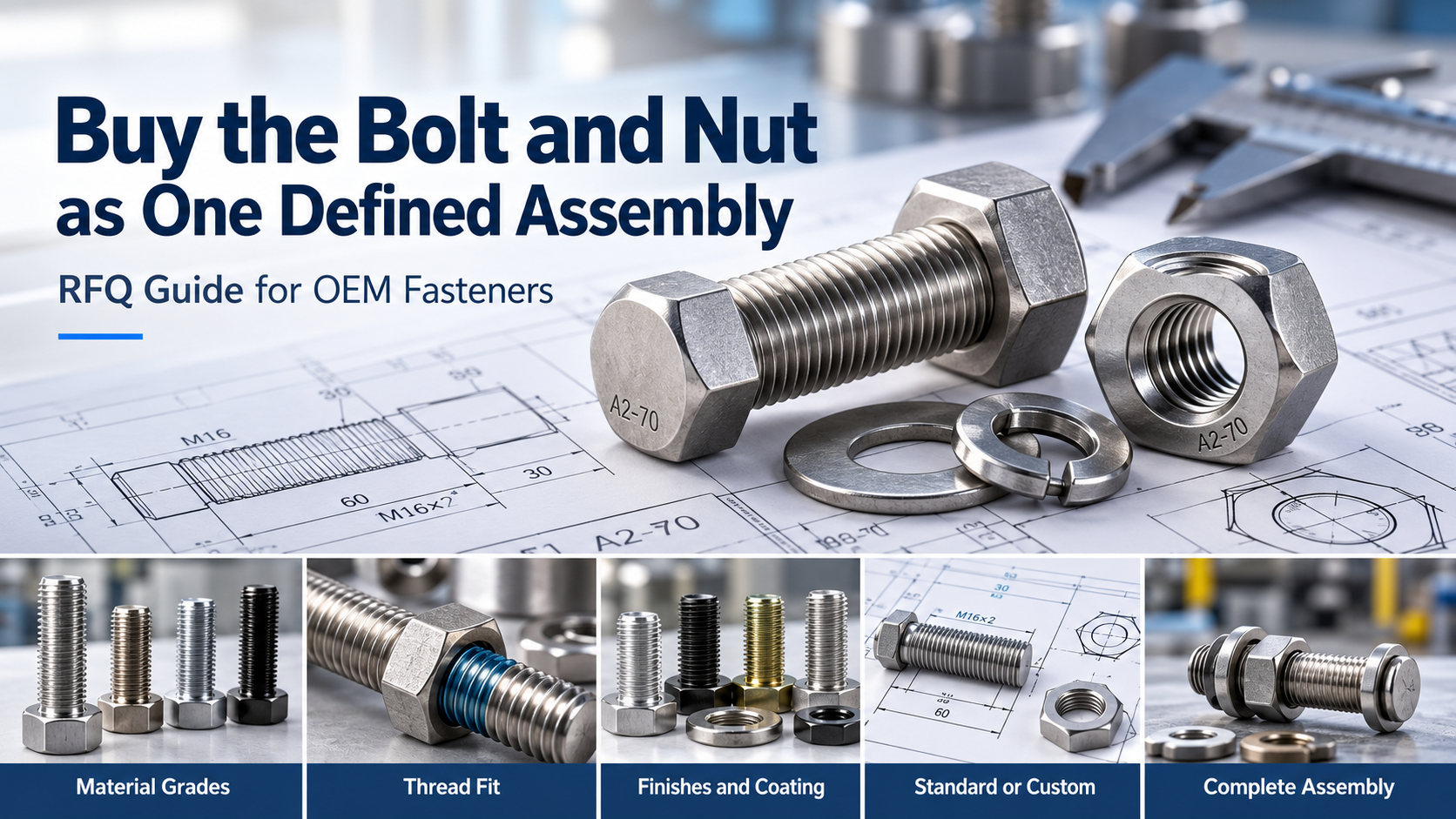
Procurement often discovers galling after changing one quiet variable: the supplier, surface finish, lubricant, nut source, installation speed or reuse rule. A correct part number is not enough when assembly behavior depends on the complete pair and tightening process. The RFQ should identify whether the bolt and nut are supplied as one controlled set, whether lubrication is allowed, and whether the joint is installed once or opened during service.
| Galling-control input | Buyer decision | Supplier evidence |
|---|---|---|
| Mating pair | Approve bolt, nut and washer materials and sources together. | Assembly identification and lot records |
| Thread quality | Define tolerance, gauges, burr limits and cleanliness. | Gauge results and visual criteria |
| Lubrication | Approve product, application quantity and compatibility. | Controlled process and lot identification |
| Installation speed | Set tool and speed limits for the actual line or site. | Representative assembly trial |
| Tightening target | Validate torque or tension method for the approved condition. | Recorded test conditions and results |
| Reuse | State whether parts are single-use or may be reassembled. | Approved instruction and inspection rule |
There is no responsible universal torque value for “an M10 stainless bolt.” Diameter alone does not determine preload. Thread pitch, property class, bearing geometry, lubricant, surface condition, tightening method and joint stiffness all matter. If clamp load is important, validate the real assembly rather than borrowing a chart with unknown assumptions.
Torque, lubricant and clamp load must be reviewed together
Lubrication that reduces galling also changes friction. If the installation team applies an anti-seize compound but continues using a dry-joint torque, the achieved clamp load may differ materially. The specification must connect the approved lubricant to the tightening procedure.The supplier cannot control field practice unless the buyer includes it in the joint plan, packaging and instructions.
ISO 16047:2005 is the useful reference when a buyer wants torque and clamp-force data for threaded fasteners within the standard's scope. Before treating a number as meaningful, ask how the test was run: which bolt and nut were paired, whether the threads were lubricated, how quickly the joint was tightened and what result was accepted. Without that context, a tidy-looking report says little about the joint on the buyer's line.
Ask the supplier to keep the sample assemblies used in a trial identifiable. Record bolt lot, nut lot, washer, lubricant batch, tool, speed and sequence. If a different factory supplies the nuts during mass production, or a packer applies another lubricant, the original test may no longer represent the shipment. This is why change control belongs in the purchase agreement rather than in a final-inspection checklist.
One purchase order can contain several very different fastener families
A stainless fastener program may contain standard bolts, tapping screws, machine screws, studs, nuts, washers, clips and pins. Similar material descriptions do not make their standards or test plans identical.For example, a tapping screw needs a different functional discussion from a bolt loaded in tension. A thin nut is not assessed in the same way as a regular nut. A washer has geometry and material requirements of its own.
JINGLE’s public product range includes stainless options in several families, including stainless steel carriage bolts, stainless self-drilling screws and stainless flange nuts. Availability, dimensions, material designation, property or hardness class, testing and production route must be confirmed for the exact SKU and order. A product-family example is not a portfolio-wide promise.
When one order mixes families, build a line-item specification matrix. Each row should carry its own standard, material, performance, surface, inspection and packing fields. Shared commercial terms can sit above the table, but technical requirements should not be copied blindly from the first item.
Build an inspection plan around failure risk
Inspection should answer the risks created by the drawing, process and application. A long generic checklist is not automatically strong.It may devote equal effort to a cosmetic dimension and a thread feature that controls assembly. Mark the functional characteristics, define the measurement method and decide what happens when a result fails.
A buyer normally needs some combination of incoming material verification, first-off approval, in-process checks and final-lot evidence. Sampling should follow the governing standard, project specification or agreed quality plan. If the order requires 100 percent inspection of a characteristic, identify the equipment, resolution, calibration status, data handling and segregation rule. “100% checked” without a named characteristic is not useful evidence.
| Control area | Typical buyer question | Possible evidence |
|---|---|---|
| Material identity | Does the input material match the approved grade and heat? | Mill/heat record, receipt identity and agreed verification |
| Dimensions | Do critical geometry and thread features meet the controlled document? | Ballooned report, gauges and measurement record |
| Mechanical properties | Does the finished fastener meet its specified class? | Applicable tensile, proof load,hardness or torsion results |
| Surface treatment | Was the agreed cleaning/passivation route completed? | Process certificate and specified effectiveness test |
| Assembly | Will the approved mating pair assemble without damage? | Fit, drive, torque/clamp or application-specific trial |
| Appearance and cleanliness | Are contamination, burrs, heat tint and damage within limits? | Approved visual standard and final inspection record |
| Traceability | Can every result be linked to shipped cartons? | Lot traveler, pack list and label cross-reference |
For third-party inspection, define the inspection body, witness or hold points, sampling, characteristics, document review, report format and responsibility for cost and schedule. An inspector can verify selected evidence at a stated time.The visit does not replace the supplier’s process control or convert an incomplete specification into a complete one.
Request a Grade and Inspection Review →
A material certificate is only useful when traceability is intact
A material certificate may report chemistry and other results for a heat or batch. It does not automatically prove that the finished fasteners in a carton came from that heat. The supplier needs an identity chain from received material through forming or machining, heat or work condition, surface treatment, inspection, packing and shipment.
Ask the supplier to define a production lot before work begins. Will one shipment contain multiple wire heats? Can parts from different forming runs be combined? Does the passivation subcontractor preserve the original lot, or does it create a new process lot linked by a traveler? If goods are repacked into private-label boxes, how is the original batch retained on the label and packing record?
The answers do not have to create a single lot for the whole shipment. Multi-lot supply is often manageable. What matters is visible separation and a reliable cross-reference.A buyer should be able to select a carton, read its lot code and retrieve the material, production and inspection evidence that applies to that carton.
Review the documents before the truck is booked
Document disputes are expensive when goods are already packed. Put the document list in the RFQ, let the supplier price any external testing, and review sample formats before production. For a first order, consider a document hold point before shipment release. The buyer can confirm that report headings, part numbers, revisions, lot codes, test methods and acceptance limits match the purchase order.
Do not ask for “all certificates” without defining what matters. A focused package might include the supplier’s certificate of conformity, material/heat evidence, dimensional report, relevant finished-fastener mechanical results, passivation or surface-process certificate, agreed effectiveness test, packing list and label photographs. Regulated or customer-controlled projects may add declarations, laboratory reports or independent inspection. Availability must be confirmed against the exact product, manufacturing source and batch.
Check report identity, not just the result column. A perfect value on a report for another size, material heat or drawing revision is not evidence for the ordered part. The review should verify units, methods, equipment where required, specimen count, acceptance rule, authorization and links to the shipment.
Packaging can create the contamination you tried to prevent
Stainless steel is not permission to pack carelessly. Contact with dirty carbon-steel bins, contaminated abrasives or mixed metal debris can leave foreign iron on the surface. Wet cartons, chloride-containing materials and poor drainage can create staining before receiving inspection. Polished cosmetic parts may also suffer abrasion that has nothing to do with alloy selection.
Write the packing instruction as if the receiving warehouse had never seen the part: name the inner bag, quantity per bag, maximum carton weight, lot-separation rule, label fields, pallet protection and moisture control. Packing chemicals deserve their own check. VCI film or oil may be acceptable for one shipment yet interfere with later cleaning, food-contact controls or adhesive bonding on another. The next operation decides whether an inhibitor is helpful or troublesome.
Private-label programs need an approved artwork and data file. The label should not claim a material, property class, origin or certification that the lot records do not support. Keep the traceability code readable after the distributor’s label is applied.

Make competing quotations describe the same job
Two quotes headed “stainless fastener” may describe entirely different supply routes. One supplier may start from a stocked standard blank; another may buy a dedicated wire lot and make new tooling. Grade, bar or wire availability, geometry, property class, forming or machining method, passivation, inspection, packing and quantity all move the price. Put those assumptions side by side before judging the unit cost.
A buyer should be able to see where tooling, samples, first-article checks, outside laboratory work, passivation, lubricant, unusual packing and freight sit in the offer. It is also worth asking for breaks at the likely trial quantity, repeat order and annual volume. Otherwise an attractive piece price can conceal a material minimum, a report charge or a packing method the distribution channel cannot use.
| Quote line | What to normalize | Question when missing |
|---|---|---|
| Product | Standard, drawing revision, grade, class and surface | Which exact technical baseline was priced? |
| Tooling | Ownership, maintenance, life and change cost | Is tooling included, amortized or separate? |
| Samples | Quantity, production intent, finish and reports | What does sample approval release? |
| Testing | Method, frequency,laboratory and report | Which tests are included in the unit price? |
| Packaging | Pieces, box, barcode, carton, pallet and protection | Is private-label packing production-ready? |
| Delivery | Incoterm, named place, shipment mode and schedule trigger | When does the lead-time clock start? |
Lead time should be a small route map. Separate technical clarification, drawing approval, tooling, material procurement, sample production, buyer approval, mass production, surface processing, final inspection, packing and shipping. Ask which milestones need the buyer’s response. This turns an optimistic date into a schedule both parties can manage.
Qualify the supplier with a sample-to-repeat-order path
A polished sample proves only what was measured on that sample. A supplier qualification should explain how the same requirements will be controlled when the lot is larger, the machine changes, the surface processor receives several batches or the order repeats six months later. Ask for a route, not a showroom story.
A practical sequence is: feasibility review, controlled quotation, representative sample, documented first article, pilot lot, mass-production release and repeat-order monitoring. Each stage should have an entry condition, evidence package, approval owner and rule for changes. If a prototype uses another process, label it and plan a production-intent sample before final release.
Supplier evidence can include relevant process flow, equipment list, gauge capability, subcontractor control, sample records, lot traveler, nonconformance process, corrective-action example and change-notification method. Sensitive factory information can be reviewed under appropriate confidentiality. The buyer needs enough evidence to evaluate control, not unrestricted access to proprietary methods.
A quote-ready stainless fastener RFQ
The template below can be copied into an inquiry. Replace every bracketed item with a controlled value or mark it “open for supplier proposal.” Attach the latest PDF drawing and an editable model when relevant.
| RFQ section | Information to provide |
|---|---|
| Part identity | Buyer part number, description, drawing number and revision |
| Governing documents | Product standard, mechanical standard, editions and precedence rule |
| Geometry | Diameter, length, thread, pitch, tolerance, head/drive and special features |
| Material and performance | Stainless fastener grade, property/hardness class, chemistry restriction and required tests |
| Environment | Fluids, chloride, temperature, wet/dry cycle, cleaning, contact metals and service objective |
| Surface | Cleaning, passivation, polish,lubricant, visual criteria and test method |
| Assembly | Mating nut/washer/material, tool, speed, torque/tension method and reuse rule |
| Inspection | Critical characteristics, sampling, gauges, hold points and third-party scope |
| Documents | Certificate, material, dimensional, mechanical, surface and packaging records |
| Quantity | Sample, first order, repeat order, annual demand and release frequency |
| Packaging | Pieces per pack, label/barcode, carton, pallet, lot separation and protection |
| Commercial | Incoterm, destination, target date, currency, payment and quote validity |
Ask the supplier to list every deviation and assumption in the quotation. “Comply” should mean the named requirement was reviewed. If the supplier proposes a different grade, passivation route, tolerance or packaging method, approve it through a documented technical and commercial review.
Related JINGLE sourcing resources
A stainless project rarely stops with one bolt. The buyer may also need a drawing-controlled screw, a special nut, an anchor or a machined companion part. These JingleFix pages lead to the right discussion for each adjacent requirement:
| Requirement | Buyer resource |
|---|---|
| Drawing-controlled fasteners | custom fastener manufacturer |
| Custom head, drive and thread designs | custom screw manufacturer |
| Project bolting assemblies | structural bolt manufacturer |
| Post-installed anchors | concrete anchor manufacturer |
| Special nuts, washers and pins | custom nut manufacturer |
| Stainless and application-specific clamps | hose clamp manufacturer |
| Precast lifting hardware | lifting anchor manufacturer |
| Sockets, inserts and connection items | precast concrete accessories manufacturer |
| Turned and milled stainless parts | precision CNC machining parts manufacturer |
| Mixed fastener and machining packages | OEM fastener and machined parts supplier |
Frequently asked buyer questions
Is A2 stainless steel always the same as 304?
Not safely. A2 names a fastener grade group in the ISO 3506 system, whereas 304 is an alloy description used under other material specifications. The purchase order should state the fastener standard, grade, property class and any chemistry requirement. The supplier can then identify the proposed material route and the evidence that comes with it.
Should I choose 316 for every outdoor project?
Not automatically.Outdoor exposure ranges from sheltered inland equipment to persistent chloride splash and chemical washdown. Material selection also depends on crevices, contact metals, temperature, maintenance and required mechanical properties. Describe the environment and let the responsible engineer approve the grade. Avoid paying for a label that still does not solve a poor joint detail.
Does stainless steel need passivation?
It depends on the manufacturing condition, cleanliness requirement and applicable specification. Stainless steel forms a passive film naturally, but processing can leave scale or contaminants. When passivation is required, name the standard, treatment, lot, test and documentation. Passivation cannot compensate for the wrong alloy, severe heat tint, damaged threads or unsuitable joint design.
Can I identify stainless grade with a magnet?
A handheld magnet is not a complete grade-verification method. Magnetic response varies with stainless family, chemistry and cold work. If magnetic performance matters, specify a measurable limit and test. For material identity, use the agreed certificate and verification method linked to the lot rather than a receiving-floor rule based only on attraction.
Why did a stainless bolt and nut seize during tightening?
Thread galling is a likely possibility, but the exact cause needs evidence. Review thread damage and cleanliness, mating materials, lubrication, installation speed, tool alignment and achieved load. Stop increasing torque blindly. Preserve parts for investigation and validate the approved bolt/nut/lubricant combination under representative assembly conditions before releasing production.
Can the supplier give one torque value for each diameter?
Diameter alone is insufficient. Thread pitch, fastener class, joint stiffness, bearing surface, lubricant, mating parts and target clamp load affect the tightening procedure. Use the value and method approved for the actual assembly. If the supplier provides test data, check that the reported specimens and conditions match the shipped parts and field process.
Do salt-spray hours equal years of service?
No direct conversion should be assumed. Salt-spray testing provides comparative or process-control information under specified chamber conditions. Actual service depends on environment, design, deposits, damage, wet/dry cycles and maintenance. Define the test method and acceptance purpose, then evaluate field suitability separately.
What documents should accompany stainless fasteners?
The package depends on the part and risk. It may include conformity, material/heat evidence, dimensions, finished-fastener mechanical tests, passivation or other surface-process records, agreed effectiveness testing, traceability and packing evidence. Define the list before quotation. Every report should identify the part, revision, lot, method, result and acceptance basis.
Can JINGLE manufacture from a drawing or physical sample?
Drawing- and sample-based development can be evaluated when technically feasible. A controlled drawing is preferred because a sample rarely reveals the original material, property class, tolerances, surface-treatment route or functional limits. Send annual demand and inspection needs with the sample. The quotation should identify tooling, process route, sample status and approval criteria.
What is the MOQ for stainless fasteners?
MOQ is product-specific. It depends on material procurement, size, tooling, forming or machining setup, surface processing, testing and packing. A standard stocked item may support a smaller trial quantity; a custom cold-headed part may need an economical batch. Ask for sample, first-order, repeat-order and annual-volume price breaks on the same specification.
How should a buyer handle an alternative grade proposal?
Treat it as a controlled deviation. Require the supplier to identify the proposed designation, governing specification, chemistry and mechanical evidence, corrosion-related basis, availability, price and lead-time effect. The responsible engineer should approve or reject it in writing. Update the drawing or purchase record so production and receiving teams do not use conflicting requirements.
What information gets the fastest useful quotation?
Send the part number and revision, standard, size, thread, stainless grade and property class, environment, passivation or finish, mating parts, inspection documents, sample and order quantities, annual demand, packaging, destination, Incoterm and target date. Mark undecided items openly. A complete inquiry lets the supplier answer with specific capability, exclusions and timing.
Final buyer checklist
- The application, exposure and contact metals are described.
- The drawing, product standard and editions are controlled.
- Stainless grade and property or hardness class are separate entries.
- The passivation or surface requirement names a method and acceptance basis.
- The bolt, nut, washer, lubricant and tightening process are reviewed as a system.
- Galling risk and representative assembly testing are addressed.
- Inspection methods and reaction plans follow functional risk.
- Certificates and reports link to the finished production lot.
- Packaging prevents contamination, mixing and loss of traceability.
- Tooling, testing, packing and delivery scope are normalized across quotations.
- Samples represent the intended production route or are labeled otherwise.
- Changes require written review before implementation.
Send the specification that you actually need
A strong stainless steel fastener inquiry does not begin with “best price for 304.” It begins with a controlled part definition and the conditions that make the material choice meaningful. That gives the supplier a fair chance to identify stock availability, manufacturing limits, passivation options, inspection scope, galling controls and packaging before the order becomes urgent.
JINGLE-TECH supports overseas buyers sourcing standard and drawing-controlled fasteners, related nuts and washers, selected stainless product options, packaging and export coordination.The actual manufacturer, grade, property class, process route, documents, testing and certification scope are confirmed for each product and batch. We do not assume one statement covers the whole catalog.
Attach your latest drawing and include the service environment, mating materials, installation method, quantity ladder, required reports, pack format, destination and target schedule. If the grade is still open, state the exposure and approval criteria. The first response can then focus on the questions that decide feasibility and a comparable quotation.
Get a Stainless Fastener Quotation →
Editorial note: This article provides general procurement and quality-planning information. Material selection, joint design, installation, corrosion assessment and acceptance must follow the controlled engineering documents, applicable standards and approvals for the specific application.