


CE Certified Fasteners: What Buyers Need to Verify Before They Place an Order
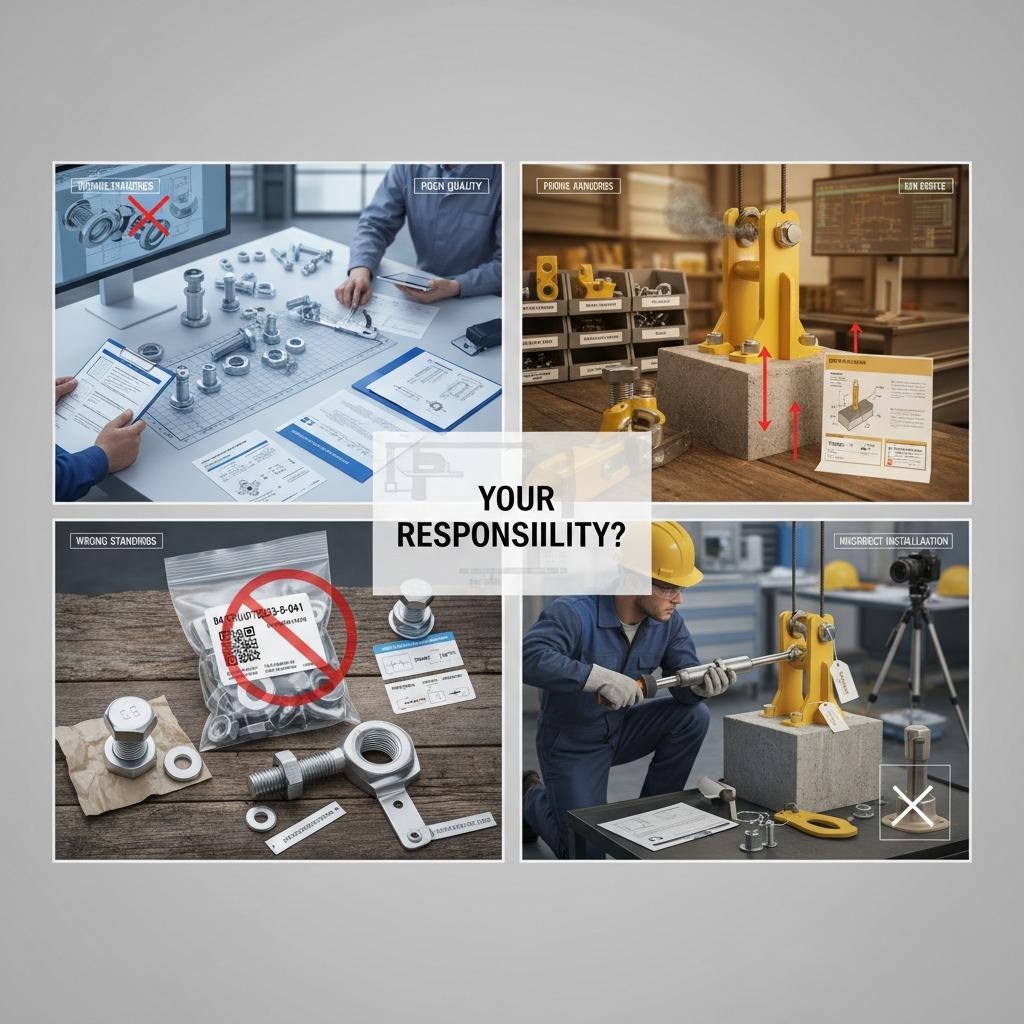
For engineers and procurement teams, CE certified fasteners are often discussed as if the marking alone settles the question of compliance. It does not. The real issue is whether the fastener is suitable for the intended application, documented correctly, and manufactured under a system that supports traceability. That matters most when the component is going into a structural, safety-related, or regulated assembly where a missing paper trail can delay a shipment or, worse, create a liability problem later.
In practice, buyers are usually trying to answer a simple question: can this part be accepted by the project, the inspector, and the end customer without extra negotiation? To get there, you need to look beyond the mark itself and check the supporting standards, the product category, and the supplier’s technical documentation. That is especially true when comparing DIN standard fasteners with EN standard lifting anchors, which are not interchangeable just because they both sit in the broader world of mechanical fastening.
Why the CE Mark Matters, and Where It Does Not
CE marking is a compliance signal used in many European-regulated product areas, but it is not a universal badge of quality. For fasteners, the key point is that the CE marking should be tied to the specific directive or regulation that applies to the product, along with the correct technical documentation. If a supplier uses the term loosely, buyers should slow down and ask for the basis of the declaration.
That caution is important because fasteners cover a wide range of parts: bolts, nuts, threaded rods, anchors, and specialized lifting hardware. A product may be suitable for one application and completely wrong for another. A general-purpose bolt is not the same thing as an anchor intended for lifting or safety-critical load handling. The naming can be deceptively similar, but the compliance expectations are not.
Quick Buyer Takeaways
If you are sourcing CE certified fasteners, the first check is application scope. Ask whether the part is intended for structural use, lifting use, or general mechanical assembly. Then confirm the governing standard and the documentation package. If the supplier cannot clearly state both, that is a warning sign, even if the pricing looks attractive.
A second practical point is traceability. Buyers in manufacturing and construction often need lot identification, material evidence, and consistent marking. This is not just administrative clutter; it becomes the difference between resolving a nonconformance quickly and spending days reconstructing what was installed where. A fastener that cannot be traced back through production and shipment history can become expensive very fast.
DIN Standard Fasteners Versus EN Standard Lifting Anchors
DIN standard fasteners are commonly associated with dimensional norms and product consistency across familiar hardware categories. They are widely used because engineers know what to expect in fit, form, and interchangeability. Still, DIN compliance alone does not answer every question about CE-related use. It tells you something important about the part’s geometry or classification, but not necessarily about the full regulatory context.
DIN standard fasteners
These are often selected for mechanical assemblies where standardization, serviceability, and procurement simplicity matter. Their appeal is practical: buyers know the profile, engineers know the mating conditions, and the supply chain usually understands the part family. For many industrial builds, that predictability is worth more than chasing a special variant that creates sourcing friction.
EN standard lifting anchors
Lifting anchors sit in a different category. They are tied to load handling and safety concerns, so the technical bar is higher and the documentation burden is heavier. EN standard lifting anchors typically require closer attention to intended use, installation method, and compatibility with the lifting system. A buyer who treats them like ordinary hardware is taking an avoidable risk.
Selection Criteria That Actually Help
Start with function, not catalog appearance. Ask how the fastener will be loaded, whether the installation is permanent or serviceable, and what environment it will face. Corrosion exposure, vibration, and temperature swings all influence the final choice. A fastener that looks acceptable on paper may perform poorly if the operating conditions were underestimated.
Next, review the supplier’s documentation package. At minimum, buyers should expect clear product identification, the standard referenced, and the declaration basis for the CE marking where applicable. If the supplier also provides batch traceability and material records, that is a useful sign of maturity. It does not remove the need for your own incoming inspection, but it makes the job easier.
Finally, consider how the part will be audited downstream. Some projects are built around strict inspection routines, while others are more flexible. A product that is perfectly acceptable in one environment may cause repetitive questions in another if the paperwork is thin or the terminology is vague.
Common Mistakes Buyers Keep Making
The most common mistake is assuming all fasteners with a compliant-looking declaration are equivalent. They are not. Another frequent error is mixing up dimensional standards with regulatory approval. DIN standard fasteners may be dimensionally reliable, but that does not automatically make them suitable for every CE-related specification.
Buyers also sometimes overlook installation responsibility. Especially with EN standard lifting anchors, a well-made product can still be misused if the mounting method is wrong or the load path is misunderstood. That kind of mistake is rarely caught by catalog reading alone. It usually shows up later, when the project is already moving.
What to Ask a Supplier Before You Commit
Ask which standard applies, what the CE marking covers, and whether the product is intended for general fastening or a safety-related function. Request documentation that matches the exact part number, not a family brochure that leaves room for interpretation. If the answer feels evasive, keep asking. Good suppliers are usually comfortable being specific.
It is also worth asking about marking, packaging identification, and traceability controls. These are not glamorous topics, but they save time when a receiving team needs to verify inventory or when a project auditor asks for evidence months later.
FAQ: A Few Questions Buyers Raise Often
Are CE certified fasteners always better than non-marked fasteners? Not automatically. They are better when the application requires that compliance framework. For simple internal assemblies, the decision may depend more on technical fit and supply reliability.
Can DIN standard fasteners be used where CE compliance is needed? Sometimes, but only if the specific product and application meet the relevant requirements. The standard alone is not enough.
Are EN standard lifting anchors just another fastener? No. They should be treated as load-bearing safety components, which changes the level of scrutiny.
Practical Next Step for Sourcing Teams
When you evaluate CE certified fasteners, build your comparison around application, standard, documentation, and traceability. That approach is slower than looking at unit price alone, but it is the difference between a clean approval process and a recurring compliance headache. If you are still shortlisting suppliers, ask them to identify the exact standard basis for each item and to separate ordinary DIN standard fasteners from EN standard lifting anchors clearly in the offer. That one step filters out a surprising amount of confusion.





