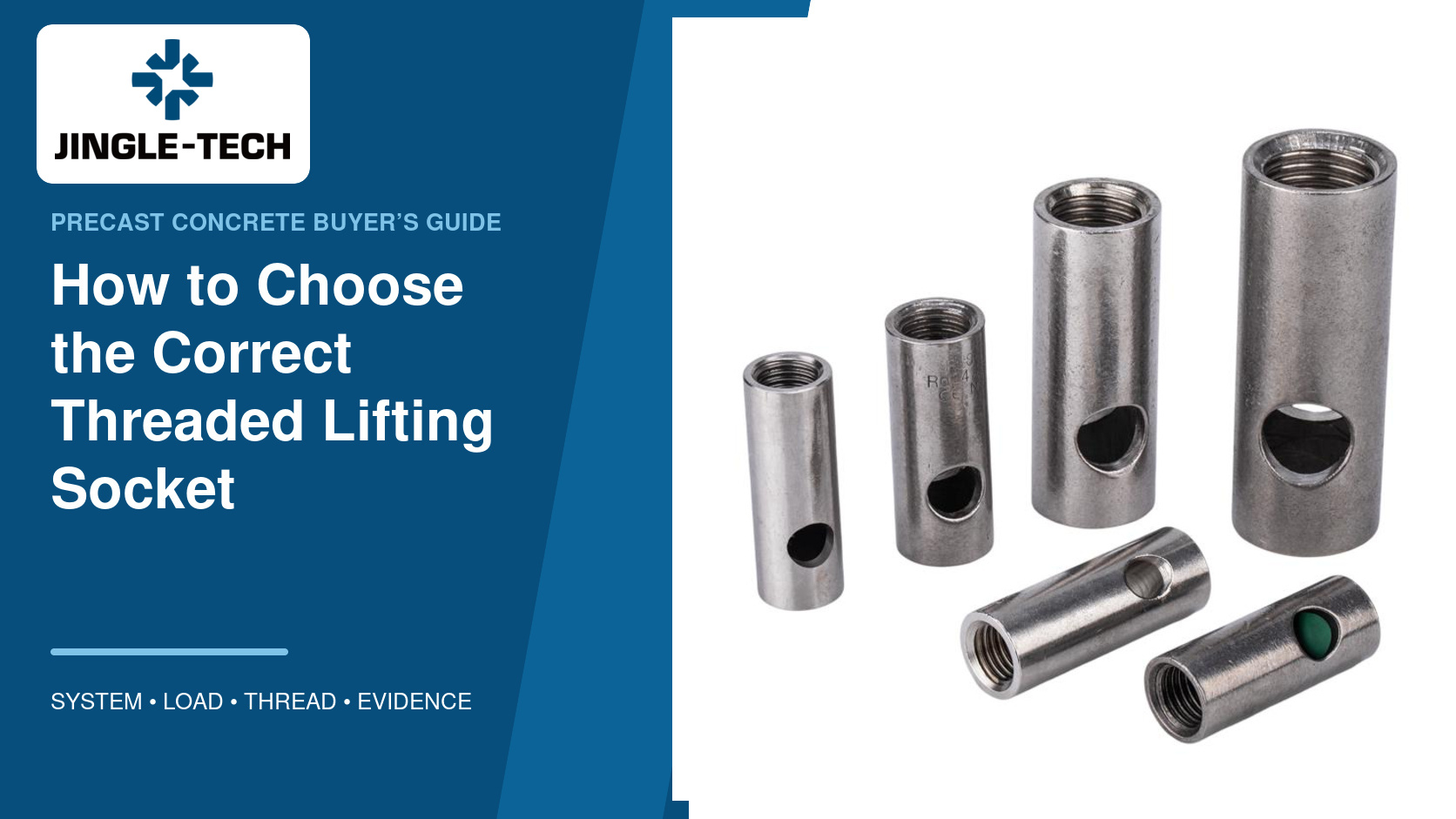
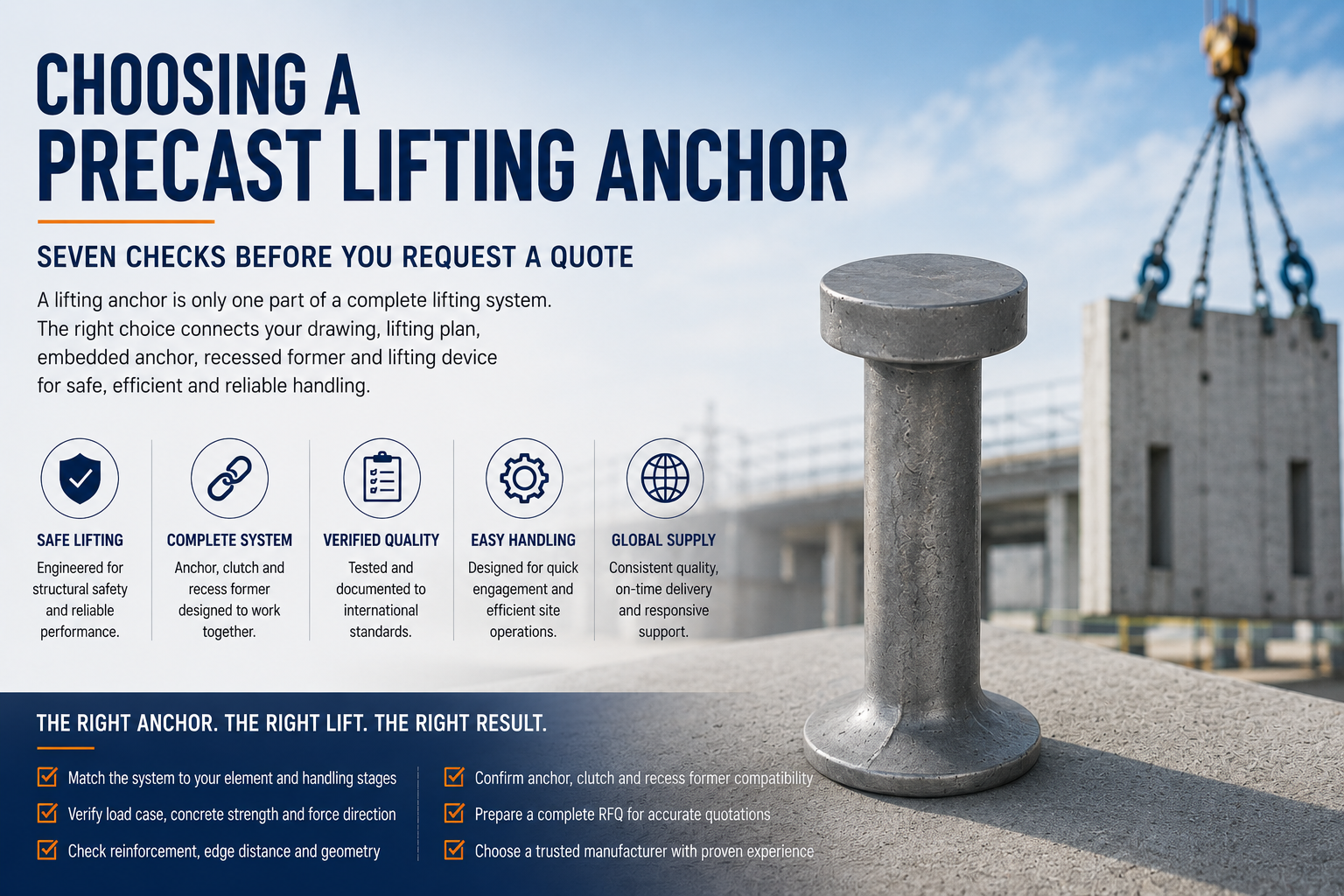
How to Choose the Correct Threaded Lifting Socket

Choose a threaded lifting socket by checking the whole lifting system, not the internal thread alone. The responsible engineer must confirm the element, each handling stage, the load at every lifting point, the concrete condition, the socket's load-transfer arrangement, the permitted loading direction, the matching lifting device, and the installation detail. Procurement can then lock the thread designation, product reference, material, finish, documents, marking, quantity, and packaging in the RFQ.
A socket that accepts a familiar lifting eye is not automatically suitable. Thread fit does not establish assembly capacity or approval for an angled or turning lift.
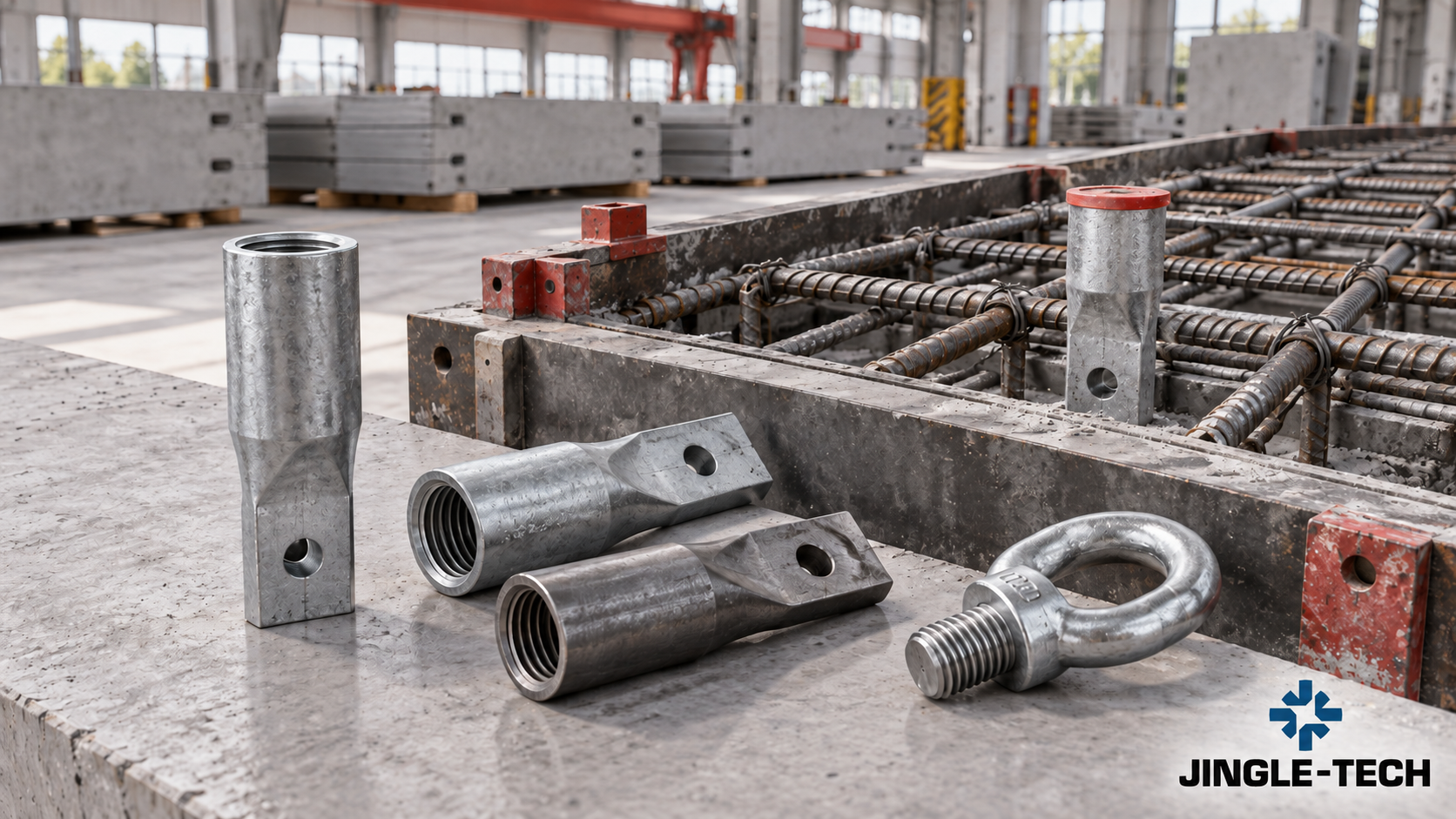
Confirm that the insert is intended for lifting
A threaded insert may be designed for temporary lifting, permanent fixing, suspension, or another purpose. Similar appearance does not make those uses interchangeable.
Request current technical information identifying the product as a lifting insert and explaining its installation, connection, inspection, and use. Stop if the document describes only a fixing ferrule or general threaded insert.
This is a purchasing guide, not a lift design or installation instruction. The project engineer and competent lifting team must use the applicable project rules and current instructions for the exact product.
Treat the socket, lifting device, and element as one system
Force passes through the lifting device, thread, socket body, tail or reinforcement, and concrete. Each interface needs a defined basis.
PFEIFER's official Thread System overview places anchors, lifting keys, marking, thread cleaning, formwork fastening, and recess closure within one system. Its anchor overview links embedded anchors with associated lifting keys. Leviat presents the Halfen HD Socket Lifting System in the same system-based way.
These sources explain why a complete system reference matters. They do not prove that a JINGLE socket, PFEIFER lifting key, Halfen lifting link, or another cross-brand combination is interchangeable. Any proposed mixed system remains [NEEDS JINGLE CONFIRMATION] and needs project approval.
Begin with every handling stage
Do not select from finished element weight alone. Send the drawing and a narrative covering mould release, rotation, factory handling, storage, loading, unloading, and erection.
For each stage, record the known engineering inputs:
- element mass and centre of gravity;
- number, position, and assumed load sharing of lifting points;
- sling arrangement and load directions;
- concrete condition at the time of lifting;
- form adhesion and dynamic effects;
- turning, pitching, or tilting steps; and
- restrictions on axial, diagonal, or transverse loading.
Mark unknowns as open. Do not ask a supplier to infer them from a photograph. Final loads and socket selection must follow the project's approved method and the current system documentation.
Choose the load-transfer arrangement before the catalogue size
“Threaded lifting socket” describes the connection at the concrete surface. It does not fully describe how force is anchored behind that thread. Products may use a reinforcing-bar tail, cross-hole restraint, head, plate, or another defined arrangement.
A bar-tail socket can suit a different reinforcement layout from a cross-hole socket. Headed and plate forms create other conditions. Compare controlled drawings rather than supplier names.
PFEIFER's Socket page describes a cross-hole socket used with defined retention reinforcement. Its Bolt Anchor page describes load transfer through a bolt head. These are manufacturer-specific examples, not JINGLE designs or performance claims.
Ask the supplier to show the socket body, tail or restraint, additional reinforcement, embedment, orientation, and installation accessories on one revision-controlled drawing. State which items are included in supply and which must be provided by the precast plant.
Check the concrete and reinforcement around the socket
Provide thickness, edges, openings, recesses, cover, lifting-point spacing, and nearby reinforcement. Mould features may also limit the opening's position.
The assembly must fit without unapproved cutting, bending, displacement, or substitution of designed reinforcement. The plant also needs room to fix the socket, place and compact concrete, and inspect its position. Record any required orientation of a cross-hole, plate, or bar tail on the shop drawing.
Lock the exact thread interface
Write the complete thread designation in the RFQ and drawing. “M thread,” “Rd thread,” or “standard socket” can still leave size, pitch, profile, tolerance, engagement, or system details unresolved. Article 08 will compare Metric and Rd terminology; the immediate rule is not to reduce the interface to nominal diameter.
The interface file should identify:
- socket thread and product reference;
- approved mating lifting device and revision;
- required engagement from current instructions;
- permitted adapters or locking features;
- recess and access requirements;
- thread inspection or gauge; and
- protection during casting, storage, and transport.
The JINGLE Flat End Lifting Socket With Hole page lists Rd and M options. The ordered size, material, finish, capacity class, lifting device, and application-specific combination are [NEEDS JINGLE CONFIRMATION]. Request the current drawing and product-specific evidence.
Match the lifting device to the load direction
A lifting loop, swivel eye, or special key is not chosen only because its thread enters the socket. Its seating, locking, inspection, and permitted load directions must suit the lift.
PFEIFER publishes different application information for its Lifting Loop and Swivel Eye. Use only the instructions for the approved system. Permission for one device must not be transferred to another by analogy.
Identify who supplies, inspects, and retires reusable devices. Keeping an existing device with a new socket supplier requires compatibility review. Hand fit is not lifting approval.
Plan installation, recesses, and thread protection
Agree how the socket is fixed to the mould, how its axis and depth are controlled, and whether the opening is flush or recessed. Include the specified nailing plate, fixing bolt, former, identification cap, or plug where required.
Cement paste, grit, coating, or damage can prevent seating. The Halfen HD catalogue shows system-specific nailing plates, thread protection, and recess accessories. Follow the instructions for the purchased socket.
Before casting, verify part number, orientation, depth, restraint, reinforcement, and closure. After stripping, check that the socket is accessible, positioned, clean, identified, and free from visible damage. Use only the manufacturer's approved cleaning and acceptance methods.
Match material and finish to exposure
State the exposure during production, storage, transport, and service. Published galvanized or stainless variants are not permission to substitute materials; coating, thread allowance, cover, and sealing may affect approval.
For JINGLE supply, available steel grades, stainless grades, finishes, coating controls, and supporting records are [NEEDS JINGLE CONFIRMATION]. Keep a requested finish separate from a proven corrosion-performance claim.
Use a selection matrix before requesting prices
| Selection point | Buyer sends | Supplier returns | Stop if |
|---|---|---|---|
| Intended use | Temporary lifting requirement | Exact system and product reference | Only fixing information exists |
| Lift cases | Drawing, weight, stages, rigging, concrete condition | Selection basis and limitations | Weight alone was used |
| Concrete zone | Thickness, edges, openings, spacing, reinforcement | Embedment, orientation, spacing, reinforcement detail | Arrangement conflicts with the drawing |
| Load transfer | Available anchor zone and required family | Drawing of body, tail, head, plate, or restraint | The restraint is undefined |
| Thread | Exact designation and existing device | Compatible device, engagement, and inspection | Fit is claimed from diameter alone |
| Installation | Mould face, recess, fixing, protection | Accessories and current instructions | Repeatable positioning is not possible |
| Evidence | Document list and approval milestones | Load data, compatibility, inspection, traceability | Evidence covers another revision |
| Commercial | Quantities, packaging, destination, terms | Itemized quote, exclusions, open points | Supply boundaries differ |
The matrix makes quotations comparable. It does not replace engineering calculations or current manufacturer data.
Request evidence for the exact revision
Ask for the product drawing, technical data, instructions, compatible lifting-device reference, load basis, material and finish specification, marking, dimensional inspection plan, traceability, and shipment documents.
Put testing and certification requirements in the RFQ. Check that each document covers the offered size, material, finish, revision, and loading basis. A nearby model's report and a general quality certificate do not approve the socket.
Threaded lifting socket RFQ checklist
Before sending the enquiry, include:
- buyer, project, destination, and applicable requirements;
- element and reinforcement drawings with revision and units;
- mass, centre of gravity, lift stages, points, rigging, and directions;
- concrete condition at each lift where established;
- socket function, load-transfer arrangement, and orientation;
- thread designation and mating-device reference;
- embedment, spacing, edge, recess, and formwork constraints;
- material, finish, marking, inspection, and traceability needs;
- sample, pilot, and production quantities;
- document and approval milestones;
- packaging, lot separation, delivery terms, and destination; and
- a visible list of open engineering items.
For a replacement enquiry, attach photographs and a physical sample when practical. State whether the sample is an identification aid, approved master, or test item, and record differences from the governing drawing.
Avoid common ordering shortcuts
Do not order by thread size, ask engineering to fit reinforcement around a preselected socket, replace a drawing with a photograph, assume an existing lifting eye is universal, or omit mould-fixing and protection accessories.
A capacity statement without revision, load direction, concrete basis, and compatible device is not comparable. Put each uncertainty into the RFQ.
Related JINGLE resources include the threaded socket and rebar anchor comparison, lifting socket guide, and lifting anchor manufacturer guide. See the wider precast accessories range.
Frequently asked questions
Is thread size enough to select a threaded lifting socket?
No. Thread fit matters, but selection also depends on the lifting system, load-transfer arrangement, concrete element, reinforcement, loading direction, mating device, installation, and approved technical data.
Can a general threaded insert be used for lifting?
Only when current product documentation expressly supports that use and the responsible engineer approves it. A fixing insert is not a lifting socket merely because it accepts the same nominal bolt.
Can an existing lifting eye be retained with a new socket supplier?
Do not assume so. Send its manufacturer, model, markings, drawing, condition, and thread details. The proposed pairing needs a written compatibility basis and project approval. Any JINGLE cross-brand match is [NEEDS JINGLE CONFIRMATION].
Which socket tail is best for a thin element?
Start with the actual element rather than a preferred tail. Its thickness, edge and opening layout, reinforcement cage, concrete condition, and planned load direction define which documented options are worth reviewing.
Should the socket be flush or recessed?
Follow the released element detail and system instructions. Depth affects formwork fixing, device seating, surface finish, protection, and recess closure. Record it on the drawing.
What should be checked at receiving?
Verify the part number, quantity, thread, material and finish description, markings, lot identity, packaging, visible condition, and required documents. Quarantine mixed, damaged, contaminated, or unidentified parts.
Send a controlled package for technical review
The correct socket is the one approved for the complete load path and installable under normal plant conditions. Freeze the element inputs, socket arrangement, lifting device, thread interface, accessories, and evidence before comparing prices.
Ask JINGLE's technical team to review your threaded lifting socket enquiry. Send the element and reinforcement drawings, lift sequence, thread and device references, quantities, destination, document list, and open questions.