How to Choose the Right Lifting Clutch for Precast Concrete

Start with the anchor already specified for the element. Confirm the exact clutch reference and marked class for that system. Then review how it locks into the recess, the directions in which it may be loaded, its inspection status, and its connection to the rigging. A clutch that merely fits over an anchor head is not automatically the right one. Final selection must follow the current instructions for the exact system and approval by the responsible lifting engineer.
The buyer's job is therefore not to find a generic metal connector. It is to preserve one verified path from the element and lift plan to the anchor, recess, clutch, inspection record, and rigging above it.

Begin with the anchor system, not the clutch catalogue
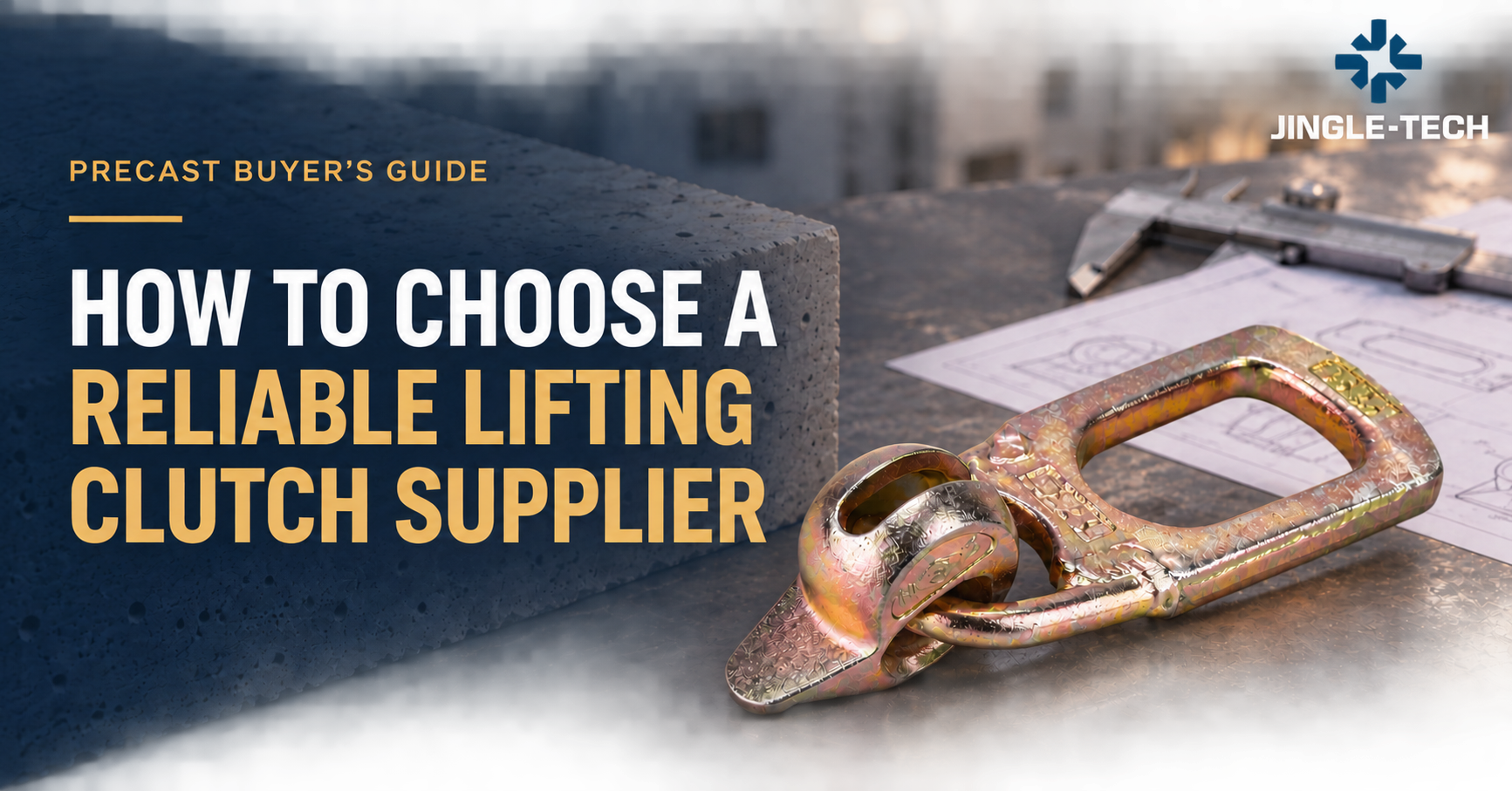
A lifting clutch is the removable link between a cast-in anchor and the crane-side gear. Its shape, moving parts, and marked class belong to a particular system definition. Start the enquiry with the embedded anchor that the clutch must engage.
Record the manufacturer, product family, anchor reference, interface dimensions, marked class, and governing drawing revision. For an anchor already in concrete, add clear photographs of its marking, head, and recess, but do not use a photograph as the sole specification.
If the anchor cannot be positively identified, stop. An unidentified insert is not a sound basis for choosing a clutch by trial fit. The project team must decide how the lifting point will be assessed before it is used.
Official manufacturers make this system boundary explicit. PFEIFER's WK System instructions describe its Quicklift and WK/DR anchors as matched components and warn against unmatched external parts. Leviat's HALFEN FRIMEDA system catalogue likewise connects specified ring-clutch load classes with the appropriate anchors. These examples explain the selection principle; they do not establish cross-brand compatibility for another product.
Ask engineering to establish the required class
Do not select a clutch class by dividing the element mass by the number of anchors. Sling angles, unequal load sharing, centre of gravity, formwork adhesion, dynamic effects, tilting, concrete strength, and the approved anchor arrangement can all change the force at a lifting point.
The responsible engineer should establish the design action at each stage and select the anchor system under the applicable project rules. Procurement should receive the resulting system, class, and product references as controlled inputs. If the calculation or lifting plan is incomplete, write [NEEDS JINGLE CONFIRMATION] against the product proposal and retain an engineering hold point. A supplier quotation is not a replacement for the project lifting design.
State every handling stage rather than quoting only the finished element mass. The clutch orientation during demoulding, rotation, transport, or erection may differ from a vertical pick in storage.
Verify the mechanical interface on paper
Next, compare the clutch and anchor drawings. The check should cover more than a catalogue name or nominal class. Review the head profile, opening and locking geometry, contact surfaces, recess access, clearance for full engagement, and the features that prevent incorrect closure or release.
Confirm the exact part numbers in writing. If a distributor proposes an equivalent, ask it to identify the original system, proposed clutch, governing drawings, and technical basis for compatibility. Similar appearance, colour, or claimed capacity is not evidence of an approved match.
JINGLE's lifting ring clutch guide covers the interface questions to settle before accepting a combination. Buyers defining the embedded side can also review how to choose a lifting anchor for precast concrete.
Check engagement in the actual recess
Paper compatibility still has to be carried into production. The recess former controls the space around the anchor head. Concrete contamination, damage, an incorrect former, or poor anchor position may prevent the clutch from seating and locking as intended.
Before a lift, the authorised user should be able to see that the recess and anchor are in acceptable condition, place the clutch without forcing it, close the locking mechanism fully, and confirm the orientation required by the current system instructions. The link or bail also needs room to align with the planned pull. Never grind the clutch, enlarge the recess casually, hammer the locking part closed, or improvise a connection to make a mismatch disappear.
Include a recorded first-article fit check when a new reference enters production. A hand fit supports assembly verification; it does not prove capacity or approve a departure from the system instructions.
Match the clutch to the complete handling method
The crane-side connection is part of the choice. Record how the clutch will connect to the hook, shackle, sling, spreader, or other approved lifting gear. Check that the connection does not crowd, twist, side-load, or prevent the clutch from aligning as intended.
Ask practical questions before buying:
- Can the operator engage and verify the clutch from the planned working position?
- Does the recess provide access when the element is in the mould, rack, truck, and final location?
- Will the clutch and rigging remain free to orient through the approved movement?
- Is remote release required, and is it approved for the exact system?
- Can the crew identify the clutch class and inspection status at the point of use?
Do not infer permitted load directions from a swivel-looking shape. Use the manufacturer's current operating instructions and the engineer's lift plan. If the element will be tilted or turned, say so in the RFQ and require the proposed arrangement to address that stage.
Compare candidate clutches with a release matrix
The following matrix keeps commercial convenience from hiding a technical gap.
| Decision point | Evidence to review | Accept only when | Stop or escalate when |
|---|---|---|---|
| Anchor identity | Marking, part reference, approved drawing, system record | The embedded component is positively identified | The head is unmarked, damaged, or described only by appearance |
| Clutch identity | Part number, marking, drawing, supplier declaration | One exact clutch reference is named | The offer says “universal” or “fits similar anchors” |
| Class selection | Approved lift plan and system data | Engineering has confirmed the required class and arrangement | Selection relies only on element mass or anchor count |
| Interface | Anchor and clutch drawings, current instructions | Geometry and locking method belong to the verified system | A trial fit is the only compatibility evidence |
| Recess and access | Former reference, first-article check, site review | Full seating, closure, inspection, and release are possible | Concrete or geometry obstructs correct engagement |
| Lift movement | Stage-by-stage handling plan | Permitted directions cover every approved stage | Tilting, rotation, or side pull is omitted or assumed |
| Device condition | Identification and inspection record | The clutch is in date and passes the required pre-use check | Record is missing, marking is illegible, or damage is found |
| Commercial supply | Quantity, certificate scope, marking, packaging, lead time | Quote matches the controlled technical definition | Price is based on an unresolved alternative or silent substitution |
Treat a lifting clutch as reusable lifting equipment
Unlike the embedded anchor, the clutch returns to the tool cage and may be used many times. Selection must therefore include an inspection and retirement plan.
Ask for current inspection and use instructions for the exact model. Establish who performs pre-use and periodic checks, how intervals are controlled, what is assessed, and how rejected devices are quarantined. Do not copy an interval from an unrelated product.
The check may need to cover identification, deformation, cracking, wear, corrosion, damaged link components, movement, and positive locking. Exact criteria and limits must come from approved documentation. Give every clutch a traceable identity linked to its receipt, certificate where applicable, inspection history, and status. Physically separate available, awaiting-inspection, and rejected equipment.
Specify quality evidence before requesting the final price
The RFQ should state which records are due with the quotation, sample, shipment, and repeat orders. The approved list may include a controlled drawing, destination-required declaration or certificate, inspection or test records, operating instructions, and traceability details.
Connect every document to the exact clutch reference and, where required, the supplied batch or device. Confirm permanent markings, labels, and separation of different classes and systems. Obtain the manufacturer's rules for service parts; dismantling does not imply that a local repair is permitted.
For a wider supplier review, see JINGLE's lifting clutch buying guide and the precast accessories range. The lifting foot anchor page is an example of the embedded component that must be matched with the correct system accessories; it is not a compatibility statement for every clutch.
Send a quote-ready lifting clutch RFQ
An effective enquiry is short enough to review and complete enough to expose unanswered questions. Include:
- project, destination market, and applicable specification or approval basis;
- precast element type and the approved handling stages;
- anchor manufacturer, system, exact reference, marked class, and drawing revision;
- recess-former reference and photographs of existing installations where relevant;
- required clutch reference and quantity, or a request for the supplier to identify its proposal;
- approved design actions or lifting-plan reference supplied by the responsible engineer;
- rigging connection and any access or remote-release requirement;
- required markings, instructions, inspection records, certificates, and traceability;
- sample or first-article purpose, acceptance checks, and approval hold point;
- packaging separation, labels, destination, Incoterm, and requested delivery date; and
- a written list of every supplier assumption, exclusion, and proposed deviation.
If the existing system is uncertain, send the available drawings, marked dimensions, and clear photographs, but label them as identification inputs. Ask JINGLE to state what can be confirmed and what remains open. Do not ask for a capacity recommendation from photographs alone.
Final buyer checklist
- The anchor system and exact embedded component are positively identified.
- The responsible engineer has approved the lift plan, system, and required class.
- Every handling stage, including demoulding, turning, transport, and erection, is covered.
- The clutch part number and marked class match the controlled system documents.
- Anchor head, locking geometry, contact surfaces, and recess access have been reviewed.
- A first-article fit check is defined where a new combination enters production.
- Crane-side rigging and operator access allow the clutch to align and release as intended.
- Current use, inspection, rejection, and permitted-repair instructions are available.
- Each reusable clutch has identification, inspection status, and a quarantine route.
- Documents, markings, packaging, quantity, commercial terms, and delivery scope are agreed.
- Alternatives and deviations require written technical review before supply or use.
Frequently asked questions
Can I choose a lifting clutch from the anchor's nominal load class alone?
No. The marked class is an important system identifier, but selection also depends on the exact anchor family, clutch reference, interface geometry, approved lift arrangement, permitted directions, and current system instructions.
Is a successful trial fit enough to prove compatibility?
No. It can confirm that the parts physically assemble in the tested condition. It does not establish that they form an approved system or meet the required lifting performance. Review the controlled drawings and obtain written technical confirmation.
Can a higher-class clutch be used on a lower-class anchor?
Do not assume so. Some defined systems may group particular components in a specific way, while another system may not. Follow the current compatibility information for the exact manufacturer and references.
What should I do if the anchor marking cannot be read?
Stop the selection and escalate the unidentified lifting point under the project's procedure. Photographs and measurements may help an authorised technical review, but a clutch should not be chosen by trying several products until one appears to close.
How often should a lifting clutch be inspected?
Use the interval, competence requirements, checks, and acceptance limits required by the applicable rules and the exact manufacturer's instructions. The usage environment and project controls may add requirements. Keep the result tied to the clutch's unique identity.
Can a worn lifting clutch be repaired locally?
Only when the manufacturer's current instructions expressly permit the specific work and the project controls accept it. Quarantine the clutch first. Welding, grinding, heating, straightening, or unapproved part replacement can change a safety-critical device and should never be improvised.
Ask JINGLE to check the proposed system
For a compatibility review and commercial offer, contact JINGLE with the anchor system and reference, drawings, markings, required clutch quantity, approved handling information, rigging connection, document needs, packaging, and destination. JINGLE can identify its proposed supply scope and flag missing information. The responsible engineer must approve the final lifting system and method, and users must follow the current instructions for every component.