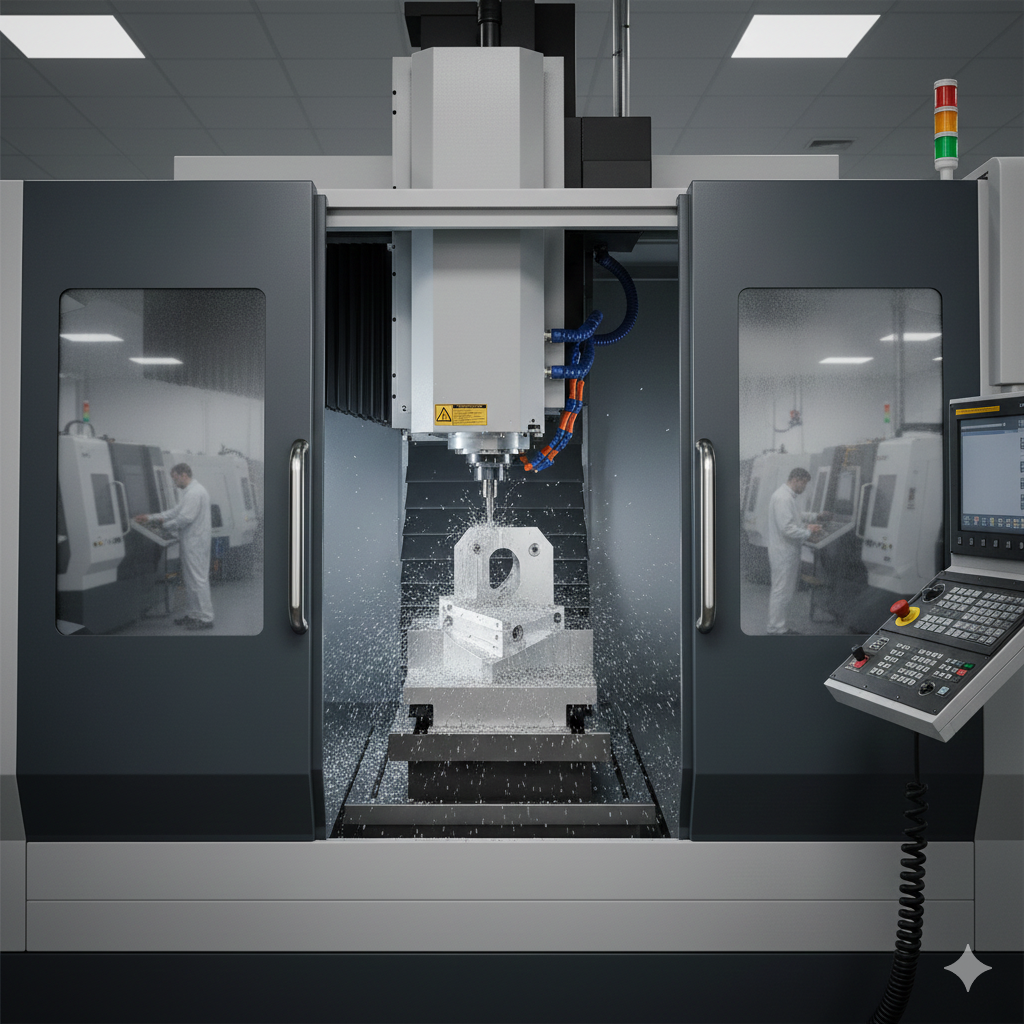
CNC Machining Parts Manufacturer: What Determines Part Accuracy, Lead Time, and Risk
In CNC machining, problems rarely start with machines.
They start with process assumptions.
Parts arrive on time but fail during assembly.
Samples pass inspection, but batch consistency drifts.
Drawings are followed, yet tolerance stack-up causes fit issues downstream.
In most cases, the root cause is not programming skill.
It is how the manufacturer controls the entire machining system, not just the cutting step.
CNC Machining Is a Process Decision, Not a Quotation Line
From a buyer’s perspective, many CNC suppliers appear similar.
They list comparable machines, materials, and tolerances. Prices vary, but not dramatically.
From a project perspective, the difference is significant.
A CNC machining parts manufacturer determines:
-
how tolerances are interpreted, not just stated
-
how material variability is handled across batches
-
how process drift is detected before parts fail
-
how quickly issues are corrected once production starts
Once production ramps up, these factors define whether a supplier becomes a long-term partner or a recurring risk.
Where CNC Machining Problems Usually Surface
Most CNC issues do not show up in first-article inspection.
They emerge later, quietly, and expensively.
Common real-world scenarios include:
-
dimensions staying “in tolerance” but failing functional fit
-
surface finish changing between batches
-
burrs or edge deformation affecting assembly
-
inconsistent hole position due to fixture variation
None of these indicate a broken process.
They indicate a partially controlled process, which is often harder to fix than an obvious failure.
Tolerance Is About Control, Not Capability
Many suppliers advertise tight tolerances.
Fewer can hold them consistently.
What matters is not the minimum tolerance a machine can reach, but how reliably it can repeat it across material lots, shifts, and tool wear cycles.
Key control points include:
-
fixture repeatability
-
tool life monitoring
-
offset management strategy
-
in-process measurement frequency
Manufacturers that rely solely on final inspection tend to discover issues too late. Those that control variation during machining reduce scrap, rework, and delivery risk.
Material Handling Shapes Machining Outcomes
Material choice affects more than strength or cost.
It affects how parts behave during cutting and after release.
| Material factor | Impact on machined parts |
|---|---|
| Heat treatment condition | Influences dimensional stability |
| Internal stress | Causes post-machining distortion |
| Batch consistency | Affects repeatability |
| Surface condition | Alters cutting behavior |
Experienced CNC machining parts manufacturers adjust feeds, speeds, and sequencing based on material behavior—not just material grade.
This is especially critical for aluminum alloys, stainless steels, and alloy steels used in structural or load-bearing applications.
Why Process Sequencing Matters
Machining order is not arbitrary.
It defines how stress is released and where distortion appears.
For example, removing material symmetrically can reduce part movement. Poor sequencing can produce parts that pass inspection but deform during assembly or service.
Suppliers with mature process planning treat sequencing as a design decision, not an afterthought.
This is one of the clearest indicators of manufacturing maturity.
Batch Production Is Where Suppliers Are Truly Tested
Prototype success proves feasibility.
Batch stability proves capability.
In real projects, the challenge is not making one correct part, but making hundreds or thousands of identical parts over time.
Key indicators of batch stability include:
| Control area | What it reveals |
|---|---|
| SPC records | Process repeatability |
| Tool change tracking | Drift prevention |
| Fixture maintenance | Positional consistency |
| Corrective action logs | Response speed |
Manufacturers such as Jingle structure CNC production around batch repeatability rather than one-off optimization, reducing risk during long-term supply programs.
Lead Time Is a System Outcome
Lead time is often treated as a scheduling promise.
In reality, it is the result of upstream discipline.
Reliable lead time depends on:
-
material availability planning
-
fixture readiness
-
program validation before release
-
capacity buffering for variation
Suppliers who compress lead time by skipping validation steps often create downstream delays through rework or re-approval cycles.
Predictable lead time matters more than aggressive promises.
Where a CNC Machining Parts Manufacturer Adds Real Value
A capable manufacturer does more than cut metal.
They reduce risk by:
-
flagging tolerance conflicts early
-
suggesting manufacturable geometry adjustments
-
stabilizing batch output
-
documenting process control clearly
This support shortens project cycles and prevents avoidable redesigns—benefits that rarely appear on quotations but dominate total project cost.
CNC Machining Across Industrial Applications
CNC machined parts support a wide range of industries:
| Application sector | Typical part role |
|---|---|
| Construction hardware | Load-bearing connectors |
| Industrial equipment | Structural and motion components |
| Energy systems | Mounting and interface parts |
| Automotive supply | Brackets, housings, adapters |
| Automation | Frames and alignment components |
Across all sectors, the common requirement is predictable performance, not just dimensional accuracy.
Capability Is Proven in Consistency
Choosing a CNC machining parts manufacturer is less about machines and more about control discipline.
Suppliers who understand variation, material behavior, and batch dynamics deliver parts that assemble smoothly, ship on time, and perform as expected. Those who do not create hidden costs that surface later.
The difference becomes clear only after production begins.
To explore industrial CNC machining capabilities and related fastening solutions, visit the Jingle home page or reach out through the contact page for project-specific discussions and documentation support.