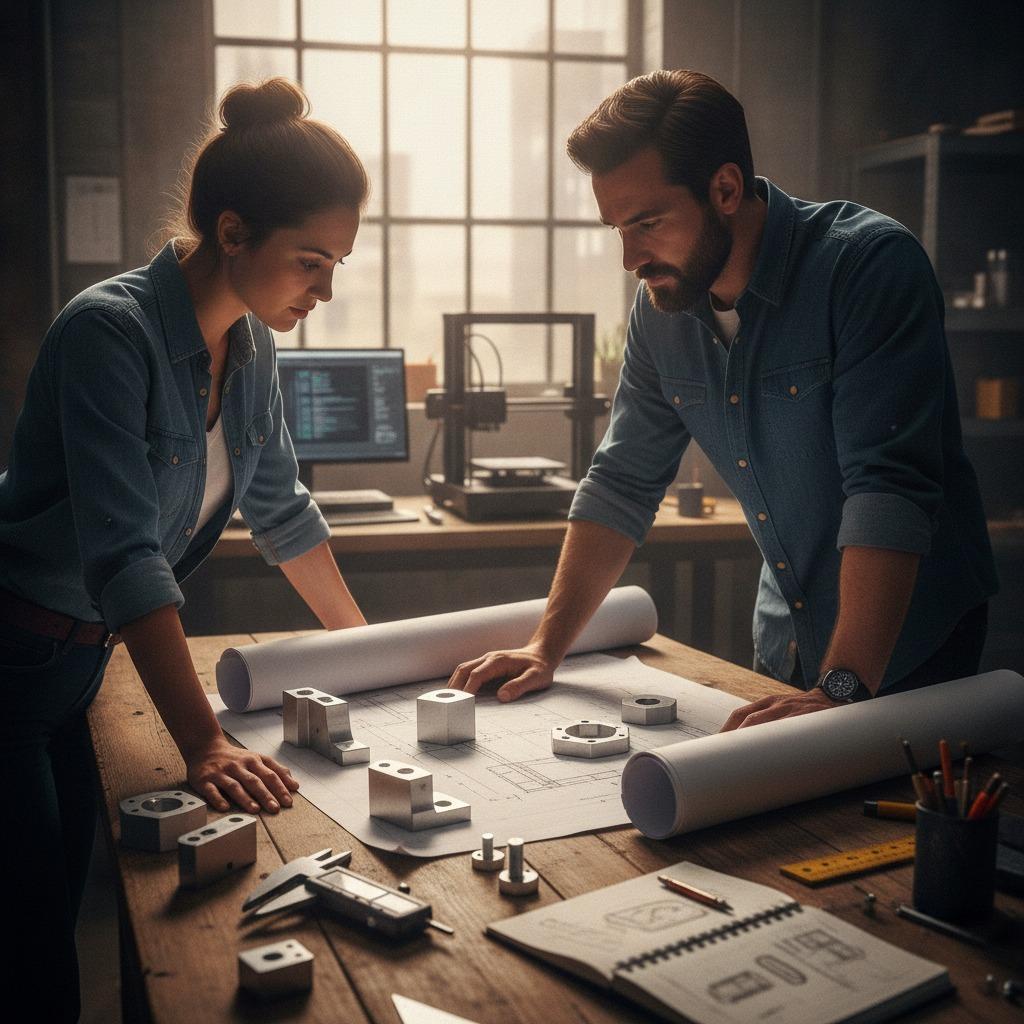
CNC Milling vs. Conventional Milling: 6 Key Differences That Redefine Modern Machining
The Turning Point in Modern Manufacturing
Metal cutting has evolved from hand-operated tools to computer-controlled systems capable of micron-level accuracy.
For decades, conventional milling was the foundation of metal fabrication—skilled machinists guiding handwheels, reading dials, and feeling resistance through their fingertips.
Then came CNC milling, replacing human reaction with digital precision.
But this shift isn’t simply automation—it’s transformation.
The difference lies not only in how the machine moves, but in how predictably it repeats every motion.
At Jingle, both technologies have their place. But in high-tolerance production, CNC milling sets the new benchmark for repeatability, cost control, and efficiency.
1. Control Mechanism: Manual Skill vs. Digital Accuracy
Conventional milling relies on an operator’s hand-eye coordination and mechanical gauges. Each pass depends on human steadiness.
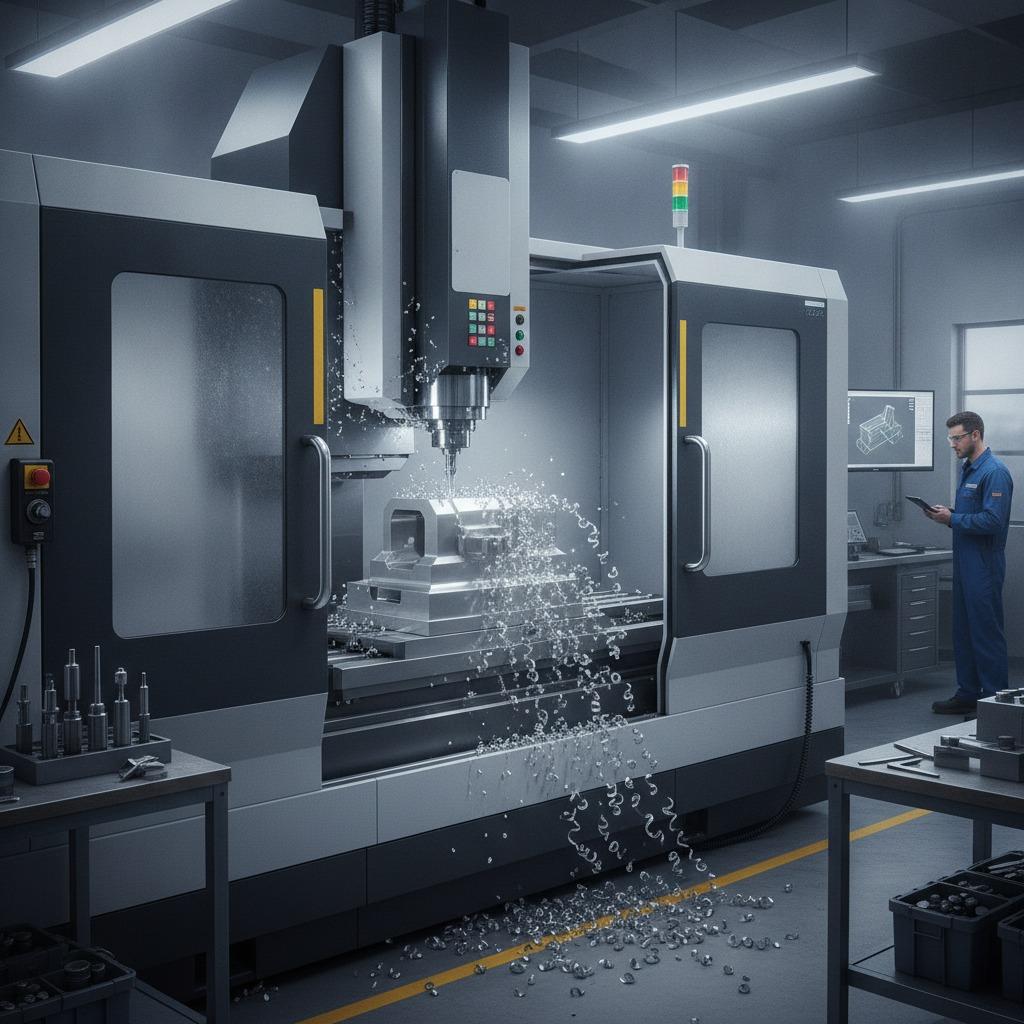
CNC milling, by contrast, uses computer numerical control systems to interpret G-code, allowing automatic, multi-axis tool movement.
In practice:
-
Human error in manual milling leads to dimensional variance.
-
CNC systems repeat complex toolpaths with ±0.01 mm precision.
-
Modern CNCs integrate real-time feedback loops to auto-correct deviations.
At scale, this means fewer reworks, faster throughput, and parts that fit perfectly—every time.
2. Complexity and Geometry Capabilities
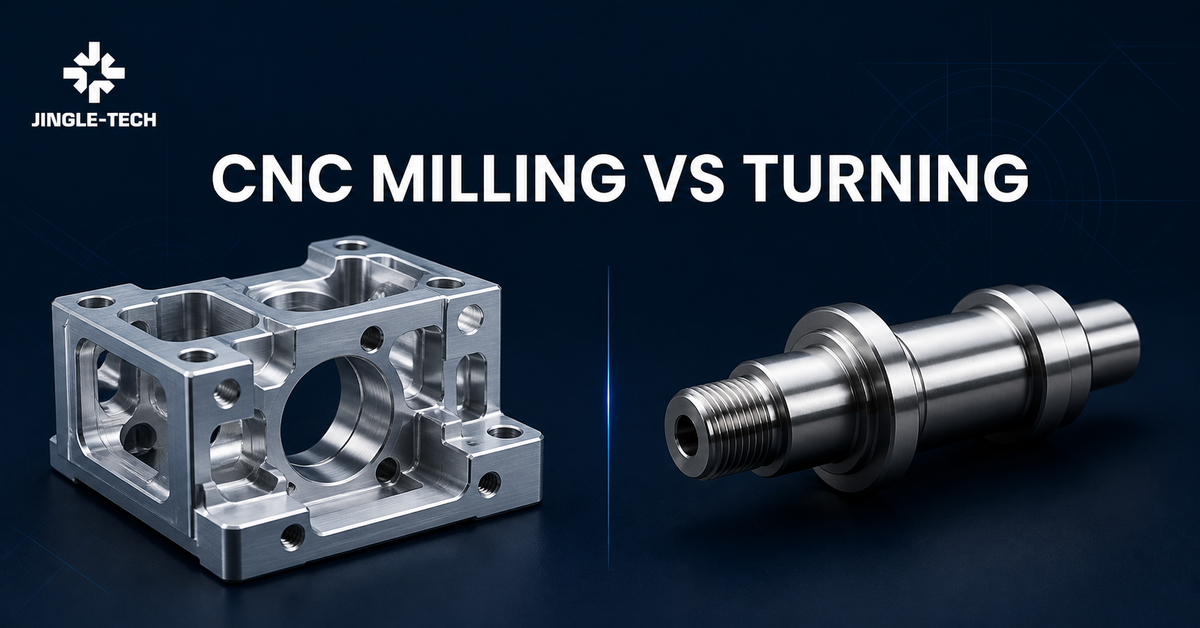
Conventional milling works well for flat or simple profiles. But when you need contoured surfaces, deep pockets, or compound angles, manual operation reaches its limit.
CNC milling supports:
-
5-axis machining for multi-directional cutting.
-
Automatic tool changes for complex geometries.
-
Multi-surface contouring in one continuous operation.
This enables production of aerospace housings, automotive molds, and medical instruments—all of which demand precise multi-plane accuracy.
Jingle’s CNC division routinely handles parts that once required three or more setups, completing them in one pass for unmatched consistency.
3. Efficiency and Throughput
In traditional milling, efficiency depends on the operator’s stamina and attention span.
CNC milling, however, runs 24/7 with minimal supervision, translating programming into thousands of identical parts.
| Metric | Conventional Milling | CNC Milling |
|---|---|---|
| Setup Time | Manual alignment | Preprogrammed coordinates |
| Operation | Continuous human input | Fully automated |
| Production Speed | Moderate | Up to 3× faster |
| Operator Fatigue | High | Minimal |
| Repeatability | Variable | Consistent |
This automation allows Jingle to maintain high-volume delivery schedules without compromising tolerance or finish quality.
4. Precision and Repeatability
Accuracy in manual milling depends on operator experience, machine condition, and environmental stability.
CNC machining removes those variables.
Key precision factors:
-
Digital coordinate control: Toolpaths defined in microns.
-
Thermal compensation systems: Prevent expansion-based drift.
-
Servo motor calibration: Maintains accuracy across cycles.
In testing, Jingle’s CNC milled components consistently achieve ±0.005 mm repeatability, outperforming conventional setups by up to 80%.
5. Flexibility and Automation Integration
Conventional machines are limited to one part at a time and rely on mechanical stops for repeat jobs.
CNC systems integrate with CAD/CAM software, robotic arms, and automated material loaders—forming a digital ecosystem that accelerates production.
At Jingle, automation extends beyond cutting:
-
Robotic pallet changers minimize idle time.
-
Machine learning algorithms optimize tool wear prediction.
-
Cloud-based monitoring ensures real-time quality tracking across global plants.
This synergy transforms CNC milling into a smart manufacturing hub, not just a machining tool.
6. Cost Structure and Long-term Value
At first glance, CNC equipment costs more. But over time, its advantages outweigh the initial investment.
Cost Implications:
-
Lower labor overheads.
-
Reduced scrap and rework.
-
Faster turnaround for repeat batches.
-
Predictable quality for international compliance (ISO / DIN).
| Aspect | Conventional Milling | CNC Milling (Jingle) |
|---|---|---|
| Initial Cost | Low | High |
| Long-term ROI | Moderate | Excellent |
| Waste Rate | High (manual error) | Minimal (automated control) |
| Labor Skill Demand | High manual expertise | Programmable repeatability |
For manufacturers aiming at global supply chain consistency, CNC milling provides precision that scales—something manual operations can’t sustain economically.
Industry Applications Where CNC Milling Dominates
1. Automotive Systems
Engine blocks, transmission cases, and custom aluminum components.
2. Aerospace Manufacturing
Titanium and Inconel parts with multi-axis contours and low defect tolerance.
3. Renewable Energy
Machined wind turbine hubs and solar mounting structures.
4. Tooling and Mold Fabrication
Mold cavities with complex geometries and mirror finishes.
5. Construction Hardware
Custom couplers, rebar inserts, and precision anchors for large-scale infrastructure.
By integrating CNC precision into every production stage, Jingle ensures components meet structural, functional, and aesthetic requirements across industries.
FAQ: Understanding the CNC Edge
Q1: Does CNC always outperform conventional milling?
Not in small-batch prototyping where manual adjustments are faster. But for precision and consistency, CNC is unmatched.
Q2: Can CNC machines replace skilled machinists?
No—human expertise in toolpath optimization and fixture design remains essential. CNC amplifies skill; it doesn’t erase it.
Q3: What materials benefit most from CNC milling?
All metals—from soft aluminum to hardened alloy steels—benefit due to precise feed-rate and temperature control.
Q4: Is maintenance more complex for CNC systems?
Maintenance is more technical but less frequent. Regular calibration ensures consistent quality with minimal downtime.
The Future Is Precision-Driven
The difference between CNC and conventional milling reflects the evolution of manufacturing itself—
from craftsmanship to computational accuracy.
At Jingle, our investment in CNC technology delivers not just precision, but predictability.
Each component is cut, measured, and verified with the same perfection—no matter the batch size or material complexity.
For OEMs seeking scalable precision and repeatable quality, explore our machining solutions on the homepage or get in touch via the contact page.