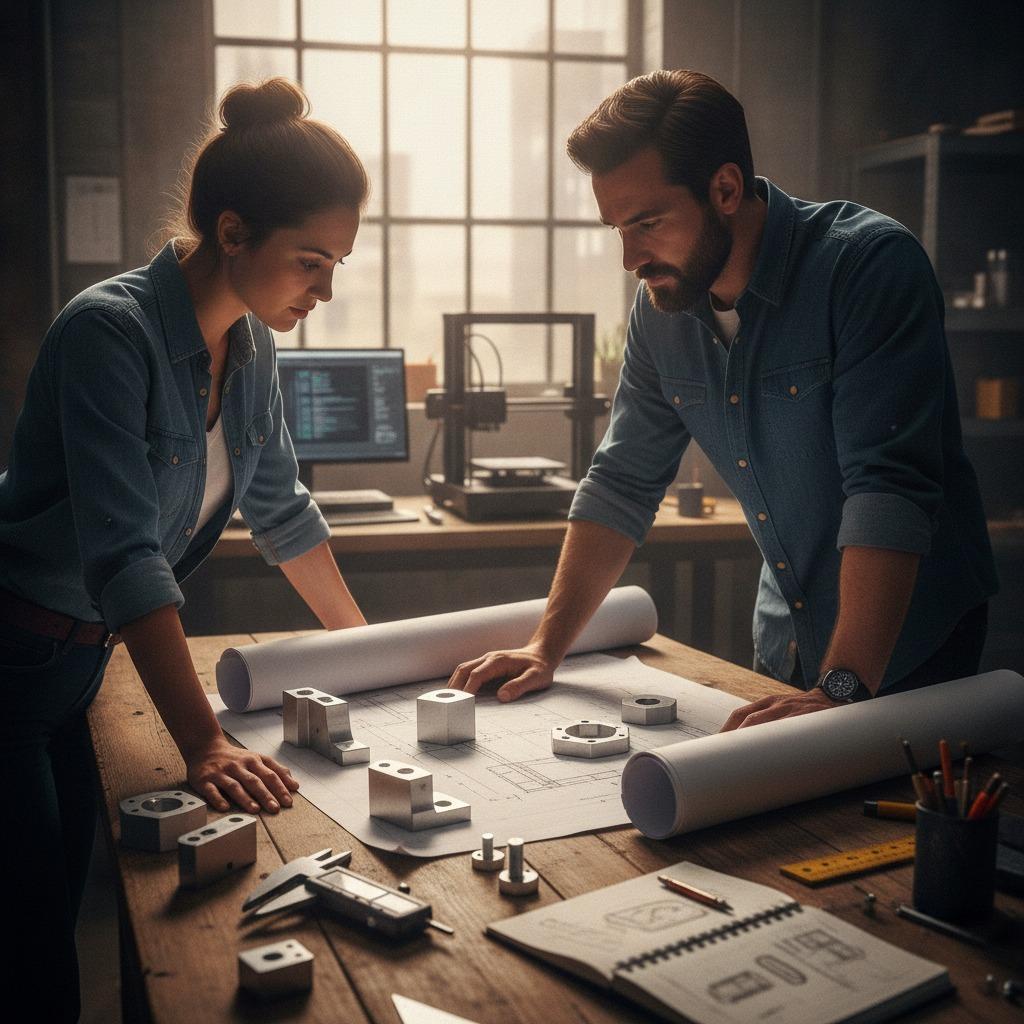
Why non-standard parts matter more than many teams admit
Non-standard parts are the pieces that keep a product moving when off-the-shelf components stop fitting the job. For engineers and sourcing teams, they are usually not a luxury; they are the practical answer to an awkward geometry, a packaging constraint, a legacy interface, or a performance requirement that standard catalog items cannot meet. That is why the discussion around non-standard parts is rarely just about fabrication. It is about risk, repeatability, and how much design freedom a program really has.
In many projects, the first version can be assembled from standard hardware. The trouble appears later: a bracket needs a different hole pattern, a shaft needs an unusual shoulder, a housing needs extra clearance for an adjacent assembly, or a replacement component has to match an older machine with no current equivalent. At that point, the buying decision shifts. The question is no longer “Can we find something close?” but “How do we get the exact function we need without creating long-term supply problems?”

What buyers are really comparing
When teams evaluate custom or non-standard components, they are usually balancing five practical factors: fit, function, material choice, production method, lead time, and the ability to reorder the same item later. That last point is easy to overlook. A one-off part may solve an urgent issue, but if the design is not controlled, the next purchase can become a fresh engineering exercise.
For sourcing managers, the real value of a reliable non-standard parts supply is consistency. The dimensions may be unique, but the buying process should not be chaotic. Clear drawings, revision control, agreed inspection points, and a defined material specification matter more here than they do in many catalog purchases. A part that looks simple on paper can become expensive if tolerances are poorly communicated or if the material choice is left vague.
Common types of non-standard parts in manufacturing
Machined components
These include shafts, spacers, adapters, housings, bushings, mounting plates, and other parts shaped to exact requirements. Machining is often chosen when dimensional accuracy, surface finish, or small-batch flexibility is important. It is a familiar route for mechanical assemblies that need a dependable fit without high tooling investment.
Fabricated structural pieces
Brackets, frames, guards, and support assemblies often fall into this category. They may look ordinary, but the details matter: weld placement, hole alignment, stiffness, and how the part behaves under load. For these items, the drawing should show the load path as clearly as the geometry.
Application-specific replacement parts
These are often the most urgent. A production line, field installation, or older machine may require a replacement that no standard supplier lists anymore. In those cases, reverse engineering, sample matching, and careful verification become part of the sourcing work. A small dimensional mismatch can turn a repair into a second shutdown, which nobody wants.
Selection criteria that save trouble later
Teams usually make better decisions when they treat the specification as a buying document, not just an engineering note. Start with the function of the part. What must it carry, locate, seal, guide, connect, or protect? Then define the material family, any critical dimensions, and the inspection features that matter most. If a surface condition matters for wear, sealing, or appearance, say so plainly.
It also helps to think about manufacturability early. Some non-standard parts are perfectly reasonable to make, but not in the shape originally sketched on the first pass. A small change in corner radius, wall thickness, or hole access can simplify production without changing the function. That kind of adjustment is often where a good supplier adds real value.
Common mistakes buyers still make
The first mistake is assuming “custom” automatically means “better.” It does not. If a standard part does the job safely and economically, use it. The second mistake is sending an incomplete drawing or a rough sample and expecting the supplier to infer the rest. That is how variation creeps in. The third mistake is failing to control revision history, especially when multiple departments touch the same design.
There is also a quiet commercial risk: choosing the lowest quote without asking how the part will be made. A cheaper offer may be fine, but it may also rely on a process that is harder to repeat, inspect, or scale. For recurring programs, repeatability is often worth more than the first-round saving.
Practical buyer advice before you place the order
Before committing, confirm three things: the final drawing or sample, the material or equivalent material standard, and the inspection method for critical dimensions. If the part is going into an assembly, check whether it needs to be compatible with adjacent components, coatings, fasteners, or thermal conditions. These are small details until they are not.
For recurring demand, ask how the supplier manages reorders and revisions. A well-run non-standard parts program should make the second order easier than the first. If every repeat order starts from zero, the supply chain is not really controlled.
FAQ: quick answers for sourcing and engineering teams
Are non-standard parts always more expensive?
Not always. They can be economical in low volumes or when they prevent larger system changes. What matters is the total cost of ownership, not just unit price.
Do custom parts take longer?
Usually, yes, especially if drawings need clarification or if tooling is required. But the timeline depends heavily on complexity and how complete the inputs are at the start.
When should a team choose a non-standard part over a standard one?
Use the custom route when the application genuinely needs a specific fit or performance feature that catalog parts cannot deliver reliably.
Next step for a better buying decision
If your project depends on non-standard parts, the most useful next step is often not a quote request; it is a tighter specification. Clean up the drawing, define the must-have dimensions, and document the intended function in plain language. That gives both engineering and procurement a better basis for comparing offers and reduces the chance of a part that looks acceptable but behaves poorly in assembly.
In this category, precision is important, but clarity is what saves time. The better the input, the less guesswork on the shop floor and the fewer surprises when the parts arrive.