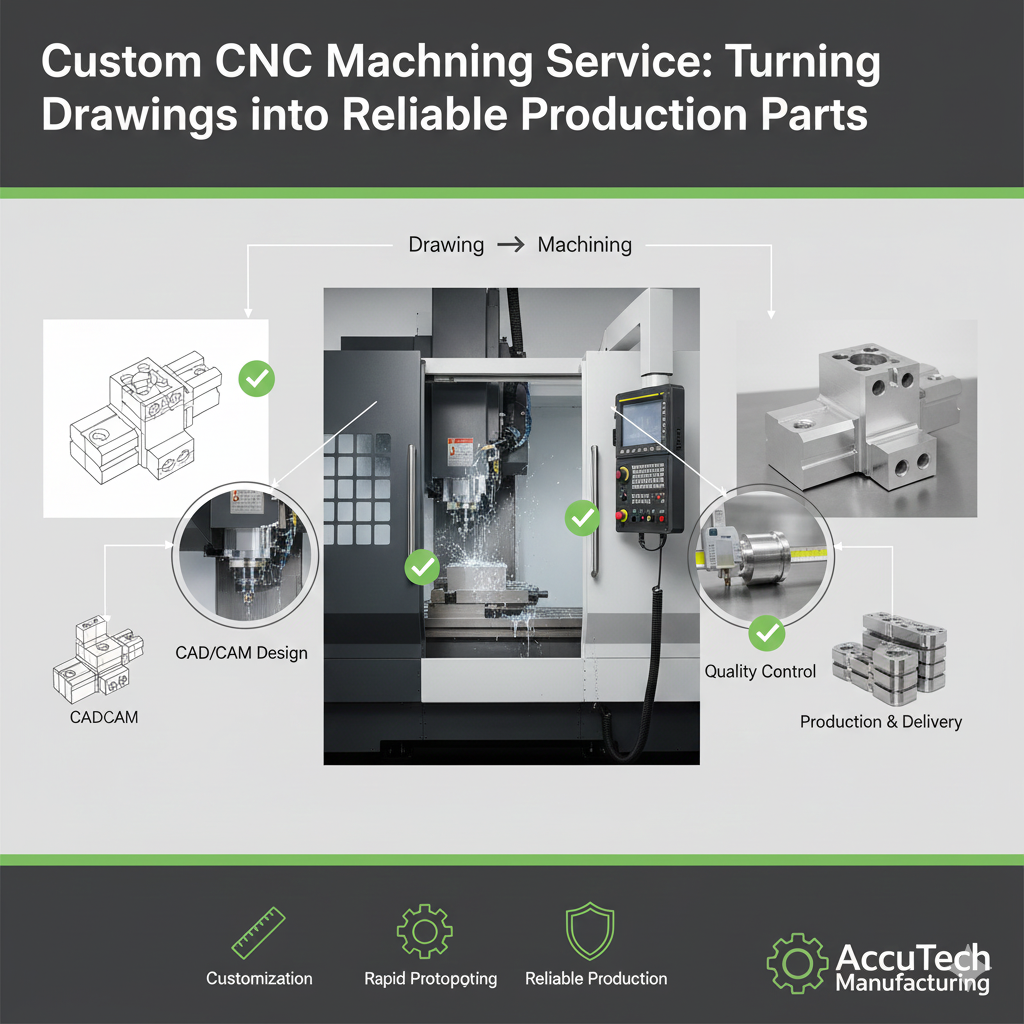
Custom CNC Machining Service: Turning Drawings into Reliable Production Parts
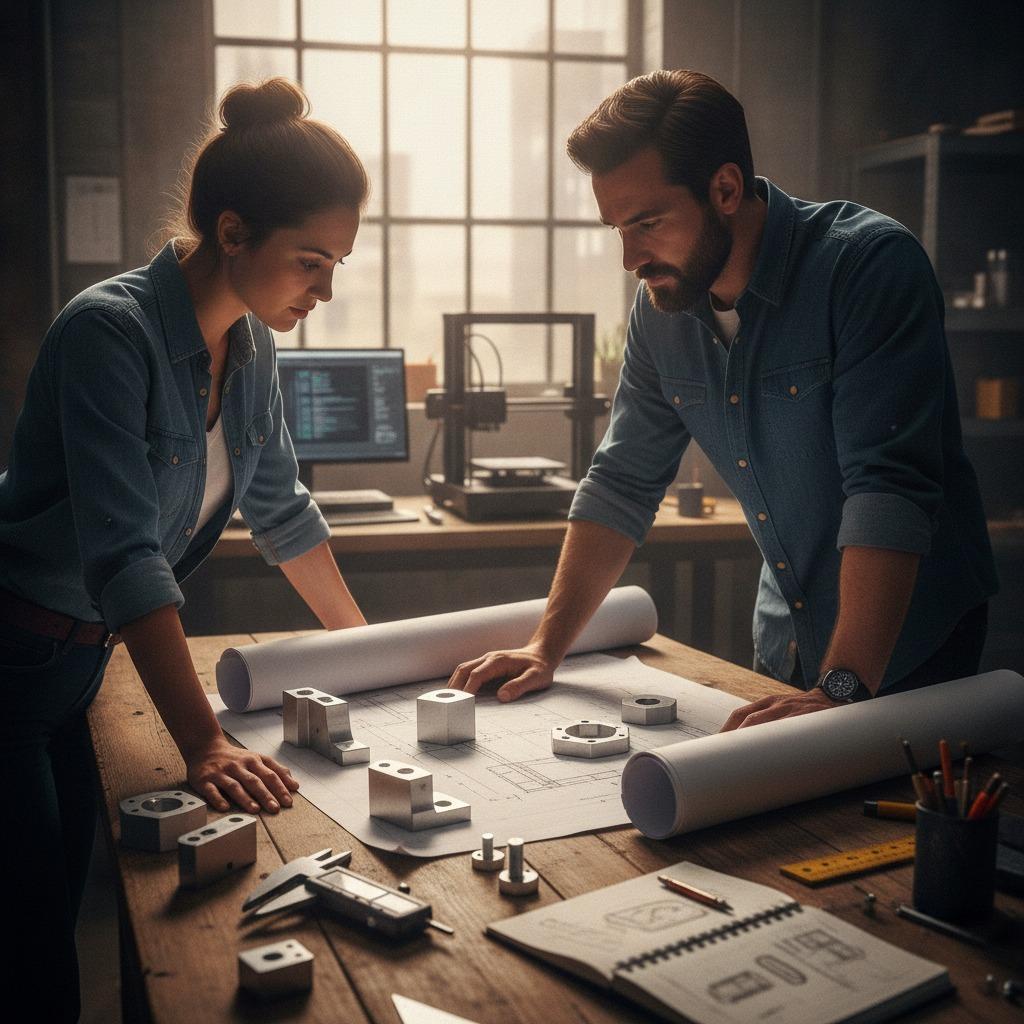
In custom CNC machining, the drawing is only the starting point.
What matters is how that drawing survives contact with material variation, tool wear, and production reality.
Many projects fail quietly at this stage.
The parts look correct. Measurements pass inspection.
Then assembly begins—and problems appear.
This gap between “to print” and “to function” is where a custom CNC machining service proves its real value.
Custom Machining Is a Translation Process
A drawing describes geometry.
A CNC machining service translates that geometry into a repeatable physical outcome.
This translation involves decisions that are rarely visible to buyers:
-
how tolerances interact across multiple features
-
how material stress is released during cutting
-
how fixturing affects part position over time
-
how inspection data feeds back into machining adjustments
Suppliers that treat custom machining as simple execution tend to push problems downstream. Those that treat it as a controlled system reduce uncertainty before parts ever reach assembly.
Where Custom CNC Projects Commonly Break Down
Most issues do not appear during prototyping.
They appear when quantity increases or when parts meet mating components.
Typical failure points include:
-
features meeting tolerance individually but conflicting in assembly
-
flatness or parallelism drifting between batches
-
surface finish affecting sealing or sliding interfaces
-
burrs and edge roll interfering with fit
These are not drawing errors.
They are process interpretation errors.
Tolerance Interpretation Shapes Real Outcomes
Custom parts often include tight or mixed tolerances.
What matters is not how tight they are, but how they interact.
Experienced CNC teams look for tolerance chains early and flag risks before cutting begins. In some cases, relaxing one dimension slightly improves overall functional fit. In others, machining sequence must change to preserve geometry.
This proactive review separates dependable suppliers from reactive ones.
Material Behavior Is Part of the Machining Plan
Material selection affects more than cost and strength.
It shapes cutting behavior, distortion risk, and surface quality.
| Material factor | Effect on custom CNC parts |
|---|---|
| Heat treatment state | Influences dimensional stability |
| Residual stress | Drives post-machining movement |
| Alloy consistency | Affects repeatability |
| Surface hardness | Alters tool wear rate |
A capable custom CNC machining service adjusts feeds, speeds, and machining order based on how material behaves, not just what it is called on paper.
Why Process Sequencing Matters More Than Speed
Machining faster does not mean machining better.
Removing material in the wrong order can release stress unevenly, leading to parts that look correct initially but shift later. Proper sequencing reduces deformation and protects critical features.
This is especially important for thin-wall parts, brackets, and structural components used in construction hardware or industrial assemblies.
Prototype Success Is Not the Finish Line
Prototypes prove feasibility.
Production proves reliability.
The real test of a custom CNC machining service is whether it can deliver:
-
stable dimensions across batches
-
consistent surface condition
-
predictable lead times
-
clear corrective actions when variation appears
| Production control area | Why it matters |
|---|---|
| SPC tracking | Reveals drift early |
| Tool life management | Prevents sudden variation |
| Fixture validation | Maintains feature alignment |
| Change documentation | Ensures repeatability |
Manufacturers such as Jingle structure custom machining around batch stability rather than one-off optimization, reducing risk once programs scale.
Lead Time Reflects Process Discipline
Quoted lead time is a promise.
Delivered lead time is a result.
Reliable delivery depends on preparation: material readiness, program validation, and capacity planning. Suppliers that shorten lead time by skipping these steps often recover that time later through rework or delay.
For buyers, consistency matters more than speed.
Where Custom CNC Machining Adds Real Project Value
A strong custom CNC machining service contributes beyond part supply:
-
highlighting manufacturability risks early
-
suggesting geometry adjustments that simplify production
-
stabilizing output for long-term programs
-
supporting design revisions without disruption
These contributions reduce total project cost, even when unit price appears higher.
Custom CNC Machining Across Industries
Custom CNC machining supports diverse applications:
| Industry | Typical part use |
|---|---|
| Construction hardware | Structural connectors |
| Industrial equipment | Frames and mounts |
| Energy systems | Interface components |
| Automotive supply | Brackets and housings |
| Automation | Alignment-critical parts |
Across all cases, the common requirement is not complexity—but reliability.
Conclusion: Custom Means Controlled, Not Complicated
Custom CNC machining succeeds when complexity is managed, not amplified.
Suppliers who understand tolerance interaction, material behavior, and batch dynamics deliver parts that assemble smoothly and perform consistently.
Those who do not create hidden costs that surface later.
To explore custom machining capabilities and related industrial components, visit the Jingle home page or reach out via the contact page for project-specific discussions and documentation support.