


-
Custom & OEM Screws · Pillar sourcing guide
Custom Screw Manufacturer: Complete OEM Sourcing Guide
The expensive screw problem is rarely obvious at quotation stage. It appears later, when a drive recess strips during assembly, a tapping screw forms a weak thread in the production sheet, or a coating changes fit enough to upset a previously stable joint. A part can match its drawing and still be wrong for the job because the drawing never described the job.
This guide is for OEM buyers, engineers, and quality teams sourcing machine screws, self-tapping screws, self-drilling screws, or made-to-print screws produced by cold forming, machining, and mixed routes. It shows how to define the joint, choose the right sourcing path, issue a controlled RFQ, review samples, and compare suppliers on evidence rather than claims.
It does not certify JINGLE—or any supplier—for a particular process, standard, material, or market. Those facts require project-level confirmation. The practical value here is the method: a buyer can use it with any qualified bidder and retain a clear record of why the award was made.
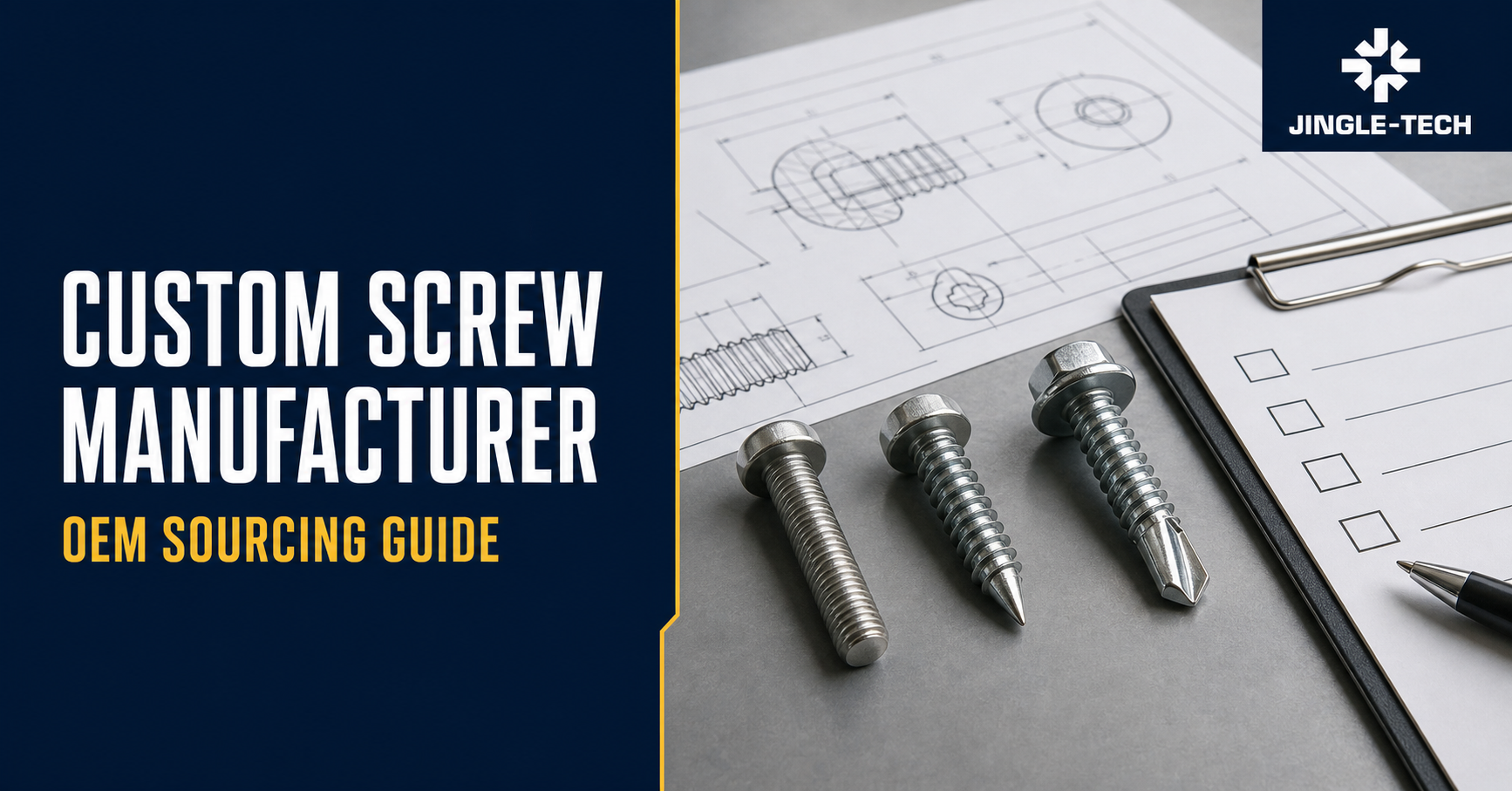
Start with the joint and engagement path; the manufacturing route follows from that decision. Where This Custom Screw Manufacturer Guide Fits in the Sourcing Decision
This page is the pillar for the Custom & OEM Screws topic cluster. It answers the broad program question: how should an OEM move from joint requirement to approved source? Two supporting guides handle narrower decisions. Use self-tapping vs self-drilling screws when the unresolved issue is whether the fastener must enter a prepared hole or drill its own. Use the guide to custom screw cost when the technical scope is stable and the team needs to understand the quotation.
The buyer’s search intent changes during the same project. Early research is informational: terminology, screw families, materials, and processes. The middle is commercial investigation: which route fits, what evidence separates plausible suppliers, and how should bids be normalized? Transactional intent begins only after the drawing, demand, validation, and commercial boundary are clear enough to request samples and a repeat-production quote.
Before commissioning a special part, check whether an existing item in the fastener range closes the requirement. A custom feature should earn its place by solving an interface, assembly, service, availability, or performance problem. “We have always bought it this way” is not a functional requirement.
If the application and current definition are ready for a first review, summarize the joint, part revision, quantities by stage, required evidence, and destination. The contact page does not imply file-upload capability; agree on an approved method before transferring controlled drawings.
Machine Screw vs Self-Tapping vs Self-Drilling: Define the Product Before the Supplier
“Custom screw” is a commercial umbrella, not a manufacturing specification. One project may need a standard machine screw with unusual length and finish. Another needs a point and thread developed around a particular sheet stack. A third is an obsolete shoulder screw reconstructed from an assembly. Treating all three as the same commodity produces vague RFQs and incomparable prices.
Direct comparison of OEM screw families and their decisive inputs Screw family What happens during installation Input that often decides suitability Useful validation evidence Machine screw Engages a prepared internal thread in a nut, insert, or tapped component Mating-thread definition, engagement, bearing condition, access, and installation method Thread and dimensional results, material or property records, finish condition, joint trial when function requires it Self-tapping screw Forms or cuts a mating thread in a prepared hole Substrate material and condition, thickness, hole size and method, burr direction, and support Representative drive-to-seat and failure testing using controlled joint coupons Self-drilling screw Creates the hole, then advances and forms or engages the thread Complete layer stack, individual thicknesses, coatings, gap, drilling direction, and swarf risk Drilling and seating trials in a representative stack, with the tool and acceptance window recorded Custom cold-headed screw Uses forming for the main geometry, often followed by thread rolling and secondary operations Stable design, formable geometry, material condition, forecast, and tooling case Production-intent samples tied to the intended route and tool state Custom machined screw Removes material to create development, complex, larger, or locally precise features Datums, setups, burr control, thread method, quantity, and any future route change Setup-specific dimensional evidence and a separate approval plan if production later moves to forming Machine screws are defined by the mating interface
Diameter and pitch do not finish the callout. The internal thread, tolerance or class, engagement length, coating condition, bearing surface, and service cycle all affect the joint. A countersunk panel screw, captive service screw, and shoulder screw used as a pivot may share a nominal thread yet demand completely different head, drive, straightness, and wear controls.
Self-tapping screws are joint-specific, not simply “for metal” or “for plastic”
The substrate is part of the specification. Sheet grade, hardness, thickness, polymer condition, casting porosity, coating, pilot-hole method, and installation speed can move the result. The official scope of ISO 2702:2022 covers mechanical and physical properties and related tests for specified heat-treated steel tapping screws. It does not select a screw for an unknown substrate.
Self-drilling screws add a drilling process to the assembly line
The point must pass through the real stack before the thread can do useful work. A trial through one flat sheet says little about a joint containing two coated layers, a gap, and a hidden obstruction. ISO 10666:1999 is an official reference for drilling screws with tapping screw thread within its scope; the OEM still owns the representative application and acceptance criteria.

A buyer’s verification path connects the application, controlled drawing revision, process route, and relevant quality evidence. How to Choose a Custom Screw Manufacturer for an OEM Program
Do not begin with a machine list. Begin with the part and the decisions that can still move. A capable route may involve forming, machining, rolling, heat treatment, coating, patching, sorting, or assembly across more than one site. What matters is whether those steps produce the approved result and remain under one coherent control plan.
1. Make the joint understandable in one page
State what the screw does—clamp, locate, retain, adjust, seal, ground, or provide service access. Name the load and the unacceptable failure. Add a simple joint section showing every layer in order, including material, thickness, hole condition, insert, washer, adhesive, gasket, gap, and accessible bearing area. A supplier reviewing a pivot screw needs mating material and movement; a supplier reviewing a drilling screw needs the full stack and support condition.
2. Mark fixed requirements and genuine DFM freedom
Interfaces, regulatory notes, customer-controlled features, and validated characteristics may be fixed. Other details may be inherited preferences rather than needs. Label those that engineering can review: head height, recess, point, underhead radius, thread length, local tolerance, material alternative, or process route. This prevents silent substitutions while giving useful manufacturing feedback somewhere to go.
3. Compare the quoted route with the program stage
A machined development sample may be entirely sensible, even when repeat production is expected to be cold headed. The risk lies in treating one as proof of the other. Record the sample route and production route separately. If material flow, thread method, heat treatment, finish, tooling, or natural variation will change, define what must be approved again.
4. Follow the critical feature through the process
Choose two or three characteristics that can stop assembly or damage function. Trace each one from material and tooling through outside processing, inspection, packaging, and shipment. A drive recess, for example, is affected by head formation, tool wear, coating, sorting, and driver-bit correlation. The route should explain that chain rather than rely on a final inspection promise.
5. Confirm ownership at process interfaces
Outsourced heat treatment or coating is common and not inherently weak. The practical questions are who approves the processor, how the drawing and special requirements flow down, what identifies the lot, who reviews results, and who leads containment if a problem crosses company boundaries. “Handled by our partner” does not define responsibility.
6. Judge the response, not the confidence
A useful technical reply points to the drawing: this radius affects forming; this recess leaves little head material; this thread limit must be interpreted after coating; this test needs the real substrate. Open questions are evidence of review when they are specific. A rapid “no problem” is not.
Custom Screw RFQ Checklist: Create One Controlled Version of the Truth
Good RFQs are not necessarily long. They are internally consistent. Put a file index on the first page with part number, revision, date, units, and the governing document if the 2D drawing and model disagree. Withdraw superseded files instead of correcting them through an email chain.
Information needed for a comparable custom screw quotation RFQ block Buyer provides Quotation makes visible Part definition Controlled drawing or complete standard and edition, model status, units, critical characteristics Revision quoted, deviations, ambiguities, and proposed DFM changes Application Joint function, stack, mating thread or hole, installation method, environment, unacceptable failure Application assumptions and missing facts that affect the route Technical result Thread, material, properties, heat treatment, finish, marking, cleanliness, appearance limits Production route, outside operations, applicable standards, and inspection basis Demand Development, validation, first release, normal release, forecast, and program timing Price breaks and tooling logic tied to usable quantities Approval evidence Sample purpose, tests, report format, traceability, acceptance owner Sample route, included records, production-intent status, and open approvals Commercial boundary Destination, requested delivery basis, packaging, labels, currency, validity request Separate tooling, samples, production, testing, packaging, logistics, assumptions, and exclusions Complete the thread, head, drive, and point definition
For the thread, include system, nominal diameter, pitch or threads per unit, tolerance or class, handedness where relevant, thread length, runout, incomplete-thread allowance, and point or lead-in. State whether limits apply before or after coating. Head and drive notes should cover bearing or countersink, access, recess depth, tool interface, and any feeding requirement. A special point needs a stated job, not only a sketch.
Use standards with their scope and edition
ASME’s official page for ASME B18.6.3-2024 identifies inch-series machine screws, tapping screws, and metallic drive screws. The designation is useful only when its scope matches the part. Likewise, ISO 898-1:2013 covers specified mechanical and physical properties for certain carbon- and alloy-steel metric bolts, screws, and studs while identifying exclusions and limitations. A familiar standard number is not a universal performance claim.
Protect drawings and IP before technical transfer
Classify the data before it leaves the company. Share only what the review needs, mark controlled information, confirm the legal entity and intended recipients, agree confidentiality terms where required, and use an approved transfer method. Do not assume a website contact form supports secure drawing upload. Record who may retain, reproduce, or pass information to sub-suppliers, and what happens when the review ends.
Once the package is internally consistent, the next step is a drawing-specific feasibility conversation—not an automatic production release. Sample availability, commercial quantity, timing, tests, and data-transfer method all remain subject to confirmation.
Custom Screw Manufacturing Process: Cold Heading, Machining, and Mixed Routes
There is no honest rule that cold heading is always cheaper or machining is always faster. Geometry, material, quantity, tool availability, secondary features, and approval stage change the answer. The quotation should name the route used for samples and the route intended for repeat production.
Cold heading and thread rolling
Forming can suit repeat screws when the material and geometry can flow through a practical tool sequence. Head volume, recess depth, flange shape, diameter reductions, underhead radius, and point are connected. Rolled threads add their own questions: blank condition, roll timing relative to heat treatment, thread runout, and limits after finish. A formed route is credible when those relationships appear in the DFM response.
CNC machining
Machining may fit early development, larger parts, local precision, cross-holes, shoulders, undercuts, or geometry unsuited to the proposed forming route. It also brings concrete controls—datum strategy, number of setups, tool access, burrs, edge condition, thread method, and measurement access. If demand later justifies forming, treat that change as a new process state rather than a quiet cost reduction.
Mixed routes and outside processes
Many custom screws are formed, machined locally, rolled, heat treated, coated, patched, sorted, and packed. Purity of process is irrelevant. Control of the handoffs is not. The route should show where lot identity travels, where characteristics can move, what evidence returns from outside processors, and which team has authority to stop release.
Tooling and change control
Separate tooling from part price. Document ownership, dedication, storage, maintenance, replacement, expected condition at sample approval, and treatment of design changes. Then define which changes require notice: production site, material, tool concept, thread method, heat-treatment route, coating system, outside processor, inspection method, or packaging that can affect condition. The boundary should fit the program’s risk; it should not be copied blindly from another commodity.
Custom Screw Quality Documentation: Buy Evidence That Answers a Risk
A thick report package can still miss the critical question. Match each record to a failure it is meant to prevent. Dimensional results address measured geometry. Material evidence supports identity or properties. A coating record addresses a defined finish. Functional testing addresses the screw in a controlled joint. One certificate does not replace the others.
Material, heat treatment, and finish must agree
“Steel,” “stainless,” and “high strength” are incomplete. Define grade or property requirement, condition, relevant standard, and the evidence due at sample and production stages. Heat treatment interacts with geometry, thread production, hardness, distortion, and surface condition. The finish changes more than color: thickness may affect fit, and friction may alter installation behavior.
The official scope of ISO 4042:2022 covers electroplated coating systems for fasteners within stated conditions and includes requirements and recommendations related to hydrogen-embrittlement risk. It is a useful specification reference, not a prediction of field life. The actual joint, service exposure, damage, and assembly method still govern suitability.
Lot definition and traceability
Decide what constitutes a lot and how material, production order, outside processing, inspection, package label, and shipment connect. The depth should reflect product and contractual risk. A buyer that never uses heat numbers or sub-lot identity should not request them by reflex; a regulated or safety-relevant program should not discover missing links after a failure.
Measurement correlation
Critical results can disagree when datum, fixture, preparation, equipment, or reporting convention differs. Correlate the supplier’s method with receiving inspection during approval. Thread gauges, optical measurement, contour systems, hardness tests, coating measurements, and functional fixtures answer different questions. Instrument names alone do not establish equivalence.
Production-intent samples
Label each sample state. Record drawing revision, route, material, tooling status, heat treatment, finish, deviations, reports, and the question being answered. A machined sample might confirm fit but not formed grain flow, natural variation, or the eventual thread-rolling process. Approval should say exactly what it authorizes.
Click the banner to discuss your drawing, application, sample plan, quality evidence, and quotation scope with JINGLE-TECH. Custom Screw Price and Lead Time: Compare the Assumptions Behind the Number
A unit price has meaning only beside its scope. Put quotations into a common sheet before ranking them. Confirm the same drawing revision, material, route, tooling state, sample plan, reports, packaging, quantity, and delivery basis. A lower number attached to a different requirement is not a saving.
Fields to normalize before selecting a custom screw manufacturer Field What must match Why the difference matters Technical scope Revision, thread, material, properties, finish, and approved deviations Bid prices may describe different parts Production route Sample and repeat-production methods, tooling state, and outside steps Sample evidence may not represent production Nonrecurring cost Tooling, fixtures, gauges, sample work, testing, and approvals Unit price can hide the cost of starting or changing the program Demand Sample, first release, normal release, and realistic price breaks An unusable order quantity transfers cost into inventory Lead-time basis Open decisions, material, tooling, sample approval, outside processing, production, and transit One quoted date may begin only after several unpriced approvals Delivery boundary Packaging, labels, freight, duty, insurance, destination, and local charges Ex-works price and landed operating cost are not the same Lead time should be shown as a chain of dependencies, not one unexplained promise. Separate technical clarification, tooling, material, sample production, report review, customer approval, repeat production, outside processing, packing, and transport. If the design is still moving, the schedule is conditional. The most useful quote says so.
For cost reduction, return to the requirement. One recess, undercut, tolerance, coating, test, or pack format may drive the route. Engineering can then decide whether that feature earns its cost. An arbitrary percentage demand produces less information and may simply move risk into an exclusion.
A Practical Custom Screw Supplier Scorecard
Use a scorecard only after bids are technically normalized. Weighting can reflect the program, but every score needs a note or document behind it.
- Application understanding: the response identifies the joint facts that affect screw choice and validation.
- Route credibility: sample and production processes are stated, with meaningful DFM tradeoffs.
- Control of critical features: process and measurement methods fit the characteristics that carry risk.
- Outside-process ownership: flow-down, lot control, records, and containment responsibility are clear.
- Sample relevance: the proposed sample state can answer the written approval question.
- Commercial clarity: tooling, quantities, lead-time dependencies, packaging, delivery terms, and exclusions are visible.
- Communication discipline: revisions, open items, deviations, and changes have named owners and a durable record.
Certificates belong in the file, but they should be read narrowly. A management-system certificate applies to the entity, site, scope, standard, certification body, and validity shown. It does not certify a particular screw to your drawing. Product conformity still depends on the approved definition, process controls, tests, and lot-linked evidence.
For U.S. projects, NIST’s official Fastener Quality Act compliance FAQ explains that coverage is limited and describes exclusions and record concepts. Applicability should be determined for the actual product and transaction; the fact that an item is called a screw is not enough.
Reusable OEM Screw Sourcing Workflow
- Frame the joint: function, stack, load, installation, environment, and unacceptable failure.
- Choose the family: prepared internal thread, prepared pilot hole, or drilling action.
- Control the definition: one revision set, complete callouts, fixed requirements, and DFM freedom.
- Shape the demand: development, validation, first release, normal releases, and forecast.
- Review the route: sample process, production process, tooling, outside operations, and change boundary.
- Design the evidence: representative samples, measurements, functional tests, records, and approval owner.
- Normalize the quote: recurring and nonrecurring cost, quantity, timing dependencies, packaging, and delivery basis.
- Release in stages: feasibility, sample authorization, sample disposition, production approval, and ongoing change control.
This sequence is deliberately reusable. The part, standards, and depth of evidence will change; the need for a visible decision trail does not.
Frequently Asked Questions About Custom Screw Manufacturers
How much do custom screws cost?
There is no responsible price without a defined screw and commercial scope. Geometry, material, forming or machining route, tooling, heat treatment, finish, inspection, samples, quantity, packaging, and delivery basis all contribute. Send quantities by program stage and require recurring and nonrecurring items to be separated. The custom screw cost guide provides the detailed comparison method.
What is the lead time for custom screw samples and production?
Lead time depends on how much technical work remains, material availability, tool design, sample route, heat treatment or coating, testing, customer approval, production quantity, and transport. Request a milestone schedule with dependencies. Do not treat a sample date as a production commitment, and do not assume the clock begins before open requirements are resolved.
What quality documents should come with custom screws?
Specify documents by name and purpose. Depending on the project, these may include dimensional results, material evidence, mechanical or functional test reports, heat-treatment or coating records, sample approval, lot identification, and a certificate of conformity. The applicable standard, contract, market, and risk determine the package; “full certificates” is too vague.
How can an OEM protect drawings and intellectual property?
Use the company’s legal and information-security process. Confirm the receiving legal entity, recipients, confidentiality terms, permitted sub-supplier disclosure, file markings, retention, and deletion expectations. Share only the data needed for the stage and use an approved transfer channel. A contact page is a conversation starter, not proof of secure upload.
Can a custom screw manufacturer quote from a physical sample?
A sample helps with identification and reverse engineering, but it cannot reveal original design intent, all tolerances, material condition, coating specification, mechanical requirements, or acceptance rules. Agree who will create and approve the new drawing, what testing establishes function, and whether destructive analysis is permitted.
Does every custom screw require new tooling?
No. The answer depends on geometry, route, quantity, development stage, and available tool concepts. A machined part may need programming and fixtures rather than heading dies; a repeat formed part may need dedicated tools. The quote should explain the tool scope, ownership, maintenance, replacement, and effect of drawing changes.
Should prototype screws use the final production process?
Production-intent samples reduce uncertainty, but a different route may be justified for early fit or assembly learning. Record the difference. If forming, thread production, heat treatment, finish, or tooling changes later, identify which tests and approvals must be repeated.
How do I compare self-tapping and self-drilling screws?
Begin with the hole-making requirement. A self-tapping screw generally enters a prepared hole and creates or cuts the mating thread. A self-drilling screw also creates the hole. The latter therefore depends on the full material stack and drilling condition. See the focused self-tapping vs self-drilling screw guide.
How do I know whether a supplier understands the joint?
Look for application-specific observations. A meaningful response connects the recess to the driver, the thread to the mating material, the point to the stack, the coating to fit and installation, and the sample state to the production route. Generic assurances do not show that work.
Can a quality-system certificate replace product testing?
No. A management-system certificate and product evidence answer different questions. Verify the certificate’s entity, site, scope, standard, issuer, and validity, then define the dimensional, material, mechanical, coating, functional, or traceability records required for the screw itself.
Prepare a Reviewable Custom Screw Inquiry
Bring the latest definition, joint description, mating component or substrate, quantities by stage, sample purpose, required records, packaging, destination, and open decisions. State what engineering may change and what it may not. Then request a route, deviations, sample status, assumptions, exclusions, and milestone schedule.
Use the contact page to ask whether the project can be reviewed. No capability, sample availability, minimum quantity, price, test scope, or delivery date should be assumed until it is confirmed against the actual requirement.
Research Basis: Traceable Primary Sources
These official pages support the terminology, product-scope, mechanical-property, coating, and regulatory cautions above. Confirm the correct document, edition, and applicability for the actual project; a public scope summary is not a substitute for the controlled standard.
- ISO 1891:2009 — Fasteners terminology
- ASME B18.6.3-2024 — Machine screws, tapping screws, and metallic drive screws (inch series)
- ISO 2702:2022 — Heat-treated tapping screws
- ISO 10666:1999 — Drilling screws with tapping screw thread
- ISO 898-1:2013 — Mechanical properties of specified carbon- and alloy-steel bolts, screws, and studs
- ISO 4042:2022 — Electroplated coating systems for fasteners
- NIST — Fastener Quality Act compliance FAQs
Custom Screw Manufacturer: Complete OEM Sourcing Guide
- fasteners
Posted by JINGLE On Aug 17 2026
Featured Blogs
Tag:
Share On
Featured Blogs
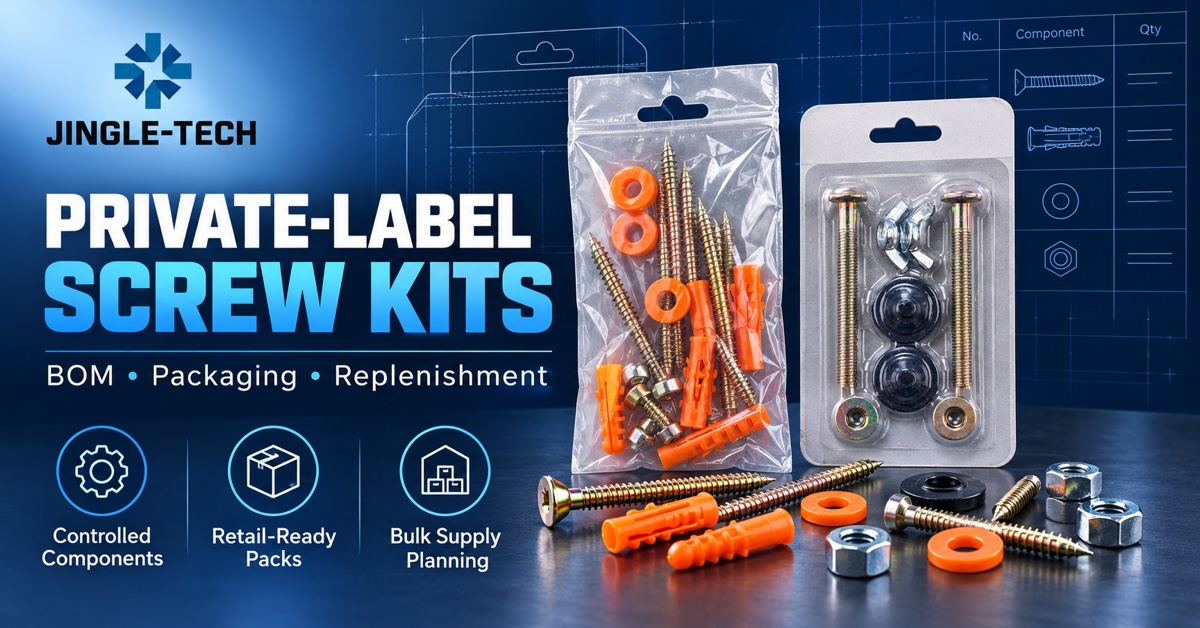
Private-Label Screw Kits for U.S. Distributors: BOM, Packaging, MOQ & Bulk Supply
A sourcing and replenishment guide for U.S. distributors buying private-label screw kits, with controlled BOMs, component validation, retail packaging, barcode and origin marking, count control, MOQ planning and repeat-order quality.
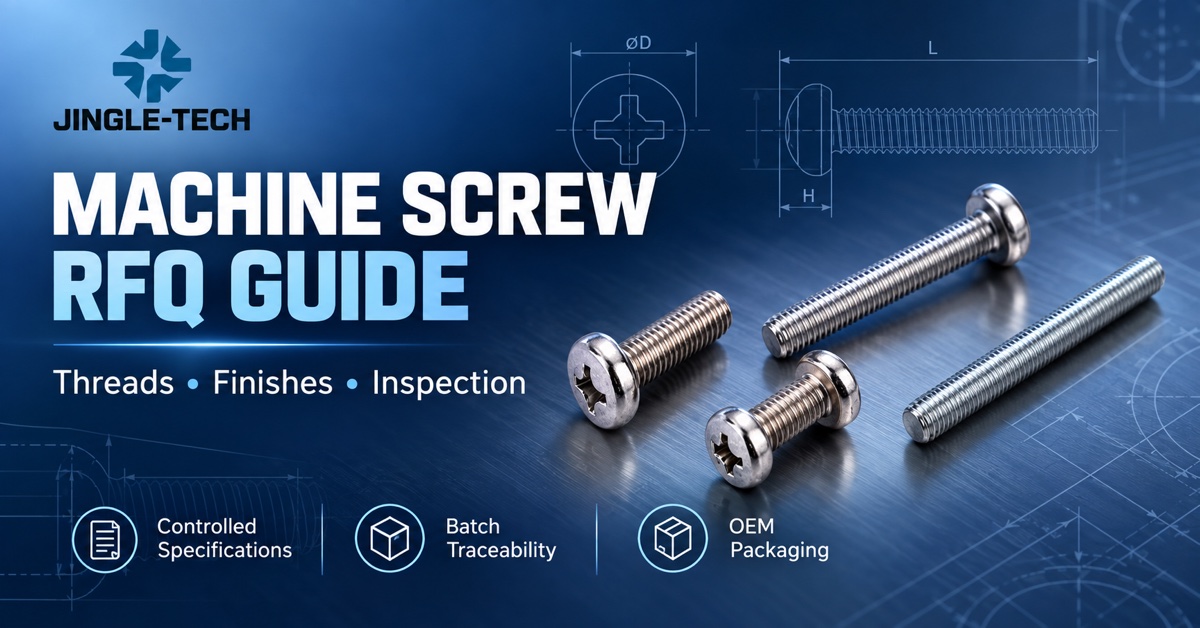
Machine Screw RFQ for U.S. OEMs: Threads, Finishes, Inspection & Supplier Checks
A practical U.S. OEM guide to preparing a quote-ready machine screw RFQ, covering thread systems, head and drive selection, materials, finishes, inspection, packaging, landed-cost comparison and supplier qualification.

Zinc Plated Fasteners Manufacturer Guide: Coating, Hydrogen Risk and RFQ
Choose a zinc plated fasteners manufacturer by checking coating systems, thickness, thread fit, hydrogen controls, corrosion tests, documents and RFQ scope.

Stainless Steel Fasteners Supplier Guide: Grades, Corrosion, Galling and RFQ
A buyer-focused guide to sourcing stainless steel bolts, screws and nuts by grade, property class, passivation, corrosion exposure, galling controls, inspection evidence and RFQ scope.
Worm Drive Hose Clamp Manufacturer Guide: Band, Housing, Screw, Corrosion and RFQ
A buyer-focused guide to specifying worm-drive hose clamp bands, housings, screws, materials, torque tests, corrosion evidence, private-label packaging and traceability.
High-Strength Bolt Supplier Qualification: Heat Treatment, Coating, Assembly and Lot Evidence
A practical buyer checklist for qualifying high-strength bolt suppliers through property class, heat treatment, coating, assembly validation, inspection records and lot traceability.