How to Choose an Industrial Fastener Manufacturer: 12-Point Buyer Checklist
Choosing an industrial fastener manufacturer is not only a price comparison. A bolt, screw, nut, washer, threaded rod, pin, or custom cold-formed part can meet a drawing on paper and still create problems in assembly, traceability, corrosion resistance, packaging, or repeat production. The right supplier must understand the application, translate the specification into a controlled manufacturing route, and prove that each production lot meets the agreed acceptance criteria.
This guide explains how to choose an industrial fastener manufacturer using a practical 12-point audit. It is written for purchasing managers, engineers, quality teams, project managers, importers, and industrial brands sourcing standard or custom fasteners.
Quick answer: Start with a complete RFQ, verify the supplier’s real process capability, check the scope of its quality system, define material and lot traceability, approve samples against a written inspection plan, and compare total landed risk—not unit price alone.
1. Begin with a complete fastener RFQ
A capable custom fastener manufacturer can only quote what the buyer has clearly defined. Sending a photo and a quantity may be enough for an early discussion, but it is rarely enough for a production-ready quotation. Missing requirements often return later as change charges, schedule delays, or quality disputes.
Your RFQ should identify the part, its intended use, the applicable drawing revision, and every requirement that affects performance or cost. If the part is safety-critical, the buyer or project engineer must also identify the governing specification and approval route.
| RFQ field | What to provide | Why it matters |
|---|---|---|
| Part definition | 2D drawing, 3D model, sample, part number, and revision | Prevents quotation against the wrong geometry or version |
| Standard | Applicable ISO, DIN, ASTM, ASME, customer, or project specification | Defines dimensions, properties, marking, tests, or sampling |
| Material | Grade, condition, heat treatment, and approved alternatives | Controls strength, toughness, corrosion, and manufacturability |
| Threads and tolerances | Thread system, class, critical dimensions, datum scheme, and gauges | Protects assembly fit and inspection agreement |
| Finish | Coating type, thickness, color, lubrication, and test requirement | Affects corrosion, friction, fit, appearance, and cost |
| Quality documents | Material certificate, inspection report, test report, FAI, PPAP, or other project record | Sets evidence requirements before production starts |
| Commercial details | Annual volume, order batch, delivery schedule, packaging, destination, and Incoterm | Allows realistic tooling, capacity, logistics, and unit-cost planning |
A supplier that asks precise questions is often reducing risk, not slowing the quote. Treat clarification quality as the first part of the supplier audit.
2. Match the manufacturing process to the part
Not every fastener factory has the same process window. Standard screws and bolts may use cold heading, thread rolling, heat treatment, and coating. Large, low-volume, or unusual parts may require hot forging, turning, milling, welding, or a combined route. The correct process depends on geometry, material, mechanical properties, annual demand, tooling economics, and inspection needs.
Ask the candidate industrial fastener manufacturer which operations are performed in-house, which are subcontracted, and how outside processes are approved and controlled. A subcontracted coating or heat-treatment process is not automatically a weakness. The risk appears when responsibilities, specifications, lot identity, incoming verification, and corrective action are unclear.
Request a simple process flow for the quoted part: raw material, forming or machining, thread production, heat treatment, surface finish, sorting, inspection, marking, packaging, and release. The route should make sense for both the drawing and the expected volume.
3. Verify the quality system—and its actual scope
A certificate is useful, but it is not a substitute for part-specific control. Confirm the certificate number, issuing body, covered site, activity scope, applicable edition, and validity. Then ask how the quality system is used on your product: drawing control, supplier approval, calibration, nonconforming material, corrective action, training, and record retention.
A qualified industrial fastener manufacturer should be able to connect these system-level controls to the actual process flow, inspection records, and release decision for your part.
ISO describes a quality management system as a defined set of processes and responsibilities used to operate consistently. For fasteners, the practical evidence is visible in controlled documents, trained operators, calibrated equipment, traceable records, and closed corrective actions.
Also confirm the exact product standard. ASTM Committee F16, for example, maintains specifications, test methods, practices, and guides for many industrial fasteners. The applicable standard must be selected from the part’s material, type, grade, dimensions, coating, and end use—not from a generic supplier statement.
4. Audit material identity and lot traceability
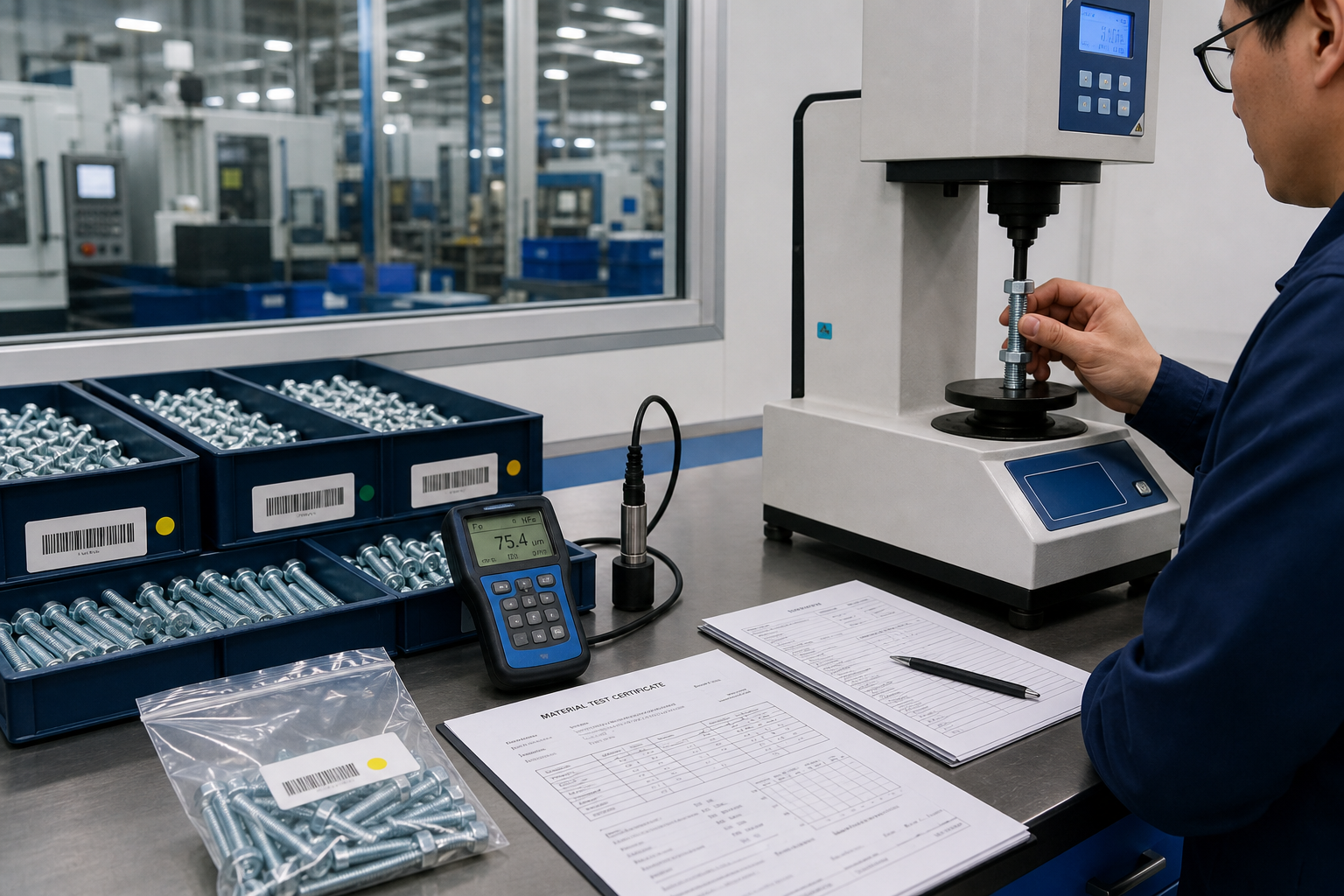
Material traceability should connect the incoming material to the finished production lot and the released shipping documents. The required depth depends on the product and application, but buyers should decide it before placing the order.
Ask how the supplier controls heat or batch numbers, material certificates, cut material, work-in-process containers, heat-treatment lots, coating lots, inspection samples, rejected parts, and packed cartons. For custom or critical parts, agree on how long records and retained samples will be kept.
For certain fasteners sold into the United States, the Fastener Quality Act information published by NIST may be relevant. Its scope is limited and includes exemptions, so the buyer should verify whether a specific order is covered rather than applying the rule to every fastener.
5. Define inspection before the supplier makes parts
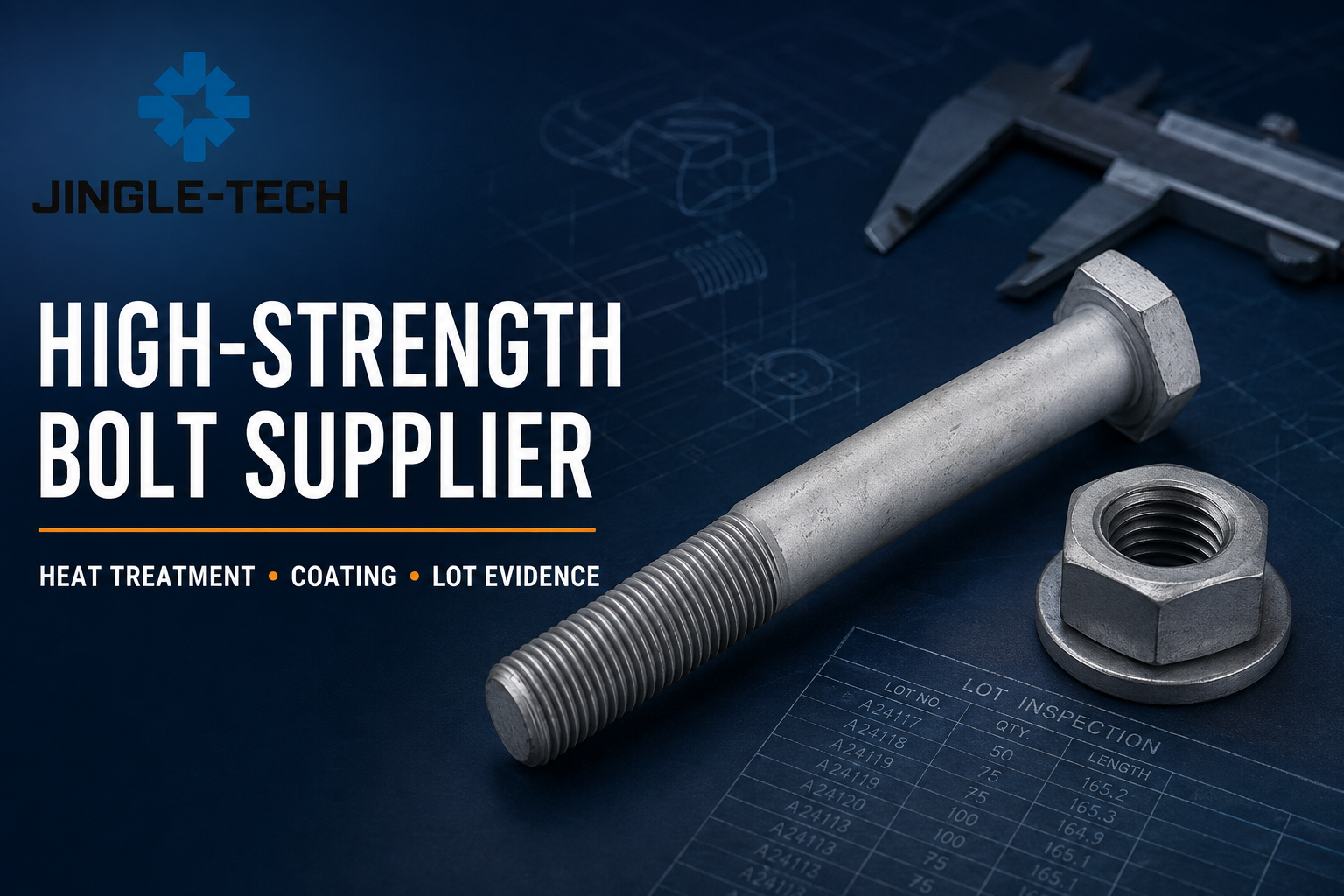
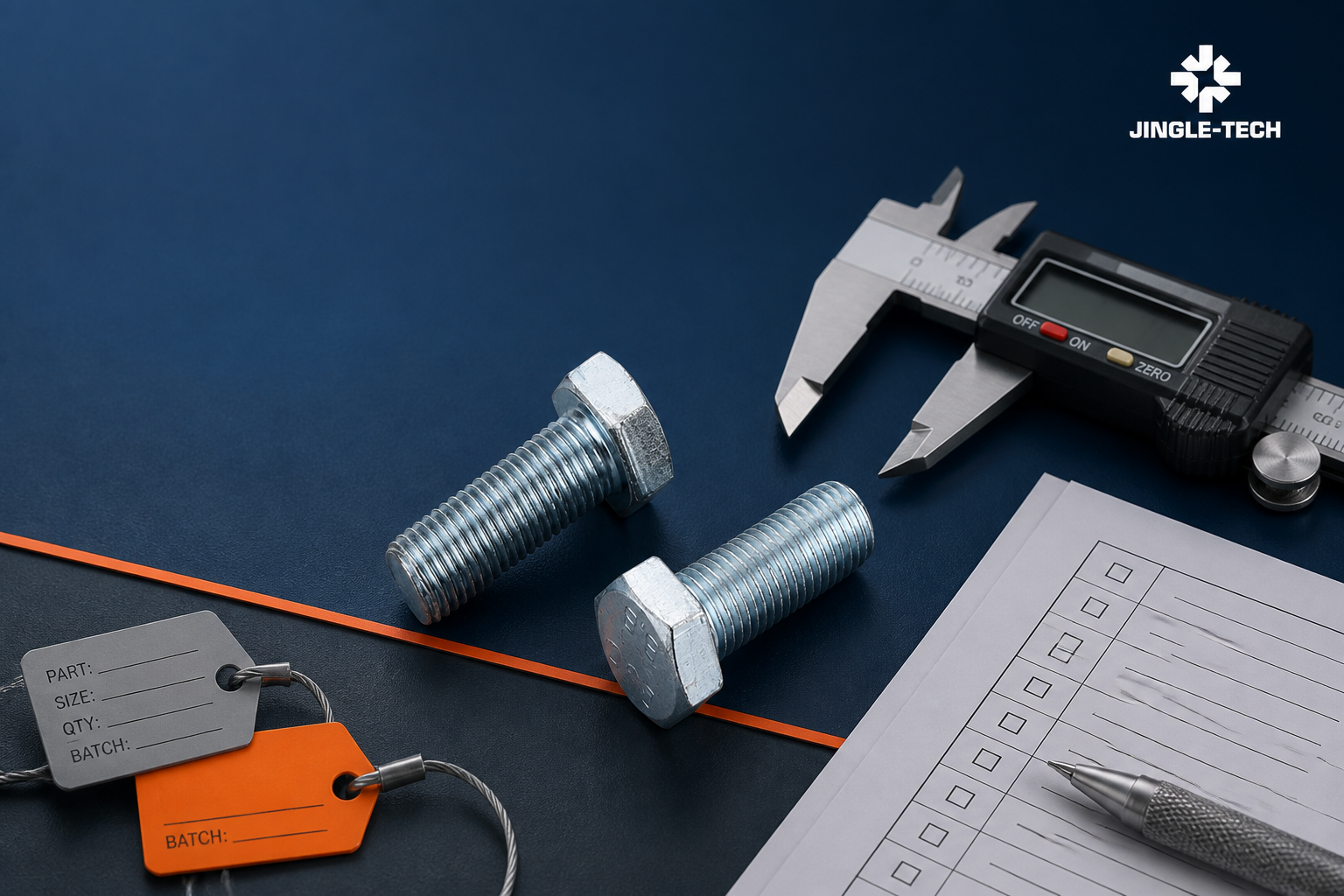
“Final inspection” is too vague. A good inspection plan identifies the characteristic, specification, method, instrument or gauge, sample size, frequency, acceptance limit, and record. Critical characteristics may need more frequent checks or error-proofing during production instead of detection only at the end.
Depending on the part, the plan may include dimensional inspection, thread gauges, head geometry, hardness, tensile strength, proof load, wedge tensile testing, decarburization, coating thickness, adhesion, salt-spray testing, surface defects, cleanliness, marking, and packaging. Only include tests required by the drawing, standard, risk assessment, or purchase agreement.
Ask the industrial fastener supplier to show a blank inspection-report format during qualification. Check whether the report records the part number, revision, lot number, instrument, result, specification, inspector, date, and disposition. A report that cannot be linked to the shipped lot provides little protection.
When comparing an industrial fastener manufacturer with a trading-only source, verify who owns the inspection plan, who releases the lot, and who has authority to stop shipment when a result is outside the agreed limit.
6. Use samples and first-article approval correctly
A sample is not merely a physical part. It should prove that the proposed material, tooling, process route, finish, and inspection method can produce an acceptable result. Before approval, agree on whether samples come from prototype tooling, production tooling, or normal production equipment.
For a custom bolt or screw, review the sample with the same drawing revision and measurement method planned for production. Test assembly fit, tool engagement, installation behavior, coating condition, packaging protection, and any functional requirement. Record deviations and update the drawing or purchase specification instead of relying on email memory.
A disciplined custom bolt manufacturer should also explain what will change between sample and mass production: machine, tooling cavity, material source, heat-treatment load, coating line, inspection frequency, or packaging method.
7. Check capacity, lead time, and repeat-production control
Capacity is more than the number of machines. Ask about the bottleneck operation for your part, normal utilization, tooling lead time, material availability, outside-process queues, inspection capacity, preventive maintenance, and backup planning.
Separate the timeline into engineering review, tooling, sample production, sample approval, material procurement, production, outside processing, inspection, packaging, and transport. This makes the quoted lead time auditable and shows where buyer approval is required.
For repeat orders, check drawing-revision control, approved master samples, tooling identification, preventive maintenance, first-piece checks, process parameter records, and change-notification rules. Stable repeat production is often more valuable than the shortest first-order promise.
8. Confirm OEM, packaging, and labeling capability
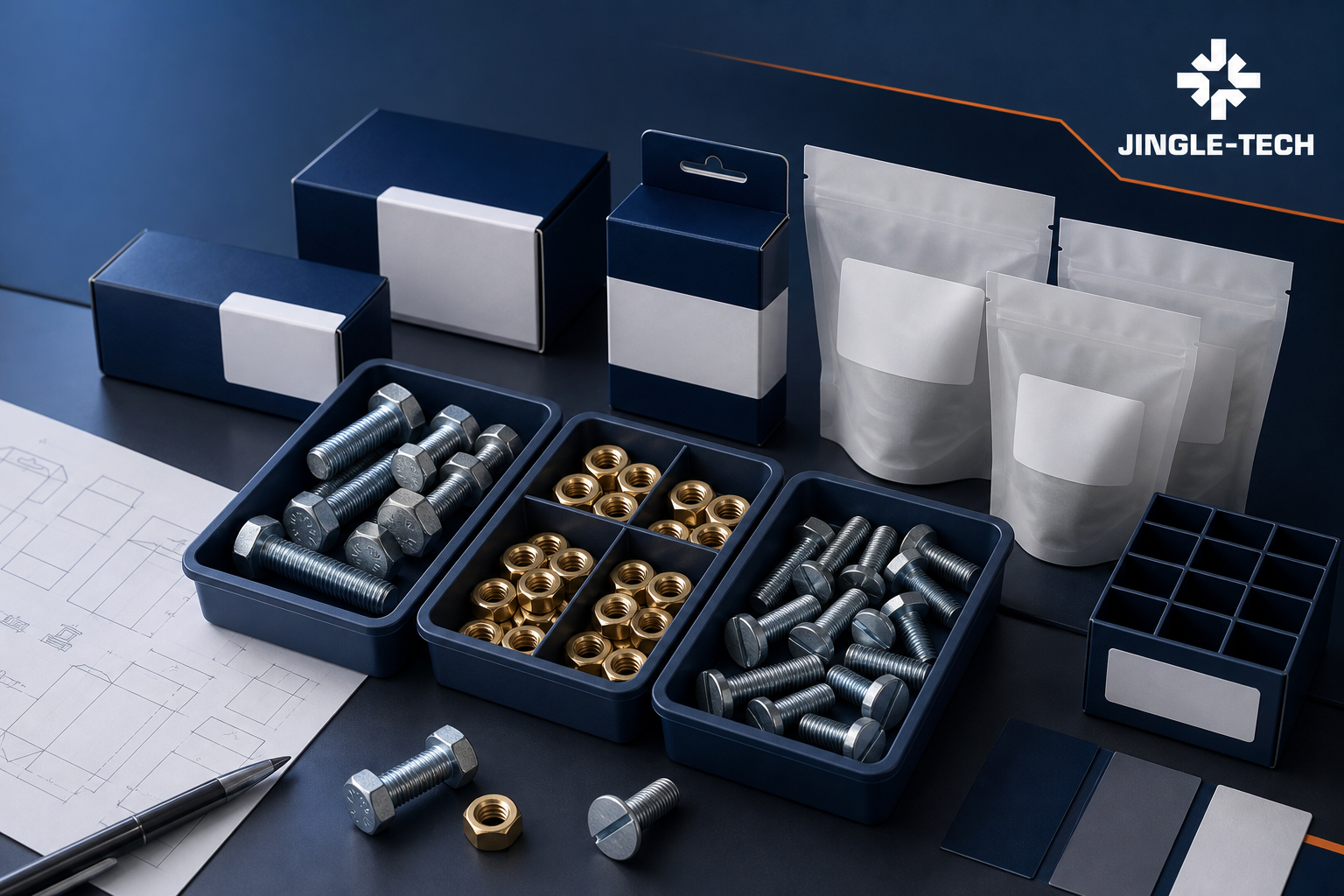
An OEM fastener supplier may need to support nonstandard dimensions, special head or drive forms, customer marks, mixed kits, private-label cartons, barcode labels, corrosion-prevention materials, or pallet rules. Define these requirements in the RFQ because they affect tooling, line setup, inspection, packing labor, and shipment volume.
Packaging must protect the finish and preserve lot identity. Heavy fasteners can damage their own coating when cartons are overfilled. Small parts can be lost or mixed if inner-bag quantities and sealing are inconsistent. Request a packaging sample or packing specification before the first shipment.
9. Compare total landed cost, not only unit price
Two quotations are comparable only when their assumptions match. Confirm material, standard, tolerances, coating, tests, documents, tooling ownership, sample quantity, packaging, Incoterm, payment terms, and validity period.
Total cost can include tooling, gauges, destructive tests, third-party inspection, sorting, special packaging, freight, duty, inventory, incoming inspection, line stoppage, rework, claims, and emergency replacement. A low unit price can become expensive when the quote leaves important requirements outside the scope.
Ask each potential industrial fastener manufacturer to list exclusions and optional costs. This creates a fairer comparison and reduces commercial surprises after technical approval.
10. Test communication and engineering response
Supplier communication should be evaluated before the purchase order. Send a controlled RFQ and observe whether the response identifies missing information, explains manufacturability risks, confirms the revision, distinguishes assumptions from commitments, and names a responsible contact.
For custom parts, establish a written change process. No material, geometry, process, tooling, sub-supplier, coating, inspection, or packaging change should be made outside the agreed notification and approval rules. Fast responses are useful; accurate, documented responses are better.
11. Score suppliers with evidence
A simple scorecard prevents the team from choosing only by price or presentation. Weight the criteria according to application risk and purchase strategy.
| Audit area | Evidence to request | Example weight |
|---|---|---|
| Technical fit | Process flow, DFM feedback, similar part experience | 20% |
| Quality system | Certificate scope, procedures, calibration, corrective-action example | 15% |
| Material and traceability | Certificate example, lot map, retention policy | 15% |
| Inspection and testing | Control plan, gauges, report format, test capability | 15% |
| Sample performance | First-article results, assembly trial, deviation closure | 15% |
| Delivery resilience | Capacity plan, bottleneck, backup and change control | 10% |
| Commercial fit | Transparent quote, MOQ, tooling, payment, landed cost | 10% |
Change the weights when failure consequences, order volume, development speed, or logistics risk differ. The key is to score evidence, not promises.
For the final shortlist, ask each industrial fastener manufacturer to submit the same evidence pack so your scoring remains consistent.
12. Start with a controlled pilot order
Before transferring a large repeat-production program, use a pilot lot that exercises the real process. Confirm purchase-order review, material traceability, production controls, inspection documents, packaging, labeling, export paperwork, delivery communication, and complaint response.
Review the pilot with purchasing, engineering, quality, production, and logistics. Close gaps in writing before increasing volume. Supplier qualification is complete only when the process works from RFQ through delivery—not when the sample looks good.
The best industrial fastener manufacturer for a repeat program is the one that can reproduce the approved process and evidence while managing changes transparently.
Fastener supplier red flags
- The quote does not reference your drawing revision or applicable standard.
- The supplier says every tolerance is easy but provides no process or inspection plan.
- Certificate claims are made without a verifiable scope, site, issuer, or validity.
- Material or test reports cannot be linked to a production lot.
- Sample and mass-production routes are different but the differences are not disclosed.
- The supplier refuses to identify subcontracted special processes.
- Lead time is a single number with no tooling, material, processing, or approval breakdown.
- Price changes appear after requirements that were already in the RFQ are “discovered.”
How Jinglefix supports industrial fastener sourcing
Jinglefix supplies industrial fasteners and supports OEM/ODM projects based on drawings, models, samples, or functional requirements. Buyers can review product families such as bolts and screws, then define material, thread, strength, surface treatment, marking, packaging, and inspection needs for the specific application.
Our recommended workflow is requirements review, manufacturability discussion, quotation and process planning, sample approval, controlled production, inspection, packaging, and delivery. Product-specific performance, certificates, tolerances, and test records should always be confirmed against the current drawing and project requirements.
If you are evaluating an industrial fastener manufacturer, send your drawing, annual quantity, material, finish, standard, critical characteristics, quality-document list, packaging, and destination. Contact Jinglefix for an engineering and quotation review.
Frequently asked questions
What information is needed for a custom fastener quote?
Provide a drawing or sample, revision, material, standard, thread and tolerances, finish, test and document requirements, order quantity, annual volume, packaging, destination, and target schedule. Identify critical characteristics and the end-use environment.
What is the MOQ for custom bolts?
MOQ depends on material purchase, tooling, setup, forming or machining route, heat treatment, coating batch, inspection, and packaging. Ask for separate prototype, pilot, and production quantities instead of assuming one MOQ applies to every design.
How long does custom fastener production take?
Lead time includes engineering review, tooling, samples, approval, material, production, special processes, inspection, packaging, and transport. Request a stage-by-stage schedule and identify which stages depend on buyer approval.
Can a fastener manufacturer work from a physical sample?
Yes, but reverse engineering should be supported by measurements, material identification, functional requirements, and buyer approval. A worn sample may not represent the original dimensions, and an application may require a governing standard or engineering validation.
What quality documents should a fastener supplier provide?
The correct list is product-specific. It may include material certificates, dimensional reports, mechanical test reports, coating reports, first-article records, process certificates, certificates of conformity, traceability data, or customer-specific submissions.
How do I verify a supplier’s quality system?
Check the current certificate and scope, then audit how the system controls drawings, materials, suppliers, equipment calibration, production, inspection, nonconforming product, corrective actions, changes, and retained records for your part.
Should I choose the lowest-priced fastener supplier?
Choose the lowest total risk-adjusted cost among technically acceptable suppliers. Compare tooling, tests, documentation, packaging, freight, inventory, incoming inspection, rework, delivery risk, and claim response in addition to unit price.
How many suppliers should I qualify?
That depends on demand, application risk, tooling ownership, switching cost, and supply continuity. Some programs need a primary and approved backup; others benefit from one deeply integrated supplier. Make the decision after technical qualification and pilot performance.