Lock Washers: What They Solve, and When They’re the Wrong Fix
A lock washer is a small part, but in assembly work it can decide whether a joint stays put or slowly loosens under vibration. Engineers and sourcing teams run into this question all the time: do you need a lock washer, a plain washer, a square washer, or a different fastening strategy altogether? The answer depends less on habit than on the load case, the joint material, and how much movement the assembly will see in service.
That matters because loosened fasteners are rarely just a maintenance nuisance. They can create noise, leakage, loss of clamping force, cosmetic defects, and in some products, a real safety issue. A washer is cheap; a field failure is not.
What a Lock Washer Is Meant to Do
In simple terms, a lock washer helps resist rotation or loss of preload in a bolted joint. The idea is not magic. Depending on the style, it may add spring force, bite into the mating surface, or create friction that discourages the nut or bolt from backing off.
That said, buyers sometimes overestimate what a lock washer can do. If the joint is badly designed, the washer is only a small insurance policy. It is not a substitute for proper thread engagement, the right torque, or a fastening method suited to the vibration level.
Typical roles in assembly
Lock washers are often used where vibration is present, where thermal cycling may relax the joint, or where the design benefits from a modest amount of anti-loosening support. They appear in machinery, appliances, electrical enclosures, vehicle subassemblies, and general industrial equipment. In many cases, the real design decision is not “washer or no washer,” but “which washer type matches the joint and the material being clamped?”
Plain Washer, Lock Washer, or Square Washer?
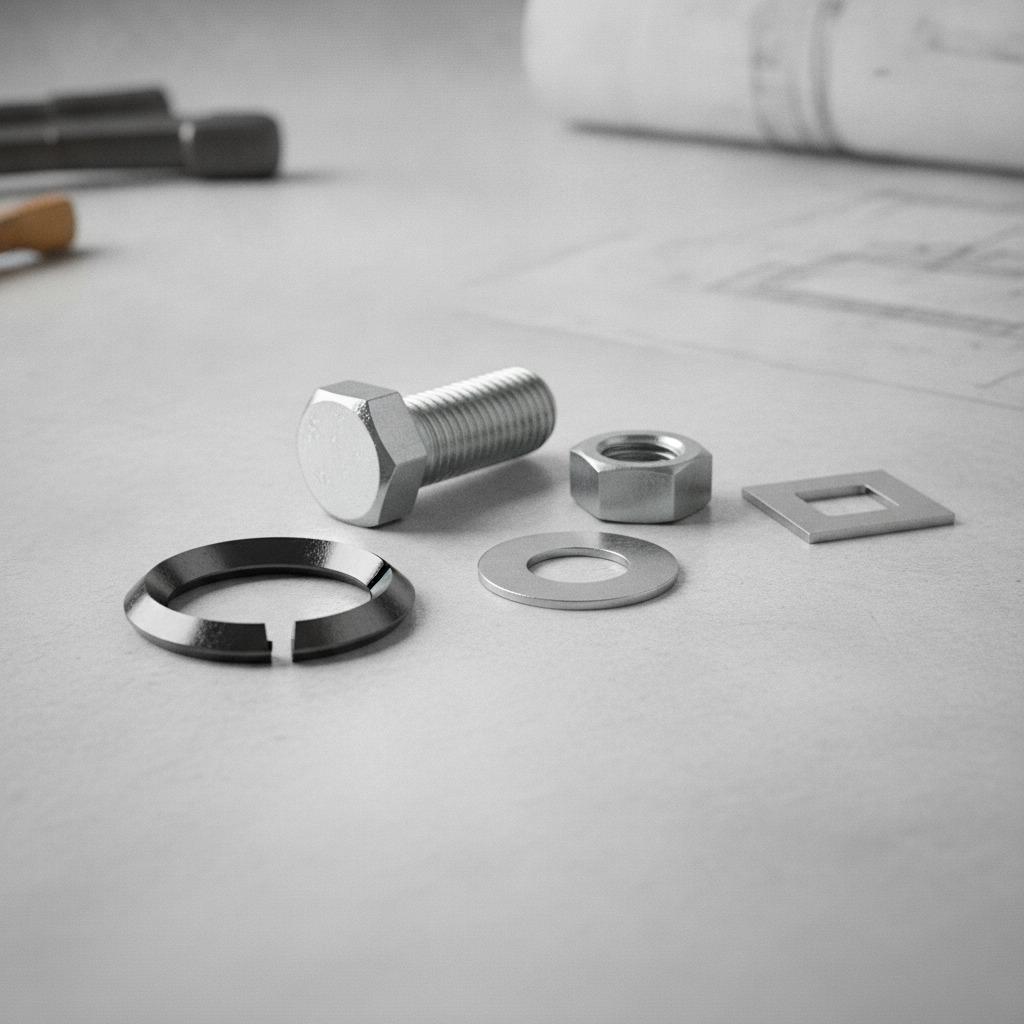
It helps to separate the functions. A plain washer spreads load and protects the surface. A lock washer tries to help the fastener stay tight. A square washer is often selected for a broader bearing area or for use with timber, structural, or legacy applications where the geometry is part of the design language.
Those roles overlap a little, but not enough to treat them as interchangeable. If a design needs load distribution on a soft substrate, a lock washer may not be the right answer at all. If the joint needs anti-loosening performance, a square washer alone usually will not deliver it. The choice should follow the problem, not the catalog page.
Common Lock Washer Types and Where They Fit
There are several familiar families, and each has its own practical limits.
Split lock washers
These are widely recognized and easy to source. They are used in general-purpose applications, though their effectiveness can be limited in some high-vibration or high-preload joints. Many engineers still specify them because they are familiar, not always because they are the best technical fit.
Toothed lock washers
Internal or external teeth can dig into the mating surface and create resistance to loosening. They may be useful where surface bite is acceptable, but they can also mar finishes or raise grounding concerns depending on the application. Electrical assemblies, in particular, deserve a closer look here.
Spring-style and specialty designs
Other lock washer styles are intended to maintain a more elastic response or improve locking behavior under certain conditions. These can be useful, but the buyer should ask whether the assembly needs genuine locking performance or just better load distribution. The two are often confused during specification review.
Selection Criteria Buyers Should Check
The first check is the substrate. Soft metal, painted surfaces, plated parts, and corrosion-sensitive components can all react differently to washer teeth or surface deformation. A washer that performs well on one joint may be a poor choice on another with the same fastener size.
Next, look at the service environment. Vibration, temperature swings, humidity, and repeated maintenance all affect long-term performance. If a joint is opened frequently, a washer that bites aggressively may make reassembly less pleasant than it sounds on paper.
Also consider whether the assembly needs a washer for geometry or for function. Sometimes a square washer is chosen because it provides a broader bearing footprint or suits a specific construction method. Sometimes a lock washer is chosen because loosening has been a recurring problem. Those are different procurement conversations, and mixing them up leads to weak specifications.
Common Mistakes in Fastener Sourcing
One frequent mistake is assuming any lock washer will solve vibration. It may help, but it may also do very little if preload is inconsistent. Another common issue is pairing a washer with a surface finish that cannot tolerate marking. A scratched coated part can look minor in the warehouse and become a quality complaint in the field.
Another practical warning: do not specify a washer in isolation. The nut, bolt, thread condition, and tightening method all influence whether the joint stays secure. A well-chosen lock washer cannot rescue poor torque control or bad thread fit.
Buyer Takeaway
If your sourcing team is comparing washer options, start with the joint problem. Ask whether the assembly needs load spreading, anti-loosening support, electrical contact, or a broader bearing area. That quickly narrows the field and prevents overbuying parts that sound similar but behave differently.
For engineers, the useful question is not simply “Which washer is strongest?” It is “Which washer suits this joint, this surface, and this service condition?” That framing usually leads to better drawings and fewer surprises after launch.
FAQ
Are lock washers always necessary?
No. Many joints perform well without them if preload, thread engagement, and service conditions are properly controlled.
Can a square washer replace a lock washer?
Usually not. A square washer may improve bearing area or suit a particular structure, but it is not a direct substitute for anti-loosening function.
Should I choose teeth or split style?
That depends on the mating surface, finish requirements, and how much locking effect the joint really needs. If the surface is sensitive, caution is warranted.
Next Step
For a new design or a sourcing review, map the fastener function first, then choose the washer style that matches it. A short specification check at the start often prevents a long debugging cycle later.