OEM procurement cost guide
Custom Screw Cost: Tooling, MOQ, Material, Thread, and Finish
Direct answer: custom screw cost is not a dependable catalog number. It is the combined result of the drawing, production route, tooling, order and release pattern, material, thread, tolerances, heat treatment, finish, quality evidence, packaging, and delivery boundary. Change any one of those inputs and the quote may change for a sound reason.
A procurement manager can receive three polished quotations and still have nothing comparable. One bidder has priced a machined development part. Another assumes cold forming and dedicated tooling for repeat production. The third has omitted coating tests and quoted at the factory gate. Sorting the spreadsheet by unit price would reward the largest gap in scope.
That is why prices found online cannot be used directly for a different drawing or set of commercial conditions. A catalog listing can help a buyer ask whether a standard screw would work. It cannot establish the should-cost of a made-to-print screw with different material, geometry, records, quantity, or delivery terms.
This guide is built for the decision that follows: how to make every bidder quote the same job, understand where the money is going, and find cost reduction without quietly reducing function.
Before Asking “How Much?”, Define the Comparison Unit
A unit price only becomes useful when the unit contains the same work. Write the basis in a sentence before releasing the RFQ:
One conforming screw made to the named drawing revision, using the specified material and process state, with the required finish, inspection evidence, pack format, order quantity, release pattern, and delivery basis.
That sentence exposes quiet differences. Is tooling inside or outside the price? Does the finish include a lubricant or test? Are shipment records included? Is freight delivered to the buyer or excluded at the factory? Is the quotation for a sample route or the intended production route?
Keep tooling and development work visible
Drawing review, process planning, programming, dies, punches, rolling tools, fixtures, gauges, sample setup, and first-article work may happen before repeat production. They are not all required for every screw, and they do not all repeat. Put them on separate lines. When a supplier amortizes a one-time charge into piece price, record the quantity and commercial assumption used. Otherwise two identical totals can look different simply because bidders spread development work across different forecasts.
Compare total landed and managed cost, not an isolated factory price
When the screw reaches the receiving dock, the quoted piece price is only one part of what the buyer has paid. Packaging and transport sit around it; depending on the trade term, insurance, duty, and local handling may sit there too. More work can appear inside the buyer's operation. Receiving might need to verify a critical dimension, bulk packs might have to be repacked for the line, or a quality concern might trigger sorting. Add those costs to the model only when company records support them.
Do not invent a defect rate or disruption percentage to make the model look complete. Use the buyer's history when it exists. If evidence is unavailable, keep the concern as a named risk rather than hiding a guess in the arithmetic.
Custom Screw Cost Drivers at a Glance
| Cost driver | What it can change | What belongs in the RFQ |
|---|---|---|
| Geometry | Forming feasibility, machine access, secondary operations, handling, and measurement | Controlled drawing, functional features, datums, mating condition, and allowed design changes |
| Production route | Setup, tools, cycle structure, material use, and the approval path | Proposed sample and production routes, including outside processes |
| Tooling cost and MOQ | Nonrecurring spend, economic batch, revision exposure, and release flexibility | Tool scope, ownership, replacement basis, production batch, order quantity, and release quantity |
| Material | Availability, formability, machinability, heat-treatment response, tests, and scrap | Grade or property requirement, condition, records, and permitted alternatives |
| Thread and tolerance | Blank, rolling or cutting, gauges, coating allowance, tool-wear window, and yield | Complete thread callout, mating part, functional limits, and measurement method |
| Heat treatment and finish | Process stages, dimensional effects, lot handling, testing, fit, friction, and corrosion behavior | Applicable specification, required properties, coating system, thickness, lubrication, and tests |
| Quality evidence | Inspection, reporting, traceability, retention, and possible laboratory work | Named records by stage, lot definition, sampling, format, and acceptance owner |
| Packaging and logistics | Counting, protection, labels, lot separation, freight, and receiving work | Pack quantity, protection, destination, Incoterm, and release pattern |
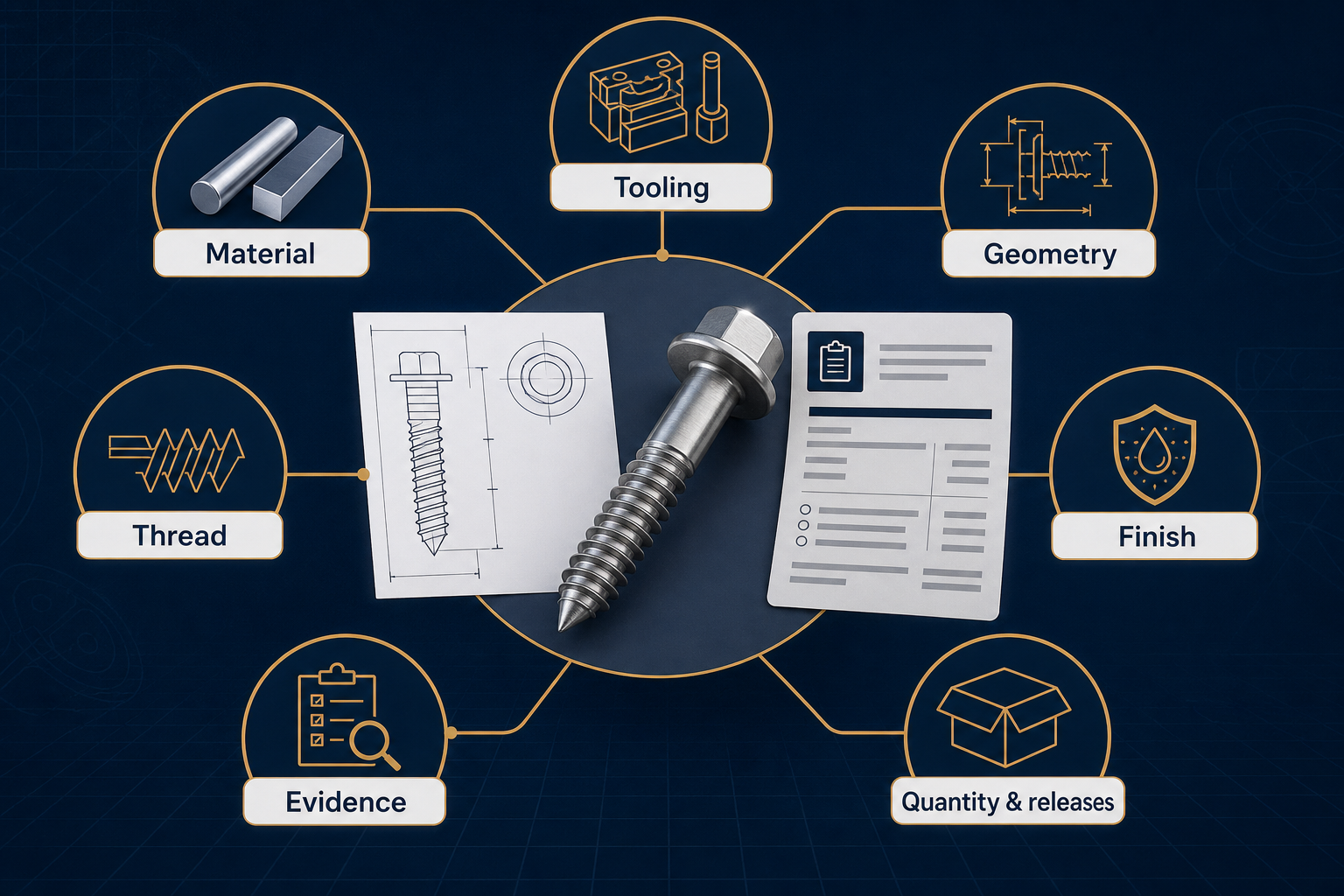
Walk the Drawing Through the Cost Stack
Geometry decides more than part weight
A screw may be light and still awkward to make. Head volume, drive depth, underhead radius, shoulder transitions, thread length, point design, cross holes, undercuts, captive features, and marking all influence how material moves, how the part is held, and how it can be inspected. A single feature may create a new operation.
Do not remove an unusual feature merely because it costs money. A low-profile head may clear adjacent hardware. A controlled shoulder may locate a moving assembly. A captive washer may prevent a line-side error. Ask what the feature protects. If the answer is unclear, the design owner can review it. If it protects function, the sourcing question becomes how to produce and verify it efficiently.
The right process route can change between sample and production
Machining can suit a development quantity or geometry that is still moving. Cold forming can suit repeat production when the material and shape support it and tooling economics match expected demand. Many practical routes are mixed: form the main body, machine a controlled feature, roll the thread, apply heat treatment and finish, then inspect and pack.
Ask each bidder to identify the route it priced. More importantly, ask whether samples and serial parts use the same route. A machined sample may answer a fit question without proving the grain flow, surface condition, mechanical properties, natural variation, or process capability of a later formed part. When the route changes, the approval plan must say what gets checked again.
Tooling cost and MOQ should be unbundled
A line called “tooling” is too vague to approve. On one screw it may mean a forming die and punch. On another, the real expense lies in a rolling die, holding fixture, or dedicated gauge. The buyer should ask the bidder to name the items. Ownership then needs plain language: is the tool reserved for this part, where will it remain, and who pays when it wears out or the drawing changes?
When a quoted MOQ seems high, ask the supplier to point to the bottleneck. Perhaps the machine setup only makes sense across a production run; perhaps material or an outside finishing partner has a batch requirement of its own. In other cases, the stated minimum comes from packaging or commercial policy and can be discussed. Procurement should also separate three questions: how many pieces are produced, how many the buyer commits to, and how many ship at one time. If those numbers differ, put ownership of the balance—and the consequence of a design revision—in writing.
Material affects the route, evidence, and finish
“Steel” or “stainless” does not support a controlled quote. Material affects availability, purchasable form, forming behavior, machining, tool wear, heat treatment, galling, corrosion, tests, and scrap. The RFQ should name a grade or applicable property requirement, the relevant condition, and any alternative that engineering is willing to review.
For a carbon- or alloy-steel screw, ISO 898-1:2013 is one place an engineer may look, provided the part falls within its published scope for fasteners with specified property classes. Stainless steel needs a different conversation. ISO 3506-1:2020 defines grades and property classes for corrosion-resistant stainless-steel bolts, screws, and studs within its own limits. These links support a scope check; they do not establish compliance. Before either document appears on an RFQ, confirm that its thread, geometry, size, service condition, and contractual use fit the actual part.
Thread details influence process and finished fit
State the thread system, diameter, pitch, tolerance or class, handedness where relevant, thread length, runout, incomplete-thread allowance, and required gauge. Include the mating component. A screw can pass an isolated gauge and still be based on the wrong assumption about the nut, insert, tapped hole, sheet, or plastic boss.
The route changes again when the screw is expected to create or prepare its own hole. A buyer sourcing for sheet should not stop at the label on a catalog page: the substrate and stack-up determine whether a pilot hole is needed and whether a drill point can complete the job without losing joint control. Installation trials still matter. Use the guide to self-tapping vs self-drilling screws to frame that choice before requesting a quote.
Also state whether thread limits apply before or after coating. Finish thickness and lubrication can affect fit and installation. If the drawing leaves that open, two suppliers can quote different finished conditions while appearing to meet the same thread callout.
Tolerances should follow the joint
Tight limits can narrow the process window, require another fixture or operation, increase gauging, or shorten the allowable interval between tool adjustments. That work is justified when a tolerance protects location, fit, sealing, clamp behavior, strength, or automated assembly. It is avoidable when the limit survived from an early design without a current purpose.
Review the datum, measurement access, method, and failure prevented by the limit. Purchasing should not widen it to reduce price. Engineering and the supplier should decide whether a proposed change preserves the joint.
Heat treatment adds interfaces that need control
Heat treatment can add transport, outside processing, lot separation, distortion management, mechanical testing, records, and handling. It interacts with material, geometry, thread state, and later coating. “High strength” is not a specification. The drawing needs the applicable property requirement and the evidence required to release the lot.
A familiar standards number may not apply to every head geometry, size, screw type, loading condition, or service temperature. Confirm applicability before using the standard as a price line.
Finish must be quoted as a system, not a color
A coating request may need substrate, coating system, thickness, conversion layer, sealer, top coat, lubricant, friction requirement, masking, appearance limits, corrosion test, and restricted-substance requirements. Only include what the application and contract need, but make those needs measurable.
The official page for ISO 4042:2022 describes electroplated coating systems for fasteners within its scope, including dimensional considerations and recommendations related to hydrogen-embrittlement risk. It does not choose the coating for a buyer or certify a supplier. It is a traceable source for defining and checking the applicable requirement.
Finish can alter thread allowance, friction, appearance, and process risk. An unfinished screw price plus a generic coating surcharge is therefore not necessarily equivalent to a controlled finished-part quote.
Quality evidence and packaging are real deliverables
“Full certification” does not tell a supplier what to do. Name the sample and production records: perhaps a dimensional report, material record, mechanical results, coating data, certificate of conformity, functional test, lot label, or customer form. State method, sampling where controlled, format, lot connection, and retention. Keep every item required by engineering, quality, regulation, or contract; remove unused paperwork only with the responsible owner's approval.
Packaging can change count verification, rust protection, thread protection, labels, barcodes, lot separation, line-side handling, and freight. Define the destination and delivery term. A bulk, factory-gate quote cannot be ranked directly against counted packs delivered to the buyer.
Build a Should-Cost View Without Inventing Industry Numbers
A should-cost model is valuable even when the buyer does not know a supplier's labor rate, machine rate, or material contract. Its job is to expose structure and test scope, not to manufacture a confident-looking universal price.
First block: nonrecurring work
List engineering review, programming, tooling, fixtures, gauges, samples, validation, and first-article activity. For each item, record what is delivered, who owns it, whether it supports samples or production, and whether a revision makes it repeat.
Second block: recurring conforming production
Map raw material, setup, primary process, threading, secondary operations, expected process loss, heat treatment, finish, routine inspection, documentation, packaging, and handling. The buyer does not need confidential rate details to verify that the quoted route covers the controlled requirement.
Third block: landed and buyer-side work
Normalize freight, insurance, duty, and local handling under one delivery scenario. Add internal work only where company evidence supports it. Keep uncertain risks as visible decision fields.
Evaluated program cost is the sum of those three blocks for one stated scenario. Evaluated cost per usable conforming screw divides that cost by the conforming quantity available for use under the same scope and period. The equation is simple. Making every supplier quote the same technical and commercial boundary is the difficult part.
Three Hypothetical Decisions a Buyer May Face
These are decision examples, not customer cases, JINGLE performance claims, or promised prices, MOQs, savings, or lead times.
Scenario 1: a standard screw except for grip length
The head, drive, thread, material, and finish follow an established specification. The drawing changes grip and overall length. The sourcing team first checks whether a suitable standard item or an existing blank can be modified. It asks which element creates the practical batch and whether the change affects mechanical properties, marking, finish, or records.
The useful outcome is a clear gap analysis. If the length protects assembly, it stays. If it is a legacy preference with no present function, engineering may review it. No conclusion about cost is made until the proposed route and quantity conditions are known.
Scenario 2: a machined sample followed by repeat production
A special shoulder screw is still changing. Machining may support early fit and assembly checks without committing to production tooling. Once the design stabilizes and the demand pattern becomes credible, bidders can evaluate forming or a mixed process.
The procurement manager refuses to blend the two stages into one price. Sample process, production process, tooling, approval evidence, revision cutoff, and recurring quote remain separate. Engineering records which conclusions from the machined sample must be confirmed again on production-intent parts.
Scenario 3: coating and lot records differ between bids
The application requires a defined finished condition and shipment records. One bid includes the requested coating system, test scope, lot identification, packaging, and delivery basis. Another quotes an unfinished or differently documented screw. The second number is lower, but it is not yet an equivalent offer.
Engineering decides whether the alternative is technically acceptable. Quality reviews the evidence gap. Purchasing normalizes the commercial boundary only after those decisions. This is the practical reason an online “corrosion-resistant screw” price cannot benchmark a drawing with a controlled finish and traceability requirement.
Send an RFQ Package That Produces a Defensible Quote
Put one controlled version of the requirement in the package. Label every line as fixed, open to a documented alternative, or not applicable.
Part and application definition
- Part number, drawing revision, units, issue date, and controlling file
- Head, drive, shank, shoulder, point, thread, runout, and mating-component details
- Datums, general tolerances, critical characteristics, and measurement methods
- Material grade or property requirement, condition, and permitted alternatives
- Heat treatment, finish, lubrication, appearance, marking, and cleanliness
- Assembly method and service facts that affect supplier review
Program and commercial definition
- Development sample, validation, first-production, and normal-release quantities
- Forecast demand labeled with its uncertainty and expected release pattern
- Sample and production milestones kept separate
- Tool breakdown, ownership, maintenance, replacement, and revision treatment
- Pack quantity, protection, lot separation, labels, destination, and delivery term
- Currency, freight, insurance, duty, tax, payment, exclusions, and price-change triggers
Quality, confidentiality, and approval definition
- Purpose and acceptance criteria for each sample stage
- Required dimensional, material, mechanical, coating, or functional evidence
- Lot definition, traceability, sampling, record retention, and labeling
- Outside-process, source-change, deviation, and corrective-action rules
- Drawing access, confidentiality terms, permitted sharing, file control, and return or destruction expectations
Check the relevant fastener categories before freezing a custom design. For supplier qualification and process questions, use the custom screw manufacturer guide. Together, these pages form the custom-screw topic cluster: product scope, supplier qualification, design choice, and cost.
Use a Quote Comparison Table That Forces Gaps Into View
Enter what each bidder actually states. A blank cell is better than an invented assumption. Resolve technical deviations before ranking price.
| Comparison line | Common buyer basis | What to record from each supplier |
|---|---|---|
| Drawing | One revision and controlling file | Accepted revision, deviations, and open questions |
| Material | One grade or property basis | Proposed material, condition, source assumptions, and records |
| Process route | Sample and production stages separated | Primary process, secondary work, and approved outside processes |
| Tooling cost | Same requested scope | Tool type, ownership, dedication, maintenance, replacement, and revision terms |
| MOQ and releases | Same demand scenarios | Production batch, order minimum, release minimum, and stock conditions |
| Thread and tolerance | Same finished-part requirements | Process, gauge, coating allowance, critical limits, and measurement method |
| Heat treatment and finish | Same property and coating system | Process scope, tests, lubricant, appearance, and records |
| Quality evidence | Same sample and shipment package | Reports, sampling, traceability, retention, and exclusions |
| Packaging | Same pack and protection | Count, labels, lot separation, thread protection, and corrosion control |
| Delivery | Same destination and Incoterm | Included freight, insurance, duty assumptions, and lead-time definition |
| IP and change control | Same confidentiality and approval rules | File access, subcontractor disclosure, source changes, and tooling access |
Keep non-equivalent offers as separate scenarios. A machined prototype quote and a tooled production quote can both be valid, but they should not compete in the same unit-price column.
Custom Screw Cost Reduction Without Giving Away Function
“Lower the price” is not an engineering instruction. A productive cost-reduction discussion points to the decision that drives the route, tool, control, or batch.
Find the feature that creates the extra step
Ask which undercut, recess, shoulder, hole, point, thread position, marking, or tolerance forces another operation. Preserve it when it protects function. Review it when nobody can explain why it remains on the drawing.
Use standard elements inside a custom screw where they fit
An established thread, drive, material, finish specification, or measurement method can reduce uncertainty without turning the whole part into a catalog item. Standardization is only useful when the joint still works.
Spend precision on the failure mode
Connect tight tolerances and cosmetic limits to their purpose. Review nonfunctional precision with the design owner. Do not relax a limit that prevents a real assembly or performance failure simply because it is expensive.
Stage tooling with design maturity
Use a flexible sample route while geometry is changing, then evaluate production tooling against realistic repeat demand. Record what must be revalidated after the route changes. This avoids permanent tooling too early and avoids treating prototype cost as serial cost.
Give suppliers an honest quantity story
Separate samples, validation, launch, normal releases, and forecast demand. A fictional high-volume request may win an attractive quotation that the real order cannot support. A candid demand profile gives bidders a chance to propose practical batches or stocking alternatives.
Remove ambiguity before removing requirements
A defined finish, named report, controlled file set, and clear pack format can reduce quotation uncertainty. Delete evidence only when the responsible quality or contract owner confirms it serves no purpose. Cleaner information is a cost-reduction method; weaker control is not.
Custom Screw Cost FAQ
How much does a custom screw cost?
No universal online figure can answer that responsibly. Custom screw cost depends on the controlled drawing, material, route, tooling, thread, tolerance, heat treatment, finish, evidence, packaging, quantity, release pattern, and delivery basis. Request a quote against one defined scenario.
Why did the price change after drawing review?
The first request may have left material, tolerance, process, test, finish, quantity, or packaging unresolved. Ask the supplier to identify the changed assumption and issue a revised scope. Preliminary quotes should list assumptions so the change can be traced.
What determines custom screw tooling cost?
Tooling cost follows the proposed route and may include forming dies, punches, rolling tools, fixtures, gauges, or handling devices. Compare the tool's purpose, sample-versus-production use, ownership, dedication, maintenance, replacement, and revision terms—not the line-item total alone.
Why does MOQ differ between suppliers?
MOQ may come from setup economics, minimum material purchase, an outside-process batch, packaging, inventory policy, or a commercial rule. Ask which constraint applies and distinguish production batch, order minimum, and shipment release.
What affects custom screw lead time?
The schedule may include drawing review, open-question closure, tooling, material, samples, approval, production, outside processing, testing, packaging, transit, customs, and receiving. Ask the supplier to define the start event, approval pauses, and finish event. Do not compare lead-time numbers with different boundaries.
Which quality documents should be included?
Include only records required by the drawing, standard, application, contract, regulation, or approval process. Name each deliverable and stage. Possible items include dimensional, material, mechanical, coating, functional, traceability, or conformity records; the actual package depends on the program.
How should intellectual property be handled in a screw RFQ?
Use the buyer's approved confidentiality and contracting process. Control who may access the drawing, whether it may be shared with outside processors, how revisions are distributed, who owns tooling and derived files, and what happens to data when the sourcing exercise ends. Do not rely on a website statement as the entire IP plan.
Can a sample price be compared with a production price?
Only after the routes and included work are separated. Samples may carry engineering and setup across a small quantity or use a different process. Record what the sample proves, which cost repeats, and what must be approved again for production.
How can buyers compare supplier quotes fairly?
Normalize revision, material, route, tooling, quantity, thread, tolerance, heat treatment, finish, evidence, packaging, delivery, and assumptions. Resolve deviations before ranking the commercial result. Keep different technical scenarios in separate columns.
Research Basis and Fact Boundary
- ISO 898-1:2013 — official scope for specified mechanical and physical properties of certain carbon- and alloy-steel bolts, screws, and studs.
- ISO 3506-1:2020 — official scope for specified grades and property classes of corrosion-resistant stainless-steel bolts, screws, and studs.
- ISO 4042:2022 — official scope for electroplated coating systems on fasteners and related dimensional and hydrogen-embrittlement-risk considerations.
These are primary standard-publisher pages used to define scope and caution. They do not establish compliance for a product, order, supplier, or facility. No price, MOQ, saving, lead time, capacity, certification, customer result, or JINGLE manufacturing capability is asserted in this article.