Most machine-screw projects do not go wrong because a buyer cannot find something that looks close. Trouble begins when five people are working from five slightly different definitions of “close.” Purchasing sees a unit price, engineering sees a joint, quality sees measurable features, the installer sees tool access, and the supplier sees the data that reached the quotation desk. A pan head may fit the envelope but crowd a cable. A familiar thread callout may omit the fit class. A zinc-plated sample may look fine even though nobody has agreed on coating thickness, torque behavior, or corrosion expectations. Each blank eventually reappears as a question, a delay, or rework.
The pages below turn that problem into a working RFQ. They follow the job from the joint and drawing through quotation comparison, sample approval, packing, and repeat orders. Engineers can use the technical checks; sourcing teams can use the commercial tables; quality teams can turn the same information into an incoming plan. A capable machine screw manufacturer should be asking many of these questions before it commits to price or delivery.
Fast answer for buyers: Start with the current drawing and revision. Add the thread, head, drive, material, mechanical requirement, heat treatment, finish, critical checks, order quantities, packing, destination, Incoterm, and requested date. If a field is still open, say so. The returned quote should show every assumption and exclusion instead of burying them in the price.
That single discipline makes quotations more comparable and usually prevents more delay than asking ten suppliers for a faster response.
1. Start with the joint, not the screw catalog
A machine screw works as part of a joint. Its performance depends on the mating thread, the clamped materials, the bearing surface under the head, the tightening method, and the environment after assembly. If the RFQ begins with “M4 pan head stainless screw, best price,” a supplier can quote something, but the buyer has not defined whether that something will work.
Sketch the stack from the underside of the head to the end of the available hole. Write the thickness and material beside each layer. Next, draw the female thread: it might be in a boss, a loose nut, an insert, or a standoff. Work out the shortest engagement after tolerances, not merely the nominal value. Now look from the side. Check the driver path, nearby cables, and the room a service technician will have years later. Add the real environment—vibration, temperature, moisture, cleaners, and visible-surface expectations. “Bright” is not an appearance standard.
Then identify the failure that matters. In a thin electronics enclosure, head bearing pressure and strip-out may be more important than screw tensile strength. In a frequently serviced cover, recess wear and galling may dominate. In outdoor equipment, the joint may fail commercially because the coating discolors long before it fails mechanically. In an automated line, a recess that causes bit cam-out can be more expensive than the screw itself.
This joint-first approach gives a screw manufacturer the information needed to discuss feasible options. It also stops product substitutions from becoming accidental design changes.
2. What makes a machine screw different?
A machine screw normally has a defined machine thread intended to mate with a tapped internal thread, a nut, or a threaded insert. That distinguishes it from many wood, tapping, and drilling screws, which form or cut their own path in the substrate. The distinction matters because the pilot feature, thread geometry, mating material, installation torque, and test method are different.
“Machine screw” is still only a family name. The designer must choose metric or inch threads and a head that suits the available space. The tool interface could be a simple slot, a cross recess, an internal hex, or a Torx-style form. Then comes the metal. Carbon and stainless steels are common; brass and less familiar alloys appear where the application calls for them. Surface treatment is chosen on its own merits. Even length can be misunderstood. Countersunk screws are commonly measured overall, while heads that remain above the surface are generally measured from beneath the head. Let the governing drawing or standard settle the rule.
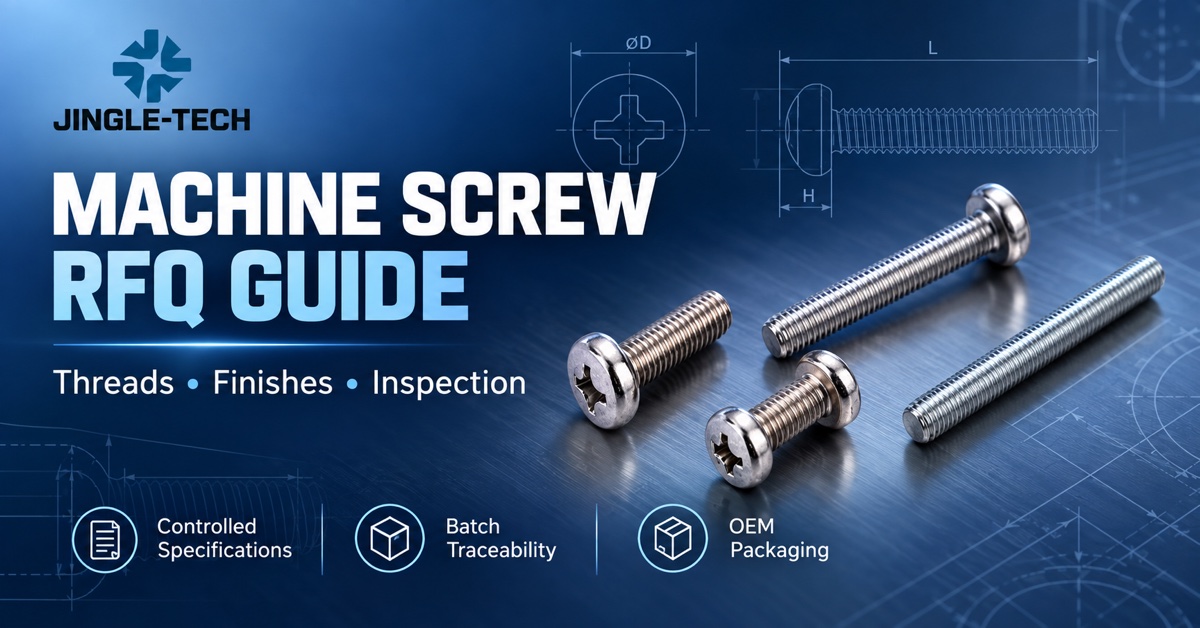
JINGLE’s public product range illustrates this variety. Buyers can review a pan head machine screw, a flat head machine screw, a zinc-plated machine screw, and a stainless steel machine screw. These pages are useful for screening. A production quotation still needs the exact standard or controlled drawing, material and performance requirements, finish, inspection scope, quantity, packaging, and destination.
3. Lock the thread system before discussing price
U.S. programs often contain both Unified inch and ISO metric hardware, sometimes in the same assembly. A supplier therefore needs more than “M4” or “#10.” Give the nominal diameter, pitch or threads per inch, series, external tolerance class, and any nonstandard thread direction. Name the mating internal thread too. That last detail catches many apparently reasonable substitutions before they reach the line.
| RFQ field | Useful example | Why it matters |
|---|---|---|
| Thread designation | M4 × 0.7 or #10-32 UNF | Prevents metric/inch and coarse/fine ambiguity. |
| External tolerance | 6g or 2A, as applicable | Defines the functional fit and inspection gauges. |
| Mating thread | Tapped aluminum boss, M4-6H | Connects screw acceptance to the actual joint. |
| Thread length | Fully threaded; usable thread 16 mm minimum | Avoids interference with shoulders or runout. |
| Acceptance method | GO/NO-GO ring gauge after plating | Makes the inspection point and condition explicit. |
For inch hardware, the official ASME B18.6.3 listing is a sensible reference point. ASME identifies its scope as inch-series machine screws, tapping screws, and metallic drive screws. Metric designs should cite the ISO product and thread documents chosen by the design authority. Keep the roles straight: head dimensions answer one question, the thread standard another, and the material callout a third.
A practical drawing should also control incomplete threads, point style, chamfer, and any unthreaded portion. These details matter in short screws where one thread can represent a large percentage of available engagement. They also matter when automatic feeders or shallow tapped holes are involved.
4. Select the head and drive as an assembly interface
The head is not only a shape. It is the interface that transfers clamp load into the top component and the feature that the assembly tool must engage. A pan head offers a broad bearing surface and leaves the head above the part. A flat head can sit flush, but it needs a correctly defined countersink angle and depth. A button or low-profile head may solve a clearance problem while reducing drive depth or bearing area. The decision belongs to the joint design, not to the supplier’s most convenient tooling.
For a pan head screw manufacturer RFQ, state the head diameter, head height, under-head geometry, recess type and size, and any wobble or concentricity requirement that affects automated driving. If a sealing washer, spring washer, or captive feature is required, put it on the drawing and bill of material. Do not hide it in an email thread.
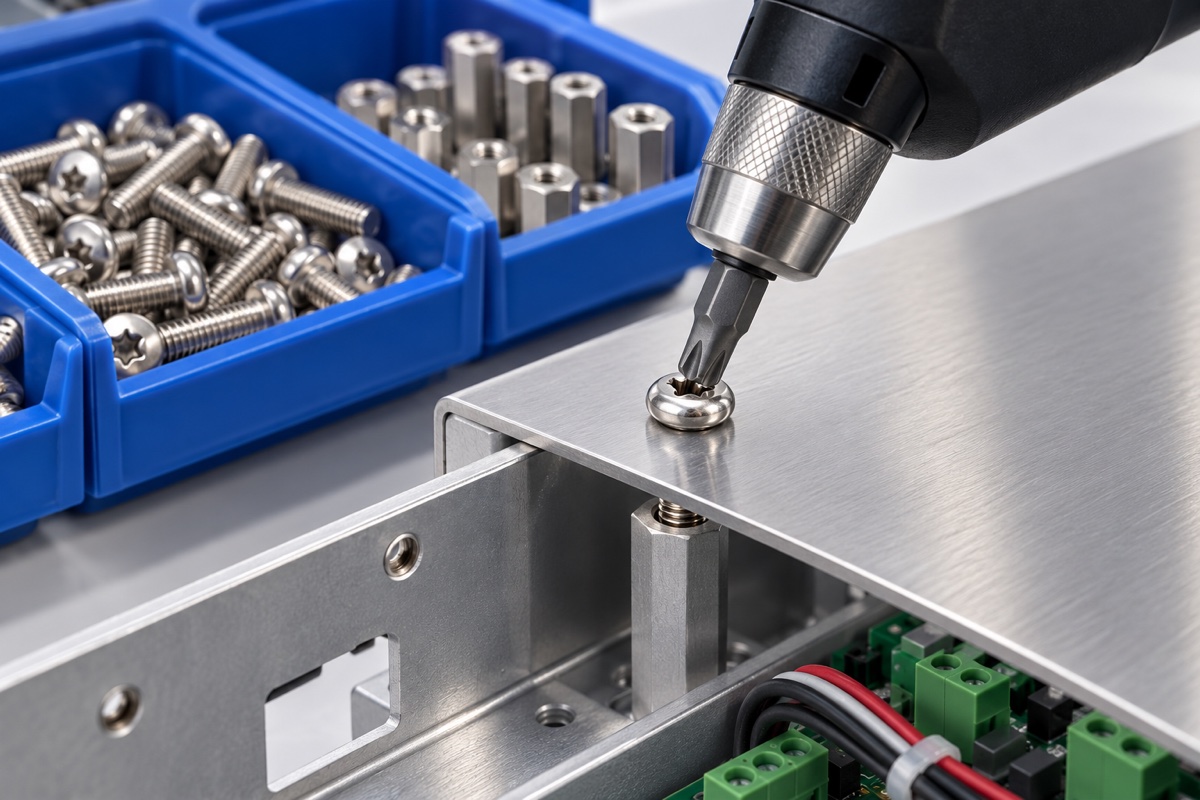
Drive selection should reflect the factory process. Phillips-style recesses are familiar, but the production line must control bit fit, axial force, and wear. Torx-style drives can provide stable engagement when the recess and bit are correctly matched. Slotted drives may be practical for low-volume manual service but are often less forgiving in automated assembly. Hex socket drives require control of recess depth, key fit, and burrs. For any drive, specify the standard and size instead of writing “cross” or “star.”
5. Separate material, property, heat treatment, and finish
One of the most common RFQ mistakes is a line such as “material: 8.8 carbon steel.” A property class is not a steel grade. Keep four decisions separate:
- Base material: the stainless designation, brass alloy, or steel grade and its governing material standard.
- Mechanical requirement: property class, hardness range, tensile requirement, torsional requirement, or application-specific performance.
- Heat treatment: say whether the part is used as formed or receives through hardening, case hardening, stress relief, or another named process.
- Surface condition: name the primary treatment first. It could be passivation, an electroplate, a black finish, or a zinc-flake system. Put lubricant, sealer, and appearance limits on separate lines so none of them disappears inside the finish name.
Stainless shorthand is easy to misuse. A2 is not a casual replacement for every mention of 304, nor does A4 automatically settle every requirement associated with 316. Read the fastener standard and select the property class deliberately. Carbon-steel drawings need the same discipline: does the design truly require a named steel grade, or does it require verified finished-part properties? Small screws do not always fail in tension. Sometimes the recess rounds first; sometimes the head separates, the screw twists, the threads are damaged, or the softer female thread strips.
Here is a useful question for the quotation review: “How will you prove each requirement on this shipment?” A thoughtful answer separates mill or raw-material records from tests performed on finished parts. It also admits where the only available support is a catalog description. That explanation tells a buyer more about a dependable screw supplier than an impressive material list with no link to the shipped batch.
6. Specify the coating as a system, not a color
“Zinc plated” does not define a complete finish. A quote-ready coating callout may need the coating type, thickness, conversion coating, sealer, topcoat, color, lubricant, corrosion test, acceptance criterion, and hydrogen-embrittlement controls where relevant. It should also state whether thread acceptance is checked after coating.
The official ISO 4042:2022 description covers electroplated coating systems for fasteners, including dimensional requirements and recommendations intended to minimize hydrogen-embrittlement risk. Buyers should use the correct standard and edition for their program and obtain engineering approval for the selected system. A salt-spray duration alone is not a coating specification and does not predict service life in every environment.
Corrosion decisions should begin with exposure. A dry indoor instrument enclosure may use a different solution from outdoor machinery, a wash-down area, or equipment exposed to deicing salts. Stainless steel may reduce red-rust concerns but introduce galling, cosmetic, magnetic, or cost considerations. A lubricated coating can change the torque-clamp relationship. If tightening performance matters, treat lubrication and friction as controlled features.
Include visual acceptance samples when appearance is important. Define whether small rack or contact marks are allowed, how color variation is judged, and whether the assembled head remains visible. Without that agreement, one side may see normal process variation while the other sees a rejected cosmetic lot.
7. Build a machine screw RFQ that suppliers can price accurately
A good RFQ is not a long email. It is a controlled package. Put stable requirements on the drawing or specification, use a separate commercial sheet for quantities and terms, and identify every file by revision. If a 3D model is supplied, state whether the 2D drawing or model controls in case of conflict.
| RFQ block | Minimum information | Common omission |
|---|---|---|
| Identification | Buyer part number, drawing number, revision, description | Old revision attached under the same file name |
| Geometry | Thread, length, head, recess, point, critical dimensions and tolerances | No definition of length or recess size |
| Material and performance | Material standard, property requirement, heat treatment, hardness or torsion | Property class written as material |
| Finish | System, thickness, color, sealer/lubricant, corrosion and appearance criteria | “Silver zinc” with no process requirements |
| Quality evidence | FAI, dimensional report, material record, thread-gauge record, coating test, sampling plan | Requesting certificates after price approval |
| Commercial basis | Sample, pilot, order and annual quantities; destination; Incoterm; target date | One quantity with no demand forecast |
| Packaging | Pack count, bag/box/carton, label fields, barcode, pallet, corrosion protection | “Export packing” without a pack specification |
Ask the bidder to return a requirement matrix marked “complies,” “deviation,” or “not quoted.” Require each deviation to identify the affected drawing note or specification clause. This keeps a lower price from winning simply because one supplier silently omitted an inspection report, coating requirement, special pack, or tool charge.
8. Compare quotations on landed, usable cost
Unit price matters, but it is only one line in the sourcing decision. Normalize the quotation before comparing suppliers. Begin with currency and quoted quantity. Add tooling and sample charges, the exact pack, included inspection records, delivery term, freight basis, duty responsibility, payment terms, and quote expiry. Then label the demand basis. Is the price for a single release, a blanket order with firm releases, or an annual forecast that remains nonbinding?
Include what happens after the carton arrives. Two thousand loose screws in one box create a different warehouse and line-side job from twenty labeled bags of one hundred. A missing first-article report is not a saving if the buyer must buy it later. Nor is an undefined coating cheap when the resulting qualification has to be repeated. Compare accepted, usable parts at the point of use—not numbers in the unit-price column.
A practical quote normalization table
| Comparison item | Supplier A | Supplier B | Buyer decision |
|---|---|---|---|
| Technical baseline | Exact drawing revision | Assumed equivalent | Do not compare until the deviation is resolved |
| Finish | Specified system, report included | Color only | Obtain complete system and test basis |
| Pack | 100/inner box, barcode label | Bulk | Add repack and handling cost |
| Evidence | FAI plus lot report | Certificate on request | Define exact document and frequency |
| Delivery basis | FOB Ningbo, Incoterms 2020 | “FOB China” | Specify named port and included charges |
9. Design the inspection plan around risk
A crowded drawing is not an instruction to measure every feature at the same frequency. Rank the characteristics. Which ones stop assembly? Which alter function or safety? Which are visible to the customer? Thread fit, head size, recess geometry, length, and selected material or finish properties often rise to the top, but the real joint—not a generic checklist—sets the order.
Agree on the inspection method. A caliper may be acceptable for a noncritical overall length and unsuitable for a recess depth or pitch diameter. Thread gauges must match the defined standard, tolerance class, and inspection condition. Coating thickness measurement needs a stated method and sampling basis. Cosmetic limits benefit from approved boundary samples and controlled lighting.

For the first production lot, buyers may request a first-article dimensional report, material evidence, thread-gauge results, finish verification, and samples from the actual production route. Repeat orders can use an agreed lot report and periodic verification. The evidence schedule should be decided before the purchase order, not after the shipment is ready.
Traceability should connect the carton label to the production or inspection lot and to the purchase order. The exact depth of traceability depends on risk and cost. Commodity fasteners may not need the same records as a safety-critical custom part, but “traceable” should never be left undefined.
10. Use samples as a controlled approval gate
A sample is useful only when everyone knows what it represents. Prototype parts made by a different process can confirm geometry but may not validate mass-production capability. A hand-selected sample can prove that one good part exists, not that a stable process exists. Request the production route, tooling status, material source, finish route, and inspection record associated with the sample.
Test the sample in the real mating component with the intended driver and assembly parameters.Record insertion behavior, seating, head bearing, recess engagement, strip-out or torque margin where applicable, appearance, and service removability. If engineering accepts a deviation, document it. Do not allow an approved physical sample to override the current drawing without a formal change.
For a new or customized design, a sensible progression is engineering sample, pilot lot, and repeat production. Quantity and evidence gates can be matched to each stage. This makes “low MOQ” a controlled development path rather than an expectation that mass-production economics apply to a handful of parts.
11. Control packaging before the first shipment
Machine screws are small, dense, and surprisingly easy to mix. Their pack has three jobs: keep the finish intact, keep the count honest, and make the part unmistakable at receiving. Build the pack from the inside out. Fix the bag or inner-box quantity first, followed by the number of inner units in a carton. Then set a carton weight limit, materials and strength, any divider or moisture protection, the pallet layout, and the data printed on each label.
A receiving label often needs both supplier and buyer part numbers. It may also carry the description, pack quantity, purchase order, and lot reference, plus the approved origin statement where applicable. Decide that content with the receiving team. Only then choose the barcode type and encoded data. A symbol that scans perfectly but calls up the wrong item is worse than no barcode.
For mixed orders, prohibit unlabeled loose bags. If similar diameters or finishes share one shipment, use visual differentiation and scan checks. Before freight is booked, request the pack-out summary: how many cartons and pallets, what each one weighs, their dimensions, and the resulting shipment volume. Private labels, small packs, reinforced cartons, and unusual pallet rules should appear as included items or priced options in the quote.
12. Prepare the U.S. import file before the goods move
Before agreeing on the commercial basis, the U.S. importer of record should sit down with its customs broker. They need to settle classification, origin marking, admissibility, and current duty exposure for the actual goods. Describe the screw plainly: what it is, the material, and the use that matters to classification. “Hardware parts” may fit on a spreadsheet, but it is not a sound description for an entry decision.
Country-of-origin marking also belongs in the pack specification. U.S. Customs and Border Protection explains that imported goods generally must be marked with their country of origin, subject to applicable exceptions, and provides detailed guidance in its Importing into the United States publication. The importer and broker should confirm the rule for the actual machine screw, retail or industrial pack, and repacking plan. The supplier should receive the approved artwork or marking instruction rather than invent a label.
Keep customs data and engineering data connected but separate. The engineering drawing controls the part. The purchase order controls the commercial transaction. The packing specification controls pack count, labels, and preservation. The shipping file controls invoice, packing list, origin statement, transport document, and any agreed inspection record. When one document changes, identify whether the others need revision. This is especially important when the part is private labeled, repacked in the United States, or sold under a distributor’s number.
The destination and Incoterm should be named precisely in the RFQ because they affect cost responsibility, risk transfer, and the information needed from each party. “FOB” without a named port, or “delivered” without a named place and duty responsibility, leaves room for two different prices to appear comparable. The quotation should state the Incoterms® 2020 rule and location, while the importer separately confirms U.S. entry requirements. Neither party should assume that a supplier’s product description is a binding U.S. customs classification.
13. How to evaluate the supplier behind the quote
Supplier titles are not evidence by themselves. A company may be a production entity, export company, sourcing group, or a coordinated network. The buyer should identify the contracting entity, actual manufacturer for the quoted part, certificate holder where relevant, inspection responsibility, and process route. That transparency is more useful than a generic “factory direct” claim.
When buyers search for a screw factory supplier, they should ask who controls cold heading or machining, thread rolling, heat treatment, plating, sorting, and packaging. Some processes may be internal and others approved external processes. The quality plan should cover both. Audit attention should follow risk, not marketing vocabulary.
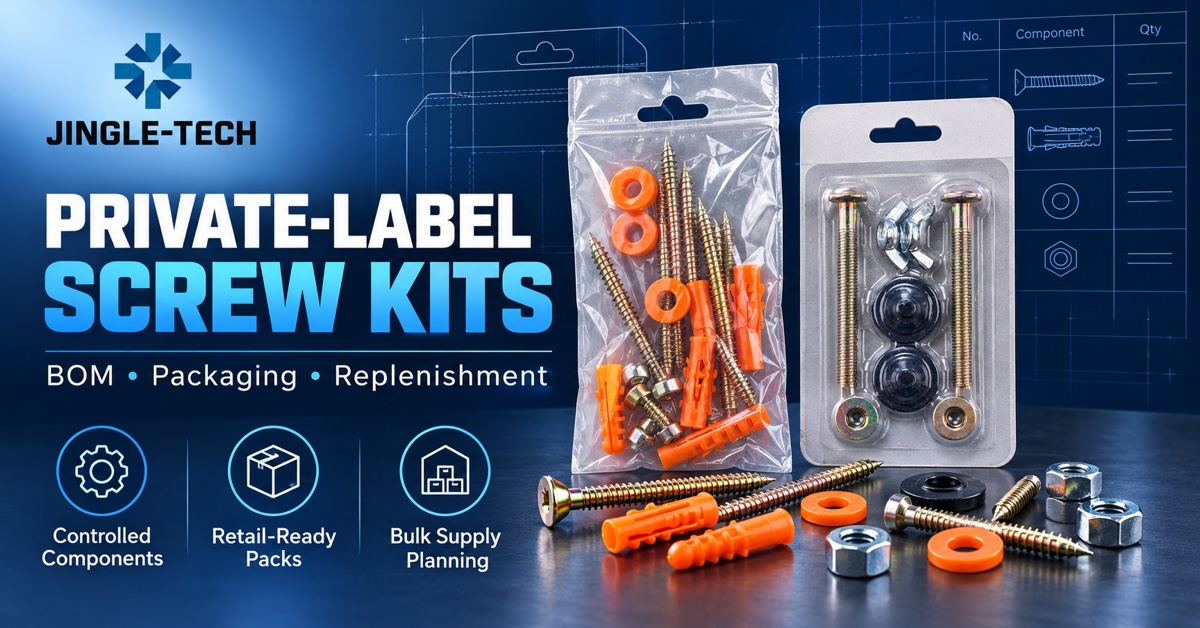
A screw bulk manufacturer or screw wholesale supplier should be able to discuss quantity ladders, pack formats, lot control, replenishment, and change notification. A buyer sourcing multiple items may also need a screw wholesale set manufacturer or screw custom kit manufacturer that can control a bill of materials rather than simply place assorted hardware into one bag.
The nine supplier phrases above describe different commercial needs. They should not be treated as nine interchangeable claims. Ask for evidence against the need that matters: controlled machine-screw production, pan-head capability, bulk packing, retail kits, drawing-based customization, or export coordination.
14. Price, MOQ, tooling, and lead time: what actually changes the quote?
Weight is only the opening line in a machine-screw price. A long, slender part may run differently from a short one. Head and recess tooling, thread form, steel or alloy choice, mechanical requirements, thermal processing, finish, sorting, inspection, and the order pattern each add their own effect. Compare a standard part tipped into a bulk carton with a short custom run that needs a special recess, a cosmetic boundary sample, individual bags, and a first-article report: the metal weight could be similar while the work is not.
Ask for quantity breaks that mirror the program: samples, pilot, normal release, and the annual estimate. This lets the supplier put startup work in one column and the repeat unit price in another. When a tool is charged, record who owns it, who maintains it, where it is stored, and how a drawing change affects it. Push one level deeper on MOQ as well. A minimum caused by a plating batch calls for a different remedy than one caused by printed bags, raw-material purchase, or machine setup.
Lead time should state its trigger. Does it begin after the purchase order, deposit, approved drawing, approved artwork, sample approval, or receipt of customer-supplied material? Separate sample lead time, first-production lead time, and repeat lead time. Ask the supplier to identify holidays, outsourced-process capacity, and document approval as dependencies. A precise schedule with conditions is more useful than a fast number with none.
15. A buyer-side example: from vague request to quote-ready specification
Consider an OEM that needs a stainless pan head screw for a control enclosure. The first request says, “M4 × 16 stainless Torx pan head, 50,000 pieces, best price.” It appears specific, but it leaves major decisions open: pitch, tolerance, exact stainless fastener designation and property class, head standard, recess size, length measurement, thread length, passivation or surface condition, galling concerns, inspection, pack count, and mating-thread details.
The revised RFQ references a controlled drawing. It calls out M4 × 0.7 external thread with the applicable tolerance, 16 mm under-head length, defined pan-head and internal drive geometry, stainless material and mechanical requirement per the approved standard, deburring and surface condition, critical head and recess dimensions, GO/NO-GO thread acceptance, first-article report, lot-level dimensional record, and 500-piece labeled bags. It states sample, pilot, annual, and release quantities; destination; requested Incoterm; and target date.
That revision does not force every supplier to quote the same process. It forces every supplier to quote the same requirement or identify a deviation. Engineering can review alternatives deliberately. Purchasing can compare commercial offers. Quality knows what records to expect. The supplier knows which questions must be closed before production. This is what a good RFQ is meant to do.
16. Machine screw RFQ checklist
- Part number, drawing number, revision, and controlling file identified.
- Metric or inch thread, diameter, pitch/TPI, series, and tolerance class stated.
- Mating internal thread and minimum engagement understood.
- Length definition, head, drive, recess size, point, and thread length controlled.
- Base material, mechanical property, heat treatment, and finish separated.
- Coating system, thickness, color, sealer/lubricant, and test basis defined as needed.
- Critical characteristics and inspection methods agreed.
- Sample approval and change-control route documented.
- Sample, pilot, release, and annual quantities supplied.
- Pack count, labels, barcode data, corrosion protection, and pallet needs stated.
- Destination, named Incoterm location, target date, and required documents included.
- Actual manufacturer, contracting entity, and evidence responsibility understood.
- Every quotation returns assumptions, exclusions, deviations, validity, and lead-time trigger.
Frequently asked questions from U.S. machine screw buyers
What information is essential for an accurate machine screw quotation?
Lead with the current drawing and its revision. The supplier still needs the complete thread callout, length, head and drive, metal and finished-part properties, any heat treatment, the finish, and the dimensions that matter most. Follow with the reports, order breaks, pack, destination, Incoterm, and requested date. A short note on the application and female thread helps expose a bad match. Mark any unfinished decision as open and require the quote to show what it assumed.
Can a supplier quote from a photo or physical sample?
A photo helps with identification; a sample gives the supplier something to measure. Neither reveals the full material history, heat treatment, coating recipe, thread class, or acceptance rule. Reverse engineering should therefore produce a drawing and specification that the buyer reviews. On the quote, use four plain labels beside uncertain data: measured, tested, assumed, or awaiting confirmation.
Should I choose metric or inch machine screws for a U.S. product?
U.S. products use both systems. The sensible choice is the one already supported by the assembly, mating parts, service tools, and design standard. Problems begin when the system is only implied. Put the full designation and female thread on the drawing, and route every near-size alternative back to engineering before it appears on a purchase order.
Is stainless steel always better than zinc-plated carbon steel?
No. Start with where the joint lives and how it is assembled. Strength, magnetism, galling, appearance, electrical behavior, availability, and budget can all move the choice. A well-defined plated-steel part may be right for one indoor unit; a stainless part may earn its cost elsewhere. Engineering should choose metal and surface condition together, then say how the finished screw will be verified.
What inspection reports should I request?
Do not order a stack of certificates by habit. Match the paperwork to the risk. One project may need first-article dimensions and a thread-gauge record; another may add material, hardness, torsion, coating-thickness, or corrosion evidence. Before the order, agree on the test basis, sampling, lot reference, and report format. “Certificate required” gives neither side enough to price or audit.
How can I reduce MOQ without losing control?
Use standard material, head, drive, thread, and finish where the design permits; separate prototype and production routes; accept neutral packaging for pilots; combine demand into scheduled releases; and provide an annual forecast. Ask what drives the MOQ. If the constraint is plating, printed packaging, or setup, the supplier may suggest a controlled alternative. Never relax a safety or functional requirement only to reach a lower quantity.
How should I handle supplier substitutions?
Put changes in writing before they reach production. That includes a different manufacturing source, material source, tool, heat-treatment route, plater, lubricant, inspection method, or pack whenever it can affect the approved part. Engineering and quality can then choose the response: a document review, new samples, partial testing, or full revalidation. The word “equivalent” on a sales email is not that review.
What should I send to JINGLE for a technical and commercial review?
Send the part number, current drawing or standard, material and finish, critical requirements, sample and order quantities, annual demand, packaging, destination, requested Incoterm, target date, and required documents. JINGLE can then confirm the responsible supply route, applicable product options, open technical questions, and quotation basis for the specific project rather than make a portfolio-wide promise.
Ready for a machine screw quotation?
Send your drawing or standard, quantities, finish, inspection documents, packaging, destination, and target date. We will review the missing fields before preparing a product-specific quotation.
Request a Quote from JINGLE →Technical note: Product suitability, standards, certificates, inspection scope, manufacturing entity, lead time, and commercial terms must be confirmed for the specific part, batch, destination, and contract. This guide supports RFQ preparation; it does not replace the buyer’s engineering approval.