Metal Hardware: The Hidden Strength Behind Every Assembly
Hardware parts are often small, but their role is immense. A poorly machined connector or bracket can compromise the entire structure of an assembly—leading to vibration, fatigue, or mechanical failure.
That’s why custom metal hardware isn’t just about fitting dimensions; it’s about designing every millimeter for strength, alignment, and stability.
At Jingle, we treat each component as part of a larger system—where precision engineering ensures reliability, and material selection determines longevity.
How Custom Metal Hardware Parts Are Engineered for Accuracy
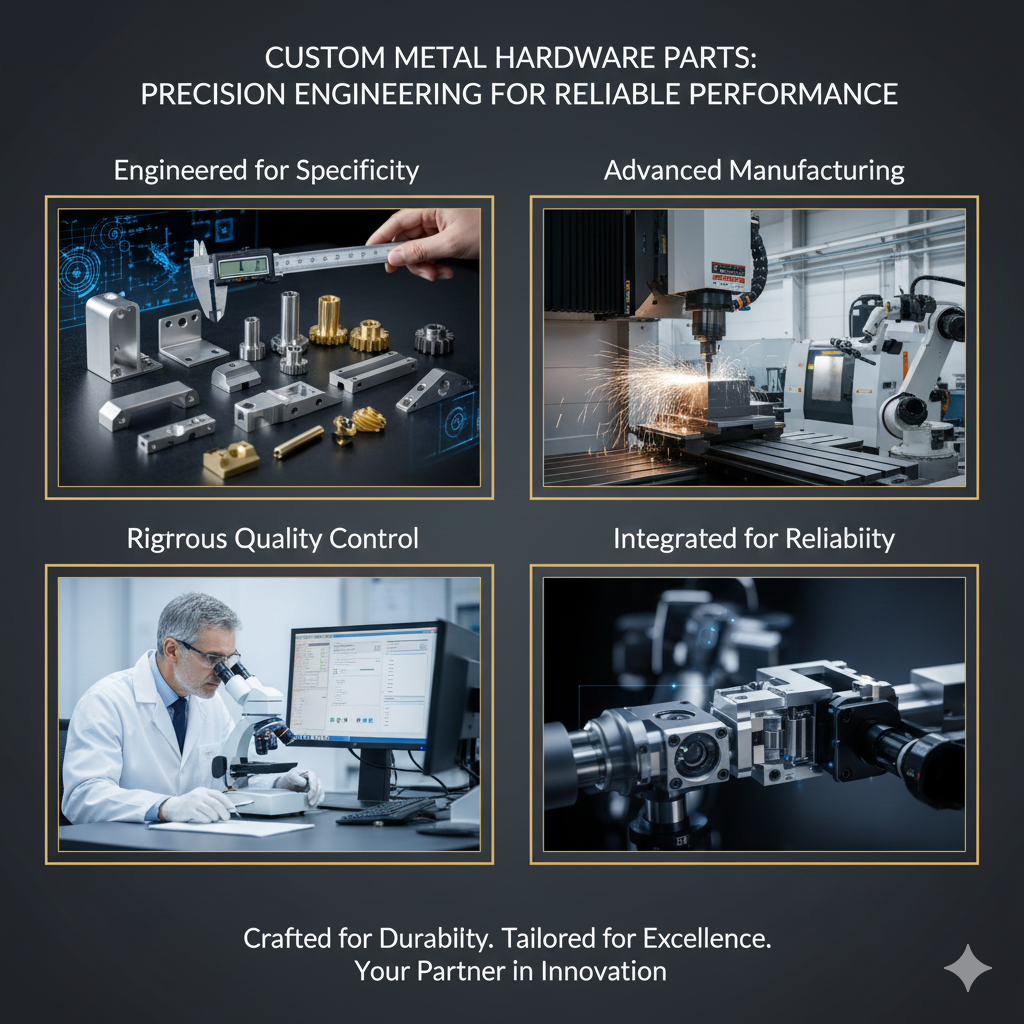
Precision starts with process control. Every custom hardware component passes through digital design, CNC machining, and surface finishing—each phase removing variability.
| Process Step | Key Function | Result |
|---|---|---|
| CAD/CAM Modeling | Define geometric tolerances | Reproducible dimensions |
| CNC Milling & Turning | Achieve ±0.01mm precision | Stable part geometry |
| Threading & Drilling | Perfect mechanical fit | Zero backlash assembly |
| Surface Treatment | Prevent oxidation & wear | Longer service life |
| Inspection & Testing | Verify tensile & yield strength | Certified quality assurance |
Unlike cast or stamped hardware, CNC machining ensures every part matches the specified tolerance—ideal for clients who demand perfect interchangeability.
Material Options and Their Industrial Applications
Different environments require different alloys. Jingle offers a wide range of materials selected based on load, temperature, and corrosion conditions.
| Material Type | Key Features | Common Applications |
|---|---|---|
| Stainless Steel (304/316) | Corrosion resistant, strong weldability | Marine, construction, outdoor fixtures |
| Carbon Steel | High strength, cost-effective | Machinery and heavy equipment |
| Aluminum Alloy | Lightweight, oxidation-resistant | Transportation, electronics |
| Brass | Anti-friction, decorative finish | Plumbing, furniture, electrical |
| Titanium Alloy | Superior strength-to-weight ratio | Aerospace, medical equipment |
Each material is chosen not just for cost, but for mechanical compatibility—ensuring every fastener, bracket, or hinge performs reliably under real-world conditions.
Practical Insights: Choosing the Right Metal Hardware
Selecting metal hardware isn’t only about specifications; it’s about understanding use cases. Below are common scenarios and their ideal hardware choices:
| Application | Environment Factor | Recommended Hardware Type |
|---|---|---|
| Coastal construction | Salt & humidity | 316 stainless steel fasteners |
| Industrial machinery | Vibration & impact | High-strength carbon steel bolts |
| Electronics housing | Lightweight design | CNC aluminum enclosures |
| Decorative fittings | Aesthetic durability | Polished brass or chrome-plated steel |
| Automotive components | Temperature fluctuation | Zinc-coated carbon steel hardware |
These recommendations help engineers and procurement managers make reliable decisions, reducing downtime and ensuring safety across projects.
Why Jingle’s Custom Hardware Solutions Stand Out
1. Consistent Tolerance Control
All CNC-machined hardware parts maintain ±0.01mm accuracy through real-time monitoring systems.
2. Surface Integrity & Coating
Advanced polishing, anodizing, and galvanizing ensure both visual appeal and corrosion resistance.
3. Flexible Customization
From M2 screws to 50mm thick brackets, we adapt tooling to every batch—without sacrificing precision.
4. Full Documentation
Each order includes dimensional reports, RoHS compliance certificates, and mechanical property testing results.
5. Scalable Production
Jingle supports both prototype development and mass production, ensuring seamless scaling from sample to shipment.
Avoiding Common Pitfalls in Hardware Procurement
When sourcing metal hardware, even experienced engineers can face preventable issues:
-
Overlooking Material Compatibility: Mixing dissimilar metals (e.g., stainless with carbon steel) can cause galvanic corrosion.
-
Ignoring Coating Requirements: In humid regions, uncoated bolts corrode within months.
-
Assuming “Standard” Equals “Fit”: Small differences in thread pitch or hole spacing can delay assembly by weeks.
-
Skipping Dimensional Verification: Lack of micrometer inspection leads to misfits under load.
By focusing on material pairing, coating, and tolerance control, Jingle helps international clients avoid costly assembly errors and unnecessary redesigns.
FAQs
Q1 – What’s the minimum order quantity for custom hardware?
Jingle supports small-batch production starting from 500 pcs for prototypes or pilot projects.
Q2 – Can you supply hardware for specific industry standards?
Yes, we comply with ISO, DIN, and ANSI standards, and can produce custom fittings per client drawings.
Q3 – How do you ensure consistency across shipments?
Every batch undergoes digital dimension inspection, hardness testing, and 3D profile scanning.
Q4 – What surface finishes are available?
Options include zinc plating, black oxide, anodizing, electropolishing, and powder coating.
Building Reliability Through Precision and Partnership
From industrial frames to mechanical assemblies, Jingle’s custom metal hardware parts are engineered for one goal—performance without compromise.
Every piece combines precision machining, verified strength, and tailored finishing to meet diverse project demands.
To explore material options and specifications, visit our Homepage or reach out via Contact Us for a technical consultation on your next custom order.