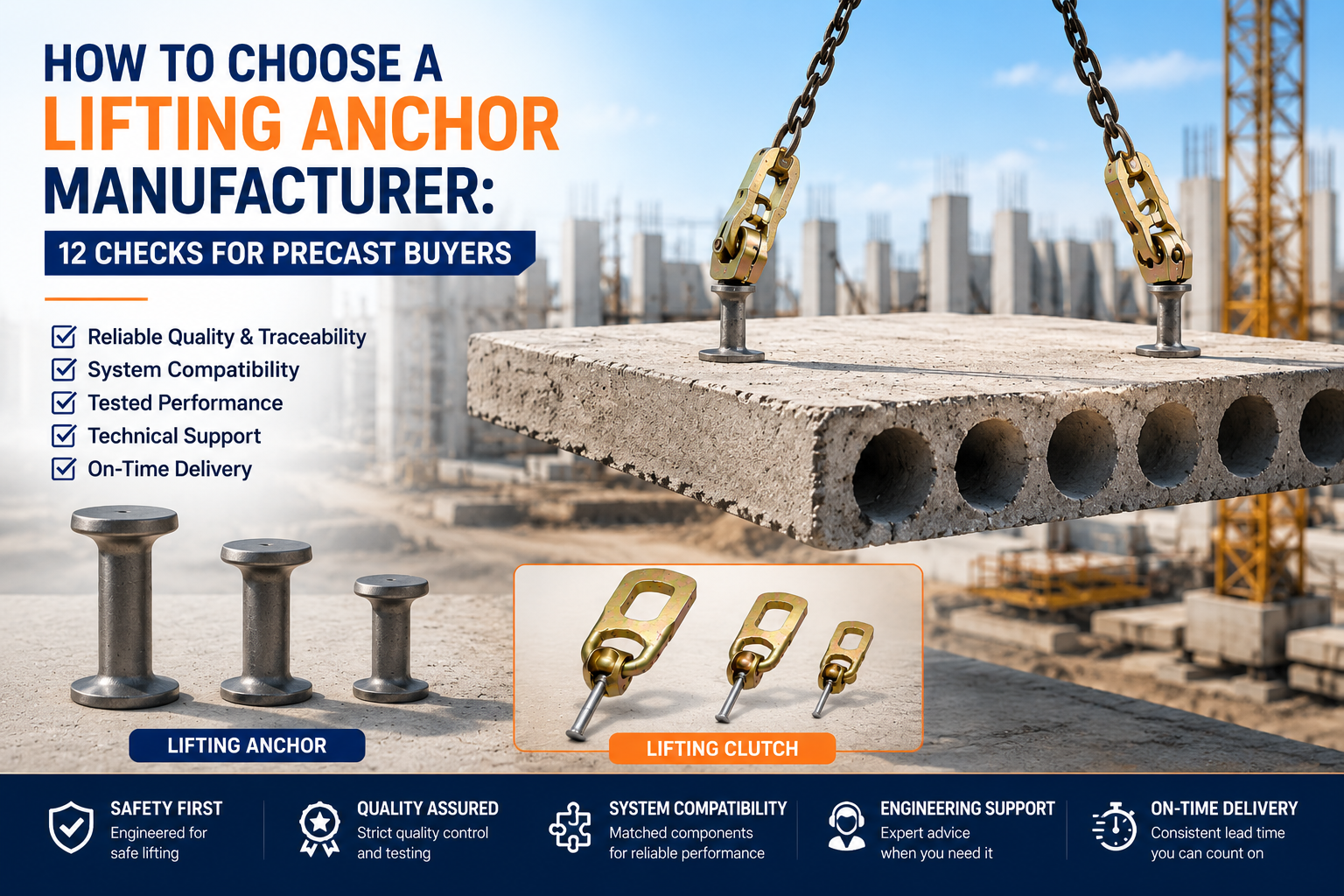
How to Choose a Lifting Anchor Manufacturer: 12 Checks for Precast Buyers

Choosing a lifting anchor manufacturer is not simply a matter of comparing catalog sizes and unit prices. A lifting anchor forms part of a load-transfer system that may include the concrete element, reinforcement, recess former, lifting clutch, rigging arrangement, and installation method.
A qualified manufacturer should therefore provide more than a steel component. It should provide enough technical documentation, production control, test evidence, and traceability for engineers and procurement teams to determine whether the system is appropriate for the intended application.
The central purchasing question is not:
“Which lifting anchor has the highest nominal capacity?”
A more useful question is:
“Which documented lifting system is suitable for this element, concrete condition, lift direction, accessory interface, production process, and applicable project requirements?”
This guide presents 12 practical checks that precast concrete buyers can use when qualifying a lifting anchor manufacturer.
Executive Answer: What Separates a Qualified Manufacturer?
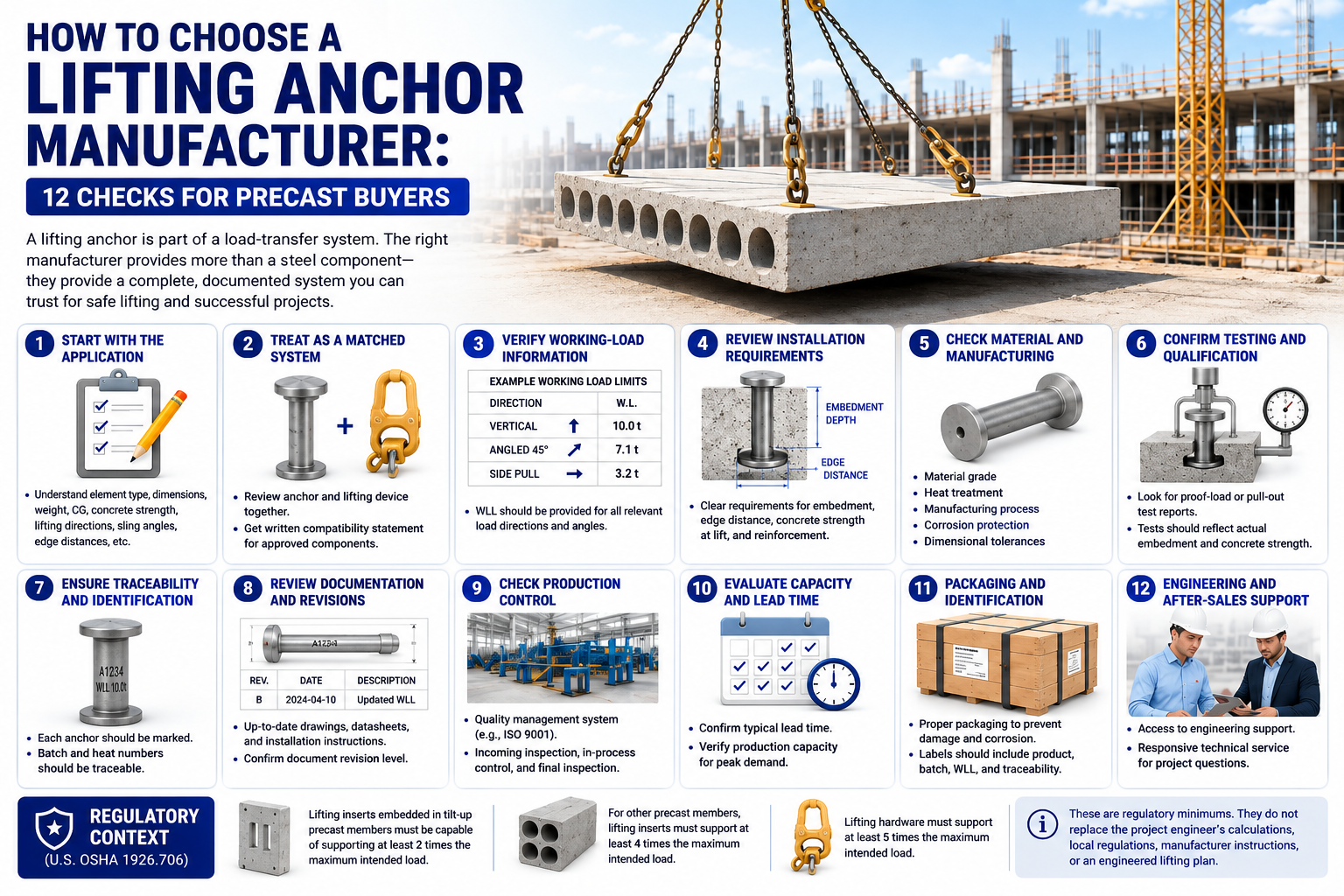
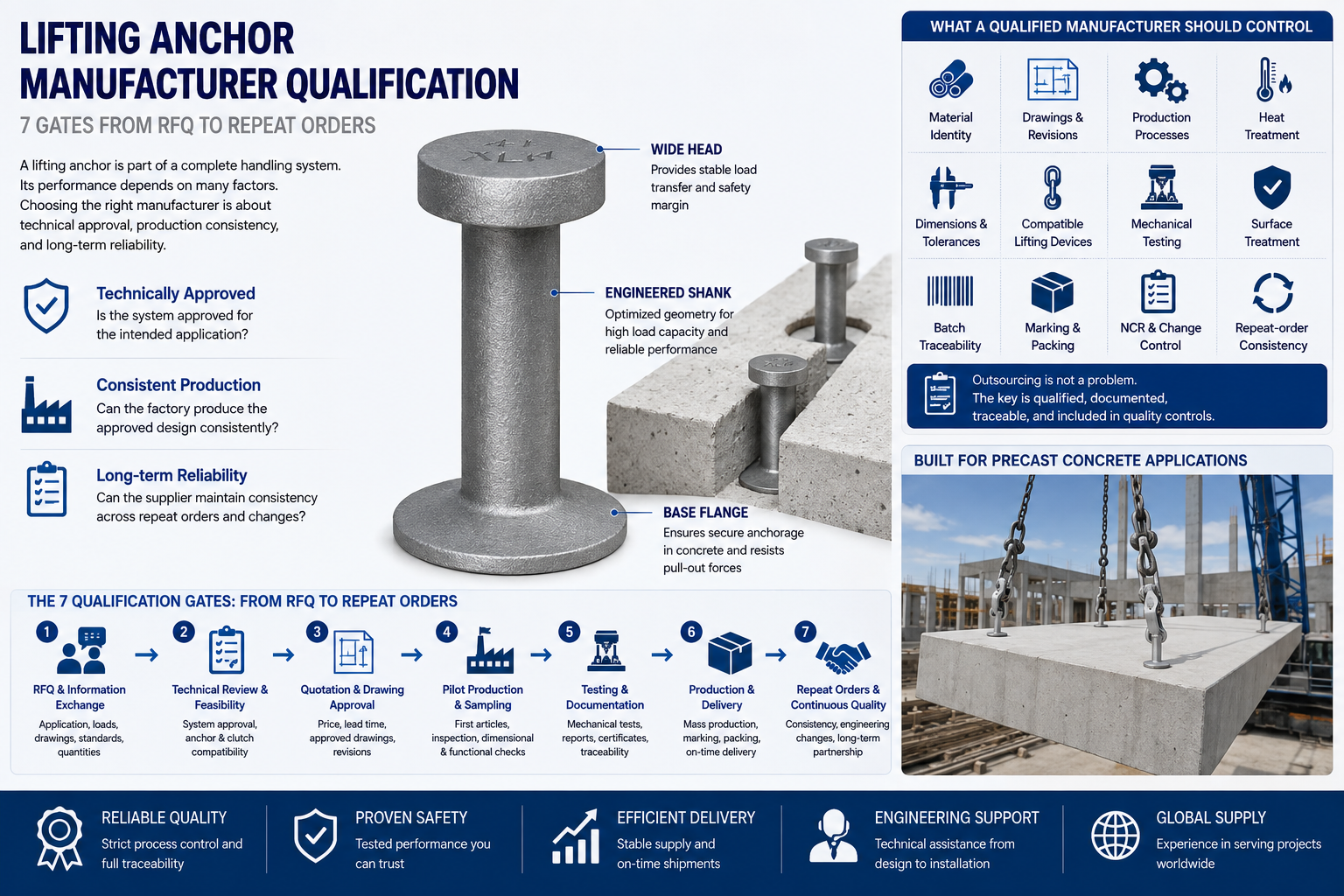
A qualified lifting anchor manufacturer should be able to connect the following information in one reviewable technical package:
-
Product geometry and dimensions
-
Material grade and manufacturing process
-
Compatible lifting clutch or attachment
-
Working-load information
-
Installation and embedment requirements
-
Concrete strength requirements
-
Inspection and testing records
-
Product and batch traceability
-
Drawing and document revisions
-
Packaging and identification
-
Production capacity and lead time
-
Engineering and after-sales support
For regulatory context, the United States OSHA requirements for precast concrete specify minimum capacity relationships for certain applications.
OSHA states that lifting inserts embedded in tilt-up precast members must be capable of supporting at least two times the maximum intended load. For other precast members, lifting inserts must support at least four times the maximum intended load. Lifting hardware must support at least five times the maximum intended load.
These are United States regulatory minimums. They do not replace the project engineer’s calculations, local regulations, manufacturer instructions, project specifications, or an engineered lifting plan.
Why Selecting a Manufacturer Is a System Decision
A lifting anchor transfers force from lifting equipment into a precast concrete element. Its performance depends on considerably more than the strength of the steel component.
Relevant variables may include:
-
Element weight and dimensions
-
Center of gravity
-
Concrete strength at the time of lifting
-
Anchor embedment
-
Edge distance
-
Reinforcement arrangement
-
Number and position of lifting points
-
Sling angle
-
Direction of loading
-
Dynamic effects
-
Formwork placement
-
Lifting sequence
-
Compatible clutch or lifting device
An anchor used for a nearly vertical lift may experience a different load condition from one used during stripping, tilting, rotating, or erection.
This is why two lifting anchors that look similar are not necessarily interchangeable. Differences in head geometry, material, heat treatment, dimensional tolerance, coating thickness, or clutch engagement can influence system performance.
The lifting anchor manufacturer should clearly identify the complete product system and its limitations. Final selection and approval should remain with the responsible engineer and competent lifting team.
The 12-Point Lifting Anchor Manufacturer Checklist
1. Start With the Application, Not the Catalog
A capable lifting anchor manufacturer should ask questions before recommending a product.
The initial application review should normally cover:
-
Precast element type
-
Element dimensions
-
Total mass
-
Center of gravity
-
Concrete strength at first lift
-
Number of lifting points
-
Anchor locations
-
Lifting directions
-
Sling angles
-
Edge distances
-
Reinforcement constraints
-
Required lifting sequence
-
Environmental exposure
-
Destination country
-
Applicable project requirements
A quotation based only on nominal load capacity is incomplete.
An anchor that appears suitable for the total component weight may still be inappropriate for a thin section, edge lift, angled load, early-age concrete condition, or rotate-and-set operation.
2. Treat the Anchor and Lifting Device as a Matched System
The embedded anchor and engaging lifting device must be reviewed together.
Depending on the system, related components may include:
-
Lifting clutch
-
Ring clutch
-
Lifting eye
-
Recess former
-
Threaded attachment
-
Socket
-
Hook
-
Installation plate
-
Additional reinforcement
Ask the manufacturer to identify the approved matching components and provide a written compatibility statement.
Do not assume that products from different manufacturers are interchangeable simply because their dimensions or appearance seem similar. Small differences in seating, locking, head geometry, or engagement depth may affect the connection.
3. Request the Design Basis and Load Documentation
The supplier should provide current technical information for the exact product being offered.
The documentation may include:
-
Product data sheet
-
Approved product drawing
-
Working-load information
-
Load-direction limitations
-
Sling-angle limitations
-
Embedment requirements
-
Edge-distance requirements
-
Concrete strength requirements
-
Additional reinforcement details
-
Installation instructions
-
Compatible lifting devices
-
Inspection criteria
-
Calculation or testing basis
Buyers should also distinguish between working-load information and minimum breaking results.
A breaking-load result from a laboratory test is not automatically an allowable working load. The relationship depends on the relevant design basis, safety factors, load direction, concrete condition, product instructions, and applicable requirements.
4. Verify the Material and Manufacturing Route
The technical file should identify the material grade and manufacturing route used for the anchor.
Depending on the product, manufacturing processes may include:
-
Forging
-
Casting
-
Machining
-
Forming
-
Welding
-
Thread rolling
-
Heat treatment
-
Surface treatment
The selected process should be suitable for the geometry and performance requirements of the product.
Ask the lifting anchor manufacturer to explain:
-
Which material specification applies
-
How incoming material is verified
-
Whether heat treatment is required
-
How heat-treatment parameters are controlled
-
Which operations are completed in-house
-
Which operations are subcontracted
-
How subcontracted processes are qualified
-
How unauthorized material substitutions are prevented
Any proposed change to the material, heat treatment, tooling, manufacturing route, or sub-supplier should require documented review and buyer notification.
5. Audit Dimensional Control
Critical dimensions should be identified on an approved drawing and controlled through an inspection plan.
Particular attention should be given to dimensions that affect:
-
Engagement with the lifting clutch
-
Seating and locking
-
Embedment
-
Load transfer
-
Thread engagement
-
Product orientation
-
Fit with recess formers
-
Compatibility with installation accessories
Ask the manufacturer for:
-
Approved dimensional drawing
-
Tolerance plan
-
Inspection method
-
Gauge-control procedure
-
Calibration records
-
First-article inspection
-
In-process inspection
-
Final inspection report
-
Representative batch records
For repeat orders, dimensional consistency may be as important as the original product design. A product that varies between batches can cause clutch-fit problems, installation delays, or field rejection.
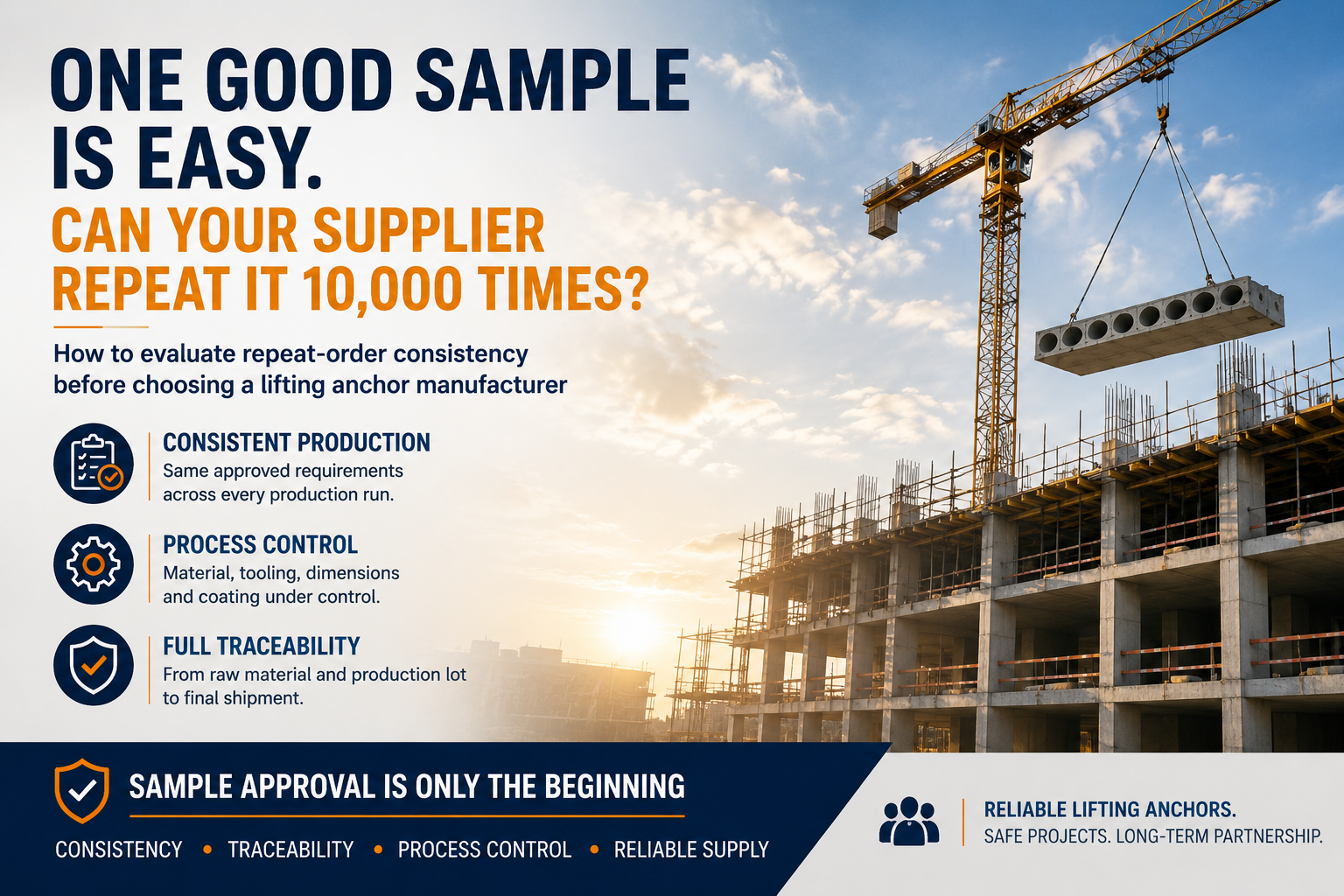
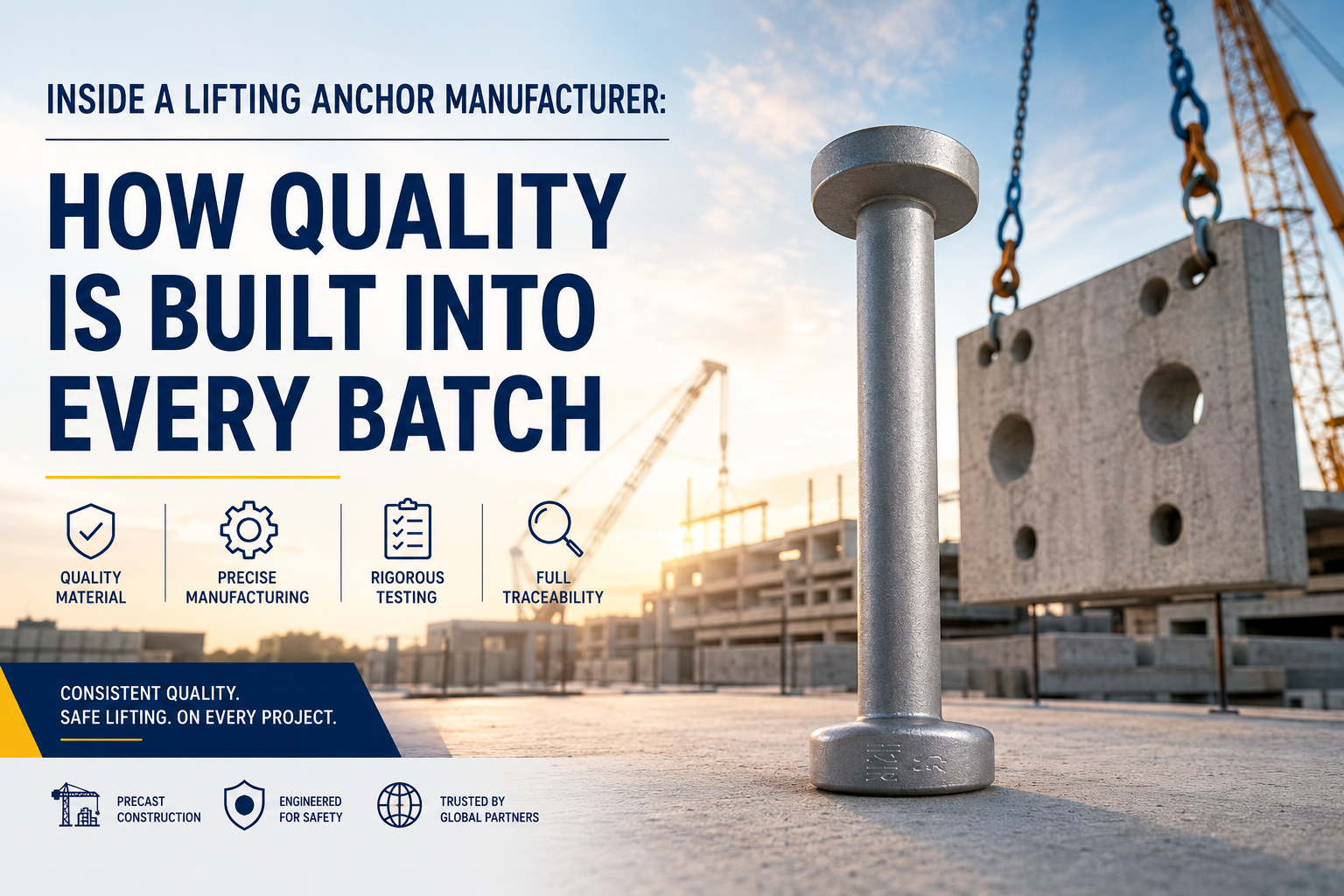
6. Demand Lot Traceability and Clear Identification
A reliable lifting anchor supplier should be able to trace the product through material receipt, manufacturing, inspection, packaging, and shipment.
The traceability system should connect:
-
Material heat or batch
-
Production order
-
Manufacturing lot
-
Inspection results
-
Test reports
-
Product marking
-
Packing label
-
Shipment record
Identification should remain clear after transportation and storage.
This is especially important when similar-looking lifting anchors have different capacities, materials, coatings, or applications. Packaging and product markings should reduce the risk of components being mixed on the precast production floor.
Ask what information is marked directly on the product and what appears only on the packaging.
7. Review Mechanical Testing and Inspection Scope
Do not ask only whether the product has been tested. Ask how it was tested and whether the evidence applies to the exact product being purchased.
A useful test report should identify:
-
Product model
-
Product size
-
Drawing revision
-
Material grade
-
Manufacturing condition
-
Surface finish
-
Sample quantity
-
Production lot
-
Test setup
-
Test method
-
Loading direction
-
Concrete condition, where relevant
-
Results
-
Failure mode
-
Test date
-
Laboratory
-
Report authorization
Buyers should understand the difference between:
-
Routine production inspection
-
Batch testing
-
Type testing
-
Design validation
-
Project-specific testing
-
Third-party testing
If a third-party report is provided, confirm that the tested size, material, geometry, finish, manufacturing process, and revision match the product being quoted.
A report for a different model or older drawing should not automatically be treated as evidence for the current product.
8. Confirm Corrosion Protection and Its Dimensional Effects
Material and surface treatment should be selected according to the service environment and project specification.
Possible options may include:
-
Plain steel
-
Electro-galvanized finish
-
Hot-dip galvanized finish
-
Mechanical plating
-
Stainless steel
-
Project-specific coating
The manufacturer should explain:
-
Coating specification
-
Coating thickness
-
Surface preparation
-
Inspection method
-
Corrosion-resistance requirements
-
Effects on threads or mating surfaces
-
Restrictions on use
-
Packaging protection
Coating thickness can affect threaded connections and clutch interfaces. A finish should not be changed without checking the relevant dimensional and performance implications.
Aggressive environments may require a different material solution rather than simply a thicker coating.
9. Check Document and Revision Control
Supplier documentation should use consistent part numbers and revision levels.
Controlled documents may include:
-
Product drawings
-
Technical specifications
-
Material requirements
-
Inspection plans
-
Test procedures
-
Installation instructions
-
Certificates
-
Packing specifications
-
Product labels
Ask the manufacturer how engineering changes are reviewed, approved, recorded, and communicated.
The supplier should also have controls to prevent products manufactured to different revisions from being mixed.
Before approving mass production, confirm that the following use the same revision:
-
Purchase order
-
Approved drawing
-
Sample
-
Test report
-
Inspection plan
-
Product marking
-
Packaging label
10. Assess the Quality-Management System
A quality-management certificate can support confidence in a supplier’s process control, but it does not independently approve a lifting anchor.
ISO describes ISO 9001:2015 as a standard for establishing, maintaining, and continually improving a quality management system.
When a supplier claims certification, verify:
-
Full standard reference
-
Certificate number
-
Certification body
-
Supplying company name
-
Manufacturing site
-
Scope of certification
-
Issue date
-
Expiry date
-
Current certificate status
The scope should cover the relevant manufacturing activities and supplying location.
ISO 9001 certification does not replace product-specific drawings, calculations, tests, instructions, traceability, or project approval. It should be treated as one part of the supplier qualification process.
Buyers should also check which edition of the standard and transition requirements apply at the time of approval.
11. Test Production and Supply Readiness
A technically acceptable product can still create problems if the manufacturer cannot supply it consistently.
Review:
-
Tooling availability
-
Tooling ownership
-
Minimum order quantity
-
Sample lead time
-
Production lead time
-
Monthly capacity
-
Capacity by size and process
-
Inspection bottlenecks
-
Subcontracted-process lead time
-
Export packaging
-
Shipping experience
-
Safety stock
-
Contingency planning
-
Forecast requirements
A factory-wide capacity statement may not reflect the capacity available for a particular forging, heat-treatment, machining, or testing process.
Ask for a production plan based on the actual size mix and order schedule.
Packaging should also protect the products and prevent different capacities, finishes, or lots from being mixed.
12. Use Samples and a Controlled Pilot Order
A new lifting anchor manufacturer should normally be qualified in stages.
A practical process includes:
-
Complete the application review.
-
Approve the product drawing.
-
Review the technical evidence.
-
Order representative samples.
-
Check dimensions and appearance.
-
Confirm fit with the intended lifting device.
-
Review marking and packaging.
-
Complete required tests or validation.
-
Freeze the approved revision.
-
Place a controlled pilot order.
-
Inspect the first production batch.
-
Approve the supplier for recurring production.
Sample approval should not rely on appearance alone.
The sample should be evaluated against the approved drawing, compatible equipment, required documentation, and intended application.
Where project-specific validation is required, testing and approval should be completed under the direction of the responsible engineer.
Product-Family Questions to Resolve Before Comparing Quotes
The product category name alone does not establish suitability. Buyers should identify the first technical questions associated with each system family.
| System family | Typical reason to consider | Questions to resolve |
|---|---|---|
| Spherical-head or foot anchor | Fast engagement with a compatible clutch; commonly used in precast handling | Head and clutch interface, embedment, lift direction, edge distance, concrete strength |
| Spread or erection anchor | Thin elements, edge lifts, rotation, or erection sequences when permitted by the designed system | Tension and shear phases, reinforcement detail, orientation, recess and clutch compatibility |
| Threaded lifting socket or insert | Recessed threaded connection for compatible lifting eyes or hardware | Thread standard, engagement length, insert restraint, corrosion protection, approved lifting device |
| Coil insert or loop system | Project-specific lifting or fixing arrangements | Intended use, matching bolt or loop, embedment, concrete capacity, reusable and single-use components |
| Wire-rope loop or cast-in loop | Handling or connection applications defined by the selected system | Loop geometry, rope condition, bend restrictions, installation position, approved attachment method |
Final product selection should follow the system manufacturer’s instructions and the responsible engineer’s review.
What Evidence Should Be in the Supplier File?
Ask the lifting anchor manufacturer for a coherent technical evidence pack rather than disconnected certificates and screenshots.
The required depth will depend on the jurisdiction, product family, and project. A strong qualification file commonly includes:
-
Current product drawing with part number and revision
-
Material and finish specification
-
Dimensions and tolerances
-
Product marking requirements
-
Installation and embedment instructions
-
Compatible lifting-device information
-
Load data and application limitations
-
Material certificates
-
Lot-traceability records
-
Inspection plan
-
Dimensional reports
-
Test plan
-
Product-specific test reports
-
Quality-management certificate
-
Packaging and labeling specification
-
Engineering change-control procedure
The evidence should consistently identify the same product model, size, material, finish, manufacturing condition, and drawing revision.
A Practical Lifting Anchor Supplier Scorecard
| Criterion | Weight | What good performance looks like |
| Application and system fit | 20% | The supplier asks about the load case and identifies compatible components and application limitations. |
| Technical evidence | 20% | Drawings, load data, instructions, revisions, and validation evidence are complete and consistent. |
| Material, process, and testing | 20% | Materials, critical processes, inspections, sampling, and tests are controlled. |
| Traceability and change control | 15% | Lots, markings, documents, and engineering changes can be traced and contained. |
| Quality system and audit readiness | 10% | The certificate scope and manufacturing site are current, and supporting records are available. |
| Supply and packaging readiness | 10% | Capacity, lead time, labels, export packaging, and contingency plans fit the purchasing program. |
| Engineering communication | 5% | Technical questions receive specific, documented answers, and unresolved points are tracked to closure. |
Missing safety-critical evidence should be treated as a qualification gate, not merely a low score that can be offset by a lower price.
Commercial comparison should begin after technical acceptance.
How Jinglefix Can Support the Sourcing Process
Jinglefix supplies industrial fasteners, precast accessories, CNC-machined components, and drawing-based OEM/ODM products.
The company’s precast accessories portfolio covers product categories that include:
-
Lifting anchor systems
-
Threaded socket systems
-
Spread anchor systems
-
Rebar systems
-
Wire loop boxes
-
Cast-in channels
-
Coil ties and coil inserts
-
Recess formers
-
Related precast accessories
This product range can help buyers discuss embedded anchors and compatible accessories within one sourcing process.
Based on the supplied Jinglefix company content library, available manufacturing capabilities include machining, forming, forging, casting, welding, heat treatment, and surface finishing. The appropriate production route depends on the individual product and should be confirmed during technical review.
Before approving a product, buyers should review the Jinglefix company profile, the company’s lifting anchor selection guide, and the applicable product information.
Current drawings, certificates, load information, compatibility details, and test evidence should then be requested for the exact product and destination market.
RFQ Checklist: Information to Send With Your Inquiry
A precise RFQ allows a lifting anchor manufacturer to respond with fewer assumptions.
Where applicable, include the following information:
-
Precast element drawing
-
Element dimensions
-
Element mass
-
Center of gravity
-
Production quantity
-
Concrete specification
-
Concrete strength at demolding
-
Concrete strength at first lift
-
Concrete strength during transport and erection
-
Lifting-point quantity and locations
-
Sling arrangement and angles
-
Equalizing system
-
Dynamic considerations
-
Stripping and turning sequence
-
Yard-handling process
-
Transport loading and unloading process
-
Final erection method
-
Required anchor family
-
Existing lifting clutch or lifting eye
-
Recess former or socket requirements
-
Project location
-
Governing regulations and standards
-
Customer specifications
-
Required approvals
-
Material and coating requirements
-
Service environment
-
Product-marking requirements
-
Lot-identification rules
-
Packaging specification
-
Inspection requirements
-
Required certificates
-
Witness or hold points
-
Sample requirements
-
Third-party testing requirements
-
Target delivery date
-
Annual demand
-
Forecast by size
To compare a standard or drawing-based product, send the application package to Jinglefix and request a technical review before asking for a final commercial quotation.
Red Flags That Should Pause Supplier Approval
Pause the qualification process if:
-
A capacity claim is provided without a product revision, test basis, installation condition, or compatible lifting device.
-
The supplier describes lifting anchors and clutches as universal but will not provide written compatibility information.
-
A test report covers another size, material, coating, geometry, factory, or drawing revision.
-
Certificates are expired, cropped, outside the supplying site’s scope, or cannot be verified.
-
Critical dimensions, materials, processes, or sub-suppliers may change without buyer notification.
-
Different capacities use indistinguishable markings or packaging.
-
The quotation is finalized before the supplier understands the element, concrete condition, lift direction, or destination requirements.
-
The supplier cannot distinguish routine inspection from type testing.
-
The sampling plan cannot be explained.
-
Material certificates cannot be connected to production lots.
-
The sample and the production drawing have different revisions.
-
Installation instructions do not identify the compatible lifting device.
Frequently Asked Questions
What does a lifting anchor manufacturer produce?
Depending on its capabilities, a manufacturer may supply cast-in anchors, spherical-head anchors, spread or erection anchors, threaded sockets, coil inserts, wire-rope loops, recess formers, and matched lifting devices.
Buyers should confirm which components are produced in-house, subcontracted, or purchased from other system suppliers.
Is nominal load capacity enough to select an anchor?
No.
Load capacity must be evaluated together with element geometry, concrete strength at lifting, embedment, edge distance, reinforcement, lifting-point arrangement, sling angle, load direction, dynamic effects, and compatible lifting hardware.
Can I use an anchor with another brand’s lifting clutch?
Only when the responsible system provider and project engineer have confirmed compatibility.
Similar appearance does not prove correct engagement, seating, locking, dimensional fit, or load transfer.
Does ISO 9001 certification approve a lifting anchor?
No.
ISO 9001 relates to the manufacturer’s quality management system. Product suitability still requires product-specific drawings, material controls, manufacturing controls, test evidence, installation instructions, traceability, and project review.
Which certificates should I request?
Request the certificates required by the project and destination market.
Verify the issuing organization, manufacturing site, certificate scope, product coverage, revision, issue date, expiry date, and current validity. A certification logo should not be treated as evidence for a specific product.
What should a lifting anchor test report identify?
It should identify the exact model, size, drawing revision, material, manufacturing condition, finish, sample quantity, production lot, test setup, method, result, failure mode, date, and testing organization.
For tests involving concrete, it should also document relevant concrete and embedment conditions.
How should a sample order be evaluated?
Check the sample against the approved drawing.
Review:
-
Dimensions
-
Tolerances
-
Material documentation
-
Surface finish
-
Product marking
-
Fit with the intended lifting device
-
Packaging
-
Batch identification
-
Inspection report
-
Traceability
Complete any required engineer-approved testing before releasing recurring production.
Can a manufacturer customize lifting anchors?
Many manufacturers can support OEM or drawing-based products, but customization increases the evidence requirements.
Before starting production, define:
-
Design responsibility
-
Drawing approval
-
Material
-
Tooling ownership
-
Validation plan
-
Inspection requirements
-
Product marking
-
Change control
-
Intellectual-property terms
-
Production approval process
How do I compare lifting anchor prices fairly?
Normalize the commercial offers against the same:
-
Material
-
Finish
-
Dimensions
-
Tolerances
-
Load-data basis
-
Testing
-
Inspection
-
Documentation
-
Product marking
-
Packaging
-
Delivery terms
-
Accessory scope
A lower unit price may exclude the controls and documentation needed to approve and use the product.
What is the best first step with a new manufacturer?
Send the application information and request a complete technical evidence package.
Resolve compatibility and documentation questions in writing, inspect representative samples, complete any required validation, and place a controlled pilot order before approving recurring production.
Conclusion: Qualify the Evidence, Then Compare the Offer
The best lifting anchor manufacturer is not necessarily the supplier with the largest catalog or the lowest initial quotation.
It is the supplier that makes the complete product decision easier to verify.
A qualified product should be:
-
Suitable for the intended application
-
Compatible with the approved lifting device
-
Supported by current technical documents
-
Manufactured through controlled processes
-
Inspected against an approved drawing
-
Supported by relevant test evidence
-
Traceable by batch
-
Clearly marked and packaged
-
Protected by effective change control
-
Delivered according to a realistic supply plan
Use the 12 checks in this guide as a technical qualification gate. Compare price, lead time, and commercial conditions only among suppliers that have passed the technical review.
For a Jinglefix technical review, prepare the precast element drawing, lifting sequence, concrete conditions, preferred lifting system, destination requirements, purchasing quantity, and required document list. Submit the information through the Jinglefix contact page.
Editorial and Technical Note
This article provides procurement and supplier-qualification guidance. It is not a lifting-system design, engineering approval, installation instruction, or substitute for a manufacturer manual, project specification, applicable regulation, competent-person review, or engineered lifting plan.
All capacities, certificates, compatibility claims, and technical parameters must be verified for the exact product model, revision, application conditions, and destination market before publication, approval, purchase, or use.