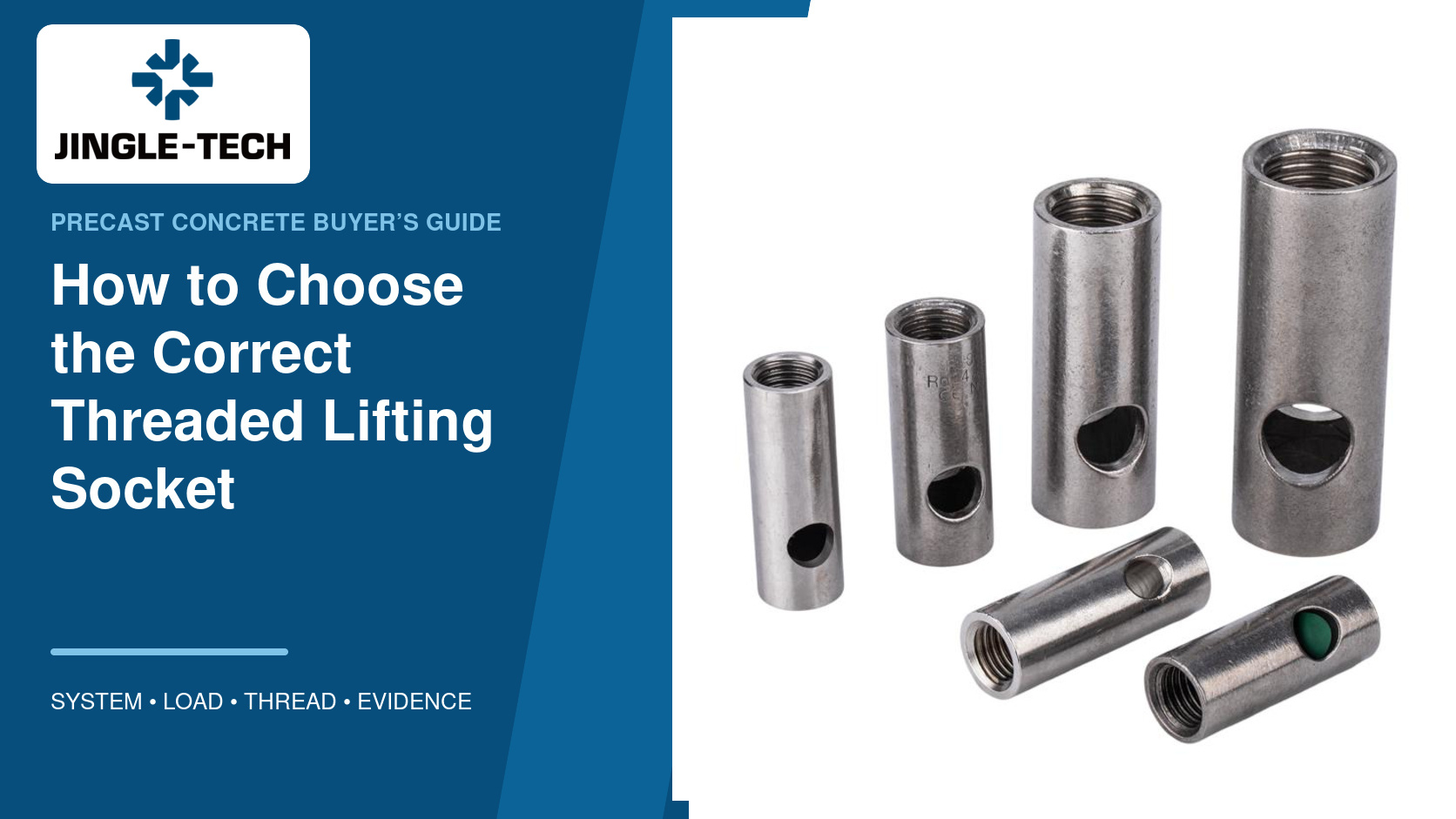
Metric vs Rd Thread for Lifting Sockets: What Should Buyers Verify?

Metric and Rd threads should be treated as different interfaces. A buyer must record the full thread designation shown on the approved socket drawing, then match it with the exact lifting device, system reference, engagement requirement, and inspection method. The same nominal number, a similar appearance, or a trial that turns a few threads does not prove compatibility.
Thread choice is only one part of socket selection. The responsible engineer still needs to approve the lifting system for the precast element, concrete condition, handling sequence, rigging, and load directions. Procurement should not convert an M requirement to Rd, or Rd to M, without product-specific written evidence.
Metric and Rd identify different thread families
The letter before the nominal size matters. ISO describes general-purpose metric screw threads with the designation M. ISO 261 states that these threads use the basic profile in ISO 68-1, with basic dimensions and tolerances covered by related ISO standards.
Rd is used for a round or knuckle thread family. DIN Media lists DIN 405-1 as the current standard for general-purpose knuckle-thread profiles and nominal sizes.
Those references establish that M and Rd are not two names for one geometry. They do not tell a buyer that every lifting socket follows a general-purpose thread standard without modification. The socket manufacturer's current drawing and lifting-system instructions remain the controlling product documents.

Write the complete thread designation in the RFQ
Avoid entries such as "thread 20," "standard metric," or "Rd type." They leave room for different interpretations.
Copy the designation exactly from the controlled drawing or product instruction. Record:
- thread family and nominal designation;
- pitch or lead information where the document specifies it;
- internal-thread tolerance or other fit requirement;
- effective threaded depth and required engagement;
- entrance form, relief, and any protected or unthreaded section;
- mating lifting-device reference and its external thread;
- drawing number and revision; and
- the inspection gauge or method named by the manufacturer.
Do not fill a missing field from memory. Mark it as an open technical question and ask the socket or system provider to answer against the exact product reference.
Match the lifting socket and lifting device as a system
A thread can be dimensionally correct while the lifting assembly is still wrong. The lifting loop, swivel eye, link, or adapter also has a body, seating face, articulation range, and permitted load directions. Its thread is only the connection into the socket.
PFEIFER's official Thread System instructions describe the lifting anchor, selected lifting device, and identification component as one system and warn against non-matched components. The Halfen HD Socket Lifting System catalogue identifies system-specific lifting devices and records thread information for anchors and accessories.
These examples support a system-based purchasing method. They do not approve a mixed PFEIFER, Halfen, JINGLE, or other-brand combination. Cross-system compatibility is [NEEDS JINGLE CONFIRMATION] and also requires the responsible project approval.
Read M/Rd catalogue wording carefully
Some catalogues show a combined heading such as "M/Rd" for a range of accessories. That wording is not a universal interchange statement. It may cover separate variants, a manufacturer's defined fit, or a table that applies to more than one product configuration.
Leviat's HD catalogue, for example, uses M/Rd wording in accessory tables and elsewhere names the lifting links permitted for the HD system. The useful purchasing lesson is to follow the product row, part number, drawing, and application note together. Do not extract the size number from one column and match it to an unrelated lifting eye.
The JINGLE Flat End Lifting Socket With Hole page lists RD thread and M thread as available types. The exact JINGLE sizes, profiles, tolerances, matching lifting devices, load classes, and orderable combinations are [NEEDS JINGLE CONFIRMATION]. Request the latest controlled drawing before placing an order.
Compare the two controlled drawings
Ask for the socket drawing and the mating-device drawing. Place the two interfaces in one review rather than checking each item against a catalogue name.
The comparison should cover the thread designation, pitch, tolerance, major and minor geometry where specified, usable engagement, runout, entry, shoulder, and seating condition. It should also show whether a plug, nailing plate, recess former, or protective device changes access to the thread.
Record any discrepancy. A proposed deviation needs a written disposition from the authorised technical parties. Purchasing should not accept "close enough," a handwritten conversion, or an unreferenced dimension on a quotation.
A hand-fit check is not approval
A shop trial can find obvious problems. The mating part may not start, may bind, may stop before seating, or may have excessive movement. That makes a hand check useful as a rejection screen.
It cannot prove the thread profile, tolerance, full engagement, material condition, assembly capacity, or suitability for a lift. Forcing a lifting device, using a spanner to overcome resistance, chasing the socket thread, or modifying the external thread can damage the interface and destroy traceability.
If a device does not enter and seat as the current instructions require, quarantine the combination. Do not try another part until one appears to fit and then release the batch on that observation.
Keep thread fit separate from lifting capacity
Thread designation does not select working load. The engineer must evaluate the element and every handling stage, including mould release, rotation, yard movement, transport, unloading, and erection.
Provide the element drawing, mass and centre of gravity, lifting-point arrangement, rigging, load directions, concrete condition at each lift, reinforcement, edges, openings, and any turning or pitching operation. The selected socket, lifting device, and installation detail must be covered by the approved system documentation for those conditions.
A larger nominal thread is not automatically a capacity upgrade. Nor does a lifting device with a higher-looking marking authorise use with another socket. Use only the published values and limitations for the named assembly.

Agree how the threads will be inspected
The purchase specification should state how the supplier will verify the internal thread and how the buyer will check it on receipt. The method must match the defined thread, drawing, tolerance, and production process.
Information to request from the supplier
Ask the supplier to identify the gauge type or measurement method, applicable revision, inspection frequency, acceptance record, and traceability link. If a special or system-specific gauge is used, its definition and control status should be clear.
For JINGLE supply, the available gauges, calibration records, inspection format, sampling plan, and lot-traceability details are [NEEDS JINGLE CONFIRMATION].
Receiving checks at the precast plant
Receiving staff can verify part numbers, permanent markings, thread designation, quantity, packaging labels, visible condition, protective plugs, and the documents named on the purchase order. Any functional gauge check should use an approved, identified gauge under the buyer's inspection procedure.
Do not use a production lifting eye as an improvised gauge. That practice mixes inspection with lifting-equipment wear and provides no controlled acceptance result.
Protect the thread from casting through use
Concrete paste, dirt, corrosion, coating build-up, and mechanical damage can change engagement. Define the specified plug, cap, formwork fixing, or recess accessory and keep its product reference with the socket.
The Halfen HD catalogue describes thread-protection and nailing-plate accessories within its system. PFEIFER publishes thread cleaning and matched lifting devices within its Thread System. Follow the instructions supplied for the purchased product rather than adopting a cleaning method from another range.
After stripping, keep the opening identified and protected. If contamination or damage is found, use only an approved cleaning and acceptance method. Recutting, chasing, or repairing a lifting thread needs explicit manufacturer instructions; otherwise the item remains on hold.
Use this comparison table before approving a quotation
| Review point | Metric M requirement | Rd requirement | Buyer action |
|---|---|---|---|
| Thread identity | Full M designation from the controlled document | Full Rd designation from the controlled document | Never order from the nominal number alone |
| Governing basis | Product drawing plus stated metric-thread reference | Product drawing plus stated round-thread reference | Record the exact document and revision |
| Mating device | Exact lifting-device part number and external thread | Exact lifting-device part number and external thread | Obtain a written system match |
| Engagement and seating | Requirement from the approved product instructions | Requirement from the approved product instructions | Check the complete connection, not entry alone |
| Inspection | Defined metric gauge or measurement method | Defined Rd gauge or measurement method | Agree acceptance records before production |
| Accessories | Correct plug, former, fixing, and recess details | Correct plug, former, fixing, and recess details | Keep accessory references on the order |
| Lift approval | Approved socket-device-element arrangement | Approved socket-device-element arrangement | Do not infer capacity from thread size |
| Replacement | Written confirmation for the exact substitute | Written confirmation for the exact substitute | Hold any mixed or changed combination |
Treat replacements and cross-brand matches as new reviews
An existing socket may be identified only by a nominal label, an old purchase record, or the lifting eye kept beside it. That is not enough for a replacement order.
Collect photographs of all markings, the original system and part references, controlled drawings, document revisions, and an unused sample if the supplier requests one. State whether the required replacement is for new production or for elements already cast. These are different decisions with different evidence needs.
A supplier may be able to identify a likely thread family from a sample, but identification is not compatibility approval. Keep the proposed substitute on hold until the exact socket, lifting device, installation, and application are covered in writing.
Send a quote-ready lifting socket enquiry
Include the following information in the RFQ:
- project and precast-element application;
- element drawing and reinforcement around the socket;
- handling sequence and approved engineering inputs;
- exact M or Rd designation from the current document;
- existing socket and lifting-device manufacturer, system, and part references;
- socket drawing and mating-device drawing with revisions;
- required socket body and load-transfer arrangement;
- material, finish, exposure, and thread-protection requirements;
- requested markings, inspection records, certificates, and traceability;
- quantity by part number and delivery lot;
- packaging, labelling, destination, and required delivery date; and
- a list of unresolved points for written reply.
JINGLE-specific materials, finishes, inspection documents, MOQ, sample availability, packaging, and lead time are [NEEDS JINGLE CONFIRMATION]. Ask for a quotation that separates confirmed scope from assumptions and exclusions.
For more background, read JINGLE's threaded lifting socket and rebar anchor comparison, lifting socket guide for precast projects, and lifting anchor manufacturer guide. The full product cluster is available under precast accessories.
Frequently asked questions
Are M and Rd lifting socket threads interchangeable?
No general interchangeability should be assumed. They belong to different thread families. Use the exact socket and lifting-device references supported by the current system documents and project approval.
Can an M lifting eye be tried in an Rd socket of the same nominal number?
Do not use a trial engagement as an acceptance method. Partial entry or apparent seating cannot establish thread conformity, engagement, capacity, or lifting approval. Keep the combination out of service unless the named pair is documented and approved.
Does M/Rd in a catalogue mean one lifting device fits both?
Not necessarily. The heading may cover multiple variants or a manufacturer-specific arrangement. Follow the part-number row, drawing, notes, and permitted lifting-device list for the exact system.
Is the nominal diameter enough for a lifting socket order?
No. The RFQ also needs the thread family, full designation, product reference, mating device, drawing revision, engagement requirement, system basis, and inspection method.
Can a supplier identify the thread from photographs?
Photographs help record markings and general form, but they rarely establish the complete thread geometry or tolerance. Send the controlled drawing or an identified sample when requested, and keep identification separate from approval.
What can a sample comparison prove?
A controlled sample can support identification, measurement planning, and fit investigation. It does not by itself prove lifting capacity, production consistency, or suitability for the project. Define the evaluation and approval route before relying on sample results.
Ask JINGLE to review the exact M or Rd requirement
Send JINGLE the existing socket and lifting-device references, along with both drawings, visible markings, sample information if requested, element details, handling sequence, quantity, document list, destination, and open compatibility questions. JINGLE can quote only the confirmed product scope and identify the points that still require technical or project approval.