Precision Fasteners for Automotive Seat Systems: Safety Starts at the Bolt
Why Seat System Fasteners Are High-Risk Components
Automotive seats aremore than comfort features—they are integral to occupant safety, airbag function, and crash survivability. Fasteners in seat rails, recliners, and anchorage systems must meetfatigue, crash, and NVHstandards across millions of units.
In 2023 alone, over3.8 million vehicles were recalled globally due to seat fastener or mounting failures(source: Global Automotive Safety Report 2024). These issues ranged from bolt loosening to fatigue-induced cracking under normal use.
Engineering Requirements for Seat System Fasteners
| Requirement | Why It Matters |
|---|---|
| High-cycle fatigue resistance | Seats move constantly; fatigue failures are cumulative |
| Consistent thread performance | Preload and vibration management depends on thread accuracy |
| Corrosion protection | Moisture from HVAC/ventilated seats can degrade bolt integrity |
| Crash integrity | Mounts must stay intact during frontal and side impacts |
| Regulatory traceability | Safety-critical parts require PPAP, COC, and CE support |
Use Case: Recliner and Slide Track Assembly
A Tier 1 seat supplier faced inconsistencies in recliner torque feedback across plants. Preload variation affected recliner locking strength, resulting in warranty rework.
JINGLE’s Solution
-
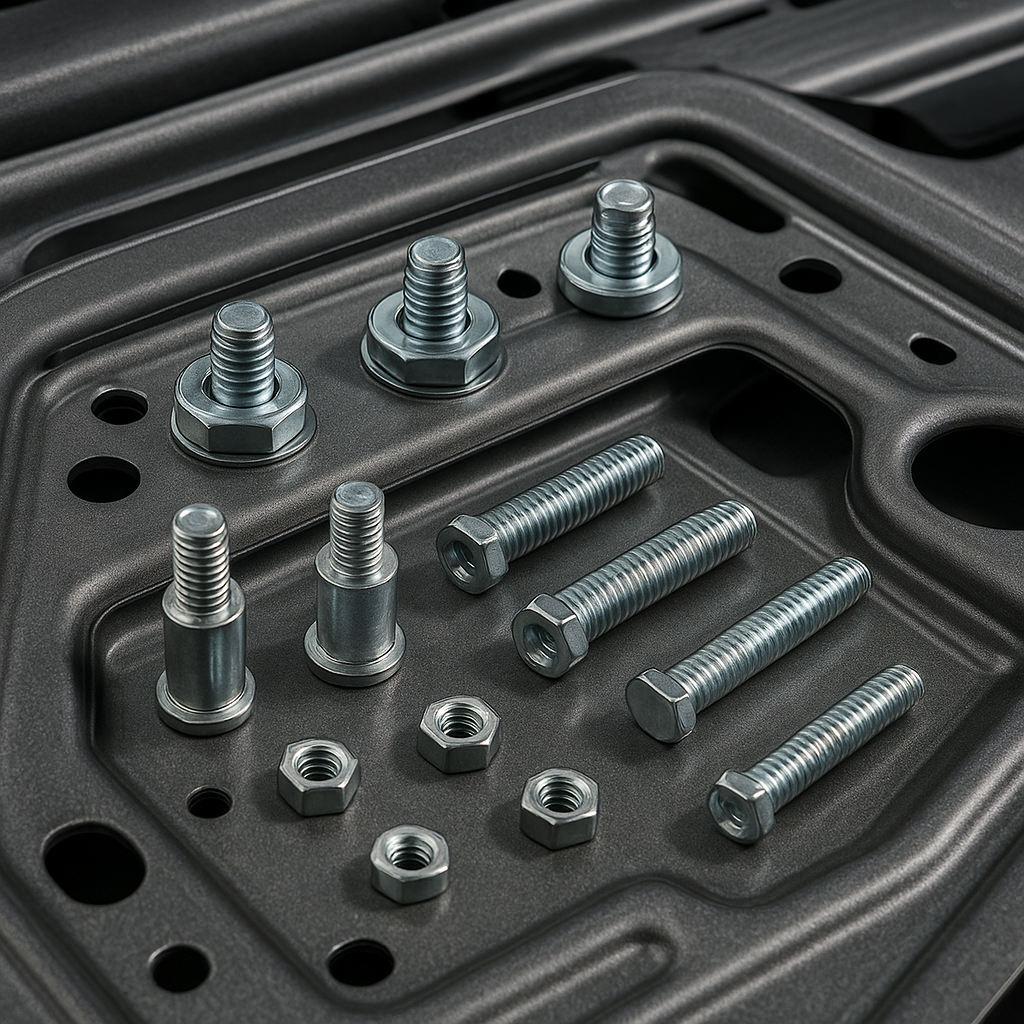
Seat system boltswith micro-lubricated threads for consistent torque-tension behavior
-
CNC-machinedseat track mountswith ±0.01 mm hole spacing accuracy
-
Salt-spray coated for long-term corrosion protection
Result: Reduced recliner locking failure rate by 92%, improved assembly repeatability across 3 regions.
Use Case: Integrated Child Seat Anchors
For a high-end SUV platform, the OEM requiredbolts with documented crash simulation data, matching ISO 13216 anchorage standards and FMVSS 225.
JINGLE’s Response
-
Fatigue-tested fastenersusing 12.9-grade steel with real-world crash profiles
-
Heat-code stamped + 100% batch-level tensile inspection
-
Supplied with CE, ISO, and FMVSS supporting documentation
Result: Supplier passed third-party audit; JINGLE’s bolts used in over 120,000 vehicles since 2023 without a single reported defect.
Quality Features JINGLE Provides for Seat Applications
| Feature | Value to Seat System Engineers |
|---|---|
| Fatigue testing to 10⁶+ cycles | Proves long-term structural durability |
| 100% PPAP + batch traceability | Simplifies OEM validation and audit |
| Pre-assembled torque patch or washers | Speeds up factory install and secures preload |
| Dimensional reports on CNC mounts | Confirms bracket fit to seating platform |
| Optional color coding / laser marking | Supports plant-level part differentiation |
Design Tips for Safer, More Efficient Seat Fastening
-
Always validate torque vs. tension behaviorwith coated fasteners
-
Use CNC mounts to eliminate bracket misalignmentat final assembly
-
Document all fatigue and tensile properties per batchfor audit-readiness
-
Apply pre-applied torque sealants or patchesto streamline high-speed install
-
Confirm compatibility with seat track adjusters and recliner mechanismsduring prototyping
Don’t Let a Bolt Become a Liability
The cost of seat fastener failure isn’t just recall logistics—it’s reputational damage, lawsuit exposure, and supply chain stress. JINGLE helps OEMs and suppliers prevent that risk with:
-
Fatigue-rated fasteners for dynamic seating environments
-
CNC mounts engineered for structural integration
-
Testing, documentation, and quality control that satisfy global safety codes
If your vehicle platform includes adjustable, powered, or child-integrated seat systems, we’ll help you lock in strength—bolt by bolt.