How Customized Fasteners Improve Safety in Critical Infrastructure
The Hidden Challenge in Structural Design
In every high-performance structure—whether a bridge, turbine, or manufacturing line—fasteners play a silent yet defining role. Standard bolts often fail to match specific load demands, corrosion resistance, or installation environments. When one component doesn’t fit perfectly, it compromises the entire system’s efficiency and safety.
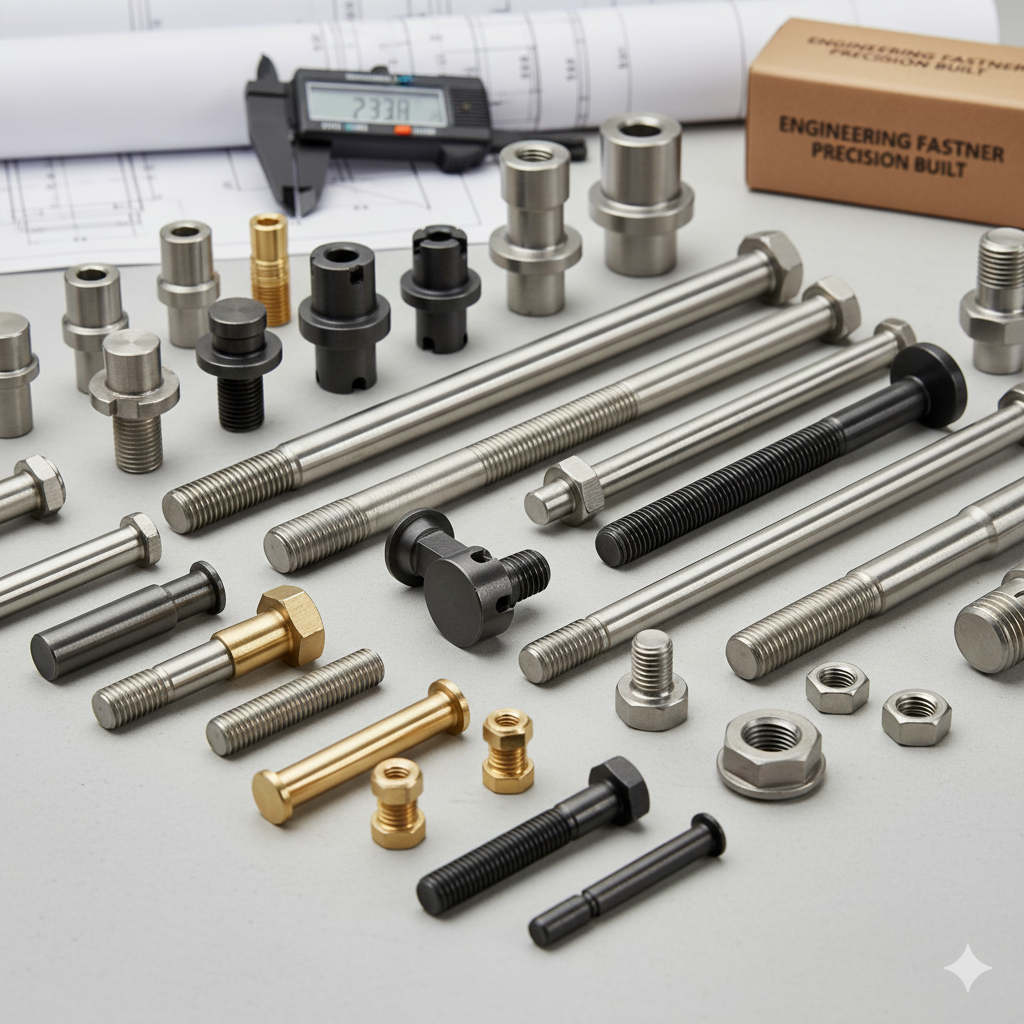
Engineering fastener customization solves this problem by tailoring each component’s geometry, thread profile, and material composition to its actual working environment. It ensures that every fastener performs as an integrated part of the system, not just a supporting accessory.
Principle: Engineering Logic Behind Customization
Custom fastener design begins with the understanding that performance depends on more than tensile strength—it’s about load behavior, vibration dynamics, and fatigue patterns.
Core engineering processes include:
-
Finite Element Analysis (FEA) to simulate torque distribution and stress concentration.
-
CNC thread rolling and head forming for consistent fiber flow and mechanical strength.
-
Material adaptation using alloy, stainless, or duplex steels based on load and exposure.
-
Surface treatment optimization—zinc-nickel, Dacromet, or phosphate—to ensure long-term corrosion control.
Through this integration of material science and mechanical design, customized fasteners deliver consistent torque retention and predictable failure points—key indicators of engineering reliability.
Comparison: Standard vs. Engineered Custom Fasteners
| Parameter | Standard Fasteners | Engineered Custom Fasteners |
|---|---|---|
| Design Approach | Generic dimensions and loads | Application-specific simulation |
| Thread Formation | Cut threads | Rolled threads (higher fatigue life) |
| Material Strength | Basic grade carbon steel | Alloy, stainless, or duplex steel |
| Load Tolerance | Limited range | Optimized through FEA and testing |
| Coating Durability | Standard plating | Advanced anti-corrosion coatings |
In real-world testing, customized fasteners show up to 45% higher fatigue resistance and 30% longer service life than conventional ones—especially in dynamic load environments like transportation and energy systems.
Core Advantages: The Mechanics of Customization
1. Structural Integrity
Tailored design ensures balanced load transfer, eliminating micro-movement and reducing fatigue cracks in joints.
2. Consistent Assembly Performance
Precision tolerances improve installation torque accuracy, minimizing failure during tightening or re-torquing cycles.
3. Durability in Harsh Environments
Coatings and materials are matched to specific conditions—such as high humidity, temperature fluctuations, or saline exposure.
4. Optimized Cost-to-Performance Ratio
Custom manufacturing may increase unit cost slightly, but the long-term ROI is achieved through reduced maintenance and downtime.
5. Verified Quality Control
Each Jingle fastener is batch-tested for tensile, yield, and salt-spray performance under ISO 898-1 and ASTM A490 standards.
Application Scenarios: When Engineering Precision Matters
-
Wind Energy Systems – Custom anchor bolts maintain torque stability across cyclical loads.
-
Bridge Construction – High-tensile fasteners ensure reliable shear and moment transfer in modular connections.
-
Heavy Equipment – Thread customization prevents vibration-induced loosening under repetitive motion.
-
Rail and Transit Systems – Corrosion-protected bolts maintain strength in outdoor exposure.
-
Petrochemical Infrastructure – Coated fasteners resist chemical degradation and high temperatures.
Each application reflects a balance between geometry, metallurgy, and environmental resilience—three dimensions where engineering precision outperforms mass production.
Professional Selection Guidance: Choosing the Right Fastener for Each Environment
Fastener performance depends on operational stress, temperature, and installation constraints. The following reference chart illustrates optimal selection based on environment:
| Operating Condition | Recommended Material | Surface Treatment | Technical Focus |
|---|---|---|---|
| Vibration or Impact Load | Cr-Mo alloy steel | Zinc-nickel or phosphate | Fatigue resistance and torque retention |
| Outdoor / Marine Exposure | 316L stainless steel | Dacromet or duplex coating | Long-term corrosion protection |
| High Temperature (>300°C) | Nickel-based alloy | Heat-resistant oxide | Prevents creep and strength degradation |
| Subzero or Cryogenic | Austenitic stainless | Passivated finish | Ductility under thermal contraction |
| Structural Steel Assembly | Carbon steel (10.9/12.9) | Hot-dip galvanization | High tensile strength and dimensional accuracy |
Expert insight:
-
Always consider the joint interface materials—using mismatched metals can trigger galvanic corrosion.
-
For dynamic load systems, use rolled threads instead of cut threads to extend fatigue life.
-
Prioritize coating compatibility with lubricants used in automated tightening processes.
Strategic Outlook: The Engineering Future of Fastener Design
Fasteners have evolved from simple hardware into engineered structural elements. In modern industry, customization equals control—control over load transfer, durability, and cost.
At Jingle, engineering fastener customization merges simulation-driven design, CNC precision manufacturing, and ISO-certified testing to ensure each component contributes measurable structural value.
To explore custom fastener solutions engineered for precision and performance, visit our homepage or reach our experts via the contact page.