The First Sample Looked Fine. Can Your Lifting Anchor Manufacturer Repeat It?

The first samples arrived in a small wooden case. The surfaces were clean, the dimensions matched the drawing, and the lifting clutch engaged without any obvious difficulty.
Everyone was satisfied.
Six months later, the third production order told a different story. Several anchors would not seat correctly in the existing clutch. The coating was visibly heavier, the packing labels used an unfamiliar part number, and the inspection report referred to an older drawing revision.
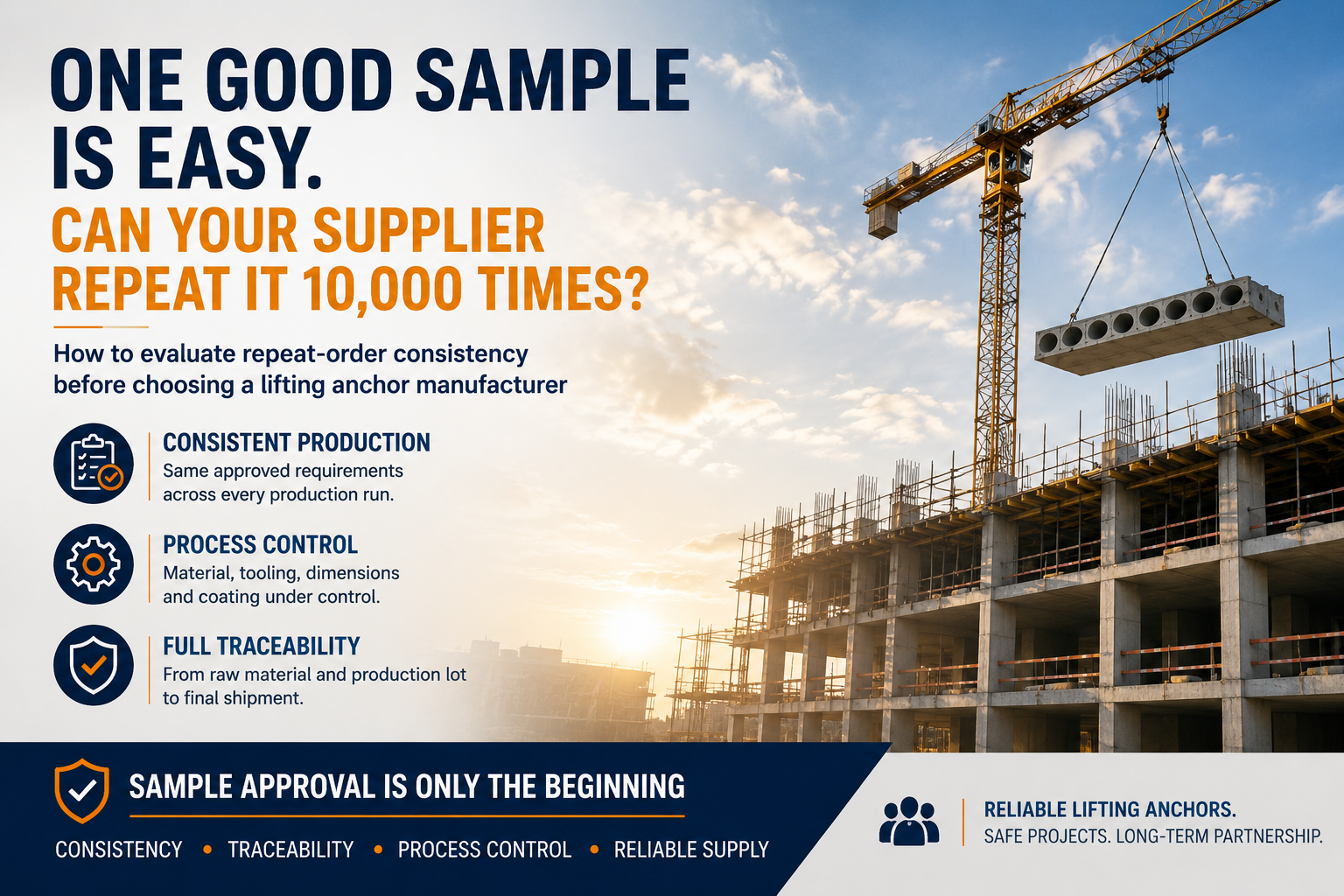
The original sample had not been the problem. Reproducing it was.
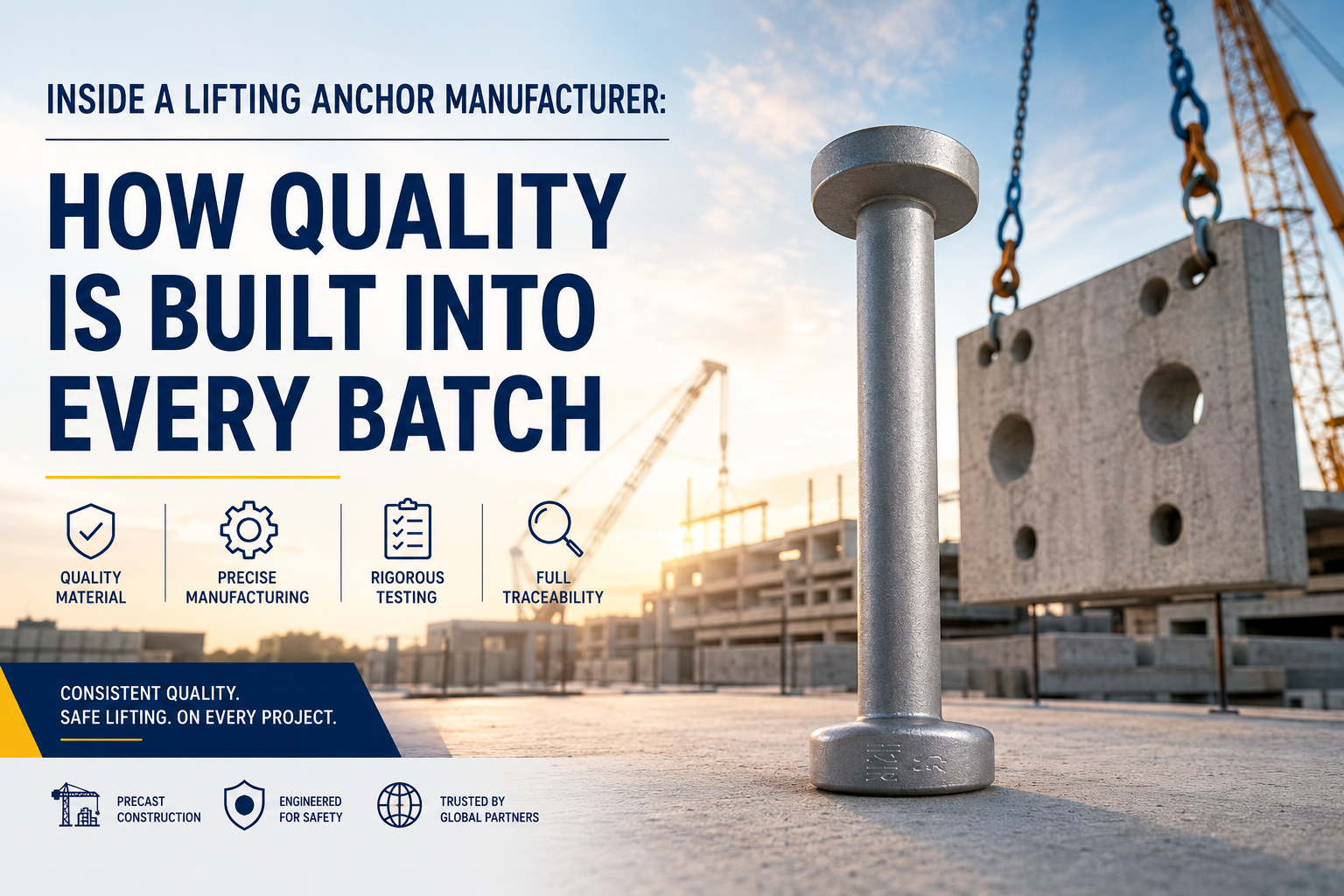
This is one of the harder questions to answer when selecting a lifting anchor manufacturer. A supplier can pay close attention to ten samples. It is much more difficult to maintain the same material, tooling condition, process settings, dimensions, heat-treatment results, coating thickness, markings, and records across thousands of parts and multiple production runs.
For precast buyers, sample approval should therefore be treated as the beginning of supplier qualification—not the end.
Why a Perfect Sample Can Be Misleading
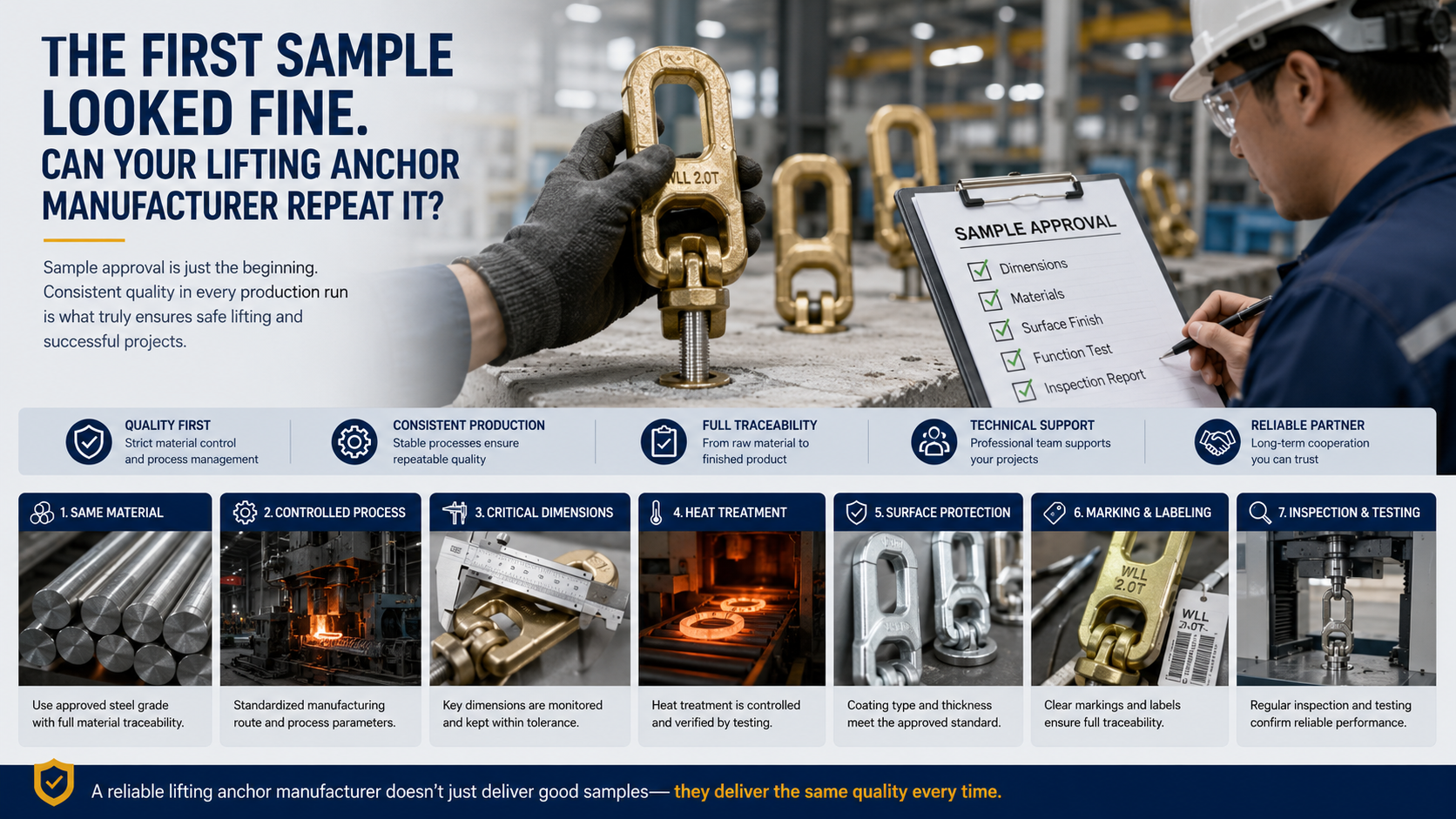
A sample tells you what a manufacturer produced once. It does not necessarily show what its normal production system will deliver every month.
Special attention may have been given to the initial order:
-
Material may have been selected from a preferred batch.
-
An experienced operator may have produced the parts.
-
New or recently maintained tooling may have been used.
-
Every sample may have been inspected.
-
Surface treatment may have been completed by a preferred subcontractor.
-
Documentation may have been prepared specifically for the approval process.
None of these points is automatically a problem. The real issue is whether the approved conditions are transferred into routine production.
A dependable lifting anchor supplier should be able to explain how the approved sample becomes a controlled production standard.
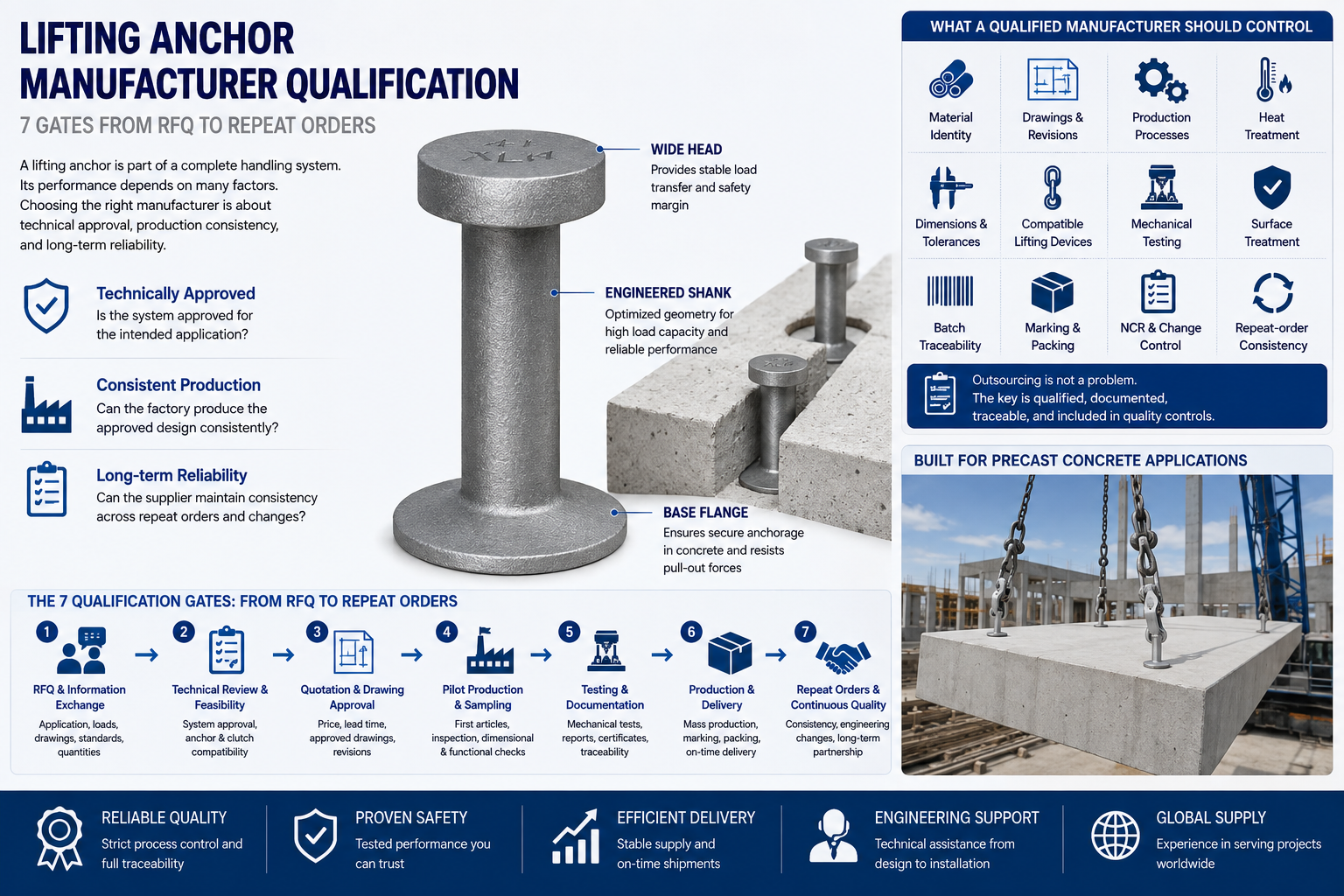
That standard should cover more than appearance. It should connect:
-
Product drawing and revision
-
Material specification
-
Manufacturing route
-
Critical dimensions
-
Compatible lifting device
-
Mechanical properties
-
Surface finish
-
Product marking
-
Inspection plan
-
Testing requirements
-
Packaging
-
Lot traceability
When these elements are controlled separately, variation can enter unnoticed. When they are connected through one product file, repeat orders are easier to verify.
The Sample Should Establish a Baseline
Before approving a sample, buyer and manufacturer should agree on what the sample represents.
At minimum, the approved baseline should identify:
| Item | What should be recorded |
|---|---|
| Product identity | Product name, part number, size and capacity class |
| Drawing | Drawing number and revision |
| Material | Grade, specification and approved material condition |
| Production route | Forming, forging, casting, machining, welding or other applicable processes |
| Heat treatment | Requirement, specification and verification method, where applicable |
| Critical dimensions | Dimensions affecting engagement, seating, locking, embedment and load transfer |
| Surface finish | Coating type, thickness and inspection requirements |
| Compatible components | Lifting clutch, lifting eye, recess former or other approved accessories |
| Marking | Manufacturer, product type, capacity class, size or lot identification |
| Inspection | Methods, measuring equipment and acceptance criteria |
| Testing | Required validation, batch testing or project-specific testing |
| Packaging | Label format, quantity, separation and corrosion protection |
Photographs can support the approval record, but they should not replace dimensional reports, material evidence, drawings, or test documentation.
An attractive sample may still contain the wrong material or come from a manufacturing route that is unsuitable for recurring orders. Conversely, minor cosmetic differences may have no effect on function when they remain within an approved specification.
The baseline must distinguish between what is safety-critical, what is functionally important, and what is only cosmetic.
Seven Questions That Reveal Whether Production Will Remain Consistent
1. Will Routine Production Use the Same Material?
Material substitution is one of the first risks to address.
The approved sample and recurring production should follow the same material specification unless a change has been reviewed and accepted in writing.
Ask the manufacturer:
-
Is the material grade stated on the controlled drawing?
-
How is incoming material verified?
-
Are heat or batch numbers recorded?
-
Can finished anchors be traced back to material certificates?
-
Are alternative material suppliers permitted?
-
Who approves a material-source change?
-
How are accepted and rejected materials separated?
-
Does material identification remain intact after cutting?
A certificate is useful only when it can be connected to the delivered production lot.
If the certificate describes one steel batch but the finished anchors cannot be traced to it, the document does not establish the identity of the delivered product.
2. What Happens as the Tooling Wears?
Tooling rarely fails in one dramatic moment. More often, it wears gradually.
Forging dies, forming tools, casting patterns, machining fixtures, thread tools, and inspection gauges can slowly move product dimensions away from the approved condition.
For lifting components, tooling wear may affect:
-
Anchor-head geometry
-
Clutch engagement
-
Seating depth
-
Locking position
-
Shaft diameter
-
Foot geometry
-
Bend angle
-
Thread profile
-
Recess-former fit
-
Product orientation
These changes may be too small to notice during a quick visual check.
A capable lifting anchor manufacturer should define inspection and maintenance requirements for critical tools. The factory should also perform a first-piece inspection after tool replacement, repair, adjustment, or a new machine setup.
Useful questions include:
-
Which tool creates each critical feature?
-
How often is the tool inspected?
-
Is tool life recorded by time or production quantity?
-
What are the replacement criteria?
-
Who approves a repaired tool?
-
Is the first production piece checked after a tool change?
-
How is dedicated OEM tooling identified and stored?
For custom products, tooling ownership and maintenance responsibility should be agreed before the purchase order is released.
3. Are the Critical Dimensions Actually Being Measured?
A final inspection report filled with general dimensions may still miss the features that matter most.
The control plan should focus on characteristics that affect:
-
Engagement with the lifting clutch
-
Correct seating
-
Locking
-
Thread engagement
-
Anchor embedment
-
Load transfer
-
Orientation
-
Recess-former compatibility
-
Fit with installation accessories
A useful inspection process normally has more than one stage.
First-piece inspection checks the setup before full production begins.
In-process inspection helps detect dimensional drift while the batch is still being manufactured.
Final inspection confirms that the completed lot meets the release requirements.
Ask to see an inspection record from an ordinary production batch—not only the specially prepared sample report.
The record should identify the product number, drawing revision, production lot, inspected characteristics, measuring equipment, results, date, and inspector.
Sampling frequency should also make sense for the process. Measuring five products at the end of a large batch may not reveal when dimensional drift began.
4. Can Special Processes Be Connected to the Delivered Lot?
Some lifting products may require heat treatment, welding, coating, or other controlled processes. The precise route depends on the individual product specification.
When a process is subcontracted, responsibility does not disappear. The lifting anchor manufacturer should still define the requirements, approve the subcontractor, preserve lot identity, review the results, and control changes.
For heat treatment, buyers may need to review:
-
Process specification
-
Furnace or equipment identification
-
Batch number
-
Time and temperature records
-
Cooling or quenching method
-
Equipment calibration
-
Hardness or mechanical test results
-
Release authorization
For surface treatment, the record may need to show:
-
Coating specification
-
Batch identity
-
Surface preparation
-
Coating thickness
-
Inspection method
-
Treatment date
-
Subcontractor identity
-
Post-coating dimensional results
Coating should not be treated as a purely cosmetic feature. An uncontrolled increase in coating thickness can affect threads, seating surfaces, recess-former fit, or clutch engagement.
A coating change may also affect whether an earlier test report remains applicable.
5. Does the Test Evidence Represent Normal Production?
A test result is meaningful only when the tested sample represents the product being purchased.
Buyers should compare the test report with the approved and delivered product. Check:
-
Product model
-
Size
-
Drawing revision
-
Material
-
Manufacturing condition
-
Surface finish
-
Sample quantity
-
Production lot
-
Test setup
-
Loading direction
-
Concrete conditions, where applicable
-
Result
-
Failure mode
-
Test date
-
Laboratory or testing organization
A breaking-load value should not automatically be presented as an allowable working load. The relationship depends on the relevant design basis, safety provisions, load direction, concrete condition, installation requirements, and applicable regulations.
For projects in the United States, OSHA 1926.704 specifies minimum capacity relationships for certain precast lifting inserts and lifting hardware. These requirements are regulatory minimums; they do not replace engineering calculations, local rules, the product manufacturer’s instructions, or an approved lifting plan.
The buyer should also ask what triggers retesting. Relevant triggers may include changes to:
-
Material
-
Geometry
-
Tooling
-
Manufacturing location
-
Heat treatment
-
Surface finish
-
Critical subcontractor
-
Production method
-
Drawing revision
A test completed years ago for another factory or an earlier product revision may not be adequate evidence for the current supply.
6. Can the Manufacturer Trace a Package Backward?
A practical traceability check can be completed with one finished package.
Choose a package and ask the supplier to trace it backward through:
-
Packing label
-
Shipment-release record
-
Final inspection report
-
Production order
-
Process records
-
Special-process batches
-
Incoming material
-
Material certificate
Then reverse the exercise.
Choose one raw-material batch and ask the supplier to identify every production lot and customer shipment connected to it.
This two-way check shows whether the traceability system works in practice.
A reliable lifting anchor manufacturer should also be able to identify affected shipments if a later problem is discovered. Without forward shipment traceability, containing a questionable batch may become slow and expensive.
7. What Is the Change-Control Rule?
Many repeat-order problems begin with a change that someone considered minor.
Examples include:
-
A new steel supplier
-
A repaired forging die
-
A different coating subcontractor
-
A new heat-treatment facility
-
A modified inspection gauge
-
A revised marking
-
A different packing method
-
A change in drawing tolerance
-
Production moved to another location
The purchasing agreement should define which changes require buyer notification and approval.
The supplier should not assume that a technically similar material, finish, process, or subcontractor is automatically acceptable.
A clear change process normally includes:
-
Description of the proposed change
-
Reason for the change
-
Technical risk review
-
Review of affected drawings and documents
-
Sample or first-article inspection
-
Retesting where required
-
Buyer notification
-
Written approval
-
Separation of old and new revisions
-
Updated traceability records
Uncontrolled change is one of the main reasons that an approved sample and a later production batch no longer match.
A Repeat-Order Consistency Checklist
Before releasing a repeat order, compare the current quotation and production file against the approved baseline.
| Check | Questions to ask |
| Part identity | Is the product number unchanged? |
| Drawing | Is the same approved revision being used? |
| Material | Is the grade and approved source unchanged? |
| Production location | Will the same factory make the order? |
| Manufacturing route | Have any operations or process sequences changed? |
| Tooling | Has critical tooling been repaired or replaced? |
| Heat treatment | Is the same specification and supplier being used? |
| Surface finish | Is the coating type and thickness unchanged? |
| Inspection | Are critical characteristics and sampling frequency unchanged? |
| Testing | Is the existing evidence still applicable? |
| Marking | Will the product carry the approved identification? |
| Packaging | Are lot separation and label details unchanged? |
| Documentation | Will the required reports accompany the shipment? |
If the answer to any question is unclear, resolve it before production begins.
Do Not Approve Repeat Orders on Price Alone
A lower price on the second or third order may result from a genuine improvement. It can also reflect a change in material source, inspection scope, subcontractor, coating, packaging, or testing.
The commercial review should therefore compare equivalent supply conditions.
Ask whether the new price includes the same:
-
Material specification
-
Production process
-
Heat-treatment requirements
-
Inspection frequency
-
Testing scope
-
Surface finish
-
Product marking
-
Traceability
-
Certificates
-
Packaging
-
Compatible accessories
-
Delivery terms
The lowest unit price may not represent the lowest total cost if the buyer later faces sorting, reinspection, delayed production, rejected products, missing documents, or replacement shipments.
How Jinglefix Can Support Repeat-Order Control
Jinglefix supplies industrial fasteners, precast accessories, CNC-machined components, and drawing-based OEM/ODM products.
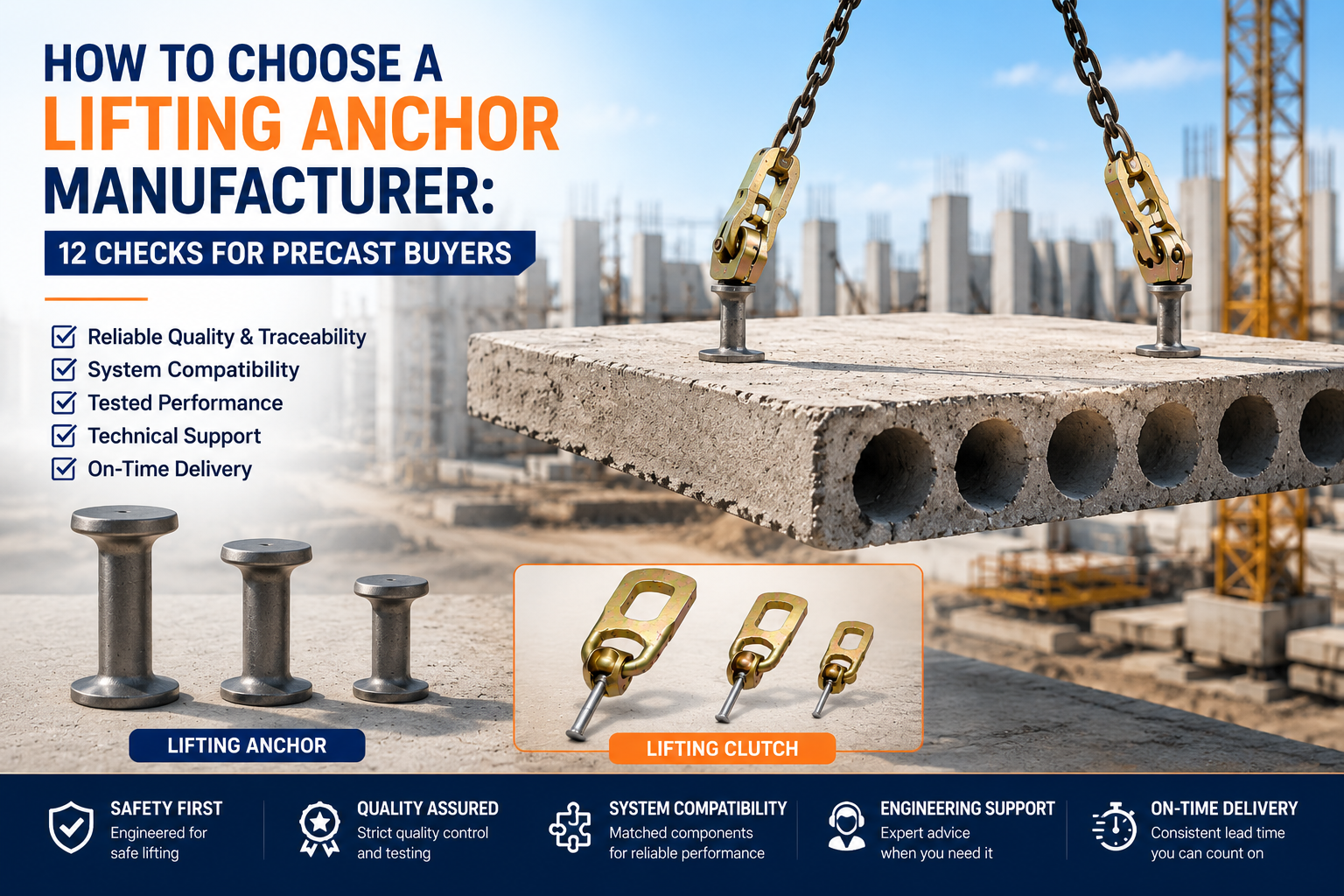
Buyers can review the company’s precast accessories portfolio, which includes lifting-anchor systems, threaded-socket systems, spread-anchor systems, recess formers, cast-in channels, coil inserts, and related precast products.
Based on the supplied Jinglefix company information, available manufacturing capabilities include machining, forming, forging, casting, welding, heat treatment, and surface finishing. The production route for an individual anchor should always be confirmed during the technical review.
For buyers who are still comparing product families, the Jinglefix lifting anchor selection guide provides additional application context. A representative product can also be viewed on the lifting foot anchor page.
A quality-management system can support document, process, nonconformance, and change control. However, ISO 9001 certification alone does not approve a specific lifting anchor. Buyers should still verify the drawing, material, production route, inspection results, test evidence, traceability, and compatible lifting device for the exact product being ordered.
When requesting a quotation from Jinglefix, provide:
-
Approved or proposed product drawing
-
Precast element information
-
Required lifting-anchor family
-
Compatible clutch or lifting device
-
Material and coating requirements
-
Destination country
-
Applicable specifications
-
Inspection requirements
-
Required certificates
-
Estimated order quantity
-
Repeat-order forecast
-
Packaging requirements
-
Change-notification requirements
The complete application package can be submitted through the Jinglefix contact page.
Warning Signs During Repeat Production
Pause shipment approval if:
-
The production drawing differs from the approved sample revision.
-
The supplier cannot connect finished products to material certificates.
-
Critical dimensions are not included in the inspection report.
-
The coating supplier changed without documented review.
-
Test evidence refers to another size, finish, material, factory, or drawing revision.
-
The inspection report was prepared before production was completed.
-
Product markings differ from the approved sample.
-
Similar sizes or capacity classes use indistinguishable labels.
-
Reworked parts cannot be identified.
-
Heat-treatment or coating records are not linked to the production lot.
-
The supplier cannot explain when tooling was last inspected.
-
Material, tooling, or process changes do not require buyer notification.
-
The manufacturer cannot identify which customers received a specified lot.
One inconsistency does not always mean the entire shipment is defective. It does mean that the discrepancy should be investigated before the products are approved for use.
Frequently Asked Questions
Is one approved sample enough to qualify a lifting anchor manufacturer?
No.
The sample should be supported by an approved drawing, material evidence, dimensional inspection, relevant test documentation, compatible-component information, traceability, and a production-control plan.
A controlled pilot order is normally more informative than a few individual samples.
Should every repeat order be tested?
Not necessarily.
Testing frequency depends on the product specification, validation plan, production process, batch requirements, project conditions, regulations, and approved quality plan.
The buyer and manufacturer should agree on testing requirements before production.
What should be checked on every production batch?
The exact scope depends on the product, but batch-release checks may include:
-
Product identity
-
Drawing revision
-
Material traceability
-
Critical dimensions
-
Surface condition
-
Coating requirements
-
Product marking
-
Lot identification
-
Inspection results
-
Required process records
-
Packaging and quantity
-
Required certificates
Can the manufacturer change the material supplier?
Only under the agreed change-control procedure.
The proposed material should be reviewed against the approved specification. Additional inspection, sample approval, or retesting may be required.
Why does coating thickness matter?
Coating adds material to the product surface. Excessive or uneven thickness may affect threads, seating, clutch engagement, recess-former fit, marking legibility, or other critical interfaces.
What is the difference between sample approval and production approval?
Sample approval confirms that particular samples meet the agreed requirements.
Production approval confirms that the manufacturer can repeatedly produce, inspect, identify, document, and deliver conforming products through its normal manufacturing system.
How can buyers reduce variation between orders?
Maintain an approved product file and include its requirements in every purchase order.
The file should identify:
-
Part number
-
Drawing revision
-
Material
-
Production route
-
Critical characteristics
-
Surface finish
-
Compatible components
-
Inspection plan
-
Test requirements
-
Marking
-
Packaging
-
Required records
-
Change-notification rules
When should a supplier be requalified?
Requalification may be appropriate after significant changes to material, geometry, tooling, manufacturing location, heat treatment, coating, production route, testing method, or critical subcontractors.
Repeated nonconformances, extended production interruptions, or major quality-system changes may also justify requalification.
Conclusion: The Real Test Begins After Sample Approval
The first sample answers a limited question:
“Can this manufacturer produce an acceptable lifting anchor?”
Repeat production answers the more important one:
“Can the manufacturer keep producing the same approved product under normal factory conditions?”
A dependable lifting anchor manufacturer should be able to preserve a continuous chain:
Approved sample → controlled drawing → verified material → stable tooling → controlled production → critical inspection → applicable testing → clear marking → lot traceability → shipment release
When that chain remains intact, repeat orders are easier to approve and problems are easier to contain.
When it breaks, a visually acceptable anchor may no longer match the product that was originally reviewed.
Before placing a recurring order, compare the proposed production conditions with the approved baseline. Confirm changes in writing, inspect representative batches, and keep technical acceptance separate from commercial comparison.
For application-specific product information or drawing-based sourcing support, contact Jinglefix with the element details, lifting conditions, preferred anchor system, destination requirements, order quantity, and required documentation.
Technical and Editorial Note
This article provides supplier-qualification and procurement guidance. It is not a lifting-system design, installation instruction, engineering approval, product certification, or engineered lifting plan.
Product capacities, compatible components, material requirements, test evidence, certifications, installation conditions, and regulatory compliance must be confirmed for the exact product, drawing revision, application, and destination market before purchase or use.