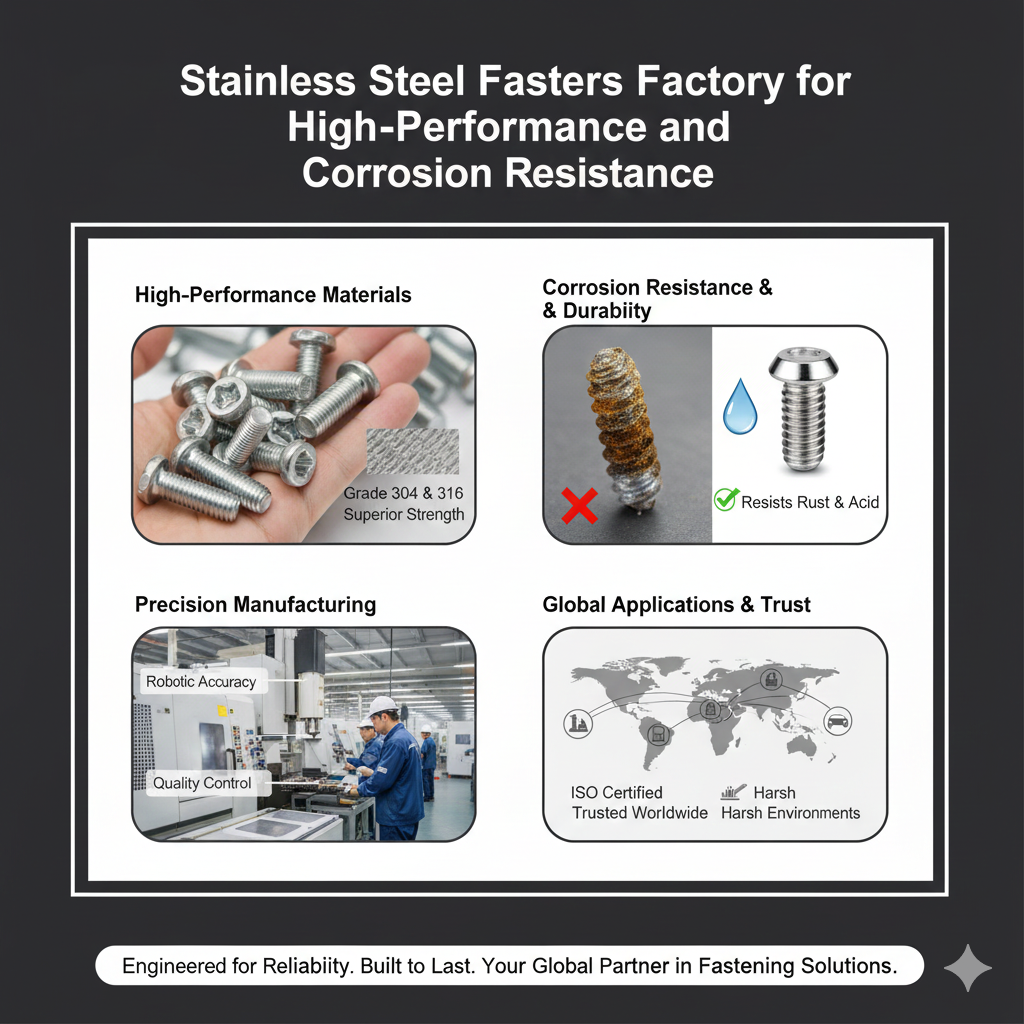
Stainless Steel Fasteners Factory for High-Performance and Corrosion Resistance
1. Why Stainless Steel Fasteners Are the Industry Standard for Harsh Environments
From shipyards to solar farms, stainless steel fasteners protect structural connections against rust, vibration, and constant exposure to moisture.
Their strength is not just in the metal itself but in the controlled process that turns raw alloy into reliable bolts, nuts, and screws.
Factories specialized in stainless fasteners maintain strict standards to ensure each product performs equally well in both mechanical and chemical environments.
For builders, OEM manufacturers, and contractors, stainless fasteners represent long-term stability and reduced maintenance costs.
2. Material Selection That Ensures Lasting Strength
Every bolt begins with the right material.
High-quality factories select stainless grades such as A2-70 (304) and A4-80 (316) for their proven resistance to oxidation and tensile load capacity.
Chromium and molybdenum elements form a thin passive layer that automatically protects the surface from corrosion, even if scratched.
Typical Specifications:
| Grade | Alloy Composition | Tensile Strength | Application |
|---|---|---|---|
| A2-70 | 18Cr–8Ni | 700 MPa | General construction |
| A4-80 | 18Cr–10Ni–2Mo | 800 MPa | Marine and chemical environments |
| Duplex 2205 | 22Cr–5Ni–3Mo | 850 MPa | Offshore platforms and energy facilities |
Each grade offers different endurance levels—factories match material type with project conditions to deliver optimal performance.
3. How a Factory Maintains Consistent Quality in Every Batch
A reliable stainless fasteners factory manages every step of production with precision and documentation:
-
Raw material testing – verifying alloy composition and purity.
-
Cold forging – forming the fastener head while maintaining metal grain alignment.
-
Heat treatment – balancing hardness and ductility.
-
Passivation – strengthening the anti-corrosion oxide film.
-
Thread inspection and torque testing – ensuring smooth assembly and secure fit.
Manufacturers such as Jingle integrate all these processes under ISO-certified systems, combining production efficiency with reliable product traceability.
4. Applications That Rely on Stainless Steel Fasteners
| Industry | Common Uses | Key Performance Focus |
|---|---|---|
| Marine construction | Ship hulls, docks, underwater joints | Resistance to salt corrosion |
| Architectural structures | Facade systems, glass fittings | Aesthetic appearance and strength |
| Heavy machinery | Equipment housings, frames | Stability under vibration |
| Energy and power plants | Turbines, pipe systems | Heat and chemical resistance |
| Outdoor installations | Solar mounting frames, lighting poles | Weather durability |
In each field, stainless fasteners provide security where other materials would quickly degrade under exposure.
5. Comparing Stainless Fasteners with Carbon Steel Alternatives
| Feature | Stainless Steel | Carbon Steel (Plated) |
|---|---|---|
| Rust protection | Natural oxide film | Dependent on coating |
| Maintenance | Minimal | Requires regular inspection |
| Strength | 700–850 MPa | 800–1000 MPa |
| Surface finish | Bright, durable | Prone to discoloration |
| Cost efficiency | Higher upfront, longer lifespan | Lower cost, shorter service life |
For environments with humidity, vibration, or chemical exposure, stainless steel’s reliability quickly outweighs its initial cost.
6. Testing That Guarantees Performance
Quality assurance in stainless fasteners is not optional — it’s continuous.
Factories test every batch using international standards such as ASTM B117 (salt-spray test), ISO 3506 (mechanical properties), and torque load assessments.
Each inspection ensures correct tensile strength, thread precision, and corrosion resistance before packaging.
Jingle performs internal testing and third-party verification (SGS, TÜV) to ensure every fastener meets specifications from drawing to shipment.
7. Key Factors When Selecting a Stainless Fasteners Supplier
When evaluating a manufacturer, prioritize technical capability over scale.
A dependable factory should provide:
-
Certified material sources and mill certificates.
-
Complete process control from forging to finishing.
-
Custom sizes and surface treatments upon request.
-
Documented inspection reports for each shipment.
-
On-time delivery with global export experience.
Choosing the right partner ensures consistency, safety, and compliance in large-scale construction or manufacturing projects.
8. Long-Term Value Built Into Every Connection
Stainless fasteners perform silently through decades of stress, rain, and heat.
Their resistance to corrosion not only protects the structure but also reduces maintenance cycles and replacement costs.
For manufacturers and builders focused on lifecycle efficiency, stainless steel remains one of the most sustainable and dependable fastening options available.
Factories dedicated to quality turn every bolt into a reliable component of long-term safety and stability.
9. FAQ: Practical Questions for Buyers
Q1: What’s the best stainless grade for coastal projects?
→ A4-80 (316) or Duplex 2205 provides high salt resistance.
Q2: Can stainless fasteners be heat-treated for higher strength?
→ Yes, controlled heat treatment enhances mechanical stability.
Q3: How can I confirm fastener authenticity?
→ Request material and inspection certificates with each order.
Q4: Are custom head shapes or finishes available?
→ Most certified factories offer customized designs for specific industries.
10. Strength That Endures in Every Environment
From marine ports to solar installations, stainless steel fasteners safeguard connections that must withstand time, weather, and corrosion.
Their performance depends on material integrity, production accuracy, and reliable supply control.
Factories committed to these standards ensure every bolt contributes to the long-term stability of your project.
To explore durable fastener solutions, visit the Jingle Home Page
or reach out through the Contact Page for specifications and technical consultation.