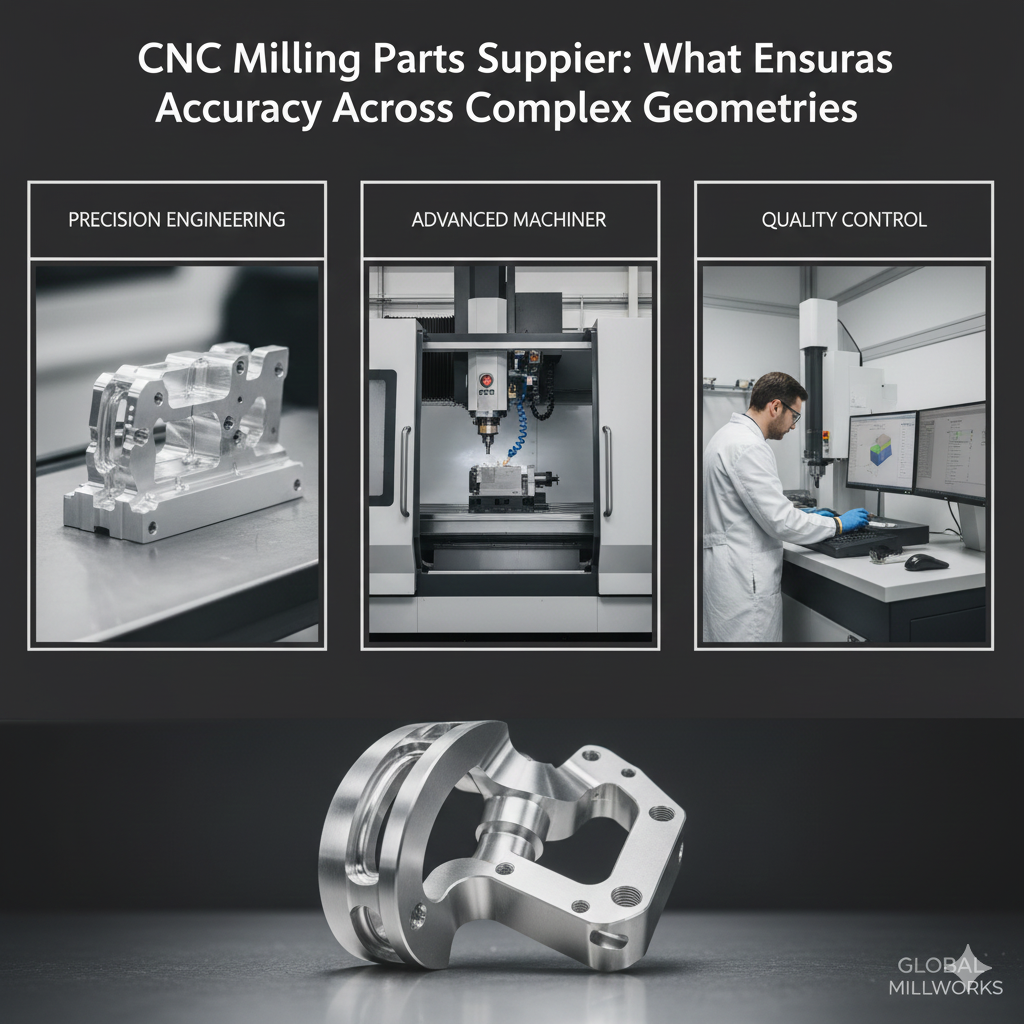
CNC Milling Parts Supplier: What Ensures Accuracy Across Complex Geometries
In CNC milling, mistakes rarely come from a single bad cut.
They come from small inconsistencies repeated many times.
A pocket that shifts slightly.
A flat surface that loses parallelism.
A pattern of holes that technically meets tolerance—but no longer aligns in assembly.
When these issues appear, the machine is often blamed. In reality, they reflect how the supplier controls the system around milling, not the spindle itself.
Milling Accuracy Is a System Outcome
CNC milling parts suppliers are often evaluated by machine lists and axis count.
Those details matter—but they are not decisive.
What actually determines outcome is how the supplier manages:
-
datum consistency across setups
-
toolpath logic for complex features
-
fixturing repeatability under load
-
feedback between machining and inspection
Once parts move beyond simple profiles, accuracy becomes a coordination problem, not a cutting problem.
Where Milling Problems Usually Appear
Most CNC milling issues do not show up in first samples.
They surface quietly, batch by batch.
Common warning signs include:
-
surface flatness drifting over time
-
hole locations staying in tolerance but losing functional alignment
-
edge conditions degrading after tool changes
-
inconsistent finish across identical parts
These problems are rarely caused by programming errors. They point to incomplete process control.
Fixturing Strategy Determines Repeatability
Milling accuracy depends heavily on how a part is referenced and restrained.
Poor fixturing introduces variation that no toolpath optimization can eliminate.
Effective CNC milling parts suppliers treat fixturing as a design activity, not a convenience.
| Fixturing factor | Impact on milled parts |
|---|---|
| Datum selection | Controls feature relationship |
| Clamping force balance | Prevents deformation |
| Fixture rigidity | Maintains geometry under load |
| Setup repeatability | Stabilizes batch output |
When fixtures are validated early, variation drops sharply across production runs.
Toolpath Planning Shapes Geometry Stability
In milling, the order and direction of material removal matter.
Aggressive toolpaths may shorten cycle time, but they often increase heat and distortion—especially on thin walls or large flat areas.
Well-planned toolpaths distribute cutting forces evenly and protect critical features until late in the process. This sequencing preserves geometry and reduces the need for correction.
Suppliers who prioritize speed over stability often discover the cost later.
Material Behavior Cannot Be Ignored
Different materials respond differently to milling stress.
Aluminum may distort easily. Stainless steel accumulates heat. Alloy steels resist cutting and amplify vibration.
| Material behavior | Milling implication |
|---|---|
| High thermal expansion | Dimensional drift |
| Residual stress | Post-machining movement |
| Hardness variation | Tool wear inconsistency |
| Chip evacuation difficulty | Surface damage |
A capable CNC milling parts supplier adapts strategies to material behavior rather than applying a single standard process.
Inspection Strategy Defines What You Actually Control
Inspection does not just confirm compliance—it determines which risks are visible.
Suppliers relying only on final inspection often detect issues after value has already been added. In-process checks expose variation while correction is still inexpensive.
| Inspection method | What it reveals |
|---|---|
| In-process probing | Setup accuracy |
| SPC tracking | Trend development |
| Feature-specific checks | Functional risk |
| Batch comparison | Repeatability health |
Inspection aligned with process behavior is a strong indicator of supplier maturity.
Scaling Milling Parts from Prototype to Production
Prototype success confirms feasibility.
Production stability confirms capability.
As quantities grow, tool wear, fixture fatigue, and operator variation expose weaknesses that were invisible at low volume. Suppliers prepared for scale build processes that tolerate these variables without losing control.
Manufacturers such as Jingle structure CNC milling around batch stability and documented process feedback, reducing risk as programs move into sustained production.
Where CNC Milling Parts Suppliers Add Real Value
Beyond producing parts, a strong supplier contributes by:
-
identifying tolerance conflicts early
-
suggesting feature simplification without functional loss
-
stabilizing multi-setup parts
-
supporting design changes without disrupting supply
These contributions reduce total project risk—even when unit pricing appears similar.
CNC Milling Applications Across Industries
CNC milling supports a wide range of industrial needs:
| Industry | Typical milled components |
|---|---|
| Construction hardware | Structural brackets and plates |
| Industrial equipment | Frames and housings |
| Energy systems | Mounting interfaces |
| Automation | Alignment-critical components |
| Transportation | Lightweight structural parts |
Across all sectors, the requirement is consistent geometry, not just correct dimensions.
Cost Pressure Appears Downstream
In CNC milling, cost rarely comes from machine time alone.
It emerges through scrap, rework, inspection escalation, and delivery delays.
Stable processes reduce these downstream costs—even if initial machining appears conservative.
Conclusion: Milling Success Is Built on Control
Choosing a CNC milling parts supplier is less about cutting capability and more about system discipline. Suppliers who control fixturing, toolpaths, material behavior, and inspection deliver parts that assemble smoothly and scale reliably.
Those who do not push risk downstream—where it is far more expensive to resolve.
To explore CNC milling capabilities and related industrial components, visit the Jingle home page or reach out via the contact page for project-specific discussions and documentation support.