Fastener and Bracket Solutions for EV Thermal Management Systems
Cooling Is Now Structural—Not Just Functional
Thermal management is one of the most safety-critical aspects of EV design. Batteries, power inverters, and electric motors all require consistent temperature control to maintain efficiency and safety. The components that hold cooling pipes, water jackets, and thermal spreaders must do more than hold—they mustendure vibration, corrosion, and variable load cycles.
According to IDTechEx, thermal systems in EVs now account for12–15% of total platform BOM, and failure rates in fastener joints were cited in22% of EV cooling complaintsin a 2023 supplier field report.
Real-World Assembly Challenges in Thermal Systems
| Challenge | Cause | Risk |
|---|---|---|
| Vibration near motor mount | Fasteners loosen or brackets fatigue | Coolant line rupture, thermal runaway |
| Coolant corrosion or galvanic mismatch | Fastener reacts with aluminum, copper, or glycol fluid | Joint failure, leakage, contamination |
| Inconsistent bracket geometry | CNC variation across batches | Misalignment with hose or cooling plate |
| Thermal cycling expansion | Mismatch between bracket and frame material | Creep, bolt loosening, cracking at anchor point |
Use Case: Battery Cooling Plate Mounts
A global EV platform neededfasteners to mount liquid cooling platesunder battery modules. Failures in vibration cycles caused slow leakage at pressure zones.
JINGLE’s Solution
-
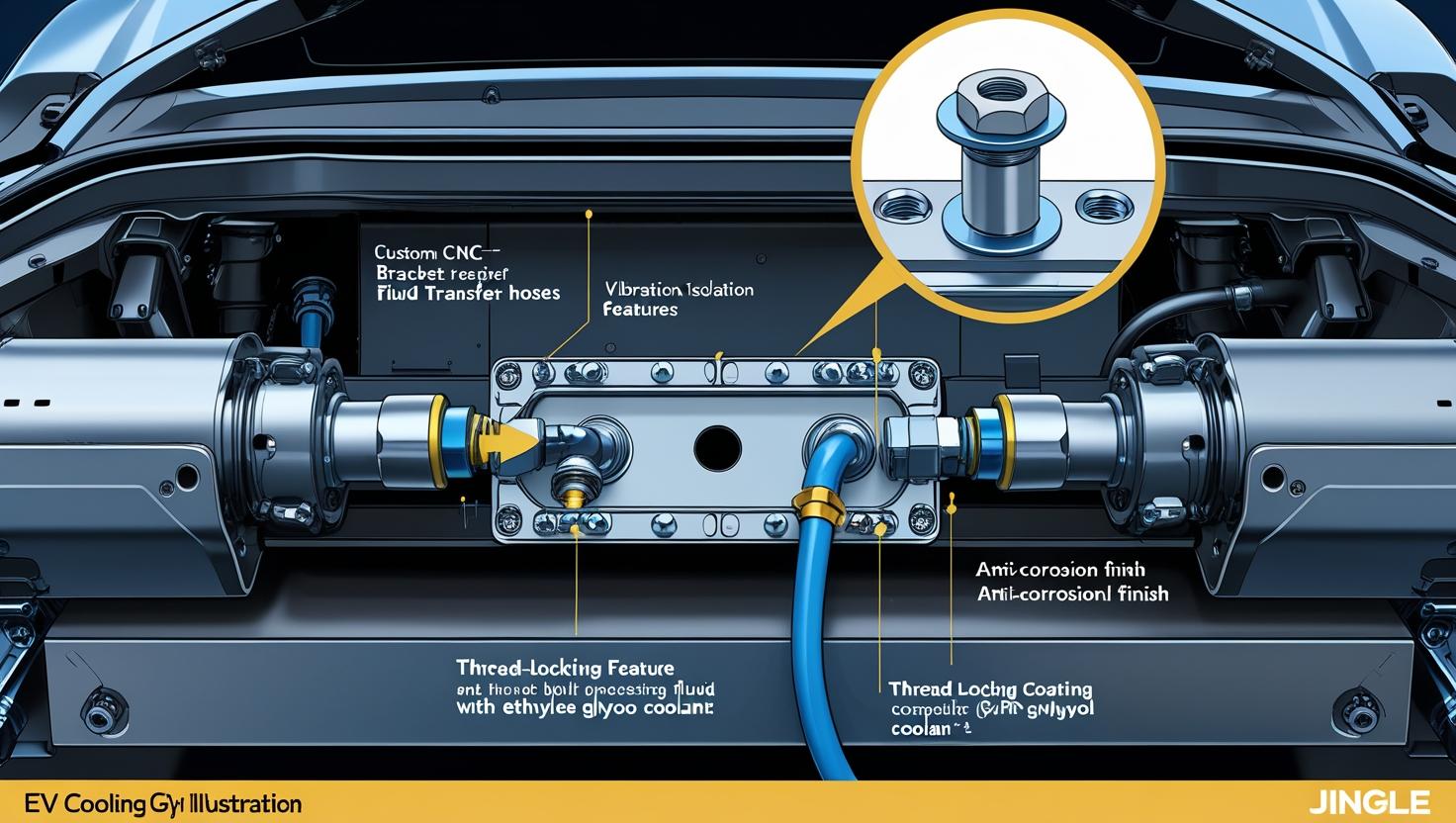
Vibration-resistant bolts with thread-lock patch + PTFE coating
-
Customized length to fit cooling plate bosses without over-torquing
-
Torque specs validated under simulated temperature swing conditions (-30°C to 90°C)
Result: Leakage rate dropped to <0.3% across 6-month fleet testing; installation time reduced by 12% due to pre-threaded design.
Use Case: CNC Brackets for Inverter and Pump Lines
A Tier 1 thermal module supplier requiredlightweight CNC bracketsto support high-pressure hoses from battery to inverter coolant modules—without interfering with power electronics layout.
JINGLE’s Response
-
CNC-milled brackets from anodized 6061-T6 aluminum, with mounting hole gaskets
-
Integrated rubber insert slots to reduce NVH and prevent line wear
-
Tolerance match: ±0.01 mm to fit across 3 EV platforms with one design
Result: Successfully passed vibration test at 200 Hz for 100 hours; installed across three model lines without redesign.
JINGLE’s Technical Capabilities for Thermal Applications
| Feature | Benefit for Thermal Systems |
|---|---|
| PTFE and fluoropolymer coatings | Resists coolant-induced chemical degradation |
| Thread-lock & vibration-resistant finishes | Maintains seal during thermal cycling |
| CNC customization with tight tolerance | Reduces install friction and part variation |
| UL94-rated components available | Meets fire safety around heated zones |
| Fatigue-tested brackets | Endure high-frequency vibration near compressors and inverters |
Design Best Practices for Thermal Fastening Systems
-
Avoid direct contact of bolts with coolant aluminum surfaceswithout coating
-
Use isolating CNC bracketsto prevent vibration transfer from motors
-
Specify chemical-resistant materials or finishescompatible with coolant types
-
Predefine torque specsunder combined thermal and mechanical load
-
Use multi-fit CNC bracket designsto streamline supply across platforms
Keep Thermal Systems Safe and Consistent with JINGLE
In a vehicle where battery temperatures can mean life or death, fastening cannot be an afterthought. With JINGLE, you can:
-
SecureEV cooling module mounts
-
Rely onvibration-resistant fasteners
-
Customizemulti-platform CNC brackets
-
Pass audits with full batch certification and testing data
We help Tier 1s and OEMskeep thermal systems tight, aligned, and compliant—under pressure, heat, and time.