What Makes a Reliable OEM Bolt Supplier from China
In a market flooded with manufacturers, identifying atruly reliable OEM bolt supplierfrom China can be the difference between a thriving export business and a series of supply headaches. The stakes are especially high for distributors and importers who rely on consistent quality and timely deliveries. So, what separates a dependable supplier from the rest?
1. Clear Engineering Standards and Material Traceability
For OEM bolts, precision isn’t negotiable. A reliable supplier should be able toprovide full technical documentation, including tensile strength, torque specs, coating thickness, and compliance with standards likeDIN, ISO, ASTM, or GB/T.
What to look for:
-
Certificates like ISO 9001 or IATF 16949 for automotive-grade production
-
Material batch traceability, especially for stainless steel or alloy bolts
-
Salt spray test reports (e.g., 48–500 hours) to verify anti-corrosion performance
This level of transparency reduces the risk of using substandard bolts in mission-critical assemblies.
2. Low MOQ + Customization Capability = Flexibility
For many distributors or OEM customers,flexibility is key. A supplier that insists on high MOQs or rigid SKUs can stifle market responsiveness.
What matters more:
-
Low minimum order quantities (as low as 5,000 pcs or mix-SKU options)to accommodate small batch testing or market trials
-
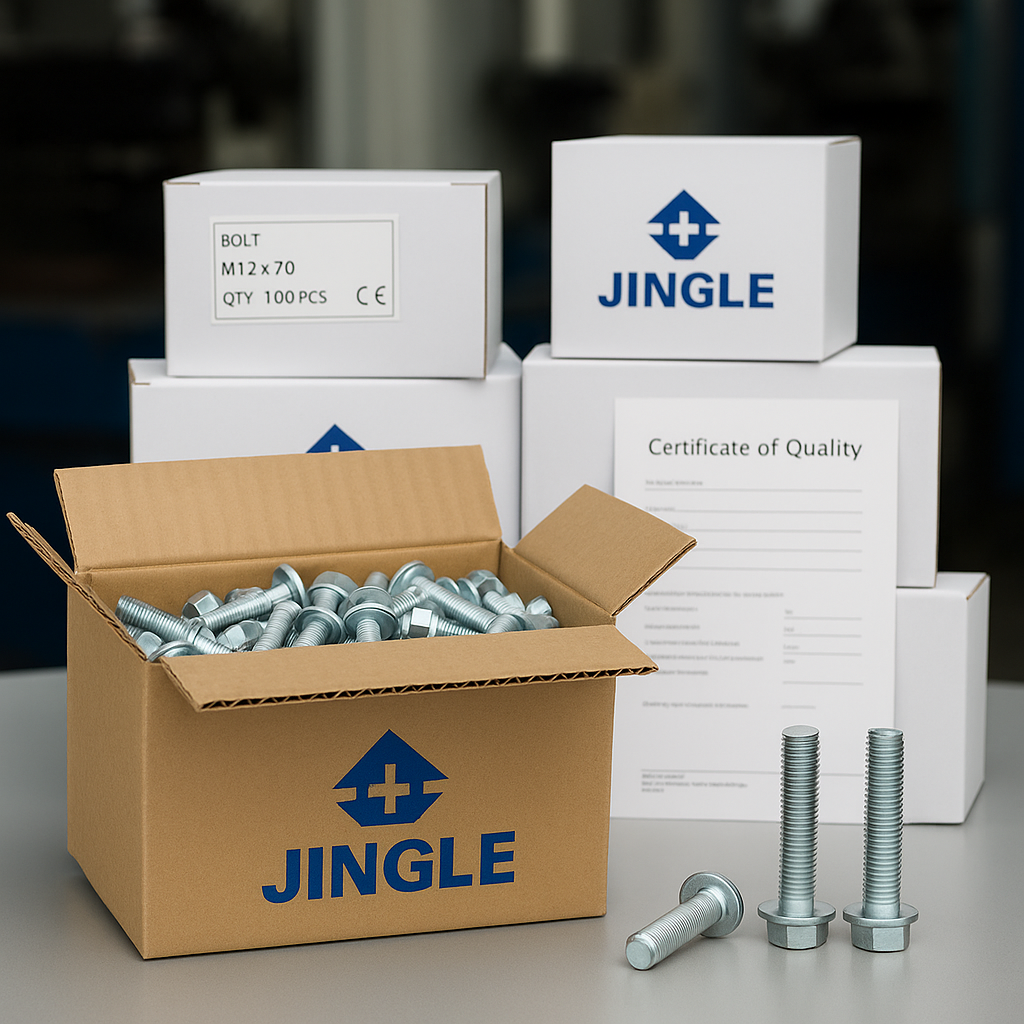
Willingness to adapt to client packaging specs, engraving requests, and unique bolt designs
-
Rapid prototyping services to validate design before bulk production
JINGLE, for instance, has enabled clients to test multiple bolt specs within one shipment—cutting down procurement cycles by 25%.
3. Quality Assurance That’s More Than a Promise
It’s easy to promise “100% inspection,” but only a few suppliers back it up with real systems.
Look for:
-
In-house labs with hardness testers, coating meters, torque machines
-
Photos/videos of bolt head marking, sorting and bagging during QC
-
Documentation for RoHS/REACH compliance (especially for EU-bound products)
Bonus tip:Ask for a sample Quality Control Report template before your first PO.
4. Lead Time Transparency and On-Time Delivery Rates
A great OEM supplier understands thatlogistics reliability = customer trust. Especially in export business, a delay in a bolt shipment could delay an entire assembly line.
Indicators of trust:
-
Clear production cycle timelines for both standard and customized bolts
-
Real-time updates during each production phase (e.g., forging, machining, plating, packing)
-
Delivery rate above 95% over the past 12 months
JINGLE’s clients report over 97% on-time delivery, even for mixed SKU containers shipped to Southeast Asia and Eastern Europe.
5. Export Experience with Distributors and OEM Clients
Manufacturing bolts is one thing;managing overseas orders with different compliance, packaging, and communication expectations is another.
What to check:
-
Does the supplier offer HS code consultation and full packing lists for customs?
-
Do they understand end-user labeling requirements (like pallet barcodes or OEM ID tags)?
-
Are their bolts used in real-world assemblies by known brands?
A supplier with proven OEM references and export project showcases—especially to regions like the EU, US, and Middle East—is more likely to deliver at scale and complexity.
Choose Reliability, Not Risk
A reliable Chinese OEM bolt supplier isn’t defined by price alone—it’s the result ofengineering consistency, export capability, production flexibility, and communication efficiency. For distributors and OEM buyers looking to reduce risks and increase customer satisfaction, aligning with a partner likeJINGLE, who understands both fastener production and export logistics, is a smart move.
To explore our OEM bolt solutions or discuss your fastener project, visit ourhomepageorcontact us here. Let’s build dependable connections, one bolt at a time.