Why do buyers care about the origin of self-tapping screws?
When engineers look for self-tapping screw manufacturers , they are typically looking to solve a real problem, not just add an item to their bill of materials. The screws must mesh firmly, securely adhere to the appropriate substrate, and ensure a smooth assembly process, avoiding the high rework costs associated with additional drilling, labor, or on-site failures. This is especially important in sheet metal parts, housings, lightweight structural subassemblies, furniture hardware, and hybrid material structures, as the choice of fasteners impacts assembly speed and reliability.
For the procurement team, decisions are not solely based on price. More importantly, it depends on the supplier's ability to consistently produce products that meet required geometry, surface finishes, and drive mechanisms, and to support repeat orders, avoiding disruptions to the production line due to minor modifications. High-quality fasteners can blend seamlessly into the assembly process unnoticed, while inferior fasteners will be immediately apparent, often at the worst possible moment.
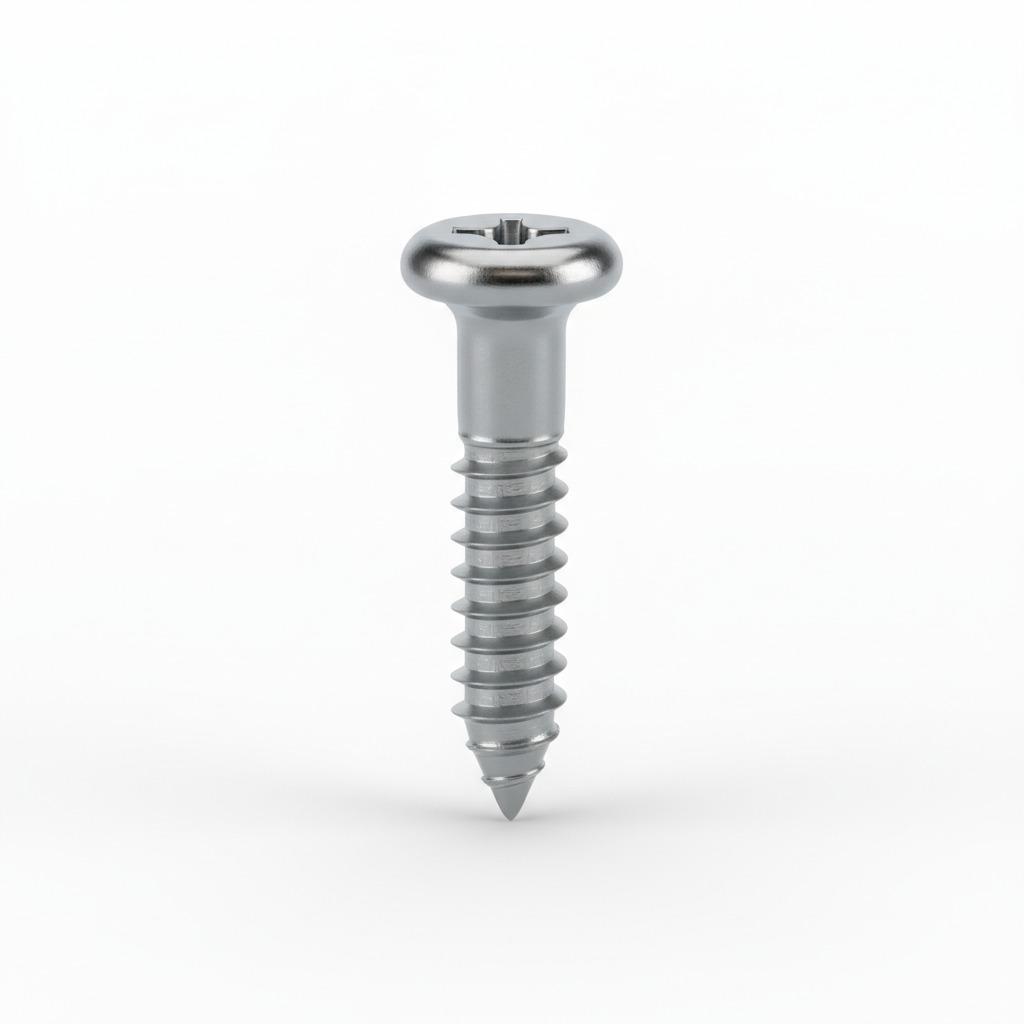
This screw looks like...
Based on the provided product information, the part appears to be a self-tapping screw or self-drilling screw, featuring a round push-button head, Phillips head drive, coarse wide thread, and a pointed tip. The silver finish indicates that it is made of steel with a bright or zinc-like coating, but the specific alloy and coating type cannot be determined from the image alone.
This combination is common in industrial fasteners because it balances ease of use and holding power. The larger round head distributes the load over a larger area. The coarser threads help the screw engage softer or thinner materials. The pointed head design suggests direct installation, but caution should be exercised until the screw's specific type is confirmed according to specifications, rather than relying solely on appearance.
Quick Comparison: What Issues Do Buyers Typically Need to Address?
Self-tapping screws and self-drilling screws
These terms are often used interchangeably in procurement negotiations, but they are not entirely the same. Self-tapping screws create threads on the workpiece themselves. Self-drilling screws go a step further, pre-drilling a pilot hole. From the buyer's perspective, this distinction is crucial because it affects installation speed, torque requirements, and the substrate to which the screws are suitable.
Button head and flat head shape
Round head screws can be useful when appearance, surface contact, or minimizing edge damage are critical. However, they may not be the best choice if the application requires a low profile or countersunk finish. This may sound obvious, but it's a common purchasing mistake: screws that meet functional requirements fail to deliver the intended product design.
What should a competent fastener supplier control?
A reliable fastener supplier or OEM fastener manufacturer should be able to discuss products in terms actually used by their production team: drive method, thread geometry, head shape, material, surface finish, and application range. For self-tapping screws, the manufacturing process typically involves cold forming and thread rolling, followed by surface finishing or electroplating. This is the standard manufacturing process for such parts, but should be confirmed based on the actual quoted product.
Equally important is consistency. Even if screws appear fine in the sample tray, uneven coating, easily worn grooves, or variations in thread shape between batches can still cause problems. Buyers should ask suppliers how they control dimensional repeatability and how they handle the inspection of incoming raw materials, molding, threading, and finishing. If the supplier cannot clearly explain these aspects, continue to ask follow-up questions.
More important selection criteria than the wording of the brochure
The first consideration is the substrate. Sheet metal, plastic, and lightweight structural components all have different properties. A screw that performs well on one substrate may crack on plastic, may produce excessive torque on thin steel sheets, or may fail to generate effective holding force in a hybrid laminate structure.
Next, we need to examine the head design and drive groove. While cross-grooves are common and convenient, they are not the best choice for high-torque assembly. If the application involves repeated driving, vibration, or on-site maintenance, then the drive type is just as important as the threaded type.
Surface finishes and corrosion resistance also need careful consideration. A bright silver finish might be perfectly acceptable indoors, but it doesn't replace selecting appropriate corrosion resistance for the specific environment. Some procurement teams make this mistake: they approve fasteners based solely on appearance, only to later discover that the actual operating environment of the components is far harsher than that of the prototype test bench.
Common mistakes buyers make
A common mistake is assuming all self-tapping screws are interchangeable. Another mistake is requesting only the diameter and length without specifying the thread profile, head shape, and surface finish. This often leads to repeated sample shipments and delayed delivery.
The second misconception is assuming that fasteners suitable for one housing or bracket will be suitable for all similar products. Even minor variations in material thickness, number of coating layers, or assembly torque can have performance effects that exceed the buyer's expectations.
Questions to ask before placing an order
Inquire whether the screw is for tapping, drilling, or both. Confirm the material type and plating process. If your design requires precise fit, request the drive standard, head size, and thread profile. If you are working with a fastener manufacturer in China , inquire about their procedures for sample approval, batch consistency, and packaging, especially if the screws will be used in automated assembly equipment.
If the fasteners will be used in electrical enclosures, HVAC components, or outdoor hardware, be sure to inquire about specific environmental limitations rather than relying solely on general surface treatment descriptions. It's better to ask for details beforehand than to discover corrosion issues after product launch.
The next practical steps for the procurement team
For buyers evaluating self-tapping screws, the best next step is to develop a concise technical list based on the actual application scenario: substrate, mounting method, drive type, head style, surface finish, and expected usage environment. Then, compare whether suppliers can clearly answer these questions, rather than just looking at the unit price.
If you are evaluating a new supplier, request a set of samples relevant to your intended use and verify its suitability in actual assembly, not just based on paper test results. Often, the truly valuable differences will become apparent in actual assembly.
Frequently Asked Questions
Can a single screw be used for multiple purposes?
Sometimes it's possible, but there must be limits. Screws that perform well in thin metals may not be the best choice for plastic or vibration-prone parts.
Is a coating enough?
No. Surface treatment is important, but it should be matched to the environment even more. Indoor use, outdoor environments, and humid environments are all different issues.
Why is head shape so important?
Because the screw head affects load distribution, appearance, tool engagement, and the screw's position in the final assembly. In the fastener industry, even minute geometric changes can have a significant impact.