Why buyers look for a self tapping screw manufacturer in the first place
When engineers and sourcing teams start comparing fasteners, the search for a Self Tapping Screw Manufacturer usually comes down to one thing: reducing assembly friction without creating new problems downstream. Self-tapping screws are attractive because they can form threads as they go, which can simplify assembly, cut part count, and make maintenance easier in the field. But the choice is not as simple as “find a screw and place an order.” The wrong fastener can strip soft materials, loosen under vibration, or force extra handwork at the line.
That is why the buyer’s real question is often broader than the product itself. They are looking for a Fastener Supplier that understands material behavior, drive engagement, plating choices, and the way a screw performs in the actual substrate, not just on paper.
What makes self tapping screws useful on the shop floor
Self tapping screws are valued because they reduce or eliminate the need for pre-tapped holes in some assemblies. In practical terms, that means fewer process steps and less tooling dependency. For sheet metal, thin enclosures, brackets, and some plastic components, that can be a meaningful advantage.
The tradeoff is straightforward: the screw has to do more work, and the base material has to tolerate it. In softer materials, poor selection can lead to excessive torque, cracked bosses, or inconsistent thread formation. In harder materials, the assembly may demand tighter control over pilot hole size and screw geometry.
A good OEM Fastener Manufacturer will usually think about the full connection, not just the head style or finish. That includes the mating material, installation method, and whether the part is expected to be assembled once or serviced repeatedly.
Reading the product details that matter
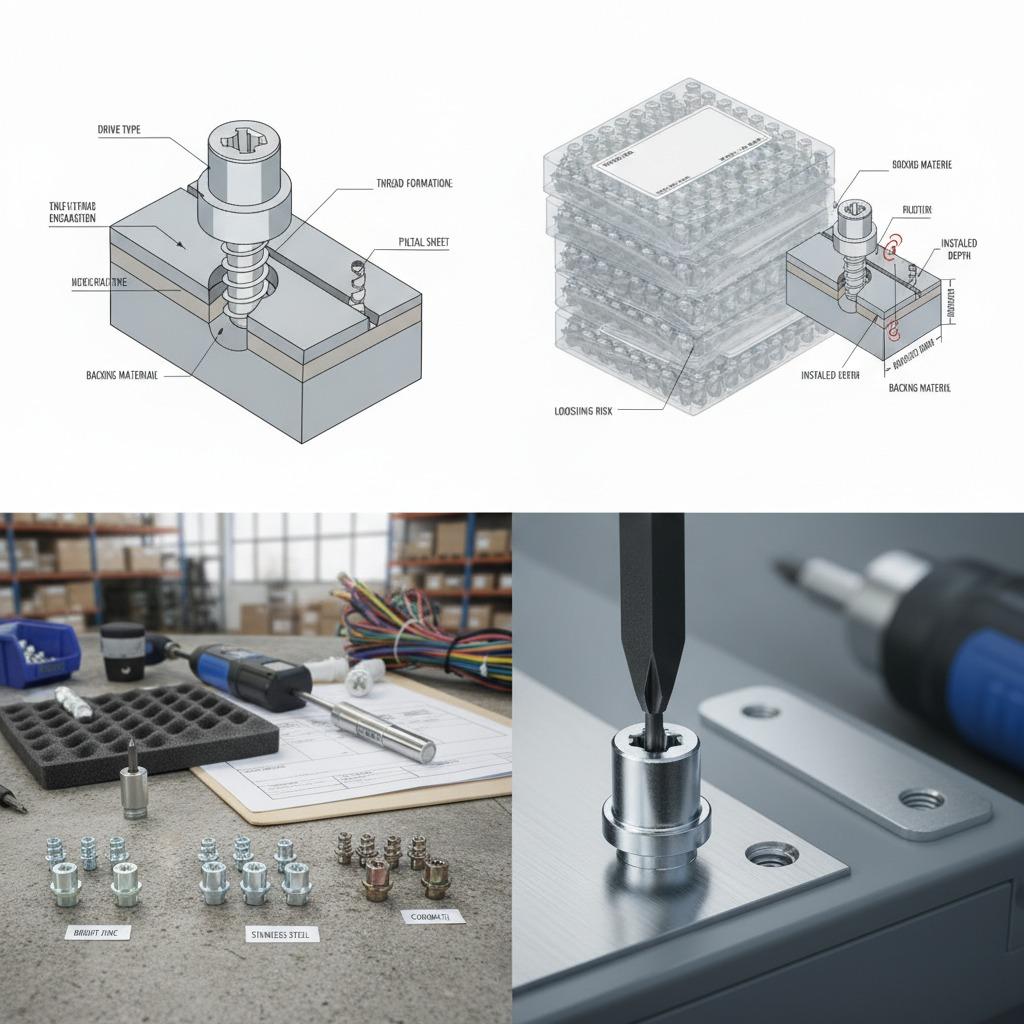
The fastener type often gets described broadly, but buyers should pay attention to the visible features that affect function. Based on the product information provided here, the fastener is a small metal part with a plated silver-colored finish, a cross recess drive, and a cylindrical shoulder or spacer-like section beneath the head. It appears to combine threading with a locating or spacing function.
That shoulder is worth noticing. In many assemblies, a cylindrical section under the head can help with alignment, bearing, or controlled spacing against a mating part. It may also help reduce surface damage compared with a purely conical contact point. The exact geometry matters, though, and photos alone cannot confirm dimensions, thread standard, or whether the shoulder is integral.
For buyers, this is the point where product drawings matter more than generic catalog language.
Material, finish, and why they affect the purchase decision
In fastener sourcing, material and finish are not decorative details. They shape how the screw behaves during installation and in service. The provided product appears to be made from steel or stainless steel with a bright plated finish, though the exact base metal cannot be verified from image data alone.
Plating can improve appearance and, depending on the system used, may help with corrosion resistance. Still, it is easy to over-assume protection from a bright finish. A sourcing manager should ask whether the coating is intended for indoor hardware, general mechanical assemblies, or more demanding environments. The answer changes the acceptable risk level.
A practical aside: if the fastener is going into electronics enclosures, brackets, or light machinery, the finish must also be checked against any conductivity, cosmetic, or corrosion concerns in the surrounding assembly.
How to compare suppliers without getting trapped by catalog language
When comparing a Fastener Manufacturer in China or any global source, it helps to separate three questions.
First, can the supplier make the geometry consistently? For a small screw with a shoulder, repeatability of head shape, thread form, and drive quality matters more than a generic “we can produce it.”
Second, does the supplier understand your application? A screw for a thin panel is not the same as one for a plastic housing or a hardware fixture.
Third, can they support the documentation you need? That may include drawings, material declarations, finish descriptions, and packaging requirements. If the supplier cannot discuss these clearly, the sourcing risk rises quickly.
Common mistakes buyers still make
One common mistake is treating self-tapping screws like commodity items when the joint is actually sensitive to torque or alignment. Another is assuming a plated finish equals corrosion protection without checking the environment. A third is ignoring the drive style until production starts and operators begin cam-out issues or tool wear.
The smaller the fastener, the more annoying these mistakes become. Small parts can look interchangeable in a sample tray and still behave differently on the line.
What to ask before you place an order
A useful buyer checklist is simple:
Confirm the base material
Do not rely on appearance alone. Ask for the stated material.
Confirm the thread and drive details
Thread form, drive type, and head geometry affect installation reliability.
Match the fastener to the substrate
Sheet metal, plastic, and mixed-material assemblies each impose different demands.
Check the finish for the real environment
Indoor hardware, enclosed equipment, and exposed assemblies do not need the same level of protection.
Where this fastener type fits best
This kind of screw is commonly suited to general machinery assembly, electronics enclosures, fixtures, panels, brackets, and hardware assemblies where compact size and controlled seating matter. The cylindrical shoulder makes it especially interesting where spacing or locating is part of the design intent.
For sourcing teams, the decision is less about finding any screw and more about finding the right production partner. The best supplier is the one that can translate a drawing, a substrate, and a service condition into a part that installs cleanly and stays put.
Next step for buyers
If you are evaluating a Self Tapping Screw Manufacturer for an OEM program, start with drawings, sample parts, and the end-use environment. Ask for the exact material, finish, and dimensional confirmation before you compare price. That saves time later, especially when a fastener looks simple but turns out to be carrying more of the assembly load than anyone first expected.