Welcome to our website
logo

Fastener Packaging for Export: Everything You Need to Know

  • blog
Posted by JINGLE On Jul 24 2025

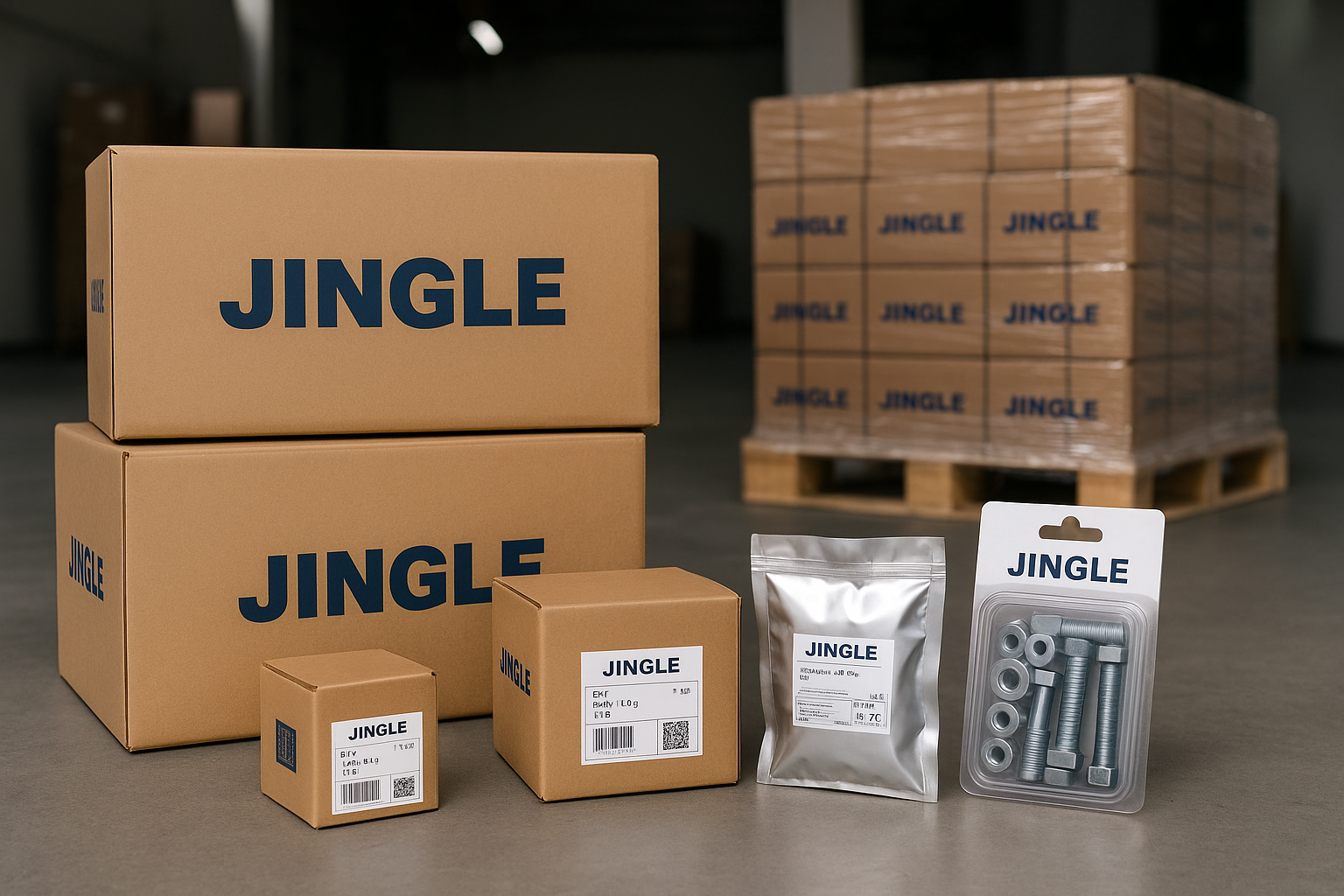
Fastener packaging for OEM export with JINGLE logo on boxes

Why Fastener Packaging Matters in Export Scenarios

When it comes to exporting fasteners, packaging is more than just a container—it's a critical factor in protecting your products, minimizing damage during transit, and presenting your brand to global buyers. For OEM clients and distributors, poor packaging can lead to increased returns, customs delays, or even lost orders. JINGLE understands these risks and offers customizable packaging solutions built for real-world export demands.

Key Challenges Faced by Exporters

OEM and distribution partners often face the following packaging issues:

  • Breakage and rust during sea shipmentdue to inadequate moisture-proof protection

  • Incorrect labelingthat causes customs clearance delays

  • Boxes collapsing under loadduring pallet stacking in warehouses

  • Clients requesting branded packaging or retail-ready designsbut suppliers offering generic cartons

JINGLE works with each customer to prevent these pain points by offering packaging solutions matched to shipping method, product type, and branding goals.

Types of Fastener Packaging We Offer

To support export requirements, JINGLE provides:

  • Bulk packagingin strong, double-wall cartons with reinforced corners

  • Small box inner packaging(e.g., 1kg, 5kg) with custom print or barcode stickers

  • Retail-ready packaginglike blister cards, clamshells, or header bags

  • Moisture barrier linersand desiccants for sea shipment

  • Pallet packaging with shrink wrap and edge guardsfor container loading

Each packaging type is validated for its durability and tested against shipping scenarios commonly encountered in export.

Branding and Customization Options

If you are a distributor or OEM buyer, you likely want your packaging to reflect your brand. That’s why JINGLE offers:

  • Logo printingon boxes and labels

  • Color-coded packagingfor different product types

  • Barcoding systemsfor warehouse integration

  • QR code or instruction insertsfor end-users

You send us your packaging guidelines—we produce and ship accordingly.

Compliance and Standards for International Shipping

Meeting international standards isn’t optional—it’s essential. All JINGLE packaging complies with:

  • ISPM-15 pallet regulations(for wooden packaging)

  • RoHS and REACH compliant labeling (if required)

  • Country-specific labeling (e.g., CE mark for EU, warning labels for USA)

  • Customs documentation pockets and itemized packing lists

This ensures fast clearance and lowers risk of penalties or shipment rejection.

Smart Packaging Is Smart Business

Choosing the right fastener packaging helps prevent damage, improves customer satisfaction, and enhances brand recognition. Whether you're shipping pallets to B2B clients or selling on retail shelves, JINGLE’s export packaging solutions are built for performance and flexibility.

To explore more of our export-ready fastener solutions, visitour homepageorcontact usfor tailored OEM packaging support.
Featured Blogs

Tag:

  • Industrial Application Solutions
Share On
Featured Blogs
Join Us at the 2026 Cologne Hardware Fair – Visit Us at Booth 3.1B078!

Join Us at the 2026 Cologne Hardware Fair – Visit Us at Booth 3.1B078!

Title: Join Us at the 2026 Cologne Hardware Fair – Booth 3.1B078 Summary: Visit us at Booth 3.1B078 during the 2026 Cologne Hardware Fair (March 3-6) to explore new hardware innovations, connect with industry experts, and discover solutions tailored to your needs.

Small Batch CNC Machining: How to Balance Cost, Speed, and Consistency in Real Production

Small Batch CNC Machining: How to Balance Cost, Speed, and Consistency in Real Production

Small batch CNC machining is widely used for prototyping, pilot runs, and low-volume production, but many projects face unstable quality, rising costs, and delayed scaling. This article explains how process planning, material control, and production strategy ensure efficient and repeatable small batch CNC machining.

CNC Milling Parts Supplier: How Complex Geometry Is Controlled in Real Production

CNC Milling Parts Supplier: How Complex Geometry Is Controlled in Real Production

CNC milling parts are widely used in structural components, housings, and precision assemblies, but many projects face dimensional inconsistency and assembly misalignment during production. This article explains how a CNC milling parts supplier controls material behavior, toolpath strategy, and tolerance zoning to ensure stable performance across real industrial applications.

Stainless Steel CNC Turning Parts: How Stability and Wear Resistance Are Achieved in Real Use

Stainless Steel CNC Turning Parts: How Stability and Wear Resistance Are Achieved in Real Use

Stainless steel CNC turning parts are widely used in high-load, corrosive, and long-life applications, yet many projects encounter premature wear, thread failure, or dimensional drift after installation. This article explains how material grade control, turning strategy, surface management, and application-driven process design ensure reliable performance in real industrial environments.

Aluminum CNC Precision Parts: How Process Control Delivers Stability Across Real Applications

Aluminum CNC Precision Parts: How Process Control Delivers Stability Across Real Applications

Aluminum CNC precision parts are widely used in automation, enclosures, and lightweight structures, yet many projects encounter instability after installation or during repeat production. This article explains how controlled material selection, machining strategy, tolerance zoning, and application-driven process design ensure consistent performance across real industrial environments.

Custom CNC Machining Service: How Customization Impacts Cost, Lead Time, and Consistency

Custom CNC Machining Service: How Customization Impacts Cost, Lead Time, and Consistency

Custom CNC machining projects often fail not because parts are complex, but because customization decisions are made without considering process impact. This article explains how material choice, machining strategy, tolerance control, and supplier workflows determine whether custom CNC machining remains stable, predictable, and scalable.