How to Read a CNC Machining Quote: Cost Breakdown, DFM, and Buyer Controls
Quick answer: CNC machining cost is not a single machine-hour number. A defensible quote converts a controlled product definition into material, programming and process planning, setup and fixturing, recurring machine time, tooling and consumables, deburring, outside processing, inspection, documentation, packaging, logistics and commercial-risk assumptions. Buyers compare offers more accurately when every bidder prices the same revision, quantity and release pattern, inspection scope, finishing route and delivery boundary—and returns assumptions and deviations in the same format.
A buyer often receives three quotations that appear to describe the same machined part. One is a concise unit price. Another separates raw material and finishing. The third carries programming, fixtures and inspection as one-time charges. The numbers can differ widely even when no supplier is making a mistake. Each bidder may have read a different baseline into the same incomplete package.
The useful question is not “Why is this shop expensive?” It is “What product, route, evidence, quantity and risk has each shop priced?” That wording changes the conversation. It lets engineering find ambiguous requirements, gives suppliers room to state a more economical route, and allows purchasing to normalize one-time and recurring cost without asking for proprietary formulas.
If you have a drawing, model, annual demand and several unlike quotations, Discuss a quote-normalization review. A commercial review can organize assumptions and questions; it cannot certify manufacturability, approve a design change or guarantee a final price.
1. Why apparently identical CNC quotes are rarely identical
A drawing is not the entire manufacturing contract. Bidders also need to decide which stock form to buy, how much allowance to carry, how the part will be held, how many orientations are needed, which features are cut together, how burrs are removed, whether finishing occurs internally or outside, what is inspected, how records are produced and how parts are protected in transit. When the RFQ is silent, every supplier fills the gaps differently.
The result is hidden scope variation. One bidder may include a dedicated fixture; another assumes soft jaws are enough. One prices inspection of every drawing characteristic; another budgets a first-piece report and a sampling check. One includes certified raw material and lot segregation; another assumes commercial stock. One carries the risk of a difficult outside finish; another excludes it.Comparing only the final unit price rewards the narrowest interpretation.
A strong quote does not have to reveal confidential shop rates or toolpaths. It should, however, make the commercial architecture visible. Ask for one-time charges, recurring unit charges, outside-process charges, document and packaging scope, quantity basis, validity, Incoterm, exclusions, buyer decisions and deviations. That is enough to determine whether two offers are comparable.
| Cost block | What may sit inside it | Question that exposes scope |
|---|---|---|
| Material | Stock form, size allowance, condition, certification, cut-off, minimum buy, yield and scrap disposition. | What exact material and starting stock does this price assume? |
| Non-recurring work | Drawing review, programming, process planning, fixture design, special jaws, gauges, first article and validation. | Which charges recur after a revision, source change or reorder? |
| Recurring conversion | Setup, loading, machining, tool changes, in-process checks, deburring, washing and normal handling. | How many setups and major process stages are assumed? |
| Outside processing | Heat treatment, coating, anodizing, plating, passivation, grinding, marking or testing performed elsewhere. | Which outside suppliers, transport legs, certificates and risks are included? |
| Quality evidence | Material traceability, inspection planning, reports, gauges, laboratory work, samples, retention and change control. | What is checked, at what frequency, by which method and with which record? |
| Packaging and logistics | Cleaning, corrosion protection, individual separation, labels, export packing, freight and customs boundary. | What condition and identity must be preserved at the receiving point? |
| Commercial risk | Forecast uncertainty, volatile inputs, short validity, expedite assumptions, exchange exposure and unclosed technical questions. | Which assumptions can change price before or after order release? |
2. Freeze the quotation baseline before asking for a lower price
The fastest way to corrupt a price comparison is to let the technical baseline move during bidding. A supplier may quote revision B while another receives revision C. A model may show a radius that the drawing does not. A note may call for a finish on “all surfaces” while the CAD model marks only a cosmetic zone. A forecast may say annual demand, but one bidder assumes a single delivery and another assumes monthly releases.
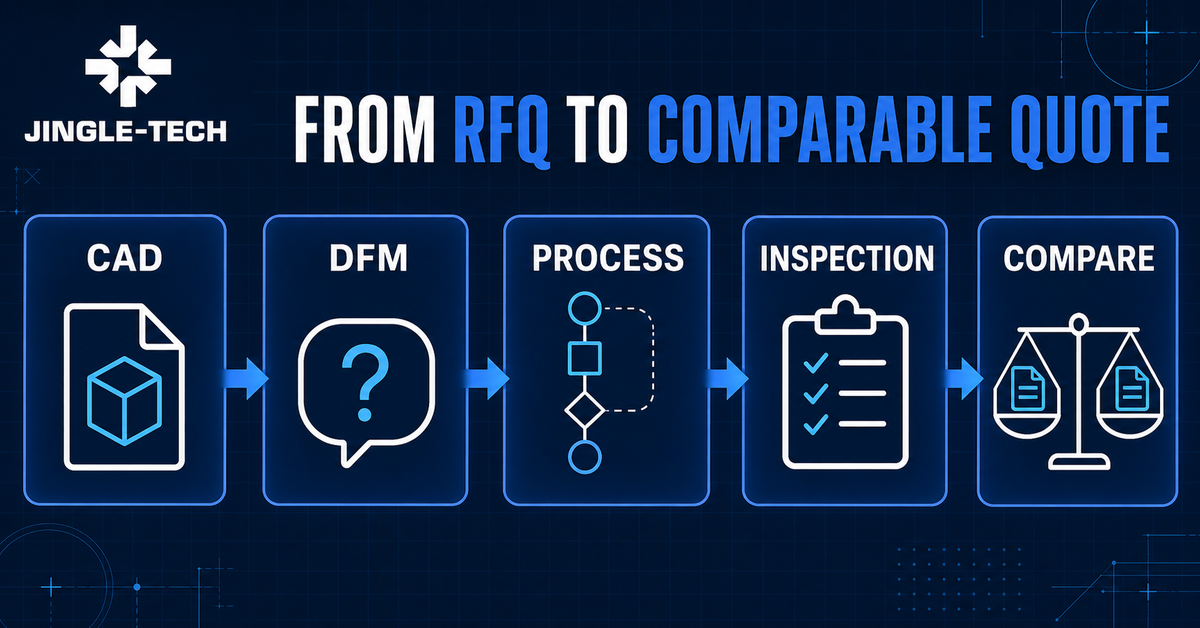
Create a quote-basis sheet before release.It should identify the buyer part number, drawing and model revisions, document precedence, units, material and condition, quantity per order and forecast, release pattern, required delivery point, finishing, inspection, reports, packaging, approval gates and open questions. Put the same sheet in every bid package and require suppliers to acknowledge it.
Digital data needs the same discipline as a drawing. ISO 16792:2021 addresses preparation, revision and presentation of digital product-definition data for model-only and model-plus-drawing approaches. ISO lists a revision draft in 2026, but the draft is not the published replacement. The sourcing lesson is simple: name the authoritative dataset and version. Do not ask a machinist to decide which conflicting file controls.
A baseline is allowed to contain open items
Not every decision must be closed before a budgetary estimate. Open items should be visible. Label a tolerance, finish or certificate “buyer to confirm,” ask the bidder to show the priced assumption, and prevent production release until it is resolved. That is more honest than an apparently firm quote built on invisible defaults.
3. Material cost begins with form, condition and buy quantity
Two parts can use the same alloy name and carry different material cost.Stock form matters: plate, bar, tube, forging, casting or extrusion may provide different starting geometry, availability, allowance and minimum purchase. Condition matters because heat treatment, temper, cold work or stress state can affect both performance and machining behavior. Size matters because the supplier buys a stock envelope, not the final CAD volume.
Ask the bidder to state the exact material designation, governing specification and edition, condition, proposed stock form, starting envelope, certification basis and any substitution. If the order needs traceability to a heat or batch, include that in the baseline. If a proprietary material is named, clarify whether equivalents are permitted and who approves them.
For covered steel products, ISO 10474:2013 defines types of inspection documents supplied according to order requirements, and ISO 404:2013 with Amendment 1:2022 addresses general technical delivery requirements within its scope. These references do not apply to every alloy or product form. They demonstrate why “material certificate included” is incomplete unless the document type, material standard, source linkage and order requirement are clear.
Material yield is a geometry question
A slim finished bracket cut from a much larger block may carry substantial removal and scrap.A hollow or near-net starting form may reduce removal but add tooling, qualification, minimum-buy or supply risk. Procurement should not force the lowest theoretical material use. Ask for alternatives that preserve the released performance requirements and compare the entire route.
4. Part geometry controls access, tool travel and setup count
Feature count is less informative than feature interaction. A part with many accessible holes on one face may be straightforward. A part with one hidden undercut, an awkward deep pocket or a critical relationship across opposite faces may require additional orientations, special tools, custom workholding or an alternate process.
When reviewing a quote, ask the supplier to identify the major setups rather than disclose a detailed toolpath. Which surfaces establish the first datum? Which features must be reached after the part is turned? Can the part remain stable after significant material removal? Is a special fixture required to hold a thin or irregular wall? Does a final operation depend on an outside process that can distort the part?
The answers reveal recurring cost and risk. Every additional setup can add loading, alignment, probing or verification. It can also introduce another relationship that must be maintained. That does not make a multi-setup part poorly designed; it makes setup count a controlled commercial assumption.
5.Difficult features may change the manufacturing route
Sharp internal corners, deep narrow cavities, long small-diameter holes, thin ribs, undercuts, inaccessible cross holes, interrupted cuts, small threads and delicate cosmetic edges can change tool choice, reach, rigidity, chip evacuation, deburring and inspection. A single feature can therefore add more cost than several ordinary dimensions.
The buyer's job is not to redesign the toolpath. It is to separate functional requirements from modelling habits. If an internal corner only exists because the CAD model used a default sharp edge, engineering may approve a radius. If a pocket bottom does not mate with anything, a different end condition may be acceptable. If a thread length exceeds functional engagement, the requirement may be reviewed. Each change needs engineering approval and a revised controlled definition.
Beware of the phrase “standard tooling” when no one defines the feature. Tool availability depends on diameter, reach, material, finish and local shop practice. The quote should state any geometry assumption that allows a bidder to use a normal route. If two bidders make different assumptions, normalize them before choosing.
6. Tolerances cost money when they change process or evidence
A tight tolerance does not create cost merely because its number is small.It creates cost when it requires a more stable process, another setup strategy, controlled temperature, special tooling, compensation, slower cutting, in-process measurement, a secondary operation, tighter material control, more inspection or a different acceptance rule.
Blanket tolerances make this worse. If every feature carries the same tight limit, the supplier may price the whole part as critical. Identify functional characteristics and relate them to datums that represent assembly. ISO 1101:2017, confirmed current by ISO in 2022, defines the symbol language and interpretation rules for geometrical tolerancing within its scope. ISO 5459:2024 addresses datums and datum systems. For ASME-based drawings, ASME Y14.5-2018 (R2024) remains in effect according to ASME. Cite the standard and edition adopted by the product definition; do not mix rule sets casually.
General tolerances also need an explicit basis. The official ISO browsing page for ISO 2768-1:1989 describes tolerances for linear and angular dimensions without individual indications and states that product tolerancing should be complete rather than left to workshop judgment.ISO showed a replacement under publication in August 2026, so buyers should verify current status before adopting an edition. A title-block reference is not permission to ignore individually controlled functional features.
A dimension may be easy to machine but expensive to prove. Ask how the supplier plans to establish datums, access the characteristic, control the fixture and make the acceptance decision. If engineering relaxes a nonfunctional tolerance, the quote should show which setup, operation or inspection burden changes. That makes DFM measurable instead of rhetorical.
7. Surface texture and cosmetic finish are different requirements
“Smooth,” “machined finish” and “no tool marks” are not complete specifications. A functional surface-texture requirement needs the relevant parameter, limit, evaluation direction or other specification details required by the adopted standard and drawing. A cosmetic requirement needs zones, viewing conditions, permissible marks, color or appearance boundaries and an agreed reference when appropriate.
ISO 21920-1:2021 specifies rules for indicating profile surface texture in technical product documentation. ISO shows it as published but under revision in 2026; the committee draft is not yet a replacement. A buyer should therefore state the adopted edition and full requirement instead of copying an old surface symbol from a legacy print without review.
Texture can affect machining strategy and measurement. Cosmetic expectations can affect tool changes, handling, separation, polishing and packaging. Do not require a decorative appearance on surfaces that will be covered, and do not trade away a functional surface because it is visually acceptable. Treat function and appearance as separate quote lines when their routes differ.
8. Finishing and outside processing add queues, handling and change risk
Anodizing, plating, passivation, heat treatment, painting, conversion coating, polishing, grinding, marking and laboratory testing can add more than a supplier's invoice. They create transport, queue, lot-transfer, masking, racking, dimensional allowance, appearance, certificate and reinspection questions. If the machining source outsources them, the buyer still needs one accountable route.
Define the governing finish specification and edition, material compatibility, class or type where applicable, controlled surfaces, masked zones, thread requirements, appearance boundary, required tests, sample frequency, documentation and post-process inspection. Ask whether the quoted price includes all movements and rejects attributable to the finishing route, and how responsibility is divided when a dimension crosses the special-process step.
A finish change after quotation can invalidate stock allowance, thread strategy, gauges, masking or packaging. Treat it as a technical and commercial change, not an administrative note. The supplier should return the effect on route, price, evidence and schedule for approval.
9. Quantity affects setup recovery, not just volume discount
Buyers often ask for a price at annual volume while placing small releases. That creates a mismatch. A supplier may be able to spread programming, setup, fixture preparation and first-piece activity over a larger batch, but frequent small releases can bring those activities back. Conversely, one large batch can create inventory, cash, storage and design-obsolescence risk for the buyer.
State at least four demand facts: firm quantity for the first order, expected production batch, shipment release quantity and nonbinding forecast. Ask which level drives material purchase, setup frequency, inspection frequency and price. If the supplier proposes a blanket order or inventory program, define ownership, revision risk, storage, shelf or corrosion controls, release timing and cancellation terms.
MIT's 2025 manufacturing-planning and cost lecture separates fixed and variable cost and shows why a fixed amount allocated per unit changes with quantity. That teaching framework explains the allocation logic; it does not supply a valid machine rate, setup time or price for this RFQ. Ask the bidder which non-recurring work is being recovered at each quoted quantity.
Prototype and production quotes should be separated. A prototype may use flexible workholding, more programming per piece and inspection intended to learn.Production may justify dedicated fixtures, gauges, optimized stock or a stable outside-processing route. Do not assume the prototype unit price will scale by simple division, and do not pay for production tooling before the design and demand case are credible.
10. Inspection cost is driven by the acceptance question
“Inspection included” can mean anything from a final visual check to a documented report covering every characteristic. Define what has to be proven and why. The plan should identify critical and key characteristics, method, frequency, sample identity, acceptance rule, record, instrument or gauge control, retention and response to a nonconformance.
Measurement method can affect both cost and result. A feature may be accessible with an ordinary instrument, require a fixture, need a profile method, or be better controlled during the process. NIST's On-Machine Measurement Use Cases and Information for Machining Operations describes use cases and information elements for shop-floor on-machine dimensional measurement. It is a research publication, not a mandate to accept machine probing as final inspection. The buyer and supplier still need an agreed method, correlation and decision rule.
ISO 14253-1:2017, confirmed current by ISO in 2023, establishes decision rules for verifying conformity or nonconformity with quantity-valued GPS specifications while considering measurement uncertainty. That matters near a specification limit: two parties can measure similar values yet reach different decisions if their rule is not agreed. Put the applicable acceptance rule in the contract rather than resolving it after a disputed shipment.
External laboratory reports have their own scope. ISO/IEC 17025:2017, confirmed current in 2023, addresses competence, impartiality and consistent operation of testing and calibration laboratories. A laboratory's accreditation must still be checked for the relevant activity and scope; a logo on a report is not proof that every requested test is covered.
Sampling should follow risk and the contract
ISO 2859-1:2026 provides AQL-indexed lot-by-lot sampling schemes by attributes. It can support an agreed acceptance system within scope, but an AQL does not decide the engineering consequence of a critical defect. Quality and engineering should define the plan, lot, switching rules and any characteristics requiring process control, first-article evidence or complete verification.
11.Documentation and data traceability are quoteable deliverables
Material certificates, process records, first-article reports, dimensional results, certificates of conformity, change notifications and lot maps take time to create, review and retain. Ask only for records that support the program risk, but treat every required record as part of scope. A supplier that prices the documents honestly may appear higher than one that silently assumes a packing slip is sufficient.
NIST's Recommendations on Ensuring Traceability and Trustworthiness of Manufacturing-Related Data provides practical guidance for systems covering manufacturing-data traceability and trustworthiness, including CNC subtractive processes. It does not prescribe your purchase-order record set. It supports the broader buyer principle: the drawing revision, manufacturing evidence, part identity and decision history should remain connected.
Define file format, language, naming, part and lot references, approval status, retention, transfer method and revision control. If the buyer requires a digital inspection report, provide a template or schema. If a PDF is enough, say so. Unclear data requirements can create late manual work that was not present in the original quote.
12.Packaging protects the value already machined into the part
A precision part can pass inspection and fail at receiving because it was allowed to touch another part, retain abrasive debris, corrode, lose its label or damage a cosmetic edge. Packaging should be designed from the accepted final condition backward.
State cleanliness, rust prevention, separation, capped openings, thread protection, cosmetic zones, quantity per pack, label fields, lot segregation, moisture control where required, pallet limits, export treatment and destination conditions. Ask for a sample pack plan when damage risk is high. If the finish is sensitive, coordinate packaging after the finishing source has confirmed its handling limits.
Do not specify expensive packaging by habit. A rugged unfinished spacer and a polished sealing component do not need the same treatment. Match the package to the consequence of damage and the receiving process. The quote should make reusable, returnable, disposable and customer-supplied packaging assumptions visible.
13. Build a should-cost model without pretending to know the supplier's shop
A buyer-side should-cost is a reasoning model, not a demand that every supplier match an internal number. Its purpose is to identify which assumptions explain the quote and where a design or commercial decision could change the route. It should use ranges, confidence levels and open questions when data are incomplete.
NIST's Design-for-Cost methodology is useful as a decomposition reference, not as a public rate card. Its framework distinguishes material, manufacturing, labor and overhead, tooling, quality losses, packaging and delivery, and it treats machining time, setup and operation as visible contributors. A buyer can borrow that discipline while leaving supplier-specific rates, yields and route knowledge to evidence and clarification.
Start with physical facts: material and stock envelope, major setups, likely process stages, difficult features, secondary processes, inspection and packaging. Separate non-recurring from recurring work. Then add commercial facts: batch, release pattern, location, Incoterm, documentation, validity and buyer approval timing. Do not insert an invented machine rate and call the result objective.
| Block | Known buyer input | Supplier clarification | Decision lever |
|---|---|---|---|
| Material | Specification, condition, part mass, envelope and traceability. | Stock form/size, minimum buy, allowance and approved substitute opportunity. | Nearer-net stock, demand pooling or approved material alternative. |
| Non-recurring | Revision status, launch phase and expected program life. | Programming, fixture, gauge, first article and requalification triggers. | Freeze design, reuse approved tools or amortize transparently. |
| Recurring route | Geometry, critical features, batch and release pattern. | Major setups, special features, deburr/clean route and recurring checks. | Approved DFM change, batch strategy or feature standardization. |
| Outside process | Finish/test specification, appearance and records. | Source, transports, queue, masking/racking, allowance and reinspection. | Approved finish simplification or consolidated process route. |
| Quality | Critical characteristics, acceptance and report needs. | Method, frequency, fixture/gauge, external test and data format. | Risk-based characteristic/frequency review by engineering and quality. |
| Commercial/logistics | Destination, Incoterm, pack, forecast and firm releases. | Validity, exclusions, currency basis, shipment mode and change conditions. | Quote normalization, release plan or alternative delivery boundary. |
The model is most useful when it ends with questions, not accusations. If the quote seems high because the supplier sees three setups and the buyer expects two, compare datum access and feature relationships. If finishing dominates, inspect the finish boundary. If inspection dominates, identify which requirement or record drives it. That is quote control.
14. Use DFM as a controlled decision, not a price-cut slogan
Design for manufacturability is valuable when it identifies a requirement that changes the manufacturing route without protecting function. It is harmful when “make it cheaper” becomes permission to alter material, datums, fit, strength, fatigue, sealing, corrosion or appearance without engineering review.
A good DFM proposal has five fields: current requirement, observed manufacturing burden, proposed change, predicted route effect and validation/approval needed. It should arrive as a redlined drawing or marked model, not an informal message that can be lost after purchase order.
| Proposal type | Manufacturing question | Engineering check | Quote response |
|---|---|---|---|
| Internal corner | Would a larger radius remove a special tool, reach or secondary operation? | Mating envelope, stress, flow/cleaning and assembly clearance. | Show setup/tooling/cycle or risk block affected, not just a new total. |
| Tolerance or datum | Can the requirement follow functional location and one stable inspection setup? | Fit, stack-up, interchangeability and measurement interpretation. | Identify process and inspection change plus any new gauge need. |
| Pocket/depth | Can depth, width or bottom form change to improve access and rigidity? | Function, mass, fluid/cleaning, stiffness and neighboring features. | State stock or machining route effect and revised evidence. |
| Thread/hole | Can standard size, realistic engagement or accessible direction replace a special feature? | Joint design, mating part, service load, sealing and maintenance. | Separate tool/setup effect from any purchased-component change. |
| Finish zone | Can the special texture or cosmetic requirement be limited to functional/visible surfaces? | Tribology, sealing, adhesion, corrosion, appearance and cleaning. | Show machining, outside-process, inspection and packaging effects. |
After approval, issue a new controlled revision and request a delta quote. Preserve the old and new scope, one-time change charges, remaining inventory and effective serial/lot. A verbal concession may lower the first order and create a dispute on the second.
15. Normalize quotes before negotiating
Price comparison works only after technical and commercial normalization. Build a side-by-side matrix with the same rows for every supplier. Where a bidder has bundled a charge, ask for a scope note rather than forcing a confidential rate disclosure. The goal is comparable boundaries.
| Comparison row | Normalize to | Red flag |
|---|---|---|
| Technical revision | Same drawing/model/note hierarchy and approved deviations. | Price cites no revision or silently substitutes material/finish. |
| Demand basis | Same firm batch, release quantity, forecast and contract duration. | Annual-volume price assumes one shipment or noncancelable stock. |
| One-time/recurring | Separate programming, fixtures, gauges and first article from unit price. | Amortization period and ownership are unspecified. |
| Quality and documents | Same characteristics, methods, frequencies, reports and retention. | “Standard inspection” has no defined content. |
| Finishing | Same specification/edition, zones, testing and appearance. | Outside process is excluded or allowance/masking is unresolved. |
| Delivery boundary | Same packaging, destination, Incoterm, freight and duty assumptions. | A low ex-works price is compared with a delivered price. |
| Validity/change | Same approval timing, validity window and price-adjustment mechanism. | Critical assumptions can change after PO without buyer approval. |
Once the rows align, negotiation becomes specific. You may discuss fixture ownership, batch releases, stock alternatives, DFM, report frequency or packaging.You are no longer asking one supplier to match a number built on another supplier's narrower scope.
Compare your CNC quote assumptions
16. Send an RFQ that separates requirements from assumptions
A quote becomes more reliable when the supplier can tell what is fixed, what may be proposed and what remains open. Put requirements in controlled fields. Put questions in a separate list. Ask the bidder to return both a compliance matrix and a priced assumption sheet.
| RFQ block | Buyer sends | Bidder returns |
|---|---|---|
| Identity and authority | Part number, title, drawing/model/spec revisions, units and precedence. | Acknowledged baseline, received-file list and conflict/open-item log. |
| Material | Exact designation, condition, prohibited/allowed alternatives, traceability and document type. | Offered stock form/size, source basis, certificate scope and substitution proposal. |
| Geometry and DFM | Critical features, datums, mating/assembly context and change-approval route. | Major setups, special tooling/fixture assumptions, clarification and marked DFM proposals. |
| Finish and secondary process | Specification/edition, zones, appearance, masking, tests and certificates. | Route, outside-source boundary, dimensional allowance, transport and reinspection. |
| Quality | Characteristic classification, methods, frequency, acceptance rule, first article and report format. | Inspection plan, gauge/fixture assumptions, external-lab scope and sample record. |
| Demand | Prototype/pilot/production phase, firm order, batch, release and nonbinding forecast. | Price breaks, minimum-buy/batch basis, capacity reservation assumptions and reorder basis. |
| Packaging and delivery | Cleanliness, protection, labels, pack quantity, destination, Incoterm and requested gates. | Pack plan, freight boundary, quote validity, exclusions and decision-dependent schedule. |
| Commercial return | Required currency/tax format, tooling ownership, payment and confidentiality terms. | One-time/recurring/outside/logistics split, assumptions, deviations and change triggers. |
Do not make a supplier sign “full compliance” while the RFQ contains unresolved conflicts. A row-by-row response allows a qualified exception, evidence reference or buyer decision. That protects both parties and produces a quote that can survive purchase-order release.
17. Questions that reveal whether the price is controlled
Buyers do not need access to confidential programs or a complete factory cost ledger. A short technical-commercial interview can still expose the route and its risks.
- What exact drawing, model and specification revisions did you price? Listen for a controlled file list, not “the attachment.”
- Which material form and condition are assumed? Ask about allowance, minimum purchase, certification and any proposed equivalent.
- How many major setups and outside-process transfers shape the route? A bidder can answer at a high level without revealing toolpaths.
- Which features dominate tooling, reach, stability or deburring? This creates a focused DFM conversation.
- Which tolerances or relationships dominate process control and inspection? Ask how the datums and method match the drawing.
- What is included in “standard inspection”? Get characteristic, frequency, report and acceptance details.
- What changes would trigger new programming, fixtures, gauges or first article? This prevents surprise non-recurring charges.
- How do batch and release quantity affect setup recovery and material buy? Compare the answer with the forecast and order plan.
- Which finish, test or laboratory steps are external? Understand source control, documents, transport and responsibility.
- What remains excluded or subject to buyer confirmation? A clear exception is safer than hidden optimism.
- How will lots, revisions and evidence stay linked? Ask for a redacted sample record or label where appropriate.
- What is the schedule's critical decision gate? Separate buyer approval, material, production, outside processing, inspection and freight.
18. Common CNC quote mistakes buyers can prevent
Comparing unit price before scope
A low quote may omit certification, finishing, reports, packaging or freight. Normalize those items first.A higher quote may still be commercially better if it includes the approved route and evidence, but no article can determine that without the actual offers.
Demanding a detailed supplier cost ledger
Rate disclosure can create resistance and still leave the buyer with misleading data. Ask for cost blocks, route assumptions, one-time/recurring boundaries and change triggers. That provides control without pretending the supplier has no confidential information.
Using annual volume to obtain a production price for prototype releases
State the actual phase and releases. Request separate prototype, pilot and production bases if appropriate. A supplier can then propose the point at which dedicated tooling or batch strategy becomes relevant without promising an automatic curve.
Treating every tight dimension as equally critical
Engineering should identify function and datums. Quality should define the acceptance method. The supplier should identify process burden. Purchasing should not relax anything; it should route a specific DFM proposal for approval.
Approving a DFM idea without revising the definition
An email does not reliably control repeat orders. Revise the drawing/model/specification, disposition old inventory and identify the effective lot. Request a delta quote against that revision.
Ignoring packaging until the first damaged shipment
Define final condition, contact-sensitive areas, protection and labels in the RFQ. Ask the supplier to price the pack plan before production, especially where finish or cleanliness is a deliverable.
19. Two hypothetical quote-control scenarios
Hypothetical scenario A: the cheapest prototype quote cannot be compared
An OEM buyer sends a 3D model, a drawing and a small prototype quantity to three suppliers. One price is much lower. The buyer's first reaction is to use it as the negotiation target. A normalization review finds that the low bidder assumed commercial stock, no material certificate, unfinished parts, visual inspection and bulk packaging. Another bidder included a specified finish, a dimensional report and separated parts. The third noticed a conflict between model and drawing and held the quote open.
The buyer does not award or reject from the first totals. Engineering resolves the file conflict. Quality defines the prototype report. Purchasing issues one baseline and asks all bidders for revised returns.The quotes move closer in scope, though not necessarily in price. The exercise does not prove which supplier wins; it prevents an award based on different products.
Hypothetical scenario B: an inherited drawing creates recurring cost
A production part carries a tight general tolerance and cosmetic note across every face, inherited from an older program. A supplier identifies one relationship that drives an extra setup and a large inspection report. Instead of asking for an unsupported discount, the buyer requests a marked DFM proposal.
Engineering confirms that only selected interfaces are functional and defines datums accordingly. Product and quality teams approve limited cosmetic zones and a risk-based report. A new revision is issued. The supplier returns a delta quote showing which fixture, setup, inspection and packaging assumptions changed. No savings percentage is promised in this scenario. The value is a traceable connection between requirement and cost.
20. Control reorders, revisions and price changes
The first quote is not the end of cost control. Reorders can change with material markets, batch size, forecast, outside processes, freight, drawing revision, document requirements or supplier route. The purchase agreement should define how price changes are proposed, supported, approved and made effective.
Maintain a quote history tied to revision and quantity.Record one-time tooling and ownership, amortization if used, remaining stock, approved outside sources, open deviations and valid packaging. When the product changes, request a delta quote that distinguishes consumed work from new work. When only commercial conditions change, keep the technical baseline stable.
Change notification must cover more than price. A new stock source, outside finisher, process location, fixture, inspection method or data system may affect risk. The required notification boundary depends on the project and contract. Do not assume an ISO 9001 certificate defines your part-specific approval. ISO lists ISO 9001:2015 with Amendment 1:2024 as the current published edition in August 2026, with a replacement under publication. A management-system certificate can support supplier evaluation but does not prove a particular part, process or site meets the order.
21. Keep related sourcing questions in the right topic cluster
Quote control works best when it links to the right technical guide. Use the precision CNC machining parts manufacturer page for the broader supplier and process-evidence review. This article stays narrower: it explains how to read and normalize the offer without repeating generic cost-saving lists.
Programs that combine machined components with drawing-controlled hardware may also need a custom fastener manufacturer review. Screw-specific product questions belong with the custom screw manufacturer guide, while construction bolting belongs with the structural bolt manufacturer cluster.
Post-installed or cast-in anchoring decisions should use the concrete anchor manufacturer guide. Nuts require their own thread, property and finish controls, covered by the custom nut manufacturer page. A hose clamp manufacturer comparison addresses another assembly and failure path.
Temporary precast handling systems need the application-specific lifting anchor manufacturer framework and the wider precast concrete accessories manufacturer cluster. When one supplier coordinates both machining and fasteners, use the OEM fastener and machined parts supplier guide to manage the combined commercial route while preserving separate technical acceptance for each family.
22. Frequently asked questions about CNC machining quotes
What is normally included in CNC machining cost?
The scope may include material, programming, setup, machining, tooling, deburring, cleaning, finishing, inspection, documentation, packaging and logistics, but no universal bundle exists. Ask the bidder to separate one-time and recurring charges and list exclusions, outside processes and delivery terms.
Why can two CNC machining quotes differ so much?
Suppliers may assume different stock, setup count, fixtures, batch, finish, inspection, documents, packaging, freight and risk. They may also use different routes. Normalize the technical revision, demand and scope before treating the price gap as an efficiency difference.
Should a supplier show its machine hourly rate?
Not necessarily. A buyer can control scope without requiring confidential rate disclosure. Request major cost blocks, setup and route assumptions, one-time/recurring boundaries, outside-process scope and change triggers. An hourly rate alone does not reveal whether the quoted process is comparable.
Which part features usually increase the quote?
Features that change access, rigidity, tooling, setup, deburring or inspection often matter: deep cavities, awkward undercuts, thin walls, long small holes, critical relationships across orientations, specialized threads and sensitive surfaces. The effect depends on the entire part and supplier route, so ask which features drive the proposed process.
Do tighter tolerances always cost more?
Not automatically. Cost rises when a requirement changes process capability, setup strategy, environmental control, tooling, measurement, acceptance or scrap risk. Identify functional characteristics and ask the supplier which tolerance actually changes the route.
How does order quantity affect a machined-part quote?
Quantity influences how non-recurring work and setup are recovered, how material is purchased, how fixtures are justified and how inspection is planned. State firm batch, release quantity and forecast separately. A larger batch can lower one cost and raise inventory or revision risk elsewhere.
What should a buyer send for an accurate CNC quote?
Send controlled drawing and model revisions, units and precedence, material/condition, quantity and releases, finish, critical features, inspection and reports, packaging, destination, Incoterm, approval gates and open questions.Ask for assumptions, deviations and a compliance matrix.
What is a CNC should-cost model?
It is a buyer-side model that connects material, non-recurring work, major process stages, outside processing, quality, packaging and commercial assumptions. It should highlight questions and confidence, not impose guessed supplier rates as facts.
How should tooling and fixtures be quoted?
Separate the charge and define ownership, storage, maintenance, expected reuse, revision triggers, replacement and transfer rights. Clarify whether cost is paid once, amortized or embedded, and what happens to unfinished amortization when demand changes.
Does first-article approval guarantee production pricing?
No. First article addresses an approval objective defined by the contract; production price also depends on stable revision, batch, route, material, finishing, inspection, capacity and commercial terms. Request a separate production basis and identify what must be reapproved after change.
Can DFM lower price without changing the drawing?
A supplier may optimize its own route without a drawing change. If the proposed cost change depends on altering geometry, material, tolerance, finish or acceptance, engineering and quality must approve it and the controlled product definition should be revised before production.
How should inspection reports be priced?
Define the characteristics, method, frequency, sample identity, acceptance rule, format and retention. A short targeted report may differ greatly from recording every drawing feature. Ask for one-time gauge/fixture costs separately from recurring report work.
Why does packaging affect a precision machining quote?
Final parts may require cleaning, corrosion protection, separation, capped openings, cosmetic protection, lot labels or export packing. These materials and handling protect value after inspection. Match packaging to the actual damage risk rather than specifying it generically.
How often should CNC prices be reviewed?
There is no universal interval. Review when the contract requires it and when material, demand, revision, route, finish, inspection, packaging, freight or commercial assumptions change. Keep the technical baseline and effective date attached to every price.
23. Official sources and edition-control notes
Editorial check date: 25 August 2026. The official pages below were reviewed for title and publication status or scope on that date. Catalogue pages and abstracts do not replace licensed standards, the released product definition, applicable law or project-specific requirements. Recheck every edition before contract release.
- Three catalogue pages support the drawing-rule discussion above: ASME Y14.5-2018 (R2024), ISO 1101:2017 and ISO 5459:2024. Confirm the edition printed on your own controlled drawing; these links do not choose a rule set for you.
- ISO 2768-1:1989 official browsing page—general tolerances for linear and angular dimensions without individual indications; ISO showed a replacement under publication in August 2026.
- ISO 16792:2021—digital product-definition data practices; published but under revision, with the draft not treated as final.
- ISO 21920-1:2021—indication of profile surface texture; published but under revision in 2026.
- ISO 14253-1:2017—decision rules for verifying conformity/nonconformity with quantity-valued GPS specifications while considering measurement uncertainty; confirmed current in 2023.
- ISO 10474:2013—inspection documents for steel and steel products within scope; confirmed current.
- ISO 404:2013 with Amendment 1:2022—general technical delivery requirements for covered steel products.
- For an AQL-based, lot-by-lot attribute-sampling plan, see ISO 2859-1:2026. The scheme still needs a buyer-approved inspection plan.
- When an outside laboratory is involved, check ISO/IEC 17025:2017, then verify that the laboratory's accredited scope covers the requested test.
- ISO 9001:2015 with Amendment 1:2024—current published quality-management-system standard at the editorial date, with a replacement under publication.
- NIST AMS 300-10—recommendations for traceability and trustworthiness of manufacturing-related data, including CNC subtractive processes.
- NIST AMS 400-1—use cases and information for on-machine dimensional measurement in machining operations.
- NIST Design-for-Cost methodology—a research framework for decomposing manufacturing cost; used here as a reasoning reference, not a supplier-rate benchmark.
- MIT OpenCourseWare 2.008, Manufacturing Planning and Cost (2025)—a teaching source for fixed/variable cost and quantity allocation; not a supplier-specific rate source.
Standard status can move between RFQ and production. Put the adopted edition on the drawing, specification or purchase order and require supplier acknowledgement. If a new edition appears, review the change through engineering and contract control; it does not silently rewrite an existing order.
24.Turn the quote into a controlled sourcing decision
The purpose of a CNC machining cost review is not to force every price into one formula. It is to make each offer answer the same product definition, route boundary, quality evidence, quantity and delivery assumptions. When the scope is comparable, engineering can evaluate DFM, quality can approve evidence and purchasing can negotiate specific commercial levers.
Send the controlled drawing/model package, material and finish, demand by phase, inspection and report requirements, packaging, destination and open items. Request a compliance matrix, one-time/recurring split, major route assumptions, outside-process boundary and change triggers. That is enough to begin a qualified discussion without inventing a target rate.