What Hex nut manufacturers really need to do right
When buyers look for hex nut manufacturers , they're not typically looking for generic fasteners. They need parts that can withstand vibration, fit perfectly to bolts every time, have a high-quality surface finish and thread, and won't cause any problems on the production line. This may sound simple, but problems become complicated when a batch of nuts gets stuck during assembly, or when repair personnel discover that replacement parts don't match the original hardware.
Hex nuts appear simple: six flat surfaces, a threaded hole, and sufficient metal thickness to withstand wrench torque without easily wearing down. However, in actual production, this simple shape hides numerous considerations, including materials, forming methods, thread machining, surface finish, and inspection. These choices affect the performance of the parts in machining, automotive repair, equipment installation, and general industrial fastening.
Chinese hexagonal nut suppliers or factories: What do buyers typically compare?
In procurement negotiations, the term " hex nut supplier " often encompasses a broad range. Some suppliers are trading companies; others have their own forming and threading production lines. Hex nut factories in China may be attractive due to their supply volume and range, but what truly matters is not the factory's geographical location, but rather the manufacturer's ability to guarantee consistency in geometry, thread quality, and surface finish for every order of hex nuts.
Buyers typically compare three things first: material consistency, thread precision, and surface finish. If these three aspects are not effectively controlled, the subsequent procurement process becomes exceptionally difficult. Even if a nut looks clean in a photo, a rough inner bore or poor thread machining can still create resistance in the threaded rod. These kinds of problems are often only discovered in the assembly shop, which is precisely where problems should least occur.
Stainless steel hex nuts and carbon steel hex nuts
Material selection is usually the first consideration in practical applications. Stainless steel hex nuts are often the preferred choice when corrosion resistance, appearance, or longer service life are required. They are commonly used in equipment in wet, washable, or outdoor environments. Their disadvantages include higher cost and sometimes different torque characteristics compared to other metals.
Carbon steel hexagonal nuts remain widely used in mechanical and structural fastening. They are often a wise choice when strength, cost control, and plating compatibility are more important than the corrosion resistance of the bare metal. Many buyers prefer them for applications where the nut itself is protected by components or enclosed equipment. The practical considerations here are obvious, but it's worth reiterating: the actual application environment is more important than the descriptions in the product catalog.
How are these nuts usually made?
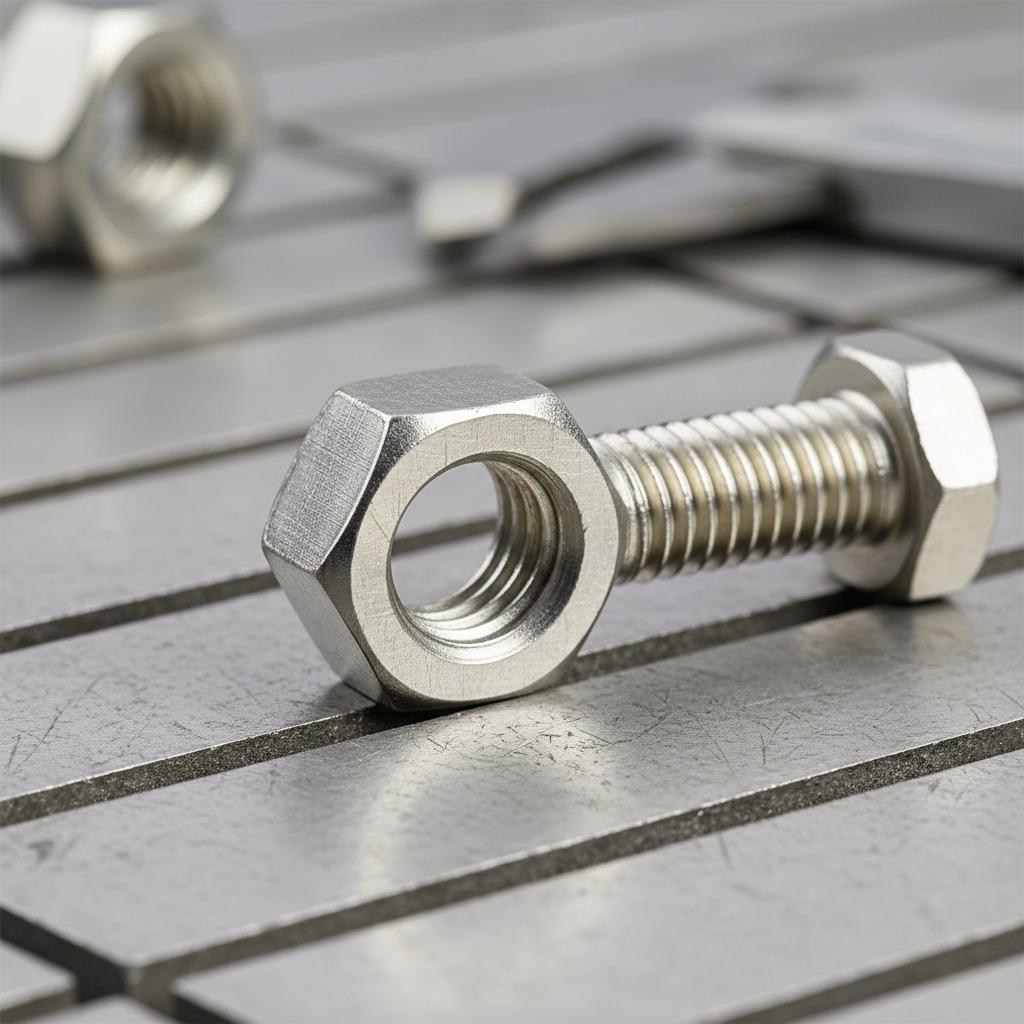
From a manufacturing perspective, the visible parts are the hexagonal outer ring and the threaded center hole. The nut in the product information has a bright silver-gray surface, chamfered edges, and obvious machining marks, indicating that its manufacturing process is likely a traditional metal fastener process, such as cold forming, forging, or machining, followed by threading and surface treatment. The specific manufacturing process cannot be determined solely from the image, and prudent buyers should not make assumptions.
Generally, nuts are designed to balance two aspects: efficient production and reliable fit. Cold forming is typically used for high-volume production, while machining may be used for small-batch or special-purpose nuts. Thread quality is just as important as the shape. If the internal threads are clean and centered, the nut will slide smoothly on the bolt or shank. Conversely, a poorly centered thread will quickly become difficult to use.
Selection criteria that engineers should not ignore
Engineers and purchasing managers often achieve better results by clarifying the application scenario before finalizing parts selection. It's crucial to ask what conditions the nut needs to withstand: vibration, temperature fluctuations, moisture, repeated disassembly, or simply a static connection. Then determine if standard fastening is sufficient or if a locking fastener is required. The product shown in the image may be a standard threaded fastener or a locking threaded fastener, but the specific locking function isn't clearly indicated in the image; therefore, consult the specification sheet rather than making guesses.
Other key points to confirm include thread standard, dimensions, material grade, surface finish, and whether the part is for metric or imperial units. These details determine whether the parts are interchangeable. Factories can tolerate differences in appearance, but generally cannot tolerate thread mismatch.
Common mistakes buyers make
A common mistake is purchasing based solely on appearance. A shiny surface and neat hexagonal faces do not prove that dimensional control is adequate. Another mistake is mixing stainless steel and carbon steel nuts in the same process without recording the intended use of each type. This complicates future maintenance and replacement. A third mistake, especially in the procurement stage, is treating nuts as ordinary goods that do not need to be documented. For critical components, this is a risky shortcut.
Pragmatic buyers typically request samples to verify the actual thread fit on the bolts and check if the supplier can guarantee consistent appearance and function for repeat orders. This last point is especially important for equipment manufacturers selling to multiple regions, as they cannot afford the risk of incompatibility between different batches of hardware.
What questions should I ask before placing an order?
If you are evaluating a manufacturer, be sure to focus the conversation on practical matters. Ask what materials they offer, how the threads are manufactured, what surface treatments are available, and what inspections they conduct before shipment. If the nuts will be used in environments with frequent maintenance, ask about their ease of disassembly and reuse. If the application environment is corrosive, ask which material is more suitable, rather than assuming that a shiny material will solve all the problems.
Quick warning for buyers
Don't dismiss product specifications based solely on photos. Product photos may show precise hexagonal outlines and clean threaded holes, but dimensions, grades, coatings, and rated loads still need to be clearly stated. Otherwise, an order may appear perfectly correct, only to discover problems on the day of installation.
Next steps for the procurement team
If your team is comparing hex nut options, the next best step is to create a short list of requirements: application scenario, material, thread standard, surface finish, and whether the part is a standard or locking type. Then send this list to your trusted list of hex nut manufacturers and compare their responses, not just their quotes. This is often where the real differences lie.
For industrial applications requiring repeated use, a suitable nut should be easy to install, perfectly match the matching fasteners, and remain reliable after initial use. This may seem insignificant, but it is crucial.